
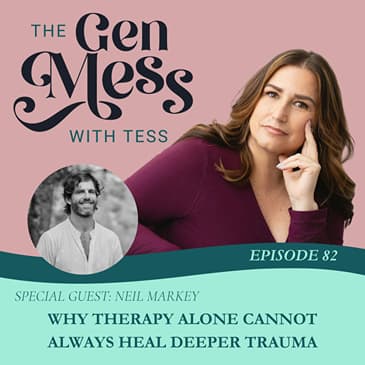
This episode examines what it takes to heal when talk therapy and medication are not reaching the root cause. Neil Markey, co-founder and CEO of Beckley Retreats and a former U.S. Army Ranger who completed three combat deployments, shares how unresolved PTSD brought him to meditation and professionally facilitated psychedelic experiences, and how that personal path became a professional one.
Tess and Neil explore why high-achieving professionals often feel empty despite accomplishing everything on paper, how trauma is stored in the body rather than just the mind, and why psilocybin retreats are gaining serious traction from the VA to bipartisan lawmakers. Listeners will come away with a clearer picture of what psychedelic-assisted therapy actually involves, how it differs from ketamine, and why developing a meditation practice may be the most important investment anyone can make in their mental health right now.
KEY TAKEAWAYS
- SSRIs and anti-anxiety medications reduce symptoms, but they do not address the root cause of trauma. Many people who rely on them alone remain stuck in a state of fight or flight.
- Trauma is stored in the body, not just the mind. There are more neural channels running from the body to the brain than from the brain to the body, which is why body-based practices often reach what talk therapy cannot.
- High-performing professionals are at particular risk of emotional disconnection. Years of operating in analytical, problem-solving mode can quietly cut off access to emotion, intuition, and genuine human connection.
- The fear of losing your edge after a psychedelic or healing experience is almost universally unfounded. People who complete these programs consistently report gaining capacity, not losing capability.
- The benefit of a psychedelic experience is not the experience itself. Without new habits and practices installed around it, most people revert to their previous patterns over time because the body returns to what it knows.
- Psilocybin is non-toxic and non-addictive. The main risk is taking too much in an uncontrolled setting. In a structured retreat with trained facilitators, the risks are manageable and are often part of the process.
- Ketamine is federally legal in the United States and psilocybin is not, though legal psilocybin programs exist in certain state and international contexts. Ketamine can be addictive and toxic at high doses. Psilocybin tends to amplify what is already present emotionally, making set and setting critical.
- The VA has formally included the evaluation of psychedelic medicines in its strategic plan for the first time. The issue has rare bipartisan political support.
- Healing happens in community, not just in individual clinical settings. Group retreat models provide therapeutic benefits that one-on-one therapy alone does not, particularly for veterans.
- MBSR, Mindfulness-Based Stress Reduction, is the most clinically studied form of meditation and requires no spiritual framework. Committing to a structured course is one of the most accessible starting points for anyone looking to build a lasting practice.
TIMESTAMPS
- 00:01 - How September 11th led a college student to become an Army Ranger
- 02:27 - Why PTSD keeps the nervous system in fight or flight long after combat ends
- 05:12 - How trauma lives in the body and why the mind cannot reach it alone
- 10:16 - Who comes to psychedelic retreats and what they are actually looking for
- 12:37 - Why high performers are especially prone to emotional disconnection
- 18:03 - What Gen X professionals most want from this kind of work
- 21:19 - How Beckley Retreats structures programs before, during, and after
- 28:05 - Psilocybin versus ketamine: what the real differences are
- 32:25 - Why group healing models work, especially for veterans
- 41:03 - How the VA and bipartisan lawmakers are changing access to psychedelic therapy
Learn more about Neil Markey and Beckley Retreats at beckleyretreats.com
Learn more about host Tess Brigham at tessbrigham.com
Subscribe to The Gen Mess with Tess for weekly episodes tackling the generational challenges and complexities of navigating life and work.
Powered by the WRKdefined Podcast Network.
[00:00:02] Ever Feel Like Different Generations Just Don't Get Each Other? Certified Coach, Licensed Therapist, and Speaker, Tess Brigham, tackles the generational challenges shaping our personal and professional lives on The Gen Mess with Tess. Hello, and welcome to The Gen Mess with Tess, where we're not just fixing the mess, we're figuring out how to live in it. I'm your host, Tess Brigham. So let's start making sense of the mess together.
[00:00:26] So my guest today is Neil Markey, and he has lived two very different lives. And the space between them is exactly what brought him to the work that he's doing today. He served as a captain in the US Army Special Operations 2nd Ranger Battalion, completing three combat deployments. And it was after coming home that unresolved PTSD and depression led him to exploring mindfulness and psychedelics as a path to healing.
[00:00:51] That personal journey became a professional one. Today, Neil is the co-founder and CEO of Beckley Retreats, a holistic well-being company that integrates the science-backed benefits of psychedelic experiences with the contemplative practices to support lasting transformation. He is currently a master's student at the Harvard T.H. Chan School of Public Health, where he is studying how integrative health programs, including psychedelic-assisted therapies, affect both individual and community well-being.
[00:01:19] Thank you so much, Neil. Thank you for being on the show. Thank you for having me, Tess. All right. So you've had I'm just going to jump right in because you've had a really remarkable career and experience. So I would love to hear a bit of your story, because, you know, the question is, how do you get from Army Ranger to co-founding a psychedelic retreats company?
[00:01:47] I'm happy to tell you a bit more. I was doing my undergrad at University of Maryland. The military was not on my radar at all, frankly. But then September 11th happened. And yeah, it struck like this DNA switch in me. I had to do something and I joined the officer program at Maryland. And when I finished school, I went in as a lieutenant trying to do the right thing. I thought I was being helpful.
[00:02:16] By the time I finished training and got to my unit and went to Iraq, we had learned that that weapons of mass destruction was wildly wrong. If you remember that. Yeah. Yeah. And that was pretty challenging to come to terms with. And then I got a chance when I got home to go try out for this small special mission unit called the Rangers. And I went to Afghanistan twice with them and super grateful for those experiences.
[00:02:41] But now with the benefit of hindsight, I can tell you that everybody in that unit had some level of PTSD. It was pretty intense work that that they were doing. And I got out in 2012 and went to grad school. I went to Columbia for business. So, you know, by some measures going OK professionally, but emotionally and spiritually, I was in a really bad place.
[00:03:05] And I tried SSRIs, anti-anxiety medications and sleeping pills. And I think they all have their place. You know, they can be really helpful when you're in a really bad spot. But at best, their symptom reduction. You know, they're not necessarily getting to the root cause of what's causing those symptoms. And I was fortunate enough to kind of stumble into this mindfulness for business leaders class. And I got introduced to meditation.
[00:03:35] And meditation was the first thing that I was like, oh, there's something here. And this is helping me get underneath. And then through that meditation network, I had some professionally facilitated psychedelic experiences. And I can tell you, you know, a bit more about those as we go. But yeah, for me, it felt like it was accelerating what I was trying to do with meditation. And I really believe they're quite closely linked.
[00:04:03] Like they're kind of pointing in the same direction. And there's a long history of veterans getting access to these treatments. So I was fortunate to be one of them. And then I went on to have a corporate career. I was at McKinsey & Company for a while. And then I did private equity work. And I left six years ago because I wanted to do something that had more meaning.
[00:04:28] And yeah, it was a complete honor that I got to co-found this Beckley Retreats company with this really extraordinary woman by the name of Amanda Fielding, who I can tell you a bit more about too. But it's been a long, windy road. But I feel like I finally found the thing that is what I was put on the earth to do. I really love it. I really believe in it. Yeah. Real quick. Did you ever try EMDR? Yes. And was that not effective? No, I found it to be effective.
[00:04:57] But it didn't get as deep, I would say. As the psychedelics. Because you said that you felt like you were getting when you – I should have written down your words. But it was like meditation that helped me go deeper underneath that. Yes. Can you describe that? Yeah. Yeah. Well, I was in a state of fight or flight. You know, I mean, I was metaphorically and literally walking around with my fists clenched looking for a fight.
[00:05:26] And I wasn't in a combat zone anymore. But my central nervous system had not wound out of that. And, yeah, I mean, you can put a lot of things on top that will help numb. And I think that those can be good for periods. But then you need to get in there to that central nervous system and, like, pay more attention to it and work with it to try and let some of that go. And it was in meditation when I realized, you know, how bad it was. You learn early in meditation.
[00:05:56] You know, a lot of times there's, like, counting techniques. So you try and put your mind on the breath and then count to one, count to two, count to three. And I couldn't count to two before my mind would jump to something else. And I was like, wow, this isn't normal. They're telling me to count to six. I can only get to two. And I realized that, you know, with practice and discipline, I was able to sit. And then my central nervous system, when I was doing these practices, was settling.
[00:06:24] You know, so I was getting into my system as opposed to just doing, you know, talk therapy, which is kind of just at the surface in many ways and was able to get into the body. And I think that's what we're learning is that a lot of these traumas and experiences are, they're not just in the mind. They're deep. They're in the tissue.
[00:06:45] And so you have to, there's different techniques that get in there, more somatic techniques, body techniques that I started to learn that were much more helpful. Yeah. No, I agree with you. And listen, I'm a therapist. I do talk therapy. And I, and what I often say is, yeah, talk therapy probably isn't enough for most people.
[00:07:06] I mean, it's, it's enough for some people, but it's what, for things like PTSD, very deep psychological issues like that, that are really about a moment of time that, that has passed. Do you know what I mean? It's not something that you can deal with right now. You know, you're, it's not something that's happening in the moment. It's something that's happened in the past, but it's affecting how you are today. Okay. And I always see these two things working together because you need to have the talk therapy to kind of understand yourself and understand, okay, what is, you know, what is keeping me stuck?
[00:07:36] And then once you have all that information, yeah, you can't, and I've often sent clients to people who do EMDR and I've sent them to psychedelics. I said, try this, you know, try something else because this isn't, this isn't going to be enough. And you're absolutely right. There is, there's this mind body connection that is, I don't even think we can even explain and, you know, take a while to explain exactly what's happening, but there's that connection.
[00:08:03] So I think it's, I think this word holistic is used a little too much, but it is absolutely what that is. It's, it's, you have to, you have to take any kind of mental health issue holistically. Yeah. Yeah. Yeah. And I always find it interesting to kind of look at how, you know, the central nervous system and the brain are connected and, you know, there's literally more channels of information that go from the body up to the brain versus the brain down to the body.
[00:08:30] And I think I found with like talk therapy, I was aware of the things that were bothering me. I could remember these specific events, but you're, you're just limited in the mind's ability to go down there into the body and say, Hey, stop being so amped up about these things. Right. So then there's other practices that go more direct to the body.
[00:08:54] And for someone that had, you know, symptoms like myself, those ended up being much more appropriate and effective. And I found too, that with talk therapy and I, like you said, like, I feel like I got a lot out of it and it was a good, it was a good first step. And I think it's, you know, helpful for, for many, for, for a lot of different, for a lot of different things.
[00:09:18] But my mind was so overly active because I was in this state of fight or flight that I really needed to stop thinking so much, you know, what I was doing was looping and I, I needed to like break that loop. And that was what I've found, you know, psychedelics and meditation can be really helpful. I was just, you just need some space. You don't need to come at it from another angle. You're coming at it too much already, you know, and so just being able to pause and breathe and be in the body.
[00:09:46] And then, you know, I also found that just nature is quite healing. And I think that is, there's a lot of science, a lot of science around that, you know, don't think about it. Just go do it and, you know, go and just be, just be exactly. Yeah. So, because this is Jen Maspitt's test, I do want to talk about the generation. So what are you seeing? Are you seeing younger people come in specifically, you know, are you, what's the age range of the people that are coming to your retreats?
[00:10:14] It's mostly 45 to 60, but then we've had 80 year olds. We've had our oldest guest was 86. Wow. Yeah. And so we don't provide medical services. We're not allowed to. So we screen out severe indications. So if someone has really complex stuff and comes to us, we try and get them pointed to a place that's more appropriate. Generally, it's more like in-person one-on-one type work is a better place to start.
[00:10:42] Our programs are groups and they're more suited for people that are generally well, but are looking to go from good to great. And so it's a lot of individuals that are high performing white collar professionals that are dealing with symptoms like burnout and malaise and want to be more present with their kids and feel like they've accomplished a lot, but they don't feel like they're really appreciating it. They want to live more fully like these types of things.
[00:11:11] Also, people that are in transition. So people that have just like left the corporate career and want to have like a new chapter and want to build some new skills. People that have had the death of a loved one or gone through a divorce and want to process that in a real way and honor it, not forget it, but kind of close that chapter and step into a new, more fulfilled versions of themselves.
[00:11:37] Like the types of programs that we run are really good for those types of desires. Okay. I'm going to pause on the generational piece for a second. So I want to go back to something that I've talked about this on the show about being, what does it mean to be a high performer? What does it mean to be exceptional? And so are you finding with the work that you're doing in the retreats that there's a real correlation between people that have this high achieving, high performers?
[00:12:09] That come into your programs. And because I think that, let me back up for a second. Because I think that when it comes to high performers, I think what's hard is they're the ones that are going to get stuck in the loop, the thinking loops, much more than anyone else. Because it's a place they feel comfortable. It's a place they know well. And the thinking loops and the things that they're thinking are so supported by our society. Yes. Right?
[00:12:37] And so I'm just curious to hear more about what do you find with the high performers that are coming to you? And I would, do you categorize yourself also as a high performer who made a shift? Yes. Yeah. And I think high performers, as we define them generally, like in this Western world, are people that are very mind driven. And they're very good at analyzing and problem solving and structured analytical thinking and process.
[00:13:05] And I think that's a really important skill. But if you do that all the time, you can lose some of the connection with your heart. And I know it sounds like a bit woo, but I think it's true. You can become very mechanical. And then there's this public speaking technique that I think is so interesting and illustrates it a bit.
[00:13:33] But if you're going to get up in front of a group of people and you're going to tell a really personal, emotional story, and you're a little bit worried about like how much of that emotion might come out and you want to be able to throttle it a little bit, you can do math in your head. So you can do two plus two is four, four plus four is eight, and it'll help kind of block it off. And so it just shows that if you're doing that all the time, if you're literally always processing and analyzing and making sense of and judging
[00:14:01] and figuring out this versus that and always in the head, you've cut off this other part of you, which is the heart or the emotion or this like body connection, which is really important for your connection with others, connection with your deeper higher self or spiritual self, connection with nature. It doesn't come just through the rational mind.
[00:14:21] And then that can really lead to this feeling of disconnection and emptiness because you're not getting filled up in the ways that we need to be filled up as humans, which is through connection with others. And so, yes, it's definitely correlated. And those folks, I feel, also have the most to gain, you know, because we can help them learn skills to come back.
[00:14:50] And you don't, a lot of times we hear the high performers, they're, they're one of their number one concerns is they'll lose their edge. They don't want to lose this ability to like really exercise that way. But I, I don't think I've ever met somebody that thought that after these experiences, they lost that you always have that you just have more capacity.
[00:15:10] You can switch, you can switch between more aware, present, connected and in that other mode. And you can go back and forth more freely. Yeah, it makes you wonder, you know, often like, well, what, what is the person's edge? The edge is probably a lot of anxiety and an off nervous system. And, you know, the society's shaming you, right?
[00:15:38] Like when people talk about their edge, and I've heard that too, it's something that if you've been very successful living one way, the idea, and, but you want, but something's missing, it's not enough. It's, you know, yeah, it's very hard to give that up because you're like, but this has been working for me. People, everyone at work thinks I'm amazing. Everyone thinks I'm great. My parents think I'm so accomplished, you know, whatever it is. And so that's what I was saying earlier about high performance.
[00:16:07] I think that when, when your tactics are winning, it's very hard to have to sit down in here. Like, yeah, that's taken you here, but it's not going to take you to the next level. Yeah. Yeah, absolutely. Yeah. Yeah. And I think, yeah, it just catches up with you too. You know, when you're younger, you just, you have just such a level of resilience where you can push hard and go, go, go, go, go.
[00:16:33] But then I think for a lot of people, you get, you know, into your thirties and forties and you just realize you'd like rest just becomes so much more important. You know, if you haven't practiced the ability to be able to rest and recover, then you can get into that, you know, you know, they talk about fight, flight or, you know, fight, flight or freeze where you're just kind of stuck. And I think that's where I was. A lot of veterans are, they, they, they've burned themselves out.
[00:17:01] They've got the, they've had the foot on the gas for so long that they don't know how to come off the accelerator. And then they try and put the brake on. And so you've got brake and gas at the same time, you know, and you, but luckily there are, there's, there's techniques for this, you know, like EDMAR is, I think, super helpful for many and just other ways to get at it. Yeah. Yeah. So let's want to go back to the generation.
[00:17:30] So it sounds like the bulk of the people that are coming to your retreats are Gen Xers, which is my generation, which is, you know, I think some of it is obviously that cliche-ish of being middle-aged, though I'm in my fifties now. And so I'm not going to live to be a hundred. So the realization, like I'm beyond middle-aged now. But I'm wondering, what do you see? I'm just curious. So like, what are you seeing, what are some themes or patterns that you see with this particular group coming in? What are their biggest stresses?
[00:17:59] What are they anxious about? What do they want? More meaning. You know, I think that they, again, it's usually quite accomplished white collar professionals. And then like, I've done the things, but I don't really feel fulfilled. So there's something, there's something missing. They might not even be able to like articulate exactly what it is, but they're just like, there's something that's not, there's something that's off and I want to address it, you know? And then definitely themes around relationships.
[00:18:30] And, you know, a lot of them have teenage kids or kids that are leaving and they, they've been like, no, I think people aren't coming. Generally, most of our guests are not coming down in crisis. Like they don't think things are broken, but they're like, I would prefer a richer relationship with my son. And I've been busy and I want to kind of commit to that. And I don't know exactly how to, to go about that, you know?
[00:19:00] And again, also, I get people don't necessarily say spiritual connection, but that's definitely like a theme. You know, they, they, yeah, they just feel like something's missing. They've accomplished a lot, but they know there's more. Mm-hmm. So is every, is every retreat different in the sense, or is it sort of like, no, we have these retreats, they're several times a year.
[00:19:26] And it, we take everybody through sort of the same course experience. Yeah, we do about 40 programs a year. So almost every week. And yeah, it's a structured program. It has a digital preparation and immersion that is like a retreat and then a digital follow-up.
[00:19:48] Because for us, when we set out to build the program, we took a multidisciplinary approach and tried to learn from the best science in many different domains. But we looked at adult learning. We looked at habit change science. We looked at what we were learning in the clinical environments with psychedelics. And then also what we were learning in the traditional environments. There are communities that have been doing this work for a long time. Mm-hmm.
[00:20:18] You know, there's some wisdom there. There's some, some artistry to it that actually we think is really important. And we really wanted people to have these controlled psychedelic experiences, but also develop new skills and habits. That's how I think you really maintain the benefit that mystical experience or the psychedelic experience is really important.
[00:20:40] But I think what we found, and many experts in the field would agree with, if you don't do anything around the experience in terms of consciously putting in some new ways of being, you're going to revert back to the way that you were over some period of time. Because there's just a lot of momentum there. And the body, a lot of times, will go back to what it knows more than what's best for it. You know, it goes back to what it's familiar.
[00:21:08] And so in that digital prep, you know, we're teaching meditation, mindful movement, breath work. Everything that we teach has some grounding in science. But it's stuff that, you know, isn't generally recommended in the existing established system because there's not always necessarily a good business case for it, frankly. I mean, if you look at the science around gratitude practice, it's pretty profound. Yes.
[00:21:35] But not every doctor is recommended in that because they just didn't get taught that. They just got taught to recommend a different set of tools. And so we try and give people exposure to some techniques that they can take with them and incorporate into their daily way of being. And so that's why we do the prep. And then when we're on site, we're doing a lot of those techniques. But then we're doing them together, you know, in community and in nature, which is really important.
[00:22:05] And then doing a digital detox to try and limit external stimulation. So people can actually focus on the work, which we think is really important. And then on the back end, we do six weeks of digital follow up. So it's more continued access to our practical exercises and programming. But what it looks like. And I would say the science is emerging around this, like the idea of neuroplasticity with psychedelic experiences, like that's not proven.
[00:22:34] But there's reasons to believe that there is this window of a few weeks to a few months after these experiences where there's an increased potentiality for change. So there's this like openness that's there. And so if you get people to really commit to meditation in that couple months post, there's reason to believe they're much more likely to stick to a meditation practice going forward.
[00:22:58] And so we're really big on the habit formation because we think that's what helps people sustain, sustain the benefit. Yeah, no, that's really important because I think that there is a myth and a lot of it is because of movies and TV. And again, it's it you need it for movies and TV. You're trying to make it entertaining. But the reality is people don't have these aha moments. I think there's that idea of like you go and you take the ayahuasca or you have this aha moment in there, you know, and that.
[00:23:28] Everything opens up and you might have moments where you're like, whoa, that's interesting or oh, OK. But really, truly, we change and we grow through small incremental steps every day. And it's not flashy and it's not exciting, but it is actually what will get it done. I love that you're following up with people because I do think that that is I mean, everyone that I know that who gets into a meditation practice, it's it's the, you know,
[00:23:58] sitting down and doing the meditation isn't hard. It's the finding time for it, prioritizing it, doing it, committing to it. Right. Like and then and then learning how to and I think this is especially for meditation because you're going to be, you know, it's a practice. And especially in the beginning, you're going to feel like I'm doing it wrong. I'm doing it wrong. I'm thinking about dinner. I'm thinking about this. I think. But that's the moment in time where you're like, no, stick with it. Stick with it. Like right.
[00:24:24] That moment where you're like, OK, you can you can you can push past that. But I feel that when I look around, I've been working with people for about 20 years. It's becoming more and more apparent to me.
[00:24:37] And I don't know what you think, which is the more we move towards this world of this digital world of technology, of always being online, that in some ways, the more traditional types of therapy aren't as effective for what's happening right now. That the talk therapy, the SSRIs, which I'm not discounting because that's what I do. I'm not discounting any of it.
[00:25:02] But I'm just saying that we're at such a strange point in our world, in our history where our brains are being, you know, changed in real time every single time we pick up a phone every single time. Right. And so, I mean, I just don't know what you what are you seeing? Are you finding that this work is more and more important as we become more reliable on technology? Definitely. Yeah, definitely.
[00:25:30] And I mean, meditation to me is sometimes put into the same bucket as all of these other well-being practices. And it's just like one of many things you can do. I'd make the argument that meditation is actually in a bucket of its own. And it's one act of not doing. And it's really important, particularly now, because you're intentionally limiting stimulus and you're giving the brain and the body and the being some space.
[00:25:59] And that's like really important. I think we have a tendency to just add more, more, more, more, more, optimize, optimize, optimize. But that meditation practice is just like really important. And then that spaciousness, there's so much therapeutic benefit. And we know that through the science that's been done on meditation. And if you get someone to actually adopt a practice, it's transformative for them. You see it in their sleep. You see it in their relationships. You see it in their perceptions of self. You see it everywhere. Biological changes.
[00:26:29] It's like nearly unbelievable what people have been able to accomplish with a meditation practice. The problem is, is that meditation is kind of boring and people don't really get it. And I've been working on meditation for 15 years and was, you know, teach it. And I could never if I we did a program with 20 people and you checked in six months later, maybe two, maybe the compliance was was nothing because we're all so busy.
[00:26:58] And it would just always get deprioritized down. That's part of why I think these programs are so they have so much potential is literally just because they help people understand why meditation is important. And it's not a rational thinking exercise. But when you have one of these experiences, most of our guests go home and they understand why meditation is so important. Like they just get it. They just know it in their bones and then they're able to do it.
[00:27:27] And just that is transformative for people. And I think that the need is going to increase. I mean, these tools that are so powerful and helpful for so many things are also like very addictive and have some pretty significant negative impacts. And I feel like we're going to need more and more of this somatic work and body work and, you know, conscious reduction of symptoms.
[00:27:57] And everybody's going to need to to pick up meditation to be able to balance it. It's all moving so fast. Yeah. So are you doing both psilocybin and ketamine assisted? Just psilocybin. And so what's the choice of that? Because it's quite I could have Googled it, but I didn't. I mean, what is the I've always wondered, like, what is the difference between the two? I've I actually was with somebody once where they took the ketamine. They wanted me to be there.
[00:28:25] So I've sort of witnessed that psilocybin I've never seen. Yeah. I think different strokes for different folks, you know, ketamine for sure has shown some potential positive benefit for some of these severe clinical indications, treatments for resistant depression, PTSD. Again, it kind of gives, you know, the psyche a bit of a break from, you know, all of the external stimulus
[00:28:53] and then give some give some space. It looks like it's anti-inflammatory. You know, there's some reason to believe that some of the negative things that happen from trauma creates some inflammation in the body and ketamine has a pretty direct impact on that. And people do report these kind of insights that you get from different psychedelics or there's clarity.
[00:29:19] Like they're like come out of the experience and they're like, well, I just know I need to go have this tough conversation with my mom. I just know it with my bones and then they're able to go directly to that. So in that regard, there's a lot of similarities between them. Now, the differences, I mean, ketamine is fully legal in the United States with the doctor's prescriptions. I would say it's much more widely available. You know, psilocybin is not federally legal.
[00:29:48] You can do it in some of the state models, but it's still not legal, which I, you know, is a challenge because you're breaking federal law. And the companies that are doing it, I respect and I think it's important. And it's really hard to run an organization because there's all these federal implications of it being illegal. Ketamine is toxic. You can die from it. If you can overdose from it, you can become addicted to it. It's got bladder implications.
[00:30:17] You know, it's kind of hard on the body. Not that I don't think it's beneficial, but there's definitely some things to consider. And I think consider it in relation to all of the other things that we do as humans, including all the other pharmaceuticals that we use regularly that have, you know, some negative, you know, negative risk factors too. Mm-hmm.
[00:30:44] Psilocybin is, you know, it's naturally growing. It's a fungus. It's non-toxic. So you can't overdose on it. Mm-hmm. And it's generally well-tolerated. Sometimes people do get a little bit of nausea. The biggest problem with psilocybin is people take too much in there in an environment that's not right and then they scare the heck out of themselves. Yeah.
[00:31:12] That can all be mitigated, you know, if you do it in a controlled setting. Ketamine, I would say, may be more appropriate for people that have severe anxiety. Psilocybin has a tendency to kind of amplify what is already there. And so if there's a lot of anxiety, psilocybin for some people can create a pretty anxious experience. But again, if it's done in a controlled setting with trained facilitators, that can be well-managed and in some ways can be part of the process.
[00:31:41] It's like bringing those things to the surface. And so, yeah, I think it just depends kind of where people are and what, you know, what they're looking for. And, you know, I think it's good to do your research and understand it from a rational mind perspective.
[00:32:02] But I also think it's good to sit and try and be still and listen to your intuition on some of these things, you know, your body. So that's wisdom, some real wisdom. So are you finding other people with PTSD coming to the retreats? Are you, I mean, are you finding other people that had very similar stories to yours? So most of our programs, you know, if someone has severe PTSD, they're not a fit. Okay.
[00:32:31] We're managing for a group dynamic and, you know, we're just set up to treat people that are generally well. Now everybody's got their stuff and everybody goes through a screening process. And I would say it's a whole person approach. So we look at history and kind of current state and all the support they have around them.
[00:32:55] And, you know, we're not taking people that where, you know, these experiences in some ways inherently create some instability. They shake things up. Now, if you're healthy and well, that's fine.
[00:33:20] And you can go back home and, you know, things might be a little bit brought to the surface, but we can manage that and people can work through that. And that's part of the process. If someone has severe stuff going on, that destabilization just needs to be much more carefully managed. So for our normal programs, you know, we don't take people that have, you know, kind of active PTSD, active serious psychiatric conditions.
[00:33:45] We do do some specialty programs, though, that are reserved for people that have more severe clinical indications. And we do those in partnership with appropriate orgs that are experienced in that. So we've done some veteran programs. That was my next question. I'm very, very curious about your veteran programs. Yeah, we've done a couple of those with Imperial College London and Hero Carts, which is a veteran nonprofit in the space.
[00:34:15] And it's our same model. So a digital prep and immersion and the digital follow up. But we do much more one on one support before and after. And then when we're on site, it's a higher facilitator to guest ratio. Those facilitators have specialty expertise in dealing with individuals that have, you know, this this type of presentation. So it's just like it's a beefier program with more specific support.
[00:34:45] You know, I think we're big believers in that this model does have very clear clinical applications. And, you know, some people. It just depends. Do better in a one on one environment with a trained facilitator or two on one environment, two facilitators to one individual. But when we do these veteran programs, I mean, you see the therapeutic benefit of the group. Mm hmm.
[00:35:14] Like it's so clear. And I think a lot of people, veterans particularly, they they're wired a certain way. And a lot of times they show up more for others and they show up for themselves. So this kind of cohort, we're all doing this together. We're going to take care of each other. And, yeah, the facilitators are here to kind of help, you know, hold the environment. But they're doing it with each other.
[00:35:40] You know, to me, we need to explore these models more because I think that the. For some, the benefits are better in a group setting. But then importantly, the costs are better because you can get some leverage in the facilitation model. So when I, you know, look at the amount of money that the Veterans Administration is spending on treatment for veterans, I'm like, we should be putting a lot of veterans through these programs. Now, there needs to be a good screening process.
[00:36:08] But and you can make the same, I think, argument for a lot of different specific use cases where there's like a common thread. So people that are dealing with grief or, you know, are some of our facilitators do programs with parents that have lost children. You know, like doing that in a in a cohort where they're able to have that therapeutic benefit of the other people that are sharing their stories. It just it really works, you know. Yeah. Special. Special. Yeah. Yeah.
[00:36:41] So I'm so it's kind of I don't know if you're going to have a response to this or not. But so. So after all the work that you've done, the mindfulness, the psychedelic work, all of that, the research, what do you think healing requires of us that people aren't willing to do? That people aren't willing to do. Yeah. I think you've got to give yourself some space. And that's it's just hard. You know, we've all got such busy lives.
[00:37:09] But I think the time for yourself, whether it's to meditate or spend time in nature or go do community give back work. I mean, the research around that, where you're giving, where you're getting out of your own head and not, you know, focusing on your own situation, but you're helping others. Because, you know, a lot of these things are quite simple and they work.
[00:37:36] It's just people got to make it a priority and make the time for it. And I think this idea of feeling whole and like healing, it does happen in relationship. It happens in community. And so, again, I think the one-on-one model is so helpful for many. And it's most appropriate for a lot of people, depending on what they deal with.
[00:38:02] But, like, I think that there needs to be more of a community model where people are doing this together and taking care of each other and looking after each other, where now it's just so individualized. You know, we're not really doing that. I think, like, even particularly for men. But I'm encouraged because there are, even in the last 10 years, I feel like the, you know, these, like, men's circles and, like, men's groups and stuff. Like, I think that's, like, really important.
[00:38:29] And I didn't, that didn't exist in my world 10, 15 years ago. You know, you went to the doctor, you went to the therapist for your, for the issues you were having. And then you just went back to your old world. You know, it was, like, kind of segmented. Like, I think we need to all do it together in some regard. Yeah. No, I absolutely agree with you. So, it's, it's, it's what you're talking about is, like, prioritizing it, making it an important part of your life.
[00:38:55] And I always think it's, it's that, like, people don't see that if you create this space, that it will give you more of what you want. It's, like, that, that idea of creating a space seems very scary. I always think it's a combination of that and discomfort. Right? Because who, you know, yeah, when you have to look at yourself, when you, I, you know, I've been doing some form of therapy or something for a long, long time. And every time you're, like, it's like going to the gym. It's like, oh, God, I don't want to do this. You know?
[00:39:25] And, okay. You know, and you, you know, and you work through this stuff. And then when it's over, you feel really good. You're so happy that you did it. But it's not fun. Right. Like, there's nothing enjoyable and, like, jumping for joy.
[00:39:38] But I think that that is that, that piece that's really important is, is that, but that hour of discomfort or that week in a retreat of feelings of discomfort can absolutely open up so much of your, of your life, of, of what you can see. And I think that there's a real fear for some people of, like, if I open up Pandora's box, like, I'll never be able to, to shut it down.
[00:40:07] But before we wrap up, you know, it's, I am, I am curious of what are you seeing? I mean, I don't think our, our, do you get the sense that we are going to get to a point where the Veterans Association will be funding these kinds of programs? Yes, it's happening. It's happening. Okay. This is very exciting. Yeah, it's really exciting. It's extraordinary.
[00:40:31] So the evaluation of psychedelic medicines is formally in the VA's strategic plan for the first time that just happened a couple years ago. And yeah, I mean, we're staying, we're quite close with senior leaders of the Veterans Affairs. And, you know, so it's, it's happening. And veterans have actually been a big part of driving the policy change.
[00:40:59] You know, there's people that have been going outside the country for years and saying, hey, I'm getting a lot of benefit out of this. We need to look at this. And it's one of the very few bipartisan issues. You've got extreme, right? You know, Dan Crenshaw, for instance, in Texas or Rick Perry. And then you've got AOC on the left.
[00:41:24] And, you know, they've come together and shook hands on acceleration of, you know, exploration of these treatments. And then the Trump administration just a couple months ago had that executive order. We still don't exactly know how it'll play out. But, yeah, I think it's coming. I think it's really coming. And so I'm quite encouraged. Yeah. No, it's very exciting. So I grew up primarily in Berkeley, California.
[00:41:52] And when I was, this was back in like 2009, I was in the midst of getting my hours to become a therapist. And I worked at this inpatient drug and alcohol program, and we had the contract for the military. So, and the military also required that the therapists that you work with have to be master's level or above. So myself, all of us who had these master's level, you know, we were the ones that only worked with military.
[00:42:20] So for three or four years there, I worked at the height of like 2009, 2010 with all of these young men that were coming back. And it was so, it just struck me how it's like we, you sent all these men over. They've gone through these extraordinarily difficult things. Something happens where they get injured. They get prescribed opiates.
[00:42:50] That was the typical story. They get prescribed opiates. And then, but there's no help after that. And then it's not until your opiate addiction is like, or that is so bad that then they send you to treatment. And then after that, people, a lot of the men in our program were like, they needed to complete this 28 days. And then they were going to go to a PTSD program. And, you know, that part, it was just watching all of this, seeing what's happening.
[00:43:17] I'm like, this is, this is really, you know, and this is a country where we say we respect our veterans. And I think I, for me personally, growing up in a place like Berkeley, there was this real attitude towards the military and all of that. And for me personally, it just helped me have such a tremendous appreciation for people who serve, what they're giving up, what they're willing to do, the sacrifices. And it really, it really changed me.
[00:43:44] You know, it just made me think about war and, and military and, and the people that I saw that were in the military at that time. You know, there's a lot of socioeconomic issues, right? Like, you know, people are saying I had nothing else. Different, different story than yours. Like I had nothing else going on. So the military was the only place to go. My childhood was so awful that I had to go somewhere.
[00:44:07] And a common thing that I heard was actually I have more PTSD from my childhood than from the military, but that just brought everything to the surface. And now I'm, now I have a drug, you know, now I'm addicted to the substance. Yeah. Yeah. And that is definitely part of the challenge that the VA has is that the type of general, you know, the military is a huge beast with many, you know, million people.
[00:44:37] But a lot of the younger soldiers that do enlist come from traumatic backgrounds. And then they get put into a traumatic environment in an adult. And it's childhood trauma mixed with the adult trauma that creates these really complex cases that are hard to work with. But, yeah, that over prescribing. I mean, there was a I saw this myself even, you know, for me.
[00:45:06] But there was an article in the Wall Street Journal a couple of years ago that was called Combat Cocktail. But it was it, you know, it's not uncommon for a veteran to have 10 or 12 or 15 different medications. And, yeah, at some point you got to say, is this criminal activity to like, you know, be prescribing this many meds to someone without, you know, trying a different approach? It's really disturbing. But I do think we're making progress.
[00:45:33] You know, I think kind of as a society, we're a bit fed up with that. We're kind of starting to call bullshit on that a little bit. And and there's there are these other approaches that are available, although, you know, psychedelics are not an end all be all and not magic bullets either. But they need to be explored. So I'm I'm encouraged. You know, I'm really optimistic that we're going to make a lot of progress over this next 10 years. Yeah, no, it's very it's very exciting. So final question.
[00:46:03] So for someone who may see themselves in your story, but they have no idea where do I start? What's the best advice that you could give them? I mean, I think developing a meditation practice is just like so foundational. And I I got started with MBSR, which is mindfulness based stress reduction. It's the most clinically formed form of medicine or most clinically studied form of meditation.
[00:46:30] And there's no like religious there's there's no woo to it. It's just super pragmatic. And that's what I loved about it because I was not looking for spiritual stuff. It's just breath awareness. And you can take a course. And I think for some people, there's all the free things, but they're just so easy to fall to the wayside. So if you just like pay the money and commit to a course, do it for a few months. I think that's like enough to kind of kick the habit off. Yeah.
[00:46:56] I just like at some point in your life, do an MBSR course, you know, meditation. I think we'll we'll we'll you know, so many different benefits. And then. Yeah. I mean, luckily, there's so many different there's there's good information on our website. You know, we have a lot of the research there. There there's the multidisciplinary Association of Psychedelic Studies, Johns Hopkins, so many different.
[00:47:23] And very well respected institutions that are doing research on psychedelics that you can read and try and get the synthesis of and understand the risk factors and become an educated consumer. And then, yeah, if it's programs like ours, you know, people should reach out like we're very easy to get in touch with. It's not uncommon for us to talk to someone three or four times and then we talk to their wife or daughter like we were.
[00:47:53] We know it's a big decision and we try and be helpful thought partners and making that decision. And we oftentimes tell people that it's not a good fit or they might be better suited starting somewhere else. So, you know, we're here as a resource, too. Yeah. And so what would you like to plug? Tell us about I'm going to obviously have the link in the show notes, but tell us about Beckley, the retreat program. And yeah. Yeah.
[00:48:21] You know, we run programs almost every week in Jamaica and the Netherlands and it's fully legal. So it's all above board. We know where the mushrooms are coming from. Like I said, it's mostly very accomplished white collar professionals, but we do get a mix of individuals. But you're with good people that are taking it seriously. We don't. There are places where if you pay, you can show up.
[00:48:47] And I would just like question that because you don't know what the screening is with places like that. And I think there's some risk in mixing severe clinical indications with people that are looking for more personal development. And we're very thoughtful about the curation of the group. You're with good people that are there for similar reasons. And it's beautiful locations, you know.
[00:49:08] It's like a vacation where you're going to do some very meaningful work and go back home with some new skills and some very meaningful experiences. And I'm sorry, how many days? It's five nights. It's five nights. Okay. So now it's like Jamaica or the Netherlands. Mm-hmm. Which one do you pick? Which one do you pick? I would solve for ease of travel.
[00:49:34] And, you know, so Americans, Jamaica usually makes more sense. Uh-huh. We don't do programs there in the summer. We take kind of August and September off because it's a bit hot. But Jamaica is amazing. Yeah. And it's a 2,000 acre horse farm. Oh, wow. It's really beautiful. And they're both, you know, becoming more and more of like a culturally immersive experience. So in Jamaica, it's Jamaican facilitators. It's Jamaican food. It's Jamaican land.
[00:50:04] We teach in Jamaican indigenous plant use. And so there's a Jamaican flavor to the Jamaica programs. And then similarly in the Netherlands. But it just depends. They're both beautiful properties. Yeah. And good teams. And the same program, but just different locations. No. I love that. Well, thank you so much. Thank you for sharing us your story and everything that you've gone through.
[00:50:27] And I absolutely agree with you that, especially when it comes to meditation, especially when it's a daily, it's something that you want to become a daily practice, that having some kind of kickoff, having some kind of, some structure to begin with to help you do that is always the best thing to do. And there are many, many people that have been meditating for years and years and years, and they will, you know, go to a retreat and be like, I just need a refresher or I've been slacking or whatever it is.
[00:50:57] Because you have to think about it like a practice. But thank you so much. And thank you for listening to the Gen Mess with Tess. Remember, we're not just fixing the mess. We're learning how to live in it. Stay curious, be kind to yourself, and I'll see you all next time. You've been listening to the Gen Mess with Tess with your host, Tess Brigham. Make sure to subscribe wherever you get your podcasts. And make sure to follow Tess Brigham on all social channels.
[00:51:25] To learn more about Tess's books, courses, or to have Tess speak to help clean up the Gen Mess at your organization, head on over to TessBrigham.com. Thanks for listening.
Sponsors
