
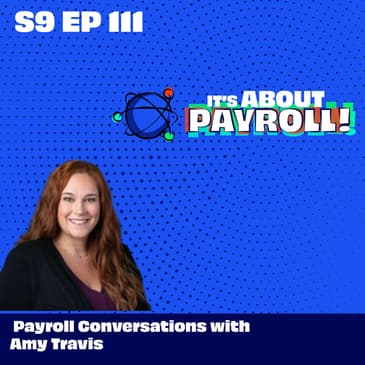
Empathy in Payroll: A Conversation with Amy Travis
This episode of 'It's About Payroll', hosted by Brian Escobar and Walter William Duncan II, delves into the significance of empathy in the payroll profession. The hosts share their personal journeys and growth towards understanding and advocating for empathy in the workplace. Special guest, Amy Travis, CPP and soon-to-be president of the Greater Atlantic Payroll Association, shares her unique entry into the payroll field, starting from buttering garlic bread to ascending into leadership. She emphasizes the importance of empathy, especially in leadership positions, to foster a supportive and efficient team environment that enhances both employee satisfaction and performance. The episode also covers potential dangers of modern technologies like AI and the necessity of continuous vigilance against payroll fraud. Additionally, a discussion on the impact of company culture on payroll departments, whether they fall under finance or HR, is explored, highlighting the evolving focus on the human element in HR. Amy Travis' story of perseverance and her emphasis on the importance of empathy in payroll make for an enlightening conversation.
00:00 Introduction to the Payroll Podcast
00:30 Celebrating Milestones and Personal Growth
01:34 Special Guest Announcement: Amy Travis
02:07 Deep Dive into Empathy and Personal Evolution
02:57 Payroll News Segment: Tackling Payroll Fraud
11:49 Exploring Technological Solutions to Prevent Fraud
19:10 Guest Spotlight: Amy Travis's Payroll Journey
22:15 Choosing a Career Path: Payroll or Dental Assistant?
22:44 The Professionalism and Planning Behind the Scenes
23:56 Empathy in Payroll: A Deep Dive
25:49 Building an Empathetic Team: Strategies and Successes
26:46 The Ripple Effect of Empathy in the Workplace
27:33 The Importance of Employee Experience in Today's Workforce
29:05 Navigating the Current Job Market: Insights and Advice
39:25 Exploring the Role of Empathy in Payroll Careers
43:39 Why We Love Payroll: A Personal Insight
45:01 Closing Remarks and Community Engagement
Link: https://www.timetrakgo.com/signmeup?utm_source=SMB24&utm_medium=IAP&utm_id=SBM24
WALT
Key Points from the Article:
1. **Prevalence of Payroll Fraud**: Association of Certified Fraud Examiners (ACFE) revealed that Payroll fraud makes up 15% of all occupational fraud schemes in the United States and Canada. It often goes undetected for an average of 18 months, resulting in an average loss of $2,800 per month.
2. **Industries Affected**: While no industry is immune, payroll fraud is most common in the construction industry and in government and public administration.
3. **Common Types of Payroll Fraud**:
- Payroll diversion through phishing tactics.
- Ghost employees, where non-existent employees receive wages accessed by fraudsters.
- Overpayment schemes, such as inflating overtime payments.
- Embezzling withholding, involving pocketing legitimate withholdings from wages.
- Expense reimbursement fraud, including padding expenses or submitting fictitious expenses.
4. **Prevention Strategies**:
- Educating employees about phishing threats.
- Implementing two-factor authentication.
- Segregation of duties in employee onboarding and termination.
- Running exception reports to detect unusual patterns.
- Requiring original receipts for expense reimbursement.
5. **Future of Technology Solutions**:
- The use of AI and machine learning for fraud detection is expected to nearly triple over the next two years.
- Despite technological advancements, vigilance remains crucial as technology can both enable and prevent fraud.
6. **Ongoing Vigilance**: Employers and accounting professionals should remain vigilant even with technological solutions, as new tools for perpetuating fraud can emerge alongside advancements in technology.
BRIAN
Pay News Updates!
Direct deposit switching (DDS) is a mobile banking feature that allows customers to send their direct deposits to a new bank account or debit card without leaving their banking app.
Powered by the WRKdefined Podcast Network.
[00:00:00] William Duncan III.
[00:00:01] Welcome to our podcast, Its About Payroll.
[00:00:03] We're your hosts, Brian Escobar and Walter William Duncan III.
[00:00:07] Whether you're new to the payroll game or a seasoned veteran, we have something for
[00:00:16] you.
[00:00:17] Welcome back folks.
[00:00:18] This is Its About Payroll episode 111.
[00:00:25] Man, what is going on?
[00:00:30] How you doing today sir?
[00:00:33] Man, I am good.
[00:00:35] I'm excited to be here.
[00:00:37] We're almost in my birthday month.
[00:00:39] Yes.
[00:00:40] So inching closer to 42, man.
[00:00:42] Just feeling blessed.
[00:00:43] God bless you man.
[00:00:44] How about you?
[00:00:45] I'm good man, I'm good.
[00:00:46] I'm growing man.
[00:00:47] I'm going through a season of growth and look, I love where I'm at.
[00:00:52] I can't wait to see where I'm going man.
[00:00:55] It's been a ride bro, it's been a ride.
[00:00:58] Look, I'm glad you're on the ride with me man because you said something recently
[00:01:03] that said our paths are locked.
[00:01:05] Right?
[00:01:06] So when you're going through stuff, so am I, vice versa.
[00:01:10] And it made me think about that and it's so crazy right?
[00:01:14] As we talk about it and it is true because we talked about that and then what?
[00:01:19] It felt like minutes later I start seeing posts about be careful who you keep in your
[00:01:24] circle because your energy and their energy and blah.
[00:01:28] And I was like, oh man, we ain't just talking about this.
[00:01:32] Yeah man, so I'm good, I'm good.
[00:01:34] I'm excited to have Miss Amy Travis on the show tonight.
[00:01:38] It's been great.
[00:01:39] Someone, an amazing payroll professional.
[00:01:42] We went through the pre-con, not conversation because I don't like talking with the
[00:01:47] guests before the show.
[00:01:48] I like to keep it fresh and but we were going back and forth in email.
[00:01:52] She sent us this like dossier who was just like she threw out topics.
[00:01:58] She got to talk about this.
[00:01:59] I was like, oh my gosh, we got to have on the show a bunch of times because she
[00:02:03] had a good topic to talk about what we're going to cover tonight, which is
[00:02:08] something more near and dear to Walt is empathy and giving folks grace.
[00:02:14] You two, you two, you act like you don't care what you give.
[00:02:18] No, I do now.
[00:02:20] I think look between my wife and you, I've had to evolve into this place where
[00:02:27] right because I was a jerk man.
[00:02:29] I'm telling you my young years.
[00:02:30] I was a jerk and sorry to all the folks.
[00:02:33] I wasn't including more.
[00:02:36] But no, but hey, I was there with you man because I had this delusional
[00:02:42] mindset that I was all that couldn't be touched and I needed to be humble.
[00:02:46] I had to be knocked down.
[00:02:48] Yeah, I thought I was all in a pizza.
[00:02:51] You still doing it.
[00:02:55] Oh man.
[00:02:56] So yeah, it's been some but before we get into our guests, we have of
[00:02:59] course pay news for you folks.
[00:03:01] Walt's gonna start us off with his story and I'll go into mine.
[00:03:05] And now word from our sponsor, Time Track Go.
[00:03:09] To celebrate small business month, Time Track Go is offering you a
[00:03:13] chance to experience the power of their time clock software completely free
[00:03:18] for the first month.
[00:03:20] The simply better employee time clock software that is going to make your
[00:03:25] life easier.
[00:03:26] Time Track Go already has a unique graphical employee time card and that
[00:03:33] will help you quickly identify and fix the mistakes.
[00:03:39] Time Track Go just announced the addition of automatic PTO accrual earnings.
[00:03:43] So you can say goodbye to those manual calculations and Time Track Go
[00:03:47] integrates with your favorite payroll systems including QuickBooks, Gusto,
[00:03:52] ADP Workforce Now, Paychex and more.
[00:03:55] Don't miss out.
[00:03:57] Take advantage of this special offer.
[00:03:59] Use the link in this post to start your 14 day trial in the month of
[00:04:03] May to qualify for your first month free.
[00:04:07] Let's go.
[00:04:08] Yeah, so I have an article from Thompson Reuters.
[00:04:14] It's about payroll fraud.
[00:04:16] And this article talks about the prevalence of payroll fraud, key
[00:04:21] identifiers and prevention strategies.
[00:04:23] It's a really interesting read.
[00:04:25] Check it out.
[00:04:26] The links will be in the show notes.
[00:04:28] I have five or six key points to talk about and then I'll pass to
[00:04:32] LaTonka for it.
[00:04:33] So the first point is that there is the prevalence of payroll fraud.
[00:04:39] The Association of Certified Fraud Examiners, ACFE,
[00:04:43] revealed that payroll fraud makes up 15% of all occupational fraud schemes
[00:04:49] in the United States and Canada.
[00:04:52] That's a good one.
[00:04:54] That's a good stat.
[00:04:56] Yeah.
[00:04:57] Yeah.
[00:04:58] It often goes undetected for an average of 18 months.
[00:05:01] What?
[00:05:04] Resulting in an average loss of almost three,
[00:05:08] a little under 3K per month.
[00:05:10] Oh, wow.
[00:05:11] So think about that.
[00:05:12] So what is that?
[00:05:13] Like almost $60,000?
[00:05:15] Almost 50K I think.
[00:05:17] I'm going to do the math right now.
[00:05:19] You do three times, three times 12 is 36.
[00:05:22] You say 18 months.
[00:05:23] Yeah, 50K.
[00:05:24] Yeah.
[00:05:25] 50K.
[00:05:26] Wow.
[00:05:27] Wow.
[00:05:28] So 50K.
[00:05:30] Wow.
[00:05:31] So 50K.
[00:05:32] And then number two, the industries affected.
[00:05:35] While no industry is, payroll fraud is most common in the construction
[00:05:40] industry and in government and public administration.
[00:05:46] The government, bro.
[00:05:48] The government.
[00:05:49] No, are you kidding me?
[00:05:52] Nothing gets shut down.
[00:05:54] Look, it's one of the three most common places that payroll fraud happens.
[00:05:58] But look, no diss to the government.
[00:06:01] But my guess is it's because of the antiquated systems,
[00:06:05] the just old tech.
[00:06:08] And maybe lack of oversight.
[00:06:10] Who's overseeing the government?
[00:06:11] Or maybe even too much oversight and you got too many people layered
[00:06:15] and the right people aren't seeing the right things.
[00:06:19] Talk about that a lot.
[00:06:20] There needs to be an overhaul in the government.
[00:06:22] I think they know that.
[00:06:23] It's going to take a while before it changes.
[00:06:26] It's too much bureaucracy, too much red tape.
[00:06:28] Construction industry.
[00:06:29] We did a few pay through payroll crimes on the construction industry.
[00:06:33] So that makes sense.
[00:06:34] And public administration.
[00:06:36] Yeah.
[00:06:37] The same.
[00:06:38] What's different?
[00:06:39] What's the difference between public administration and government?
[00:06:41] I guess you could.
[00:06:43] I don't know you're asking the wrong person.
[00:06:44] Yeah.
[00:06:45] While you do, I'm going to Google while you talk about the next one.
[00:06:47] So number three, it's the common types of payroll fraud.
[00:06:51] So the first one is payroll diversion through phishing tactics.
[00:06:55] Number two is ghost employees where non-existent employees receive
[00:06:59] wages.
[00:07:00] Assessed by fraudsters.
[00:07:02] Overpayment schemes such as inflating overtime payments.
[00:07:06] Embezzling withholding.
[00:07:08] Involving pocketing and legitimate withholdings from wages.
[00:07:11] Expense reimbursement fraud, including padding expenses or submitting
[00:07:14] fictitious expenses.
[00:07:17] These are all things that we do on True Payroll Crime Stories to your
[00:07:21] point.
[00:07:22] Good article.
[00:07:24] So number four, prevention strategies.
[00:07:26] Educating employees about phishing threats.
[00:07:28] So we definitely want to educate ourselves.
[00:07:30] We are employees ourselves so we need to be educated on it as payroll
[00:07:33] pros too.
[00:07:35] Employees who are paying for their employees.
[00:07:37] We need to be educated on that.
[00:07:39] And then finally,
[00:07:40] we have the next one is the next type of payroll fraud.
[00:07:43] So we need to be educated on it as payroll pros too.
[00:07:46] Implementing two factor authentication.
[00:07:49] Segregation of duties and employee onboarding and termination.
[00:07:53] So that's sticking to that.
[00:07:55] People doing stuff in a.
[00:07:57] Running exception reports to detect unusual patterns.
[00:08:00] Running those reports to find those metrics, right?
[00:08:03] Those common occurrences.
[00:08:05] Requiring original receipts for expense reimbursement.
[00:08:10] Yeah, that's a good one.
[00:08:12] Can I call out some?
[00:08:14] Okay, cool.
[00:08:15] But with the exception reports, not only exception reports,
[00:08:18] if your system has a robust audit report,
[00:08:21] run the heck out of that thing and look at it.
[00:08:25] And look, it's trust, but verify.
[00:08:28] Okay.
[00:08:29] You can.
[00:08:31] Look, me and Walt have worked together.
[00:08:34] A few times now and.
[00:08:37] I've had to ask him about things that he's doing.
[00:08:40] It's not that I don't trust him.
[00:08:42] It's just like.
[00:08:43] Trust for verifying.
[00:08:44] And it's not, yeah, for me, I do trust you, but it's like,
[00:08:47] why did you do this?
[00:08:49] Right.
[00:08:50] Why does it look like.
[00:08:51] And then you have to say, oh, well, why?
[00:08:53] Because then you could be too.
[00:08:55] Yeah.
[00:08:56] A better practice.
[00:08:57] While I'm rolling my eyes.
[00:08:58] When I'm rolling my eyes.
[00:08:59] Here you go, Brian.
[00:09:00] Cause I had to do this.
[00:09:01] That a third.
[00:09:02] And it's just it.
[00:09:03] What I would ultimately.
[00:09:04] Or not.
[00:09:05] Every time.
[00:09:06] Sometimes he tells me things.
[00:09:07] I'm like, oh yeah, I guess we don't have any choice there.
[00:09:09] But not after I exhausted his process.
[00:09:12] Hit the steps that he took to get there.
[00:09:14] And it's not about fraud.
[00:09:16] It's about.
[00:09:17] Did you do this?
[00:09:18] The best way it should have been done.
[00:09:20] Now, if I didn't know him, it could have been about fraud.
[00:09:23] Right.
[00:09:24] If I don't know you from Sam.
[00:09:25] Hey, now I am approaching it for both reasons.
[00:09:28] Is it a fraud?
[00:09:29] Are you trying to be funny business or.
[00:09:32] Do you just not trust me?
[00:09:34] Do you just not know the best way to do it?
[00:09:37] And can we get to a better one?
[00:09:38] Trust, but verify run your audit reports.
[00:09:41] Right.
[00:09:42] I talked to so many folks.
[00:09:43] That have the audit.
[00:09:44] We have audit reports, but nobody wants to run it.
[00:09:47] Nobody wants to take the time to go through it.
[00:09:49] Cause ginormous, right?
[00:09:50] The bigger the date frame.
[00:09:52] The more people you have doing transactions.
[00:09:54] The bigger that audit report is going to be.
[00:09:57] And it does.
[00:09:58] It takes time.
[00:09:59] It may take a few hours to go through it and understand what you're looking at.
[00:10:03] And what it really means and a little bit of investigation and things like that.
[00:10:07] And asking people, Hey, why'd you do this?
[00:10:10] What?
[00:10:11] But that's what it is.
[00:10:12] If you.
[00:10:13] You're absolutely right, bro.
[00:10:14] You're absolutely right because.
[00:10:16] And you want to make sure that you're running the right.
[00:10:18] Reports.
[00:10:19] Yes.
[00:10:20] Because all that other stuff that you may be doing may just be white.
[00:10:23] Yes.
[00:10:24] That wasn't that one of the things that I think it was.
[00:10:26] Mystery at the museum where he was changed.
[00:10:29] Yes.
[00:10:30] Exactly.
[00:10:31] That's a great example because he was, if you didn't run the order report, you're not catching him.
[00:10:36] Now they may not have had an audit report.
[00:10:39] So that's, Hey, all payroll systems listening, build a good order report into your system.
[00:10:46] All right.
[00:10:47] If you want to come back this 50,000, 50 K every year and a half for businesses.
[00:10:52] It's I think it's a great opportunity for you to build audit reports into your system so you can tell them, sell it.
[00:10:59] It'll help sell your software.
[00:11:01] Think about that.
[00:11:03] Think about that.
[00:11:04] A person may be at a job.
[00:11:07] That's the average team must some longer.
[00:11:10] That's right.
[00:11:11] Person person person may run that scheme and then you know what?
[00:11:14] We got some new leadership is I'm out.
[00:11:17] I'm out.
[00:11:18] See you later.
[00:11:19] Yep.
[00:11:20] And then you find out person that left was doing some shady business.
[00:11:23] And yeah, only if you're looking for it too, because think about it.
[00:11:27] They're gone.
[00:11:28] You might not even look for anything.
[00:11:30] You may not have they gone and you're not even looking as a new leader and you're going forward.
[00:11:35] You're not really looking far too much backward.
[00:11:37] You know what I mean?
[00:11:38] Unless you're asked to look some.
[00:11:41] So that's a great call out.
[00:11:42] That's a really great call.
[00:11:43] I'm sorry to sidetrack.
[00:11:45] No, it's warrants in then.
[00:11:47] So I'm almost done.
[00:11:48] I got two more.
[00:11:49] So AI, they're saying the future of technology solutions is going to help prevent it.
[00:11:54] So the use of AI and machine learning for fraud detection is expected to nearly triple over the next two years.
[00:12:00] So people are going to really start using.
[00:12:03] Yes, please.
[00:12:04] To help prevent these things.
[00:12:06] Despite technological advancements, vigilance remains crucial as technology can both enable and prevent fraud.
[00:12:17] So that's the thing we spoke to you, right?
[00:12:19] Because we're saying these hackers and these scammers are start using AI as well.
[00:12:25] What was that one episode we did where they said they were using it said something as a service hacking as a service or something like that.
[00:12:31] Yes.
[00:12:32] Remember that?
[00:12:33] Really?
[00:12:34] Yep.
[00:12:35] These people are getting better.
[00:12:36] These people are getting better.
[00:12:37] Like there was an article that I saw, Brian, that said the people that are with handbags, right?
[00:12:43] You know how women like their handbags?
[00:12:46] They're saying that they're getting way more detailed to make it look like the real thing.
[00:12:52] It looks like a replica of the real thing, but it's way cheaper to make.
[00:12:58] It's an off-off.
[00:12:59] But it feels like the real thing.
[00:13:00] If it's on the street in any city USA on the sidewalk laid out on a blanket is probably a knockoff, folks.
[00:13:08] OK, let me tell you.
[00:13:09] Let me tell you something.
[00:13:11] If they have a blanket laid down on the floor and they got a bunch of bags, don't buy.
[00:13:17] Yes, don't buy.
[00:13:18] You can buy it, but you're buying a knockoff.
[00:13:21] And nice to see that they're getting better with the craft, but it's still going to be a knockoff.
[00:13:26] Yes, bro.
[00:13:28] So the last thing is like I spoke to is ongoing vigilance.
[00:13:33] Employers and accounting professionals should remain vigilant even with technological solutions as new tools or perpetrating fraud can emerge alongside of investments and technology.
[00:13:46] And that said, I'm going to pass it over to you, Brian.
[00:13:49] All right.
[00:13:50] Oh, wait.
[00:13:51] Let me while I pull up mine, I did look up the difference between government and public administration.
[00:13:56] Yes, sir.
[00:13:57] You know me.
[00:13:59] And basically, public administration is for the greater good of the public and can often lead to a public job or government jobs.
[00:14:09] But it's basically you're doing something for the greater good.
[00:14:13] But it doesn't necessarily mean you have to work for the government to do it.
[00:14:16] So that's the difference there.
[00:14:18] For anybody who cares.
[00:14:19] I like to know that I like to know things might be a professional currently in public.
[00:14:25] Could be could be.
[00:14:27] So my story is basically on the business front, a company called Atomic is atomic and a little bit about atomic atomic is a leading financial connectivity platform trusted by over 195 financial institutions in the and fintech firms, including 13 of the industry's largest digital first
[00:14:52] Neo banks and five of the top 10 financial institutions.
[00:14:56] Very cool.
[00:14:57] Atomic serves as an essential bridge between consumer data, financial solutions by allowing unparalleled access to payroll, HRS systems and merchants, facilitating a range of financial services, including direct deposit switching, which I'm going to define because I didn't know what that meant either.
[00:15:16] Income and employment verification and payment method updating.
[00:15:21] See, I should have read the rest of that sentence because I don't know what that means either.
[00:15:24] But I'll give you all some homework.
[00:15:27] You look that up.
[00:15:28] Yes.
[00:15:29] And but so what they did was they're excited to announce that they're collaborating with the San Antonio based Frost Bank, a top 50 financial institution with 185 branches across Texas, incorporating atomic into its operations in the United States.
[00:15:45] The new operations will help frost achieve its goals of improving customer satisfaction and making banking more accessible for all frost will be using atomic solutions for direct deposit switching to provide their customers with the seamless experience that fits with the banks focus on tech.
[00:16:05] So they said at frost, they continually to spend with time with their customers to see how they can better meet their needs.
[00:16:13] Good stuff, right?
[00:16:14] I love it.
[00:16:15] Now, do you know what direct deposit switching is?
[00:16:19] No, that has to look it up.
[00:16:20] The definition is direct deposit switching DDS apparently thought that was a Nintendo system, but it's actually I thought it was DDS.
[00:16:30] I was like, DDS.
[00:16:31] Oh, what?
[00:16:32] DDS is a mobile banking feature that allows customers to send their direct deposits to a new bank account or debit card without leaving their banking app.
[00:16:43] So think connect a bank right?
[00:16:46] Yeah, connect another an outside account to your current and then you can just move money.
[00:16:52] Direct deposit.
[00:16:53] Wow.
[00:16:54] There you go folks.
[00:16:55] That's bad.
[00:16:56] It is big.
[00:16:57] Yeah.
[00:16:58] But see in my head, because of what we just said, like the technological advancements.
[00:17:04] I'm just like, oh, it's somebody hacks into that.
[00:17:07] Yeah, that's for sure.
[00:17:08] That's one of them.
[00:17:09] I can't think of it, but there's definitely danger there.
[00:17:12] But that's the thing we can't you know what?
[00:17:14] It goes back to wall.
[00:17:15] You can't be scared to go outside.
[00:17:17] You know what I mean?
[00:17:18] We can be stop.
[00:17:20] Walls a homebody.
[00:17:22] Unlike some folks that can do both.
[00:17:24] Right.
[00:17:25] And I get it.
[00:17:26] You go outside too much, then you enjoy the house and enjoy the house and go outside.
[00:17:30] I like a balance of the things.
[00:17:32] But it's like you can't not you can't not go out because you're scared of getting hit by a car or you're scared for something to fall on.
[00:17:40] There you go.
[00:17:41] Thank you.
[00:17:42] Thank you.
[00:17:43] I always these phrases always elude me.
[00:17:46] Yes, you can live in fear.
[00:17:48] And that's the thing we got technology is moving.
[00:17:51] And are we going to move at the speed of change?
[00:17:53] Are we going to move at the speed of technology?
[00:17:55] You can be if you don't want to do these things, you don't have to.
[00:17:58] It's going to happen, right?
[00:18:01] Because we were data.
[00:18:03] We're a data driven society.
[00:18:05] We're a data driven race of people.
[00:18:08] Right.
[00:18:09] People are going to attack data.
[00:18:11] People are going to.
[00:18:12] That's why you got to protect yourself.
[00:18:14] That's why you got to be smart.
[00:18:15] That's why you got to be careful where you shop online.
[00:18:17] That's why you got to be careful who you even bank with sometimes and who has access.
[00:18:22] It might be a good idea for you to update your password.
[00:18:25] Oh, heck yeah.
[00:18:26] Every so often.
[00:18:27] Yes.
[00:18:28] It might be good to move those things just to try to prevent these things from happening.
[00:18:33] I get alerts all the time through my experience.
[00:18:35] Oh, your data has been found out to be in a security breach recently.
[00:18:39] And it's happening more frequently because that's where our information is.
[00:18:44] People can get access to our money with the data.
[00:18:47] Exactly right.
[00:18:48] I was just going to say they're not sticking you up for your money anymore.
[00:18:51] They're sticking you up for the data.
[00:18:53] And then that gets them to many things.
[00:18:55] They could do a lot of things with the data.
[00:18:56] They could do way more.
[00:18:57] They can get money.
[00:18:58] They can get other things.
[00:18:59] So yeah, folks, very cool articles today.
[00:19:03] I love it.
[00:19:04] And now, you know, let's get ready for our guest, Amy Travis.
[00:19:10] All right.
[00:19:11] Welcome our esteemed guest, Amy Travis, CPP.
[00:19:15] Amy was recently elected president of the Greater Atlantic Payroll Association
[00:19:20] and is currently a payroll director at Rexel USA.
[00:19:24] Welcome Amy to the show.
[00:19:26] Welcome, Amy Travis.
[00:19:28] How do you do today?
[00:19:30] We're so glad to have you on the show.
[00:19:32] Tell us a little bit about yourself.
[00:19:34] We always love to hear origin stories of how folks got into payroll.
[00:19:39] Yeah, it's funny.
[00:19:43] I'm currently very exhausted after a 13 hour day yesterday trying to get a
[00:19:47] vesting payroll to go through.
[00:19:49] So I know everybody can side with that.
[00:19:53] But yeah, so my name is Amy.
[00:19:55] I actually live in Atlanta, Georgia.
[00:19:57] I have been doing payroll for over 20 years now, which I know I don't even
[00:20:01] look that old.
[00:20:02] They always have to tell people.
[00:20:04] Yeah, it's funny how I got started.
[00:20:06] I was actually buttering garlic bread at a Sunnies barbecue when somebody
[00:20:10] came up to me, one of the managers and said, what would you do if I told
[00:20:15] you didn't have to butter that garlic bread anymore?
[00:20:17] I got moved into the corporate office.
[00:20:19] I had worked as a catering coordinator and we had a subsidiary company in
[00:20:24] Golden Corral where they had a DOL audit and needed someone to come key
[00:20:29] all of the manual adjustments for overtime look back for tipped earning.
[00:20:34] So I guess I liked my data entry skills.
[00:20:37] This office straight from there.
[00:20:39] Oh, my goodness.
[00:20:40] Wow.
[00:20:41] That's awesome.
[00:20:42] That's the best.
[00:20:44] That's awesome.
[00:20:45] That's the best story ever.
[00:20:48] It all started with garlic bread.
[00:20:50] All started with garlic bread.
[00:20:52] I love it.
[00:20:53] And we're foodies.
[00:20:54] So we're going to be telling that story a lot now, Amy.
[00:20:58] That's great.
[00:20:59] Yeah.
[00:21:00] I did a lot of restaurant payrolls.
[00:21:02] I was living in that world for a while and then I ended up landing a
[00:21:06] job in 2014 with a really popular dealership group.
[00:21:10] And I was able to go from a lead payroll specialist all the way up to a
[00:21:15] payroll director by my eighth year.
[00:21:17] I really have to do a shout out to Jade Haynes because she was my
[00:21:22] mentor during that time and I wouldn't even know about a CPP or a
[00:21:27] payroll source or anything like that without her.
[00:21:30] And she really taught me a lot.
[00:21:32] So yeah, that's basically how I got here.
[00:21:36] That's awesome.
[00:21:37] We always talk about most folks fall into it.
[00:21:40] I mean, the greater majority of it.
[00:21:42] But Walter actually chose payroll when he went into the military.
[00:21:46] Look, you're unique bro.
[00:21:47] Don't say come on now.
[00:21:48] Very unique in that manner where you chose this job.
[00:21:51] Look, I'd gone into military.
[00:21:53] I would choose something kind of low risk also.
[00:21:57] Right?
[00:21:58] I feel like that even though you had to carry a gun and you were
[00:22:01] still risked, right?
[00:22:02] There's a caveat to that.
[00:22:03] For what?
[00:22:04] Yes.
[00:22:05] So I was still in the, all that stuff while I was in the military,
[00:22:08] but you have to take the ASVAB test, right?
[00:22:10] And depending on the score that you get,
[00:22:12] then that opens up the certain types of jobs that you do.
[00:22:16] I didn't do so good on the test because I didn't sleep well that
[00:22:19] night before.
[00:22:20] So I was just like,
[00:22:21] I had a few jobs to choose from.
[00:22:25] So it was either like a dental assistant or payroll.
[00:22:28] I was like, you know what?
[00:22:29] We'll do payroll.
[00:22:31] You chose the safer route you thought?
[00:22:34] I saw it.
[00:22:36] Oh, wow.
[00:22:37] That's something to see.
[00:22:38] He's always like layering on the new details for us.
[00:22:42] See what I'm saying?
[00:22:43] That's cool.
[00:22:44] So now.
[00:22:45] I can't give you everything.
[00:22:46] When I want to tell folks when we were,
[00:22:48] I don't know,
[00:22:49] start planning,
[00:22:50] when we started planning this conversation with Amy,
[00:22:53] she gave us such a professional
[00:22:58] list of things.
[00:22:59] We were blown away.
[00:23:00] Holy crap.
[00:23:01] This is great.
[00:23:02] She could probably help us with content for the rest of the year.
[00:23:05] Right?
[00:23:06] It was so much.
[00:23:07] Yeah, I know a lot of things.
[00:23:09] Yeah.
[00:23:10] And no, but we love it.
[00:23:11] It was the first time anybody has ever,
[00:23:12] because we are notes and our things look like that.
[00:23:14] And I didn't even know where we landed because when we finally
[00:23:18] started talking about it and I was like,
[00:23:20] Hey,
[00:23:21] Walt, she's the one that gave us that long list of very detailed
[00:23:24] subject topics.
[00:23:25] And he's, yeah.
[00:23:26] And I was like,
[00:23:27] She can't do this.
[00:23:28] I'm like,
[00:23:29] Hey,
[00:23:30] she's the only other person that I,
[00:23:33] that probably,
[00:23:34] I guess my wife actually taught me where empathy meant,
[00:23:37] but that I have to talk about this stuff with on a regular
[00:23:40] basis because wall is very much pay,
[00:23:42] give yourself grace,
[00:23:43] give others grace.
[00:23:46] And I think they can,
[00:23:47] in the same realm tell us and my doc is not up wall.
[00:23:51] What's what does it say exactly?
[00:23:52] Okay.
[00:23:53] So I don't know.
[00:23:54] I don't know.
[00:23:55] Exactly.
[00:23:56] Okay.
[00:23:56] So the first question is, do you feel that there's enough empathy and payroll?
[00:24:03] Why or why not?
[00:24:05] Yeah.
[00:24:06] And so I think that this is something that we're at an impasse with where
[00:24:09] we've got a lot of people who have been in this industry for a very long time.
[00:24:15] So we've got that old school of thought.
[00:24:17] And then after the pandemic, I really believe that the whole diversity, equity,
[00:24:23] inclusion really turned a corner for the world.
[00:24:27] People were burnout and they were raising their hands and they were saying,
[00:24:31] see me as a person, I'm human.
[00:24:33] I have things, I have kids.
[00:24:37] And I just, it really resonated with me because I suffered from burnout
[00:24:41] and I just, it's always been so important to me to make sure that the
[00:24:46] person that I'm speaking to knows that they're important, knows that they're heard.
[00:24:50] I did Mary Kay a long time ago.
[00:24:52] And there was a quote that they always used to tell us that you should
[00:24:55] always speak to somebody as if they have a sign around their neck that
[00:24:58] says, make me feel important.
[00:25:00] And I've just always taken that with me and I just don't think that we're
[00:25:04] really in a position where we can avoid this topic anymore.
[00:25:08] Employees, your payroll team, your peers, they all want to be heard.
[00:25:13] They want to be seen.
[00:25:14] And when you do that in turn, it trickles down to who they're speaking to.
[00:25:21] And once we can get that synergy with the payroll team and your peers,
[00:25:26] it's just a trickle down effect from there.
[00:25:29] I love it.
[00:25:30] Awesome.
[00:25:31] So, Cosmo to the next question that we had in your opinion, does empathy
[00:25:36] and payroll refer more to the payroll pros or to those that we serve?
[00:25:42] Well, like I touched on, you can't expect your team to act in kindness
[00:25:47] if they're not receiving the same thing.
[00:25:49] I'm newly in a position that I've been with for a year and a half.
[00:25:53] And I basically had to build a team from the ground up.
[00:25:58] I only had two people who stayed after the transitions.
[00:26:01] It's just, it was so important to me to build a team where there
[00:26:05] was trust and respect amongst all of us because you really have
[00:26:11] to focus on getting to know the people who work for you because anybody
[00:26:16] can go and do a job, but the jobs where they feel like they make
[00:26:21] a difference and that what they do is important that they'll stay with.
[00:26:27] And I just really feel like when you can focus on that with your team,
[00:26:32] it really just goes a long way.
[00:26:35] Wow.
[00:26:35] See, you said that trickle down effect because they're, I think that's
[00:26:40] so important because I think there's power in what you just said, Amy.
[00:26:43] Wow.
[00:26:44] And I see Brian taking note here for what you just said, but you cannot
[00:26:48] expect your team to be kind.
[00:26:50] They're not receiving kindness as well.
[00:26:52] Right.
[00:26:53] And I think that is so powerful because you're absolutely right.
[00:26:57] Payroll can sometimes be stressful and hard.
[00:27:01] It can be challenging.
[00:27:03] And during those moments is when we have to remember that we're human,
[00:27:08] the people that work for us and we that we serve are also human.
[00:27:12] Right.
[00:27:12] And I think sometimes we can get lost in that and forget that even so
[00:27:18] when somebody calls us and they're frustrated, we have that function
[00:27:23] enough sometimes to respond in kind, to respond with the same energy.
[00:27:26] Hey Amy, I'm going to come back at you and that's not how it should be.
[00:27:30] So I think it's really important.
[00:27:32] Yeah.
[00:27:32] Agreed.
[00:27:33] Brian, do you have any other?
[00:27:34] No, it resonates with me because I was talking to a leader
[00:27:37] recently and just like reminding them that we were talking about customer
[00:27:41] service and how employees and the HR employee experience, and just reminded
[00:27:48] them if you treat your people good, your people will treat your customers good.
[00:27:53] All right.
[00:27:53] It's the same thing with empathy involved in it.
[00:27:56] And it goes in that vein is just, you have to treat your team well.
[00:28:00] You got to treat, we're in a new place in the employee experience.
[00:28:03] Now it's EX, employee experience is a thing.
[00:28:06] It's a trend.
[00:28:07] And I have a 20 year old daughter and I talk to her a lot about the
[00:28:11] workforce and we talk about things because she's curious, she's constantly
[00:28:15] asking questions and she hears me talking and she's what is all that?
[00:28:18] And she gives her point of view.
[00:28:20] And I tell her all the time, I love it.
[00:28:22] I still remember a day when I was coming up in corporate where, shoot,
[00:28:28] people had just stopped smoking in the office, right?
[00:28:31] And yeah, it was that toxicity, that mad men type of toxicity was just ending.
[00:28:39] Ish and yeah, it's still around.
[00:28:43] Yeah.
[00:28:43] Yup.
[00:28:44] Yup.
[00:28:45] And people and I'm good goodness, even into 2008 when the bubble burst
[00:28:49] after the bubble burst, then it was that attitude of lucky you have a job.
[00:28:54] Exactly.
[00:28:55] That evolution of that, right?
[00:28:58] What's up?
[00:28:59] That's funny that you say that because I, do you feel that with the current
[00:29:02] climate and I don't want to veer too off too much of the topic.
[00:29:05] Do you feel like some of that is, do you feel like some of that is
[00:29:08] happening right now with everything that's going on with inflation,
[00:29:11] the prices of everything going up?
[00:29:13] Do you feel like that people are?
[00:29:16] Sure.
[00:29:16] I actually had listened to your last podcast and you were talking about
[00:29:20] 85% that are most likely leaving their jobs this year and I see it
[00:29:25] everywhere.
[00:29:26] If the companies don't change, if they don't realize what's important to
[00:29:31] people, if they don't take a step back, look at market medians and
[00:29:37] salary ranges and start to actually respect employees, they're just
[00:29:42] going to leave.
[00:29:44] We have no choice.
[00:29:45] Yup.
[00:29:46] That's right.
[00:29:47] Yeah.
[00:29:47] We have to treat people better.
[00:29:48] Right.
[00:29:48] And then, and you're right, Walt, it's like, it could be, I think
[00:29:53] everybody's too scared right now.
[00:29:55] I don't think employers are that bold right now because of that stat
[00:30:00] that folks are just leaving again and talking about the quiet quitting
[00:30:04] again and no, it's not free residence.
[00:30:06] So all this, the retention of things is still such a trend.
[00:30:10] Whoa.
[00:30:11] We should be worried about talent acquisition as we should be and
[00:30:15] retention as we should be because it has to evolve.
[00:30:19] It has to get to a place where all companies understand in every
[00:30:23] department, right?
[00:30:24] We can't have burnout.
[00:30:26] We have to be empathetic.
[00:30:27] We have to meet.
[00:30:28] I love the ideology of meeting your employees where they are, right?
[00:30:34] What are they doing?
[00:30:35] How do you keep them happy?
[00:30:37] And it's different for every employee.
[00:30:39] It could be money for one person, could be status for another, could
[00:30:42] be impact, could be flexibility.
[00:30:44] There's all these things and you have to learn what that is so
[00:30:48] that you can meet them where they are.
[00:30:50] Yeah.
[00:30:50] And that's why it's so important to build those relationships because
[00:30:54] you don't know what your employees are going through or what they need
[00:30:57] unless they trust to confide in you.
[00:31:00] And I'm not asking them to tell me their medical history, care about
[00:31:03] the fact that they have kids.
[00:31:04] I care about that.
[00:31:05] The single mom who has to leave unexpectedly to go get her child.
[00:31:10] It's all super important.
[00:31:11] Like they can't determine what's going to happen and we're not
[00:31:16] going to leave a child at daycare.
[00:31:17] I mean, you just have to hang around.
[00:31:20] You just have to know that employees need things.
[00:31:23] They need help.
[00:31:23] They need to know that they're heard.
[00:31:25] They need respect.
[00:31:30] Yes.
[00:31:30] That is, yes, you're absolutely right because something that I keep thinking
[00:31:34] about and let me know if it resonates with both of you, the fact that we
[00:31:40] are all feeling some sort of pressure in life right now, pressure in our
[00:31:45] jobs, pressure personally, and we, as you were saying, Amy, to your point,
[00:31:52] we as companies and employers could do better with not adding so much pressure
[00:31:59] to the people that work for us because they already have pressure on the
[00:32:02] jobs that they already have to do.
[00:32:04] We have to deliver and make sure that these people are paid properly
[00:32:09] and so that they can fulfill their needs and provide for their
[00:32:14] loved ones and their family.
[00:32:15] Right.
[00:32:15] And there's so much pressure out in the world with everything that's
[00:32:18] going on.
[00:32:19] I think we definitely need some empathy.
[00:32:22] I think that's the perfect segue to our next question.
[00:32:25] What could we do as payroll pros to help promote empathy?
[00:32:30] Yeah, it's really that trust in that relationship building because when you
[00:32:35] get to know who they are on the inside and they know that you actually care,
[00:32:39] it opens up a lot of more conversations around being truthful.
[00:32:45] Like I don't have the employee who's going to call out sick unexpectedly
[00:32:49] the next day because they wanted to go to a field trip with their kid,
[00:32:54] but were afraid to ask me.
[00:32:56] My team can come to me and they can tell me the most off the wall
[00:33:00] thing that's important to them.
[00:33:02] And I will say, okay, we've got you.
[00:33:07] And with building such an empathetic team who rallies around each other,
[00:33:12] cares about each other, anything can happen.
[00:33:15] And they're jumping in, picking up their tickets, doing their work
[00:33:19] without even asking.
[00:33:20] We recently had someone go on leave unexpectedly and without a team like
[00:33:26] that, we would have never rallied together.
[00:33:29] And I'll even go behind them and saying, oh, I need to help them.
[00:33:32] And then I go and look and nothing's there.
[00:33:34] They've done it all.
[00:33:35] Wow.
[00:33:37] Because they care.
[00:33:37] They care about the job.
[00:33:39] That's awesome.
[00:33:40] Yeah.
[00:33:40] And that says a lot about the leadership.
[00:33:42] So that goes to you.
[00:33:43] Congratulations.
[00:33:45] That's awesome.
[00:33:46] So now the, so the last one is there such thing as given too much empathy?
[00:33:51] We haven't invented the magic wand.
[00:33:53] It's more like we can always have the answer or always be able to fix the
[00:33:58] problem, but it's so important that when we're talking to our employees and
[00:34:04] they come to us with all these crazy questions, right?
[00:34:07] Like it's the person that didn't get their paycheck on time because maybe
[00:34:12] their bank account got hacked.
[00:34:14] We can't do anything about it, but what we can do is listen.
[00:34:18] We can empathize.
[00:34:20] We can relate.
[00:34:21] We can make sure that they know that we care.
[00:34:24] We hear them and we're going to do whatever we can to help them with what we can.
[00:34:30] It's not always an immediate satisfaction, but it's the person on the other side
[00:34:35] knows that they're being heard and they're important.
[00:34:37] I, it just goes so much longer.
[00:34:39] A long way.
[00:34:40] Agreed.
[00:34:41] Yeah.
[00:34:42] Great.
[00:34:42] Thank you for sharing that.
[00:34:43] We were curious too.
[00:34:45] You, we saw that you were part of the greater Atlanta payroll association.
[00:34:50] Is that president?
[00:34:51] Get it right.
[00:34:52] Brian.
[00:34:53] The president.
[00:34:55] Oh, Hey.
[00:34:57] As an elect, excuse me.
[00:34:59] Yeah.
[00:35:00] Yeah.
[00:35:00] So the way that we have it modeled is that we do a president and
[00:35:04] elect at the same time so that you can shadow each other for two years.
[00:35:08] Oh, awesome.
[00:35:09] So your bill take over basically.
[00:35:13] In two years.
[00:35:13] Oh wow.
[00:35:14] Okay.
[00:35:15] Yeah.
[00:35:15] That's still great.
[00:35:16] So you got a four year term.
[00:35:18] Wait, and then you'll stay two years.
[00:35:23] In two years, you'll stay for two years.
[00:35:25] Okay.
[00:35:26] So four years or six years.
[00:35:28] That's really four years, two years learning, three years serving.
[00:35:30] Okay.
[00:35:31] Got it.
[00:35:31] Awesome.
[00:35:32] Correct.
[00:35:32] Yeah.
[00:35:33] Is it attached to payroll org?
[00:35:36] Is it part of payroll?
[00:35:37] Yeah, we actually went out for a year last year.
[00:35:40] Oh wow.
[00:35:41] Also, wow.
[00:35:42] So this is a big congratulations.
[00:35:45] Goodness.
[00:35:46] See Walter might be going to Georgia.
[00:35:48] So you got a, you got a chapter you might need to join there, sir.
[00:35:53] Yeah.
[00:35:53] Yeah.
[00:35:54] Learn from the best.
[00:35:56] That's yeah.
[00:35:57] Yeah, for sure.
[00:35:59] Before we let you go, we have a, we have a game that we like to play with
[00:36:02] our guests.
[00:36:03] It's this or that you can pick one, the other neither both doesn't matter.
[00:36:07] Just, just some fun to help folks kind of get to know you past payroll.
[00:36:11] Well, you want to start it or I'll start it or we want to do.
[00:36:15] I'll go ahead and start and then I'll finish it off.
[00:36:16] All right, cool.
[00:36:17] There's six questions.
[00:36:18] I'll do three.
[00:36:19] We'll do three.
[00:36:20] So first one is pizza or burgers.
[00:36:23] Pizza.
[00:36:25] What type, what kind of pizza?
[00:36:27] I'm actually a, like a white sauce kind of girl or garlic and garlic and olive oil
[00:36:33] with just cheese and artichoke heart.
[00:36:35] Yes.
[00:36:37] I don't like red sauce.
[00:36:38] Okay.
[00:36:38] No, that's cool.
[00:36:40] It's funny that you say that because so I'm from New York and one of the
[00:36:44] best places for pizza, I'm not going to say the best cause we all have our
[00:36:47] regionals and they're good, but I miss I'm in South Florida right now
[00:36:52] and South Florida doesn't have a lot of pizza where you can walk in and get a
[00:36:56] whole array of slice pizza by the slice.
[00:36:59] That was one of my favorite slices.
[00:37:01] My mom used to get the white slice a lot.
[00:37:03] And I used to, one day I was like hungry.
[00:37:05] I was like, Oh, I got to taste this.
[00:37:07] And it was really good.
[00:37:07] I love it.
[00:37:08] The next one is a night in or a night out.
[00:37:12] It depends on where I'm at from my day and my week.
[00:37:16] I would say both there's a time and place for everything just because
[00:37:20] sometimes I want to just, you know, space out and watch a movie or like
[00:37:25] a stupid movie that I don't even have to think about just laughs.
[00:37:29] And then I also enjoy going to concert.
[00:37:33] I just love live music.
[00:37:34] Nice.
[00:37:35] Awesome.
[00:37:36] I love it.
[00:37:37] All right.
[00:37:38] My last one is Excel or Google sheets.
[00:37:43] Excel.
[00:37:43] Yup.
[00:37:44] Yes.
[00:37:45] Everybody thinks Excel.
[00:37:47] Dude payroll.
[00:37:48] Paul's real good in Google sheets and I can't just make, I can't make the adjustment.
[00:37:52] I'm I love Excel.
[00:37:53] I'm comfortable.
[00:37:54] It's for me, it's more functionality.
[00:37:56] It's easy to get the, maybe it's just a change thing.
[00:37:58] All right.
[00:37:58] Well, it's, it's fun for that one too.
[00:38:01] Great.
[00:38:03] When not when I'm trying to totally work out a worksheet.
[00:38:07] Exactly.
[00:38:12] All right.
[00:38:12] Coke or Pepsi?
[00:38:18] So I'm actually originally from North Dakota.
[00:38:21] Okay.
[00:38:22] Where my family is from, I was raised by the North.
[00:38:25] So I have to say Pepsi.
[00:38:29] All right.
[00:38:30] Sorry, Atlanta.
[00:38:30] Sorry.
[00:38:31] Exactly.
[00:38:31] Yeah.
[00:38:35] I get it.
[00:38:35] Hey, you got to represent.
[00:38:36] You got to represent.
[00:38:36] All right.
[00:38:37] Amazon or Target?
[00:38:40] Amazon has a hold on me.
[00:38:42] It's, I really want to go against the man, but.
[00:38:47] I just, I have too much history.
[00:38:52] That's hilarious.
[00:38:52] We love you, Jeff.
[00:38:53] All right.
[00:38:53] And then my last, my last one is more AI or less AI.
[00:39:02] I'm going to go more AI.
[00:39:04] ChatGPT has been game changing for me.
[00:39:07] I always get stuck on starting a project if I have nowhere to start from.
[00:39:12] And when I can get like a PowerPoint outline or just like a base process
[00:39:16] document, it gets me started.
[00:39:19] So yeah, I'm forever.
[00:39:21] Yep.
[00:39:22] All right.
[00:39:22] Agreed.
[00:39:23] Love it.
[00:39:24] All right.
[00:39:25] So we do have one more section.
[00:39:29] Can stay on if you would like, it's a safe talk segment that we have, or
[00:39:34] we ask a question that is maybe a little tough to talk about.
[00:39:38] So you can stay on if you want, maybe five or 10 minutes.
[00:39:42] Would you want to stay?
[00:39:42] So can you successfully navigate a payroll career without?
[00:39:50] I think you probably could.
[00:39:52] You would come out on the other side pretty burnt out, but I think that
[00:39:58] it's probably definitely smart to make sure that when you're accepting jobs
[00:40:05] that are in the payroll space, that you really vet out the company.
[00:40:08] You really get to know the person you'll be reporting to and really make
[00:40:13] sure that's instilled because you don't want to get stuck with someone
[00:40:18] who doesn't believe in you.
[00:40:21] That's true.
[00:40:22] What about you Brian?
[00:40:24] It's tough because it's that evolution thing again.
[00:40:28] I hit a point in my career where I didn't, again, my wife helped me
[00:40:32] understand what empathy is and she would tell me, look, what got you
[00:40:35] here is may not get you to the next place you want to be.
[00:40:40] And I was very straightforward.
[00:40:43] One of the things we learned in the show is that when payroll is connected
[00:40:47] to finance and accounting, your answers and the way you deal is very black
[00:40:52] and white, right?
[00:40:53] And as opposed to when it's attached to HR, you may have more empathy.
[00:40:59] So you smiled there, Amy.
[00:41:02] What are you thinking there?
[00:41:03] What were you thinking?
[00:41:04] I lost my last crowd because I was put back under finance to go and find
[00:41:09] another one that was back under HR.
[00:41:11] Look at that.
[00:41:11] There you go.
[00:41:12] And it's the research that we've done is more often than not shows
[00:41:17] that it's kind of a split, 50-50, 40-60, very on the middle, equally
[00:41:22] split where it lies.
[00:41:24] Should it be in finance?
[00:41:25] Should it be in HR?
[00:41:27] I just saw a post by Anita Latinc that kind of went into where it
[00:41:33] should be.
[00:41:33] I didn't finish reading it, but the first two things was, should it be in
[00:41:36] HR?
[00:41:37] Should it be in finance?
[00:41:38] And I was like, oh man, I got to come back to that one and read that.
[00:41:40] But yeah, I think that to answer your question, I think you're going
[00:41:44] to hit a wall in anything you do if you can't find that empathy, if
[00:41:50] you can't give grace, if you can't learn to meet people where they are,
[00:41:55] you're going to hit a wall.
[00:41:56] Folks like the directness, folks like the, you get things done, but
[00:42:01] there's a line that you just, it's so easy to go over from being direct
[00:42:07] to being a jerk and to being just bad words things.
[00:42:10] And yeah, so I just don't think that we're in that place anymore in
[00:42:14] humanity where you can live without this.
[00:42:18] Yeah.
[00:42:18] I totally agree with both of your answers.
[00:42:20] And I don't think that you can successfully navigate your payroll
[00:42:24] career today's climate without the have maybe 30, 40 years ago.
[00:42:30] Yes.
[00:42:31] Absolutely.
[00:42:31] 10, 15 years ago.
[00:42:33] Yeah, exactly.
[00:42:34] I'm telling you just look, it's all of us.
[00:42:37] So you remember that episode we did with Brad Voorhees and he was
[00:42:42] speaking about how HR is changing, right?
[00:42:45] How they're more concerned about human now and they're putting emphasis on
[00:42:52] that, so I think that is important.
[00:42:54] And so we fall under finance might not, that might not be their focus.
[00:42:57] They mean more like tie than white.
[00:43:00] And then HR is going to force you are ensure that we're making sure
[00:43:06] that the employee is experienced at the top of my, not just
[00:43:11] making sure that they pay right.
[00:43:13] Because one of the things that I think one of us said at Brian,
[00:43:16] if you have healthy employees, like mentally, emotionally, you'll
[00:43:21] have a healthy company, right?
[00:43:23] That's right.
[00:43:24] Healthy processes.
[00:43:25] I love it.
[00:43:26] So I think that no, you can't without it.
[00:43:30] I have one more parting question for Amy, and I'm going to take
[00:43:33] you from the great Jodie Parsons we had on the show.
[00:43:37] And I just, it's so, I love this comment she made.
[00:43:40] She said, don't tell us how you fell into it.
[00:43:43] Tell us why you stood in payroll.
[00:43:46] Tell us why you love payroll.
[00:43:48] Can you tell us that Amy, why you stood, why you love it?
[00:43:54] Yeah.
[00:43:54] I honestly, I really like numbers.
[00:43:56] I really like customer service and people seeing people who are being
[00:44:01] helped and satisfied and solving the problems I could go digging for a
[00:44:06] root cause analysis for five hours.
[00:44:10] Trying to record that.
[00:44:12] I just, it's fast paced and there's never a dull moment.
[00:44:16] You're not doing the same thing every day.
[00:44:18] It really just keeps your mind open and going.
[00:44:22] I love it.
[00:44:23] Awesome.
[00:44:24] Awesome.
[00:44:24] Thank you, Amy, so much for joining us tonight, making time
[00:44:28] for us in your busy schedule.
[00:44:30] And will you be at payroll Congress?
[00:44:34] Yes.
[00:44:34] Oh, we will hopefully get to see you there.
[00:44:37] I hope we get to see everybody that we've spoken to.
[00:44:40] We got to do one of those posts.
[00:44:41] Like I see folks posting that they're going to be there.
[00:44:44] Right.
[00:44:44] Have you seen it?
[00:44:45] Yes.
[00:44:46] So I think we got to do one.
[00:44:47] IEP is going to be there.
[00:44:49] You know?
[00:44:51] So yes, I'm looking forward to that.
[00:44:52] That'd be awesome.
[00:44:54] And again, thank you so much.
[00:44:55] It's been a, it's been an honor.
[00:44:57] Thank you, Amy.
[00:44:59] Yeah.
[00:44:59] Thank you.
[00:45:00] All right.
[00:45:00] Good night.
[00:45:01] Before we sign off here are a couple of quick things.
[00:45:04] Don't forget to follow it's about payroll on LinkedIn and it's about
[00:45:07] your paycheck on Facebook and Tik TOK.
[00:45:11] Thank you for being part of our payroll community and thank you for
[00:45:14] being a part of this journey with us until the next time, keep learning,
[00:45:19] keep growing, and most importantly, keep going.
Sponsors
