
For too long, HR has been measured by the programs it delivers rather than the business impact it creates.
But what happens when we stop organizing work around job titles and rigid structures—and start building organizations around the skills and capabilities needed to win?
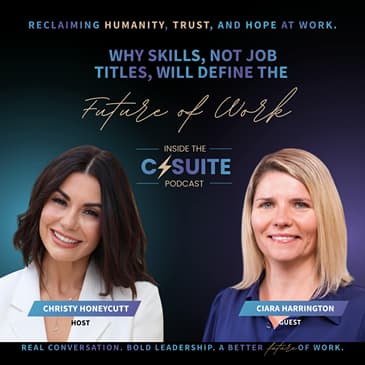
In this episode of Inside the C-Suite, I sit down with Ciara Barry, Chief People Officer at Skillsoft, to challenge traditional approaches to HR, talent development, and workforce transformation.
With more than 20 years of experience leading people strategies, global transformations, and complex M&A initiatives, Ciara brings a powerful perspective on what it takes to connect people strategy to business performance.
We explore why HR must think business first, why skills are becoming the new currency of work, and why learning only matters when it changes behavior and delivers measurable results.
What You'll Learn:
Why leading with business outcomes is a HR strategy.
Why capabilities not the “org chart” determine workforce agility.
How to anticipate your skill-supply chain needs.
Why L&D completion rates aren’t enough to move the needle.
How AI is reshaping work while making human attributes more valuable
Why skills-based workforces are shaping the future.
Why organizations are leading through experimentation.
How to measure learning through behavior and business impact.
Why courage, coaching, and stepping outside of your comfort zone are essential to professional growth.
| Connect with Us |
Follow Ciara Harrington:
LinkedIn: https://www.linkedin.com/in/ciarabarry/?isSelfProfile=false
Webiste: https://www.skillsoft.com/
(Ciara is the Chief People Officer at Skillsoft, where she focuses on connecting people strategy, workforce capabilities, and business performance. With a business-first approach to HR, Ciara challenges traditional thinking about talent development, emphasizing that building skills isn't simply a learning initiative—it's a business imperative).
Follow Inside the C-Suite:
Subscribe on Spotify: Inside the C-Suite
Subscribe on Apple Podcasts: Inside the C-Suite
Follow Christy Honeycutt:
Website: https://www.christyhoneycutt.com
LinkedIn: https://www.linkedin.com/in/christyhoneycutt/
Instagram: Christy Honeycutt (@christyhoneycutt) • Instagram profile
Facebook: https://www.facebook.com/christyhoneycutt
TikTok: Christy Honeycutt on TikTok
Book: The Inner Work of Leading in a Broken System
Want to be on the show or know someone who would be a great guest?
Podcast Nomination Form: Inside the C-Suite | Christy Honeycutt
Powered by the WRKdefined Podcast Network.
[00:00:00] What I would like to leave people with is, I think someone once said this phrase to me and it really resonated, but it's that like life begins at the end of your comfort zone. And I am always pushing myself. If I ever feel comfortable, that's my sign. I need to push myself and change things again. And I think that is how you will be successful in these jobs. These jobs require somebody who's going to lean in, who's going to keep pushing, who's going to constantly be curious, constantly be asking questions and trying to figure out how to do things better. And if something scares you,
[00:00:29] Great. That means it's exciting and that's a great opportunity for you.
[00:00:45] Hi, I'm Christy Honeycutt, your host of Inside the C-Suite, where execs get real about leadership, impact, and what truly drives high-stake decisions. Today, we're getting into something I think every executive team needs to be talking about. You can have a brilliant business strategy, but does your workforce have the skills to execute it?
[00:01:03] Today on Inside the C-Suite, we're delivering a masterclass in turning workforce capabilities into business outcomes. My guest, Kira Harrington, Chief People Officer at Skillsoft, brings a different lens to leadership. From total rewards to major transformations at Dell, EMC, NBCUniversal, and Comcast, she's learned to lead with the business, not the HR playbook.
[00:01:25] We're talking AI, skills, transformation, and why the smartest leaders know when to stop pushing harder and start asking for help. Because strategy means nothing without the people who can execute it. This is such a great episode. Let's jump in, shall we? Kira, I'm so excited you said yes to Inside the C-Suite. I know my introduction did not do you justice. I would love if you would tell us a little bit about who you are and what you do.
[00:01:49] I am so excited to be here too. And thank you very much for having me. My name is Kira Harrington. I am Chief People Officer for a company called Skillsoft. We are currently focused on helping businesses drive better business outcomes through skills management and a skills supply chain. It is very exciting to be the head of HR for a company that sells an HR product. And I think it enables me to be really close to the business, which is just so exciting for a role like mine.
[00:02:16] A little bit about me. I am originally Irish. You can probably hear this is not a Texan accent. And I do, however, live in Austin, Texas and have been here for the past nine years with my husband. And I have two boys and two dogs. I have been in HR my whole career. Started off in the total rewards space. Graduated from college with a business and systems degree. And this felt like a really good starting point in the HR space, but still a lot of numbers and logic and detail.
[00:02:42] From there, I went into consulting where I spent many, many years working on various large scale transformations and learned so much. One of my biggest pieces of advice to anyone early in their career is if you get the opportunity to do time in consulting, it is highly valuable. Going on project works and working for multiple different companies back to back allows you to see what a lot of companies do well, what they don't do well. You pick up something every single company you go to and it's like getting 30 years of experience in 10.
[00:03:12] From there, I went back into corporate in the total reward space. I went from there to a company called Syngenta where I headed up their total rewards. I had a global and North America role. And then from there, I came to my current company where I actually started as our head of total rewards and was later promoted to chief people. So that is an interesting way to come up. And that was a great resume, by the way. So kudos to you. We're both dog people.
[00:03:39] And guys, if you happen to hear any doggies, we're hoping that both of our dogs won't set each other off. They're doodles. So we need grace. So you said something in your intake that jumped out at me and I loved it. My starting point is always what is the business trying to achieve? Why isn't that automatically the starting point for HR? HR's role is to enable the business. If you really fundamentally break it down, why does HR exist? The business has outcomes it needs to drive.
[00:04:07] It needs the people and talent in its organization to drive those outcomes. And HR's job is to understand how the existing talent or new talent can best be used to drive that outcome forward. I think one of the things that's kept HR stuck in the past is a tendency to focus on what the market is doing or a tendency to focus on, well, this is how we've always run this type of a program. And it's been successful for me in the past.
[00:04:32] I'm not saying that these things are not important pieces of information and that we should absolutely be keeping these as tools in our toolbox. But at the end of the day, what really matters is these are the outcomes the business is trying to drive. We have all of those tools in our toolbox. It is our job to figure out how we use those tools best to fulfill the needs of the business. And it is really my belief that for HR to truly add value, that's how we need to be seen.
[00:05:00] Not as the administrative function who rolls out and processes the people programs, but as a true partner and enabler of the business. I love the way you answered that because we've been talking about for years that HR deserves a seat at the table. So just speaking with you this little bitty bit and having the honor to meet you, when you step into an executive meeting, what are the questions you're asking that perhaps a traditional HR leader isn't? Because you definitely have a strategic point of view. It's almost like what I just said.
[00:05:28] I start every meeting by asking, what is the outcome you are trying to drive? Like, I'll give you a good example. A leader comes to me and he says, hi, Kira, I'm going to reorganize this team. I'm going to put this person reporting to that person. I'm going to promote this one, move this one out. Can you help me get this done? That's not the type of HR organization I run. That's you making the decision and coming to me and asking me to nicely process it in the system for you. I will turn around and say, okay, I hear you, but can you tell me why?
[00:05:56] Why are you making all these moves? What is the outcome you are trying to achieve? Then let's start building a solution from there. And I think that's a really important shift in narrative because there is cases where that's how HR is treated. People come to us with a problem and their idea of what the solution should be rather than coming to us with a problem and sitting down together to solution it. So I think the biggest thing I would say is interrupt. Don't just go and do what they asked you to do. Dig in underneath it and understand what they're trying to solve.
[00:06:25] Then help them understand if this will help them solve that problem. So I loved your example about reorganizing the team because you had mentioned something about you've actually done this, right? And so you did it three or four times and some employees would think, you know, hey, could we stop changing? That might be their perspective, but maybe that wasn't your experience. Can you walk us through that? Yes. The world we live in right now where we've come into this world of AI, there is no start and stop with change anymore. I could go back 20 years early in my career and you'll probably remember the same thing.
[00:06:55] We're going to embark on a big project. We're going to start changing on December 1, you know, 2015. And then on December 1, 2016, we're now finished changing. Everybody go back to normal. Do your day jobs. Great job. We're finished. That is so not the world that we live in today. There is no such thing as stopping changing. And as the world evolves and things like AI evolve so much faster than the computer, the enterprise management system, Google, the internet, it is moving at a much faster pace.
[00:07:24] And we need to be able to keep up with it. At least I believe the HR organizations that want to keep that seat at the table and be viewed as that true partner to the executive team in the future. I run a team whereby my team are well aware the only constant is change. We are always changing in line with what the business needs. If we are not changing in line with what the business needs, we're falling behind. So I very much set a culture of this is what you can expect when you work on my team.
[00:07:52] I make a very incredible effort to hire people who are agile, transformative, and who thrive in these kind of environments. And that's who I am. When a company gets to a stable state, I give me four, six months tops before operating business as usual before I'm like, okay, I'm itching. I need some problems to solve. So I make a big effort to hire people who think like that. But I'm also really honest with my team about what I expect. And I use this example a lot.
[00:08:18] But in the first big transformation I did with my team, which was right after my new CEO came and joined us. And it was very much a swivel to moving all of our administrative work into the services function, trying to get the strategic functions to be more strategic. Not rocket science, something a lot of organizations go through. And when I went on the town hall, the HR town hall, and I explained, here's how we're going to do things going forward. We're moving from regional to global. I'm taking all of these tasks. I'm automating them.
[00:08:48] And I'm putting them over with this group here. All of your roles are now going to change. We're no longer going to have someone assigned to each country. We're going to have a pod of people. And you will all together mind multiple countries. All these tasks you do today are going to be pushed over here. And we actually had somebody resign the next day. And they actually cited what I had said on the town hall as their reason for leaving. But actually, in my mind, this is a good thing. That's not a bad thing. Because I was honest about what it needs to work here. But this person was honest. And they went, you know what?
[00:09:17] I liked doing the contracts individually. I enjoyed the one-to-one conversations with team members. I don't want to send them to a ticketing system. I like speaking one-on-one with people. And I thought that was a really positive outcome. And the individual came forward. We parted ways in a very respectful, meaningful way. She gave us a great transition. But it was a really, I think, defining moment for me to be like, this is okay if that happens. Because this is not a good fit. But then what you find is there will be people that will trickle off in their own time. They don't make the move right away.
[00:09:47] But something in them is, I'll give this a try. And then maybe it doesn't work. But what you find is all the people that are energized by what you're trying to do, well, they all of a sudden are freed up. Because you've now opened the floodgates for them to be like, oh, okay, I've now been given permission to automate all these processes, to do this in a global way instead of a local way. And you'll find everything starts to move a lot quicker. But you have to keep doing that. So the first time we did it, it freed up some things. We learned some things.
[00:10:15] But then as we elevated the org, we looked again and went, okay, now that we've solved all those problems, here are now other things we think we can start to move over here. And here's how we can think about doing this differently. And here's how we might spend more of our time on what's important to the business. Another important piece is, here are things you're going to not do anymore. Here are the six business priorities. All of this work doesn't help those. Stop doing it. If somebody complains, come to me and let's have a conversation. But until then, stop doing it.
[00:10:44] And I think you have to keep doing that. There's no such thing as a business who's static. There's no such thing as a business that even sets a strategy at the beginning of the year and midway through the year is like, yeah, everything is going exactly as we thought we're going to keep on this path. Almost every time in the middle of the year, there is a, yeah, these two initiatives, great. These two on track. These two not moving fast enough. How do we swivel resources? Or maybe the path we took isn't quite working the way we thought. Should we try a different path?
[00:11:12] All of the enabling organizations need to swivel with us or it's not going to work. Like I'll give you a really good example. If the company decides, you know what, we're going to hire 10 new roles over here because this is just a skill gap. We tried to upskill the existing team. It's not working the way we thought. We're going to hire 10 new resources, but we need them to have in-year impact. So we want them in seat in eight months. Well, guess what? If I put these 10 roles into the backlog of open roles, my recruiting team is recruiting for, you're not going to see those for eight months.
[00:11:41] I've got to go to my recruiting team and say, see all of these 60 open recs? Stop. See these 10? Front of the line. Go. Everyone re-pivot. Each recruiter, take three of these. They're your only priority until they're full. In your spare time, you may continue to recruit for this next batch that are the next top priority. And guess what? These 40, they're just not a priority, right? And again, it's not to say that we won't ever get to them or we won't come back,
[00:12:08] but it's all about how people are spending their time and how you prioritize. And you have to be constantly changing that in line with the business, or you're not going to be able to enable the business to achieve its outcomes. That was a lot. There was something you said that I had this happen to me this week. There is a space where you can be both have gratitude and be disappointed. There are always opportunities where you can have two emotions that could be completely conflicting at the same time, and it's okay. And so that's what you made me think of is like people kind of going through this,
[00:12:38] the positive and negatives of the person that you let go or that chose to leave. Rather, you were very transparent. This is the job that this isn't for me. That's beautiful because I think so often you are exhibiting what every HR leader should see. So those of you watching that want to figure this out and how to find your voice, follow Kira because this is exactly what the C-suite needs. HR Tech is coming up next week. I don't know if you're going, but there's a huge thing going around that they're going to be talking
[00:13:05] about who owns the people, who owns the process, the operations, the outcomes. Is it the CTO? Is it the CPO? Is it the C? Who is it, right? Who's on first? Who's on second? And we talked a little bit before hopping on record, and I happen to believe that everything begins and ends with the human. And so the chief people officer, the CHRO, they need to be in the conversation and in these decisions. Your org chart isn't your workforce, right?
[00:13:30] So if we still organize companies largely around jobs and initiatives, which you just talked about, but the work itself is increasingly becoming more about capabilities, are we reaching a point where the org chart tells executives less about their workforce than they think it actually does? A hundred percent. So if you really break it down, what does the org chart really tell you, right? It really tells you the functional area I have expertise in and potentially the sub-functional area. So if I'm in total rewards, I'm in HR, and I am very experienced in total
[00:14:00] rewards. Then it's going to tell you what level I can operate at, if I manage people or not, who I report to, and then some other information about what I earn and, you know, who I work with, who are my peers. It doesn't tell you if I'm driving business outcomes. It doesn't tell you what work I'm doing. It doesn't tell you who I'm necessarily doing work for. Like, if you think about, like, an organization's not static. It's a moving organism. And I think consulting is a great example of this.
[00:14:28] In consulting, they kind of call them like a mentor, but they're the person you direct line to. Your consistent point of contact. All, everything you do, they help manage your performance reviews. If you're not staffed, they help get you a project. If you're having an issue with the boss, you can go to them and they'll sort of help you resolve it. But when you're on a project, this person has absolutely nothing to do with the work you're doing. And they are not there to help you with the subject matter expertise. They're not there to help you get the work done.
[00:14:55] You report up to a project lead, and that is where all of your direction comes from. And then for the duration of that project, that's all you work on. So you are on a project. You have six months to get something done. That's all you do for six months. And then you achieve the outcome. Then you go back to the bench. And then eventually they find another role for you and you move on and you do that. But if you think about how consulting firms work, they've been operating at a skills base level for forever. There is an HR project. They come to the human capital practice.
[00:15:22] Then they say, OK, we need someone with compensation expertise. Here's Kira Harrington. We need someone who can do org design. OK, here's someone else. We need someone to lead the team. OK, here's a leader who's actually done a couple of HR areas before they have enough expertise in these areas. You put them all together and then you separate them. I tell the story because I believe this is the way the world is going to go. I don't necessarily think the org and job hierarchies go away completely. I think they simplify. I think the org structure flattens.
[00:15:51] I think the job architecture becomes less complex because everybody has to have a home. But how work gets done, that's the part that's going to dramatically change. So it's almost back to what I said earlier. And we're doing mini tests of this, both in my HR org at the moment. This is my latest change. We did our mid-year review of our strategic initiatives. And I said, guys, exactly what we talked about. These two, as good as done. I don't want anyone spending any more time on them.
[00:16:18] The rest of these three, I'm going to reorganize us as project teams. I gave each initiative a lead. I moved some of the work between them and I assigned teams to everybody. And I said, right, you all stay in your same reporting line. Your job title's not changing. Your comp's not changing. But for the rest of this year, this is the person you take direction from. These are your peers. And they are from HRIS. They're from Total Rewards. They're from HRBPs. They're all your goal. This is the outcome I want you to achieve. So at the end of this year, you all work together to deliver this outcome.
[00:16:47] Right? That's my ask of you. And we're also doing it on a larger scale in Skillsoft as a whole. But I can obviously speak more to my own. But this is us trying the model. We've moved anybody yet. Everybody's still where they are. But it's like, if we really organize around outcomes, how would that work? And would we achieve things faster? And then you need to scale it out. So mine is a mini pilot within HR. Take it a step further. Let's say I have a really good project program manager on my team. And there's another project happening somewhere else.
[00:17:16] Or let's say for my headcount project, for example, I need to collaborate with finance and IT. So there are people from IT and finance on this team as well that are reporting up through this lead. So if you take that and like amplify it, and then imagine if at the beginning of the year, the CEO sits down with, let's just say the CPO for now, and says, all right, Kira, here are my six initiatives. Okay. And then I sit down with him and I say, right, we identify the skills and capabilities we need to get that work done. We find who are the humans?
[00:17:45] What are the systems? What are the AI agents? What can the AI agents do to help this work get done? And you start putting them all together and driving towards an outcome. That's driving more focus. And this is where I think the skills-based workforce is really coming into play because how do you compare a human and an agent? Okay. A really easy way to do it is I need somebody with good communication, influencing and critical thinking skills. Okay. That's a human. Got it. I need someone who can do repetitive tasks, work 24 hours a day. Okay. You know what?
[00:18:15] An agent can do that. Or maybe an agent can do 80% of it. And then we just need a human oversight for 20. So that's the way I think the world is going to go. And we are, like I said, trying to make our way there by testing it out. I don't think any of us have the answer, by the way. But I'm also a big believer in we've got to try and move forward. Anyone on my team will tell you. I'm always telling people, come to me with an idea. And I'm like, pick a small area, try it out. Let's see if it works. And if it works, let's push it broader.
[00:18:44] So same thing with this. I talked with my CEO last week and I'm like, here's what I'm going to do. And this is what we're doing at the org scale. And then next year, you and I will check these pilots and see what was successful, what wasn't successful. And then can we scale it to more areas in the organization? I love that you eat your own dog food. Have you ever heard that phrase? Yes. I like drinking champagne personally, but we'll go with that. I like yours better. I love the way your brain works and just listening to you talk about your team and how you put the team together. It's frankly, it's how I ran teams forever.
[00:19:13] You know, just who has the special skill set that we need to accomplish the objective, surprise and delight. If you could explain Skillsoft's idea of the skills supply chain, what does that mean to a CEO? And is it living in HR terminology every day? So does it today? No. Should it? Yes. Will it in the future? I believe so. Skills supply chain is the focuses on outcome all the way through to execution. So again, back to where I started with all of this,
[00:19:41] which is if you start with the business outcome and the business outcome we need to achieve is we want to grow revenue 2%. Then we need to distill down, how do we do that? Because there's going to be a series of projects that come beneath it. Then it's a decision of what are the skills needed for each of those projects. So we'll just pick the easy one. We need direct sellers who can grow the business. So we need hunter sellers. So then, okay, we identify we don't need growth selling skills. We need hunter selling skills. Like we need new business.
[00:20:09] We need people out there in the market who can cold call, knock on doors and get us this new business. Not the renewal that we have today. So, okay, so now we know we need that. Then the next step is, well, do we have that skill at the company? So maybe I do a sweep of all my salespeople. And I might come back to Ron and say, Hey Ron, listen, there's this one person over here that I think has worked at a big tech company before where they've really done this hunter type selling.
[00:20:34] The rest of the sales force are more learning experts who sell, you know, not quite what we're looking for. And whether I can tell my CEO, hey, you said we need 10 of these. Okay, I found 10 of them. Let's go. Or I might tell him I found five and I found these other five that have half of what we need. So if we were to train them, then we could get them up to speed. Or maybe it's I have five that can do it, three that I think I can upskill and two gaps. So now my skill supply chain will say, okay, great. So these five people, they're good to go.
[00:21:04] Have at it. Here's your bag. Go start knocking on doors. These three, they could all have variations of the skill set and need different ways to upskill. So ideally, my skill supply chain will pick personalized learning for each of them that they can take to upskill on the job. And then I'll be able to say to them, okay, great. And then for the other two, I'm going to need to go external. But now I have a really solid job profile. I know exactly what skills I'm looking for because I've got my five people. I have my three. I'm going to upskill. And I'm going to need to hire those externally. Then do I grow by 3% at the end?
[00:21:34] So, you know, after I upskill these people, I should reassess them to see if they're making the mark. And then have they executed? Because that's really what matters. I think learning to date has been all about, like, guess what? You know, CEO, your company spent 100,000 hours learning this year. Okay. So great, Kira. Did anything change? Did the year change? My CFO was a bit like, is that 100,000 hours they didn't spend working? Because I'm going to have a problem with that. So, yeah. If we can actually show, okay, these people spent excellent time learning. But the learning was highly personalized.
[00:22:03] So they weren't watching hours of video content that maybe they only needed to know two of the topics being discussed of the five, right? This is very personalized. And then if they execute at the end, well, then we can say that it was successful. If we don't execute at the end, well, we need to keep going. And this is why supply chain, because it's not, again, back to start, stop. So we need to come back around, look at the outcome again and say, do you know what? We missed an influencing skill here. So we did find people that were really good at knocking on doors, but they lacked the finesse to talk to really senior leaders.
[00:22:33] Or maybe they lacked the knowledge of the learning business. Maybe we misread that needed to be stronger. So then we go through it again. And now it's going to look at all my eight people again and say, okay, actually, the five you picked originally, four of them lack a depth in understanding your product. So, okay, that's easy. I can upskill them on that. So around and around we go. And the idea being that eventually the outcome, you should be able to thread the needle from the outcome you were trying to drive all the way through to the successful delivery of that outcome.
[00:23:01] I love your ability to tell a story. I feel like I just followed you in my head with, like, images. It was so fantastic. I feel like it's actually quite complicated. If you think of a physical supply chain, like my CEO and I talk about this all the time, where you're just building on top of each other. So it's a virtual one, but it's essentially the same thing. No, I think you did a great job. So if a CEO says AI is going to transform our company, what's the next question? What is the next question that a CPO should be thinking about? So I think everyone knows AI will transform our company.
[00:23:31] I think what nobody really knows is how. Yeah. How fast we need to move to transform. And there's a little bit of where do we start? So when you think of, like, for me, I'm probably highly focused on AI agents and how we sort of build those into our workforce. And very easy ways we're doing it is, like, tier 1H or support. An agent can read knowledge articles way faster than a human. So you submit your ticket that says, is 4th of July a day off in the United States?
[00:23:58] And my agent will, United States vacation policy, ping. Yes, 4th of July is a vacation. Or if it can't find the information, it will then send it to a human. I just got asked this question. It's not in my knowledge base. Then we feed the knowledge base. And then the next time it's in there. But AI is also able to change how businesses operate, like the backbone of the operational model. So how processes flow, connecting systems to one another. Some things that we think about, if you think about you have Workday and you have Greenhouse for your recruiting system. Do I actually need to integrate them?
[00:24:28] Or can I have an AI agent go get the data from Workday I need and then combine it with the data from Greenhouse and then spit it out to me? It's a very different way of thinking. And a lot of us still go back to the basics. So, okay, Greenhouse and Workday is separate. And we think, oh, we must build an interface. But no, you have to force everyone to step back and say, no, this is the world of AI. In the world of AI, what's the best solution to this problem? So I think those are two examples, but it goes even deeper than that. And I think there's so many different prongs.
[00:24:56] I think organizations need different people looking after each prong. I think saying AI is going to change our business. Of course it is. But how we actually change our business and how we get that executed internally, I think that's a piece that people are struggling with. And then there's all things around governance. Legal friends, we need you in here. Are we going with one platform for AI agents? Are we going to allow everyone to go out and build their own agent? Well, hey, guess what? If you're an HR and I'm putting confidential pay information into that agent, is it actually secure?
[00:25:25] If I allow anyone to build an agent to train people, well, what if that agent is racist or rude or inappropriate? Whose fault is that? Is it the fault of the agent or the person who built it? So I think there's so much to that question, that to say. My advice to any CEO is going to be, you've got to break down the problem. Okay, where does the AI slot in? And then you've got to look across the skills of the people on your team. And you've got to decide who do you think has the skill sets to move this forward.
[00:25:54] I think the biggest challenge we have with this, does it sit with IT or does it sit with people? We are obviously people. Generally speaking, the skill set in HR is soft skills. It's they like spending time with humans. They generally are not the most technical. And then you have IT who are very, very technical, but they don't really understand how work gets done. Like how, you know, how business operations flow together. They're very focused on solving an end-to-end problem.
[00:26:21] I need to get this document from here through here with these approvals and all of this information intact. And I need to spit it out the other side. So I often think about the reality of is neither of us in not individually, but as a whole, really have the right skill set. IT have this gap. They've never really talked to a leader about how work gets done and how to think about dividing it out among different things. And HR tends to be not the most technical. So the race to the top, in my opinion, is probably, first of all, we need to decide,
[00:26:50] is there a distinction between an agent that does work and is considered a co-worker versus the use of AI in the background to help drive systems? And like, maybe those are two slightly different things. But either which way, I believe whoever is the most successful in this is going to be the IT leader who happens to also have very strong people skills, or the HR leader who also happens to be very technical. Or it's going to be the C-suite executive who's smart enough to know I need more technical expertise if I'm an HR leader.
[00:27:19] Or if I'm an IT leader, I need to understand more about business operations and how work gets done in order to be able to do this job. So I don't know that it's fully locked yet. And I've seen combinations out there, but that's how we try to think about it. Kudos to you and how you explain that, because that is exactly how I feel about it. And I'm seeing it too. How do we train as a CPO? How do you train the soft skill portion? Because technical to me, it's like, OK, well, there's classes for that. There's things you can do.
[00:27:47] But what are you doing to overcome the soft skill side that is so desperately needed? It's actually such an interesting point. And we actually almost did it on this conversation where you focus so hard on the lack of AI skills, you almost lose sight of the fact that with more AI skills comes more need to help train in soft skills. And the two become equally important. The other thing is that lower level jobs are going to be done by AI. That is going to happen. So people roles will all be leaders.
[00:28:15] You may be leading agents. You may be leading agents and humans. You may be leading all humans. But you are going to be a leader. But regardless of where you are, soft skills are going to become really important. So we absolutely do focus very heavily on that within our own organization. It's also things like critical thinking, problem solving. These are skills that have been out there. But again, more associated with consulting or those kinds of jobs.
[00:28:43] The fact that's now the norm is also going to be interesting because it's going to change the profile a little bit of the people that companies need to hire. And I think, again, humans that are going to be successful and in the C-suite in the future are going to need to have and build all of those skills. And I think the reality is someone with less human skills can still manage agents. We talked about this a little bit before this. So I think there is a world for people who maybe still prefer interacting with technology over humans,
[00:29:10] but they will still need some basic coordination or orchestration skills, as we call it. Because if you have two or three agents doing work for you, you're going to be able to need to go across them and understand, are they working well together? Is things breaking down? And how do you fix those things? So let me ask you a question about this. What have you personally changed your mind about in the last year? Because you've been up to a lot. The biggest realization I've come to is that how companies are organized is going to change.
[00:29:37] They've been organized this way, at least for my entire tenure, and I think for many, many years before that. What I don't know yet is what that looks like. And that, for me, is an interesting, like, realization. Maybe a year ago, I wasn't as convinced. I was like, maybe this org structure stays, but we adjust. I'm becoming more and more convinced that's not going to be the case. I'm also becoming more convinced that it is problem-solving, critical thinking, influencing skills are what is going to drive success in the future.
[00:30:06] AI can pretty much do, like, I could go into AI and ask it, can you write me a really good program for rolling out an annual compensation cycle in my company? This is my performance scale. This is how we measure people. This is how much money I have. And it can pretty much tell me what to do. So, how much of an expert in total rewards do I need to be to actually get that job done? Or is it that I need to be able to understand this is what we're trying to achieve, this is the way you would do this,
[00:30:34] and I need the critical thinking and problem-solving skills to put it together in a way that makes sense for my company? Could I, in theory, do that in any functional area? Potentially at some point. So, those are the things I think that blow my mind a little bit in terms of how that looks and the fact that we really still don't know. But again, I'm taking steps to try to figure that out because I think those are the people that will be successful. The last thing I'll say on this is there is still a huge spectrum out there.
[00:31:02] So, there is still this example of the girl I gave you earlier. I'm sure she found somewhere to work where she speaks to team members daily, organizes happy hours in the office every Friday, does contracts and personally hands them over. So, there are still organizations that are there. And then there are ones that have gone completely to AI. And then there's a lot of us in this middle that are still started as a traditional org and are really trying to make that leap. But some of us are making it faster than others.
[00:31:28] And I think this to me is going to be an interesting journey in that at what point do the people that don't move start to realize that's not sustainable? I'm assuming at some point they're going to stop making money. They're going to stop. And we will see the shift. But right now we're not there, which is still interesting to me. Yeah, I know we're all still figuring it out. But I have to say this has been such a pleasurable conversation for me because you have, it is obvious you have thought through this. It's obvious that you're leaning in with courage and curiosity. So, kudos to you.
[00:31:58] And I definitely want to stay in touch and maybe come back in a year and see what have you accomplished and what have you learned? Because there's just so much goodness in what you've shared so far, Kira. So, I'd like just a couple more questions really quick for you if we can. You had an accident that kind of changed your career trajectory. And I would really love you to share that because I love that story, the part of your story, because your career might have changed because somebody actually left you off a list. That story, yes. Yes. It's a very good story. And I was due to be signed up.
[00:32:28] This is when I was still living in Ireland. I was due to be signed up to a group coaching program that the company was running. So, it was one of those things where you would attend a class and they would help coach and guide you with a group of people all at your own level, like high performing people at the company, of course, getting you ready for that next phase at the company. They're investing in you and your development. But it was a group situation over six months. The email went out. Everything was signed up. And I get a call from my boss that day. Now, of course, I don't realize because I don't get the email because I'm not on it.
[00:32:55] And I don't think anyone near me got the email either because the first I heard is from him. And he is so apologetic. And I do not even know what he's talking about. He's like, I'm so sorry. You were meant to be on this list. I do not know how this happened. And he has spent the whole day making phone calls, trying to figure out how to get me in. And it's just one of those things that we were using an outside firm. All the assessments have gone out like the ship was just sailed. So he says, but what I am going to do, they've committed to getting you your own coach. So I was like, OK, great. So actually, this ended up being a lot better for me.
[00:33:25] So I remember I was given three coaches to meet with and see if it was a good fit. And I remember struggling because there was a female that I really liked and a guy I really liked. And inside, I wanted to kind of go with the female. And I remember saying this to my then boss at the time who was male. But I was like something about this male. I feel like it's going to challenge me more. And I think that's actually what I would like to go for. So my boss was like, no, I think go with your gut with these things. So I went in and two big things, I think. I remember him asking me the first question he asked is, what do you want to do in your career?
[00:33:53] And I said, well, I want to be a chief people officer. And then I took it back and I said, well, look, haha, I at least want to be ahead of total rewards. And he said, wait, why did you take that back? And I said, well, this was 15 years ago. I did not know one chief people officer that had come up through total rewards all through talent and culture. So I laid this out for him and I said, I don't see right now. I just don't see a path. But I said, I think it would still be really great to be like an SVP of total rewards. And I remember him saying, no, no, no, no, no. This is coaching. You want to be a chief people officer. Own it.
[00:34:23] And I was like, OK, great. So that was the first thing that I think really did set me to be like, no, I am going to aim for this. And if I don't make it, that's OK. But I am going to aim for this. And then the second thing that was really inspiring was a conversation I was having with him about all the hours that I work and a lot of friends and family being maybe critical or talking down or, Kira, you work so hard. Is it not exhausting? Did the work never let you take any time off? And I really bought into this, my doing something wrong.
[00:34:50] And I remember him asking me, well, do you mind working on the weekend? And I was like, my goodness, nobody has ever asked me that before. So I sit there and I'm like, I'm like, OK, I'll think about that for a minute. And then he said, while you're thinking, let me tell you a story. I'm like, OK. And he said, listen, every Saturday morning, he said, I get up, I get a cup of coffee, I come downstairs. He said, I sit at my desk. He said, I've got a lovely view out the window. And he said, you know what? I go through things for my clients. I catch up on work. I drink my coffee.
[00:35:20] I play some music. And he's like, Kira, I'm delighted with myself. And I thought about it and I was like, you know what? I don't mind. And he said, I think it's actually more than that. Not only do you not mind, he said, you enjoy it. Do you enjoy the work you're doing? And I was like, yes. And then I was chatting to him about this previous weekend. I'd been working on something and I'd sat down for three hours on a Saturday like that with my cup of coffee. And I was so energized. And then I was so delighted with myself when I figured it out. And it was just one of the biggest freeing pieces of advice I've ever received.
[00:35:50] I had been looking at all the extra hours I was working as negative because a little bit, that's what people around me were conditioning me to do. And what this really defined for me is I love what I do. I really enjoy it. And during the week, is it always all the stuff I love? No. HR deals a lot with last minute issues, things that are upsetting, different employee issues. And we've got to drop whatever we're doing and handle those. But usually on a Saturday or Sunday when I sit down, that's time I spend thinking about how my team is going to be organized in the future.
[00:36:19] Maybe thinking about where I'm going to integrate AI. Maybe looking through the strategic initiatives and thinking, actually, now that I look at these business ones, I'm going to make shifts here. But it's that out of the weeds time where I can like big picture think. And that's my favorite thing to do. So I think I really realized I always went into this field because I was passionate about it. My dad really wanted me to be an engineer. When I graduated, I was really good at math. I did applied math. I did physics. I did engineering. I was a top A++ student at math. But I was really passionate about humans.
[00:36:49] And I'm a really social person, really interested in human psychology. So when I graduated college, I still remember, you know, my friends in IT were earning like 50 grand a year and I was earning 35. And I remember my dad saying to me, Kira, like, and, you know, I'm like scraping to get by and my friends are all buying expensive shoes. And I remember saying to my dad, well, I might be earning less money now, but I am doing something I'm really passionate about. And I believe that this will pay off in the long run. And I think I can say that it absolutely has.
[00:37:18] But those two things I think were life changing. I had gone into this field because I cared. And being reminded that I enjoy my job and that working after hours, as long as I don't mind, is not something I should worry about. And I think that reframing was huge. Well, I love that you shared that story because there's so many people out there that need to hear this. They need to hear it's okay to be with yourself in this. I like this. I do the same thing. I will come in early before anybody's awake in the house and it's quiet. And I can't think because my brain is always going.
[00:37:47] And that's my favorite time because then you hit nine o'clock and I've already done all my things. I've already gone to the gym. I know exactly what my day is going to be. And I just have more peace. I think that's the difference between leaders and followers and also just self-awareness. So kudos to you. What would your dad say about you now? Where you're already on. I think he would say that I have been very successful. He's not one to admit he was wrong. Oh, us little girls and our dads. I mean, it is a thing. So I could talk to you for hours and hours on end. But as we wrap this up, is there anything that you didn't get to share that you'd like to?
[00:38:17] And could you let us know how the audience can get in touch with you or work with your company? So the audience can get in touch with me via LinkedIn. So Kira Harrington should be easy to find. My company is Skillsoft and very happy to connect directly with me or you can go to our website. What I would like to leave people with is someone once said this phrase to me and it really resonated, but it's that like life begins at the end of your comfort zone. And I am always pushing myself. If I ever feel comfortable, that's my sign.
[00:38:46] I need to push myself and change things again. And I think that is how you will be successful in these jobs. These jobs require somebody who's going to lean in, who's going to keep pushing, who's going to constantly be curious, constantly be asking questions and trying to figure out how to do things better. I think that's just a really good piece of advice I got. And if something scares you, great, right? That means it's exciting and that's a great opportunity for you. That's the biggest thing I like to say to people is do not be afraid. Take the risk. Oh, I love it.
[00:39:14] Go to your boss with a new idea. That is what we want. I want a team of people who come to me every day. Kira, I looked at this process and hey, I just had an idea. If we do it this way, it'll be so much better. If I have to do all of those things, it's exhausting. But it is so energizing having a team of people who feel empowered to come to you. So I would say that to anyone. If you feel stuck, if you feel like your job is getting monotonous, be curious. Think about it. Look outside the box and really lean in. I love it. And follow people like Kira and me.
[00:39:43] And guys, subscribe on Inside the C-Suite and let me know who you'd like to see next. Kira, thank you from my heart to yours and our community. Really appreciate you. Until next time, guys. Ciao. Ciao. Ciao. Ciao.
Sponsors
