
Artificial intelligence has fundamentally changed how organizations communicate. Content can be generated instantly, marketing campaigns can be automated, and information has never been easier to produce. Yet as technology accelerates, trust has become increasingly difficult to earn. Organizations are discovering that visibility alone no longer creates influence—credibility does.
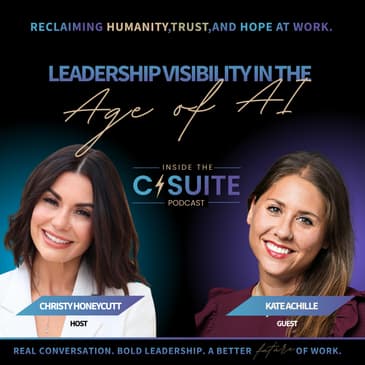
In this episode of Inside the C-Suite, Christy Honeycutt sits down with Kate Achille, CEO of The Devon Group, an independent public relations and marketing agency specializing in HR technology, fintech, and emerging enterprise brands. Drawing from decades of industry experience and a lifetime immersed in entrepreneurship, Kate shares how leaders can develop authentic executive presence while navigating an increasingly noisy digital landscape.
Throughout the conversation, Kate explores the evolution of leadership through the lens of communication, reputation, and organizational influence. From growing up around entrepreneurial dinner-table conversations to leading one of the HR technology industry's most respected PR agencies, she reflects on how leadership is built through consistency, curiosity, humility, and a willingness to keep learning.
The discussion also examines how artificial intelligence is reshaping search, public relations, and executive branding. Rather than viewing AI as a replacement for human expertise, Kate explains why leaders must become even more intentional about sharing original ideas, developing authentic voices, and investing in relationships that cannot be automated.
Beyond communications strategy, this conversation reinforces a broader leadership principle: influence is not created through volume or visibility alone. Sustainable leadership is built when actions, ideas, and values consistently align. In a world filled with generated content, authentic leadership remains one of the few competitive advantages that cannot be replicated.
Whether you're leading a startup, scaling an enterprise organization, or building your personal brand, this episode offers thoughtful guidance on developing credibility, communicating with intention, and leading with clarity in an era increasingly shaped by AI.
What you'll learn:
Growing up in an entrepreneurial family and its influence on leadership
Why great leaders choose respect over authority
The importance of leadership development in today's workplace
How companies can stand out in crowded markets without copying competitors
Building authentic executive visibility in the age of AI
Why original thinking outperforms automated content
The evolving role of PR in Answer Engine Optimization (AEO) and Generative Engine Optimization (GEO)
Practical ways executives can strengthen their personal brand
Why media training remains essential for modern leaders
Lessons on authenticity, credibility, and long-term influence
| Connect with Us |
Follow Kate Achille:
LinkedIn – https://www.linkedin.com/in/katieachille/
Company Page – https://linkedin.com/company/the-devon-group/
Instagram – The Devon Group (@devongroup) • Instagram profileCompany Website – The Devon Group
(Kate Achille is the CEO of The Devon Group, an independent public relations and marketing agency serving HR technology, fintech, and enterprise technology organizations. With decades of experience in strategic communications, executive visibility, analyst relations, and media strategy, she helps organizations build credibility, strengthen market positioning, and develop authentic leadership brands. A respected voice in HR technology, Kate is also recognized for her insights on AI, executive communications, and the future of work.)
Follow Inside the C-Suite:
LinkedIn – https://www.linkedin.com/in/christyhoneycutt/
Subscribe on Spotify – Inside the C-Suite
Subscribe on Apple – Inside the C-Suite
Follow WRKdefined:
LinkedIn – WRKdefined
Instagram – WRKdefined (@wrkdefined) • Instagram profileFacebook – WRKdefined
Website – WRKdefined Podcast Network: Conversations Pushing The Boundaries of Work
Want to be on the show or know someone who would be a great guest?
Podcast nomination form: Podcast | Empower Your Leadership Journey — Listen Now — Christy Honeycutt
Powered by the WRKdefined Podcast Network.
[00:00:00] What separates companies that break through from the noise that others don't? A few things. Reading the room is one thing. Okay. Tell me about that. It's very noisy right now. It's very noisy. And a lot of companies make the mistake of watching their competitors too closely and not focusing on what's happening on the other side of the room. They get all obsessed with what's Greenhouse doing or what's smart recruiters doing. And instead of
[00:00:25] worrying about what's happening with everyone else or the point solutions that are coming up or what features their customers really want, they're worrying about what press release Greenhouse put out or what's happening now that smart recruiters has been acquired. And that's distracting too much. And it's muddying their message and it's not allowing them to stand out. Analysis paralysis. Exactly. And they end up just copying their competitors instead of figuring out who they are.
[00:00:55] Hi, I'm Christy Honeycutt, your host of Inside the C-Suite, where execs get real about leadership, impact, and what truly drives high stake decisions. Today's guest understands something many leaders miss. The best companies don't just build products, they build stories people believe. Kate Achille is
[00:01:23] the CEO of the Devon Group, one of the leading independent PR and marketing agencies serving HR tech, fintech, and emerging enterprise brands. She spent her career helping companies and executives cut through the noise, build credibility, and earn influence in crowded markets. From promoting some of the world's most recognizable thought leaders to advising technology innovators on visibility, positioning, and growth. Kate sits at the intersection of leadership, communication, AI,
[00:01:50] AI, and the future of work. Today we're diving into what it takes to stand out in the age of AI, why executive visibility matters more now than ever, and how leaders can build trust when everyone else is fighting for attention. Let's jump in, shall we? Kate, I am so excited to have you on this show. I have not seen your bright eyes and bushy tails since HR tech last year, except for virtually, but I know what an amazing human you are and that my intro did not do you justice. I would love for
[00:02:19] you to share with the audience who you are and what you do. Well, thank you for that. Hello, Christy, and don't mind the puppy walking around in the background here. My name is Kate Achille and I am CEO of the Devon Group. We are a tech PR and marketing services agency. We are very steeped in the HR technology category, but we also do work in fintech, agtech, edtech, all of the techs. I love it. I love it. So I want to jump into your leadership journey because you have a very unique leadership journey that's family-based,
[00:02:48] and you said that your journey started around the family's dinner table. So what were those conversations teaching you before you even realized it? So yeah, very interesting leadership journey of both of my parents are entrepreneurs. My mother is the one who started the Devon Group back in 1994, so we just celebrated 32 years in business, which that in and of itself is a feat in the PR world to be an independent boutique agency that has managed to survive 32 years in business. And then my dad,
[00:03:18] he is retired at this point in his life, but he owned a cybersecurity consulting company. As you can imagine, family dinner conversation focused a lot on their businesses and what they were doing, and a little less on like, how was school kids? So I learned through osmosis, I've known a lot about HR tech, for most of my life, and I knew industry names, legends, who a lot of them are retired at this point, but folks like Bill Cutick and Naomi Bloom. And while John Summers are still working,
[00:03:46] but I've known those names, like since I was in high school. And I learned a lot about what they were doing and also what HR was just by sitting around the dinner table. All right. So if you haven't hired Kate just off that, you know you need to because like generations and generations and generations of experience there. So what was that like? Like what was your first leadership lesson or your first promotion into leadership? Well, obviously because my parents are entrepreneurs,
[00:04:11] they also instilled in me a very strong work ethic. The second I turned 15, I was pretty much told, go get those working papers and go find a job. Which is interesting because I actually read a statistic over the weekend that said working teens are going to hit the lowest level since the 1940s right now, something like that. So when I was 15, I went out and got a job at McDonald's, which teens don't really do anymore. But I wasn't there very long because as it turned out, fast food was not really
[00:04:36] my forte. But I did go over and I got a job at a local concert venue shortly thereafter. And I actually worked there all through high school and college because I am a big music fan and it's an outdoor concert venue. So what beats being outside and listening to music? There are a few things in life that are better. And I worked my way up there really quickly. So after like one year of doing the basics,
[00:05:00] someone, one of my bosses saw something in me and pulled me out from the line and assigned me my first team essentially. And they were all the kids I had already been working with who I now had to manage, which was funny because again, you don't have training, you don't know what you're doing. But once I got a taste for being in charge, having been a bossy kid to begin with. Were you sick with power? Yeah, a little bit. All of a sudden it felt good. And I realized that there was a lot you could do
[00:05:28] once you were a leader. It wasn't just about bossing people around. It was also about overseeing the production of my specific area and that I got to kind of figure things out and I got to problem solve. And so I realized that there's a lot that comes with being a leader. And like I said, I've taken that with me throughout my career journey, I guess. And here I am. I'm not going to age you, but I'm going to take you back to those years because we've all been there. You've been a solid contributor and then you get thrust into leadership. And for me,
[00:05:56] I knew what I wanted to be like and what I didn't want to be like. Did you experience that as well? And was it hard that it was like your peers that you're suddenly over? Yes. I think, I mean, obviously the workplace changes a lot and it changes very quickly. So again, not to age myself, but you could get away with things in the workplace back then that you can't get away with now. I think as bosses, there's that movie series, Horrible Bosses, that was based
[00:06:20] in some reality of how people used to act. And one of my first jobs out of college, I had to this day, the worst boss I've ever had of all time. She treated people with such disrespect. And that's the person that I, every day I wake up and say, I don't want to be like her to this day. I've carried that with me for like 16 years. That is some PTSD right there. Like our experiences shape us so much and we have two choices, right? Do we want to elevate from it or do we want to stay in it? And
[00:06:48] I love that that's your motivation to be better every day. Yeah. And I was so impressed with her at first. And then I kind of start to observe people because you can seem very interesting and very powerful when you first meet someone. And then when you actually observe how they treat other people and how they treat their team, there's more than just power. It takes more than just power to lead. And some people just get drunk on that part. Did you find it was more ego led?
[00:07:12] This particular person, it was 100% ego led. And I understand she was a woman in a tough field. So I do think if I had to play Freud with her, there was a lot I could unpack. I'm not going to try to dissect her career, but I wouldn't want to be in her shoes and what she probably had to experience coming up in her own career. But I do think I have the benefit of time and hindsight now and my own career and the mistakes I've made along the way. So nobody's perfect. Well, it has got to be tough because your mom is just a bad
[00:07:42] mamma jamma, right? And those are some big shoes to fill. And I've asked you this question before, like, when are you going to take over full reign? Like, have you done that? Or is mom still very much involved? So it's funny, because I've been calling her Jean since middle school. So whenever anyone calls her mom, I'm like, who? Yeah, there, we used to joke for a while, because people would always come up to me like, tell your mom, I said hi. And I would be like, tell your mom, I said hi, like, what do you want me to do with that? No, but Jean is now chief strategy officer, and I'm CEO. And we kind of realized
[00:08:11] that where she is in her career strategy is what she wants to do. She does not want to have to do the CEO stuff anymore. She just doesn't want to have to do the daily grind and the nitty gritty. And so I don't foresee her stepping out fully anytime soon. The Devon group is her youngest child. It is an amazing legacy that she's built, but I will continue to pry it from her. And I have been over the last 14 years, but we do work very well together, which is also a very unique,
[00:08:40] I think, situation. Most people don't enter the family business in 2026. And while I stepped in, like I said, 14 years ago, but most people don't do this anymore. It's not really a dynamic you see. What's one thing that you most admire about Jean, aka mom? Oh, the tenacity. She can step into any room and hold her own. Does not matter. But she will treat people with respect in the process. What do you think she's most proud of you for? Probably continuing to just to keep going. It might also be tenacity.
[00:09:09] That's what I started to say. Yeah. Apple did not roll very far from the tree, did it? Yeah. What do you think? Do leaders get made or do you think they just get exposed? So like the nature versus nurture. I think it's a little bit of both. I do think there are people who have leadership capabilities who decide to shy away from them. I do think there's people who just opt out. I think we've seen that there's the Gen X trope that they don't want
[00:09:34] to be in charge. So I think there are folks who are foreign leaders who just decide that's too much responsibility or I don't want to have to take the fall or any number of reasons. And I do think you can make a leader, but I don't know that anyone's really investing enough in leadership development at this particular moment. I do think training and development is something that's going underfunded for lack of a better term. I don't think people are given enough time. I don't think they're given enough resources. And I think the cracks are starting
[00:10:03] to show on the leadership development front. Obviously the enterprise is sort of one thing, but in the grand scheme of things, very few of us actually work in the enterprise. Yeah, that's very, very good. That's such a good soundbite. So I'm going to shift a little bit because you're in the business of influencing and we've seen the good, the bad, and the ugly. What separates companies that break through from the noise that others don't? That's a tough one at this exact moment. A few things. Reading the room is one thing. Okay. Tell me about that.
[00:10:32] It's very noisy right now. It's very noisy. And a lot of companies make the mistake of watching their competitors too closely and not focusing on what's happening on the other side of the room. They get all obsessed with what's Greenhouse doing or what's Smart Recruiter's doing. And instead of worrying about what's happening with everyone else or the point solutions that are coming up or what features their customers really want, they're worrying about what press release
[00:11:00] Greenhouse put out or what's happening now that Smart Recruiters has been acquired. And that's distracting too much and it's muddying their message and it's not allowing them to stand out. Analysis paralysis. Exactly. And they end up just copying their competitors instead of figuring out who they are. It does everyone a real disservice in the end because it's a very crowded market. I think AI is, instead of making things clearer, it's actually just muddying the waters more and
[00:11:30] more. We're seeing it in so many different ways. Data, role clarity, all of these things should be sharper and crisper. And instead they're just getting more and more general. And that's making it harder to influence anything. There's some people out there that become industry voices, right? While others remain kind of invisible. So if we're looking at the individual, like what do you think that's about? Some people are willing to 10 toes down, stand by what they say. It's true. I was at a PR Daily
[00:11:57] event last week and one of the things that PR Daily did was everyone who came up on stage, they had a couple of questions that they could answer. And one of the folks who was there, he's the chief digital and transformation officer at Hunter. He got up there and when they asked him, how do you produce content that resonates? And he got up there and all he said was, would you read it? And like, that's it. I mean, again, because we're all so busy. We all have so many things going on.
[00:12:25] I mean, you open up LinkedIn at any given moment and it's like just AI generated content from start to finish at this point. If you go to Mary Oliver and like, what would you do with your one wild and precious life? If you only have 10 minutes a day to read something, it has to be good. It has to be interesting. It can't be the same old canned air essentially that everyone else is putting. Yeah. It's very interesting time. I mean, I definitely use chat, right? And AI and the different
[00:12:50] things because chat is my boyfriend, but it helps the human get more clear on the idea and on what you're trying to bring to life. But I am seeing a lot of, it looks like copy paste and, you know, a little bit tone deaf. And I know a lot of people are using virtual assistants. I am one. And I have to go back through because English is second language and concepts there. It's like this podcast, she'll spit it out, but I'll have to go back through and make sure that your voice was
[00:13:18] sound and that your ideas got across and all the things. But I do, I see this a lot out there and there's people doing strategy, like one stick strategy that I've seen work really well for other people. But I'm just curious, do you have somebody, some examples in the market that you think are doing it really well? I won't ask you to call out someone that's doing it really bad. I think we know who those people are, but is there anyone out in the industry right now that you would say they're doing it right? Well, first I'll say AI, great for ideation. First drafts. I talk a lot of smack
[00:13:47] on AI because it's kind of an easy target and it can't hit back at me yet. I'm sure my day is coming where somebody is going to put my name into chat and it's going to be like, she talks a lot of smack about us. So I just want to put that out there. I'm not anti at all. Great for ideation. Great for first drafts. In terms of people with strong voices and people who are doing a great job though, there's some of the same folks who have been doing it for years. And they're the people who are willing
[00:14:12] one, again, they have really strong opinions. They've been consistent with them over the years. And the other thing is they go deep. So like Matt Charney, Matt Charney will put out a 4,000 word essay on his website and people will read it. People don't read 4,000 words from anyone anymore. But when Matt Charney publishes a post, people read it. John Sumser and Heather Bussing of HR Examiner, they're not always 4,000 words, but they are really good in their analysis of things.
[00:14:42] Heather, especially because she comes from a law background. So she wrote up something the other day on one of the newer IBM lawsuits, just summarizing what's happening because not everybody will necessarily understand a lawsuit the second they read an article. So Heather brings her legal brain and translates for us. So folks like that, I think do a really good job. There are tons of others though that I'm overlooking because just the influencer space has grown exponentially in recent
[00:15:09] years, but I could rattle on about that. Well, in influencers, I was reading an article about how UGC, user-generated content, and there's all of these influencer agencies that are popping up left, right, and center, right? Then it's like, okay, great. You can go be an influencer, but do you have the methodology? Have you been the practitioner? Do you understand what you're talking about in different spaces? And I think some things are shock value, which is great. It gets attention. It gets people talking. And I think there's a benefit for that. But I also, what I'm seeing is people are
[00:15:38] craving authenticity, transparency. They're craving something that doesn't look like it was copy and pasted. Why do leaders struggle to tell their story, to create their brand? What do you see happening there? There's a few things. I mean, one, there's the issue of time. Yes. Time is always a problem with leaders. There's different archetypes for every leader out there. One thing that we run into a lot in the HR tech space specifically is what I call the reluctant CEO. And that tends to be someone who
[00:16:05] is the company founder or co-founder who had a great idea for a company and wanted to build it. And now they're the CEO and now they're expected to be the face of the company. And that's not what they signed up for. So that's one thing that I think we run into a lot with leaders where just because you're the CEO doesn't mean you want to be the voice and your team is kind of pushing you or your PR firm is pushing you. That's one thing that's out there a lot. I think it's important to ascertain
[00:16:33] who is the right person to be the spokesperson, who wants to be. And it's also an opportunity, again, going back to training and career development and things like that, there might be somebody else on the team who's dying to go out there and talk, who would love to be on stage, who's being overlooked. I have spent many, many years being a handler. And I can tell you everything you just said is 100% spot on. It's 100% spot on. And those people maybe shouldn't be out there, right, as well,
[00:17:01] because it's going to show up inauthentically that I don't really want to do this interview. What would you say are the top three things that leaders that want to get out and that want to be in that space? What are the top three things that they can do based on your point of view to prepare themselves or to excel in that arena? Right now we're in the era of AEO and GEO. Yes. So one thing that they can be doing is really maximizing their LinkedIn profile.
[00:17:25] LinkedIn is amazingly valuable from an AEO, GEO perspective, but it is the individual profile, not the company page. So use your LinkedIn, write something, even if it's bad, or if your team writes it or have chat, write it, do the first draft and then you do the second one. Use at least one platform. I point to LinkedIn because it is still the most professional out there. Two would be
[00:17:49] get media training. It's gotten a bad rap over the years. People act like it's a bad thing to be media trained, that it's somehow you're taking away authenticity. But would you ask a professional athlete to stop practicing? No. So why would you expect someone who's going to be in front of the to not be practiced? That's good. You wouldn't expect someone who goes on a lecture circuit or a book tour to not be prepared. So
[00:18:16] media training is a very important resource. And then the third thing I'd say is do more of this. Some people don't want to be like on stage or they don't want to do, they're not ready for traditional media. Although there's like four of them left at this point. Get on podcasts. Start your own. You don't have to be the person being interviewed. You can be the one asking the questions. Yeah. You know what's crazy is I've got a book coming out and I did a podcast, gosh, was it last
[00:18:45] week? It's the craziest thing when you're the one interviewing and asking the questions versus sitting in your seat right now, right? I don't know how that is for you. But for me, I was like, well, this is harder than I remember because I don't do it a lot. I'm more asking the questions. Yep. Do you find that? Totally different dynamic. Yeah. Yeah. And it does. It stretches the way you think and how you respond and how you're holding space and all of the things. But you're right. Just get out there and do it. So I heard you give some really good examples. One,
[00:19:12] use a platform, preference with LinkedIn, media training. Where does somebody get media training? Well, if you have a PR like the Devin Group, we include that as part of your program. PR firms often offer media training as a service. There are also media trainers available for hire who offer that as a one-off service. And then for those that don't know what AEO and GEO stand for and what that means, could you give us a brief description? So most folks know what SEO was, which was search
[00:19:40] engine optimization, still exists. AEO and GEO are sort of that next generation. So now that we have AI everywhere, AEO and GEO, it's generative engine optimization, answer engine optimization. So it's basically how you show up in the LLMs. We used to optimize for Google. Now we're optimizing for Claude and Gemini and all of those places as well. So there's PR firms have actually become increasingly valuable over the last year and a half. There's this whole PR renaissance taking place
[00:20:10] because earned media has become increasingly important again. Press releases have become increasingly important again because companies need to be educating the LLMs about what they do and what they're up to and who their team is and all of those things. Otherwise, you don't exist. Yeah. It's pretty interesting. I'm looking at all this stuff and I'm going to vent for a second because I know you have a podcast as well. And we take people on as guests. One of the most
[00:20:35] irritating things I see when working with PR firms. And by the way, guys, I do work with Kate and she's amazing. And all of her guests have been amazing and very well prepared. But there are other media firms, PR firms that reach out that want their people on the show, which I love. That's great. Let's get them on. But then we get this, Hey, can they be on your show? And you say yes. And then they go, what's your downloads? And you're like, I don't know. You asked me. And then they come back and go, we can only do Fridays or we can only do Saturdays or Hey, we can only interview at 2am every
[00:21:02] third Friday. And it's like, do these leaders understand what the media, what the influencers are doing and kind of what we're giving to them because they act like spoiled children, frankly. It's a very tough media landscape right now. I mentioned that there's about four traditional media left and I was being hyperbolic, but also not at the same time. Obviously, traditional media is shrinking all the time. There are tons of podcasts out there, but a number of them are increasingly
[00:21:31] charging, which means they're not earned media anymore. And listen, if it's not earned media, it's advertising. That's a soundbite right there. There's nothing wrong with advertising. However, it does change the nature of the deliverable and the expectation of the client when they're paying for something. So when someone like Christy does a show and she is offering an earned opportunity
[00:21:57] opportunity in a landscape where there are so few of them available, leaders should be willing to play by the host, the journalist, the editor, however they position themselves. And that's what we coach our clients on is this is their game. You are playing their game. And just don't be a dick. Chapter eight. I'm going to plug the book again. But yeah, don't be a dick. Basically. No, I mean, at the end of the day, you're the one who wants exposure. If you're someone willing to give you exposure, you need to play by their rules in this instance.
[00:22:27] It's common courtesy. It is. And it's so crazy. So we talked a little bit about the future of work. What do you think workplace narratives are overblown? Like what's out there that's just like, it's just noise. Boy. So workplace narratives, they change so frequently. And every year I try to spot like what the trend of the year is. A couple of years ago, everything was skills-based. And now we've seen that pretty much fall off while these poor HR teams are actually now like, hey, we're finally
[00:22:56] becoming skills-based. But the vendors have moved on. Like I always say the vendor community is like three to five years ahead of the actual, they're paying customers. But this year I was talking with one of the industry analysts last week, and she said that she thinks, I'm kind of apt to agree on this one, that tokenization, token maxing, all of that is going to be our word of the year because it just came on the scene, what, in April? Like none of us were talking about that back in January. And now it's all anyone can talk about. Last year it was the broken rung,
[00:23:24] I think. Yeah. This year it's going to be the tokenizing. I think that's going to be the overwrought story. And usually the editors will start to push back and be like, please don't pitch me another. I don't want to hear it. And I have a feeling that day is coming pretty soon. So that's going to be the workplace narrative that comes up real fast. And by the end of the summer, no one's going to want to hear about tokens anymore. But I do think it's the cost of AI and how
[00:23:48] that's going to impact. I was in boardrooms talking about tokens years ago and I resisted it then, and I'm still going to resist it today, but you're right. It's coming. So you're a high performing female executive. Anyone that knows you knows that. Do you want to share your little crazy trait that you travel to Corpus Christi and everywhere else for? No. Yeah. I am a competitive power lifter on the side. So I compete in a federation that is the international affiliate. Actually,
[00:24:16] I was watching worlds over the last week. It was open worlds and watching people do absolutely amazing things like men who can squat over 800 pounds and women who can bench 300 pounds. It's a passion that I picked up about seven years ago. And so I continue to compete right now at the national level. I missed regionals this year, but the woman that I competed against who took one place above me, she got the invitation. So I'm really excited to see what she can do this summer. Yeah,
[00:24:44] she'll be in St. John's in Canada in August. So we'll be rooting for her there. And then the women who took the first and second spot will be competing at another world this fall. It's a really interesting community to be a part of. What is your PB? Oh, well, I changed weight classes. So I think my all-time best squat in pounds equates to about 282 pounds. My best bench is about 172 pounds. And my best deadlift
[00:25:11] is about 325, I think. Everything's in kilos. The conversions are, that's what always trips me up. They're wonky. Well, I think we should come up with some sort of a kitschy thing for HR tech. Maybe you could bench press me or something. We get donations for like dog rescues. There we go. Right? Somebody just needs to set up a, yeah, that'd be funny. I've never seen anybody do that at HR tech. See, Kate and Christy, activators, we will get people to your booth. We should bring back the American gladiators, I think. How come no one has done that at HR tech?
[00:25:40] I don't know. There's a place in Missouri that has a little indoor like gladiator thing where you get up with the joust and the whole thing. I'm sure it's a huge liability and that's why no one's done it, but it would be so fun. It would be so fun. So HR tech, I know it's the ball of the year for you guys and that's where we really see you on fire. Any big plans for this year? Yes. So that's one of the reasons the Devon Group is so branded in HR tech is we have an agency of
[00:26:07] record for the conference since its inception, since it was actually before it was even known as HR tech and the conference is in its 29th year this year. So it's taking place October 20th to 22nd at Mandalay Bay in Las Vegas. There's a lot changing this year. Every year there's new stuff that takes place. I know this year there's going to be a strategy summit on Monday that's specifically open to HR practitioners only. There's going to be an awards gala Monday night.
[00:26:33] There's a bunch of intensives Tuesday morning that are new this year, including the women in HR summit that they do every year that'll also be returning. They're putting a really heavy focus this year on HR practitioners in general. So a lot of the speaking sessions are going to be from that POV, which I think is really interesting. So they've got, I think Cisco, Microsoft, really big companies are going to be coming out and sharing stories about transformation and implementations and
[00:26:58] all the things. Yeah. But yeah, it'll be really fun. It's always got a lot happening that week. And I do know that we're going to have a podcast studio again. So hopefully we'll see your face and many others there. Well, guys, let everybody know what you want to see inside the C-suite. I will be there with bells on and maybe even let Kate bench press me. I mean, just for fun, because I know she can't, I might be able to give you a piggyback ride, but that's the best I'm going to be able to do. So if there are organizations out there that are going to HR tech, they're new emerging tech,
[00:27:28] existing tech. We know that a lot of individuals are tying up with influencers nowadays. What value can you bring? Like if they made no other decision, but to come to you, like, how can you help them? Who are your clients that don't know they're actually your clients? So many. I know. So apart from obviously HR tech, the Devon group does support lots of companies in the space from
[00:27:51] startup all the way through post IPO organizations all across the HR life cycle. And we do everything from your basic media influencer analyst relations, speaker bureau, awards marketing, content development. Again, I mentioned media training before. So we are a full, full boat PR and marketing services firm, but also those who are going to HR tech specifically can also reach out to me if they need support for
[00:28:17] what they're doing at the show on the PR front as well, because we are doing both things. So I'm here to help. I love that. Well, you definitely are the wind beneath many people's wings. And there are a few people listening that need your services. So guys, please reach out because we want to see you elevate together. I love and adore the time that you've spent with me. Thank you for saving and holding space for myself and for the audience and for always being a phone call and text away. You sincerely are very authentic and extremely transparent human being. And you say what you
[00:28:47] think, which is rare. So thank you. Thinking of you say what you think, is there anything that you'd like to leave with our audience that we didn't cover? And then also how can they reach out to you? Because we know they need to. I'm going to reiterate what my friend Michael Lamp said last week. If for anybody out there right now, thinking about content or what they want to put out there and it's, would you read it? Would you read it? I think that's a really important thing to revisit right now, just because everything is so noisy. So before you start putting all the buzzwords together,
[00:29:15] would you read it? I will reiterate that. And then if you want to find me, I'm on LinkedIn at Kate Achille. You can call me Kate, or you can call me Katie. Both are fine. The Devon Group is online, devonpr.com, Devon Group. We're easy to search. We're also on LinkedIn, Instagram, all the places. And my smiling face will be at HR Tech this year, if anybody wants to find me there. So I'm going to find you. We need a very long overdue cup of coffee or cocktail, one or the other. Both are fine.
[00:29:44] Thank you so much for joining into Inside the C-Suite. Please like, follow, and subscribe, and go connect, for goodness sakes, with Kate, because she can help you guys. And I hope to see you at HR Tech. Yeah. Same. Thank you for having me. My pleasure.
Sponsors
