
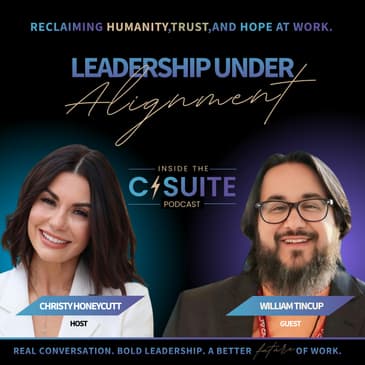
Leadership today is increasingly shaped by complexity—but its core challenges remain deeply human.
In this episode, Christy Honeycutt is joined by William Tincup, a leading voice in HR, recruiting, and the future of work, to explore how leadership, systems, and human behavior intersect in modern organizations.
The conversation looks at the gap between vendor promises and real-world adoption, where success is determined not at purchase, but through implementation, alignment, and trust in execution.
It then shifts into leadership identity—highlighting how misalignment between a leader’s natural style and their environment can quietly limit clarity, creativity, and performance.
A key theme throughout is vulnerability in leadership. William emphasizes that asking for help and engaging peers is not a weakness, but a strategic advantage that accelerates growth and decision-making.
The discussion also reinforces that communication and clarity are critical in uncertain environments. Effective leadership is not about having all the answers, but about addressing complexity directly and without ego.
At its core, the episode underscores a simple principle: leadership effectiveness is shaped by self-awareness, environment, and the willingness to engage others openly.
The strongest leadership is not defined by certainty, but by awareness, alignment, and openness to learning through others.
-
Leadership success depends on implementation, not just selection of tools
-
Misalignment between identity and environment can quietly constrain performance
-
Authentic leadership is a factor in creativity and decision-making quality
-
Vulnerability is not weakness—it is a mechanism for acceleration
-
Peer networks often provide more practical support than internal structures
-
The real value of vendors emerges after adoption, not at point of sale
-
Trust and communication are foundational to effective partnerships
-
Self-awareness is a performance driver, not just a personal trait
-
Leaders grow faster when they normalize asking questions early
-
Ego reduction improves both clarity and collaboration
-
Complexity in systems requires simplicity in communication
-
No leader operates effectively in isolation
00:00 – Introduction and guest context
02:10 – Industry expectations vs reality in vendor relationships
06:05 – Trust, adoption, and post-sale challenges
10:20 – The gap between promise and implementation
13:40 – Authenticity and leadership identity
17:50 – Vulnerability and peer learning in leadership
21:30 – Building trust in vendor-practitioner relationships
25:10 – Communication, ego, and organizational clarity
30:15 – Health crisis, advocacy, and support systems
35:40 – Empathy, uncertainty, and human behavior
39:20 – Final reflections on asking questions and peer support
🎙️ Watch the full episode here:
Podcast — Christy Honeycutt
|Connect With Us|
Follow William Tincup:
LinkedIn – https://www.linkedin.com/in/tincup/
Company Page – https://www.linkedin.com/company/wrkdefined/posts/?feedView=all
Facebook – William Tincup
Instagram – William Tincup (@williamtincup) • Instagram profile
Website – WRKdefined Podcast Network: Conversations Pushing The Boundaries of Work
YouTube - WRKdefined Podcast Network
X/ Twitter - William Tincup (@williamtincup) on X
(William Tincup is a leading voice in HR, recruiting, and the future of work. Through his work with WRKdefined Podcast Network, he explores how organizations are evolving in real time—challenging traditional thinking around leadership, hiring, and workplace systems. Known for his direct and thoughtful perspective, he brings clarity to complex conversations about how work is changing and what that means for leaders navigating uncertainty.)
Follow Inside the C-Suite:
LinkedIn – https://www.linkedin.com/in/christyhoneycutt/
Subscribe on Spotify – Inside the C-Suite
Subscribe on Apple – Inside the C-Suite
Want to be on the show or know someone who would be a great guest?
Contact Form - Inside the C-Suite Podcast
Powered by the WRKdefined Podcast Network.
Sponsors
