
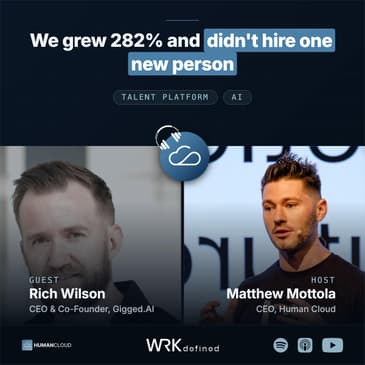
The 80-20 workforce is over. Full-time headcount is no longer a badge of honor, SOW spend is a $2.1 trillion market and the fastest-growing work category, and every enterprise is being asked what it is doing about AI agents. Rich Wilson has a number for where that lands: 40% full-time, 40% on-demand specialists, 20% AI agents.
Rich coined 40-40-20 in a blog a year ago. A CIO took it to their board as a business model. Now it is a book: The 40/40/20 Workforce, a 39-page, free, ungated guidebook for leaders, built from Gigged.AI customer conversations plus McKinsey, BCG, Gartner, and CIO.com research. Gigged.AI runs the model itself: 8 full-time, a fractional bench nearly double that, AI throughout, 282% growth in 12 months with zero new hires.
We're building Human Cloud to be the front door to the 40% on-demand layer, so businesses can find, vet, and safely engage the right flexible talent solution in minutes instead of months.
In this special book launch episode, Rich shares:
- Why 40-40-20 is the enterprise number and 80-20 is the startup number, and why full-time headcount stopped being a badge of honor
- Redefine the work before it becomes a role: 80% of the time the answer is a person, 20% of the time it is AI, and you can decide in 20 minutes
- Whose fault it is when an agent goes rogue (the person orchestrating it), and why guardrails come before deployment, not after
- Why only 30% of projects can be staffed from the skills you already pay for, and how a skills and agent inventory beats writing the Big Four a check
- The 500-person company that calls asking for "an agent by Monday," the CEO-led AI mandate that makes adoption easy, and why the biggest adoption headache CIOs report is inside their own dev teams
- The line Rich will not cross: an unpaid freelancer on a Friday afternoon talks to a human, not an agent
Rich Wilson is the CEO and Co-Founder of Gigged.AI, following 12 years in recruitment at Allegis Group and three years at Gartner advising the world's largest companies on how they hire. Human Cloud community members can get a free printed copy by messaging Rich.
Read the book free: https://gigged.ai/the-40-40-20-workforce/
Listen now on Apple Podcasts, Spotify, or wherever you get your podcasts.
About Human Cloud: We help companies find and deploy the right flexible talent solutions in minutes instead of months. We automate discovery, compliance, and orchestration across 1,000+ workforce platforms, so business teams move fast, procurement teams stay in control, and rogue contractor spend turns into a strategic advantage.
Powered by the WRKdefined Podcast Network.
[00:00:04] All right, man. Well, Rich, you got a bunch of people sitting on the other end. For those that were there, thank you for waiting. Honestly, a little delay is a perfect, perfect, perfect tie-in to what we're going to talk about, which is AI is great, on its own, not so great. It needs the human workforce.
[00:00:25] Now, with that said, the human workforce on its own kind of sucks in current state, hasn't radically been transformed in a while. And Rich, you have been one of the entrepreneurs fighting the good fight for seven plus years now, right? When was 2019 his gig was? No, five years. Five years. Feels like that, but yeah, no, 2021, we started. It feels like 25 years, Rich. It does feel a lot.
[00:00:51] It feels like 25 years. And so, not only though have you built the leading technology platform that has been ahead of the developer ecosystem, every sort of technical person in the world, you've built the platform to, in the most efficient way, connect them to work and enable companies to scale their talent, right? So, you've done that.
[00:01:11] Now, you finally found the time to write the book and we get to have a little party where a bunch of people get to ask questions, get to see you, Rich. This is going to air actually tomorrow. We're going to hyper, hyper get this across the finish line. But, Rich, let me just start with, for anyone who doesn't know you, which if they don't, that's crazy. Do you want to do a boring little intro on yourself, Rich? And then let's dive straight into the book.
[00:01:36] Yeah, sure. So, I'm Rich Wilson. I'm the CEO and co-founder of GigDI. My background, I'm one of the few platform founders that actually done a real job in the industry before. So, I was in recruitment for 12 years. I started as a trainee recruiter in 2006, just as the recession started to bite. And, yeah, I worked for a leaders group for 12 years. Again, done every job you could imagine.
[00:02:06] So, I kind of really learned the industry at the coalface and then spent three and a bit years at Gartner advising some of the largest companies in the world and how they hire, how they shouldn't hire, where they can access people. And then those two experiences led me to founding GigDI and really focusing on helping large companies access the right talent at the right time.
[00:02:33] And, as you said, it's been a journey, right? And I think at the moment, it feels like, I don't think I've ever felt as much momentum, both results, but also feel good factor. In terms of the industry and where we're going at the moment, I think AI is helping that for sure, from a good and a bad, right? But, yeah, so, you know, I've been in this game a long time, right?
[00:03:02] And, yeah, and that's what, you know, that's kind of what prompted me an experience in 2007, I think, led me down this path, right? That's where a conversation with a customer in 2007, it kind of started this whole ball rolling, if you like. So, let's, man, let's get straight in the book. Do you have it on you right now? Show it off. All right, show it off, everyone. Look at the video as we speak. First off...
[00:03:32] If you want a copy, I will send, I will post a copy for free to any Human Cloud community because I like them. Nice! All right. And then, drop me a note if you want to, if you want to, I'll get a copy. Everyone take advantage of that. Also know that, where are you shipping from? Is it shipping from Scotland? Yeah. Oof! All right. I dare all of our listeners in South Korea and Japan, that's where we had the biggest problems, surprisingly, actually.
[00:04:00] We even literally had a South Korean translated version of it. I'm not translating it. You're getting it in English. Well, your AI can translate it now. Exactly. See, that's another, that's different. It wasn't like that before. But dude, let's, let's hit straight into it. Why? Well, actually, let me ask this first. Why, why now, Rich? Did you finally have the time? Did you leverage AI to get it to, right? Like, dude, I know you don't have that much time.
[00:04:29] It wasn't, I'm actually, I'm actually working. I'm, well, as you know, you know me relatively well. I'm a maniac, right? So, you know, so I'm actually writing three books at the moment. And, um... My God! How's your team doing about that? That's just the first one. Well, the other two aren't really gig one. The other ones are kind of, kind of other projects. This, this one was very much a gig one. You know, you know, like AI definitely helped.
[00:04:54] Um, but it was really, I've been, I've been writing about this topic since September last year. About this 40, 40, 20. As you know, I've always been a big proponent of marketplaces tapping into different talent pools, right? So, I, you know, we were one of these early adopters of the internal and external, um, talent pool. Yeah, I don't, I hate the term total talent, but, you know, we were one of the first to try and build that or try and, or try and execute it. It's not easy.
[00:05:23] But over the last 12 months, a lot of our customers started showing us how agents were coming into the world and how they were bringing that into the workforce. So, we were kind of like, well, how do we, how does that look? I speak, as you know, I'm very customer-centric. I spend a lot of time speaking to customers every week, right? I speak to C-Suite and some of the largest companies in the world regularly. You know, and that kind of gave me a really unique perspective.
[00:05:50] And then, in the meantime, we have been building this orchestration platform from the ground up for a long time. And we added the agentic part to it quite early on. And that's really where it came from, right? It came from, you know, all, you know, a lot of the blogs, you know, I coined this phrase the 40-40-20 over 12 months ago. And it just seemed to stick, right? I didn't plan it to be a topic. I didn't plan it to be a campaign.
[00:06:18] It was just a blog that, you know, I write a lot of blogs and most people don't read them. That blog seemed to resonate with a lot of people. And people kept asking me, hey, can you talk to me at 40-40-20? And then, in November last year, a CIO at a charity organization, large organization, came to me and said, hey, look, I'm going to take this concept up to the board for approval. I was like, what concept?
[00:06:47] He's like, 40-40-20 concept. And I'm like, you read that blog? He said, yeah, we've built a business model. And that then let me think, well, wait a minute. And then, you know, it's really became the kind of a bit of a linchpin for us. But one of the things that a few months ago we were asked, hey, look, can you send me this 40-40-20 concept? And I'm like, well, we've only got, I've just wrote, you've got blogs on it.
[00:07:16] But there was no one single piece. So we started, myself and Sean and our AI agent, we started to pull everything together and then start to take a lot of the research, a lot of the notes. It's not just our research, right? We've pulled it from CIO.com, McKinsey Research, BCG Research, Gartner Research. And we've been able to pull it all together. So I feel like it's very, it's like a single point in time.
[00:07:44] 12 months time, this book will be totally out of date, right? But right now, I think in terms of what organizations are trying to do and the challenges and the opportunity they have, it was about getting it all in one place. And I would say, like, I would say it's more of a guidebook than a traditional sit down and read a chapter book, right?
[00:08:03] It's very much, you know, a how-to guide for leaders and how they navigate the changing state of the workforce, right? And it's, so it's very practical. It's got steps. It's got facts. It's got, you know, it's got advice. It's got opinions. It's got some spicy opinions that people, not everybody will like. What's the spiciest one, Rich? I think the spiciest one is about whose fault is it if your agent goes wrong, right?
[00:08:33] And I think it's the person that's using that agent, right? So that's probably the spiciest. Meaning whose fault is it if an agent goes rogue? Whose fault is it? Like, if I built that agent and I'm using that agent, this person using the agent, right? They're the orchestrator of that agent. Now, let me ask you from a gig lens. What does that mean for you? Because to me, my brain would go, does that mean gigged is on the hook if agent goes rogue with a gigged individual?
[00:09:03] That is definitely got to be guardrails in place for that, right? So for us to, and it's the same as an organization. So before you deploy that, there does need to be guardrails, right? So I'm not just going to deploy an agent with a freelancer just like that. I'm not going to let that happen. It needs to, there needs to be a proper step to design that workflow and make sure that the privacy and security guardrails have been done, right? It needs to be.
[00:09:33] So, and this is where there's a big gray area. So if I'm in a large organization and I use an agent and it goes rogue and it's my agent and it's my work and I'm in hook for the work, then yeah, you're probably going to feel that. However, if it's my startup and I build an agent and that agent is false, foul of, you know, security and protocol, then yeah, it's probably going to be on me, right?
[00:10:02] So I fully agree. I fully agree. Now, what are the practical implications of that? Because I mean, for me, I always put myself in the shoes of a mid-sized, lightly regulated, meaning I still have a lot of risk, but I'm not like a healthcare company. And I look at AI and I'm just like, I thank God I'm not leading that company because the amount of problems that can happen from that.
[00:10:30] I mean, remember, like, I think now it's a little more contained in terms of like, you don't need open claw. You can do anything within cloud code. But, oh my God, like if cloud code opens up a file it's not supposed to and then finds a way to somehow leak that. And even something as stupid as like if you put in your terminal sensitive data related to your company. And we all know these horror stories, right? Like maybe there's an IPO. Maybe your company was planning to IPO and you're the one that leaks it.
[00:11:00] But, oh my God, the amount of risk that AI has accelerated because it hasn't really created net due risk. It's just accelerated what's always been risky. Whether it's releasing data they shouldn't, whether it's releasing secrets they shouldn't, whatever it is. But so what do you think are the practical implications for you? And then what are you seeing these practical implications being? Again, it goes back to, you know, the guardrails, right?
[00:11:28] And what persona does that agent have? What access does that agent have? You do need to, you kind of need to have them in a box, right? I think that's the best way to look at it. You can't just have an agent that has access to everything, right? You need to limit the access of it. But I think even before that, right? I think before you even go anywhere near an agent, it's about, right, what is the work? What's the sensitivity of this work?
[00:11:58] And is an agent actually the right thing here, right? We're getting caught up in the hype train that we need to put an agent on everything. Well, you know, I think it goes back to basics. At the moment, nearly everything I do, I'm going back to first principles, right? Everything I'm going back to first principles at the moment. So, like, this week, me and Sean sat and we wrote handwritten notes in our piece of paper and we posted it all over the world, the book, with a handwritten note and said it to a lot of senior leaders.
[00:12:28] Some of them we know and some of them we want to know. That's so old school, right? It's very human. It's very, you know, and we got a lot of nice notes back because people, and for me, that was really a kind of really interesting inflection point. Could we have used our AI agent sitting in HubSpot to email that out to 100 CIOs? Sure. Would anybody have read it? Probably wouldn't even get through their agent this morning on their email.
[00:12:58] So, there's a time and a place, right, for going, like, what is the best way to do this? You know, we're launching, I don't know if Craig had talked about it in the call yesterday, we're launching this new feature, which I think does change fundamentally the hiring game and technology teams for what we're doing. I think it changes it. And, you know, going even back to first principles, and when I say that, we went back to, like, what's the challenge that our customer have?
[00:13:28] We was like, right, well, wait a minute, who is the customer? And they're like, well, it's this, it's the CIO of a Fortune 500. It's not, they're the economic buyer of our product. Who's the user? And I want you to get down, right, okay, the user is the PMO manager, the root sourcing manager. But, you know, that's just using it. They're not, you know, the CIO is not using it. They'll sign the contract and give us the money. Yeah. Who's actually using it, right? So, what's their challenge and what do they want?
[00:13:58] All right, and then it's like, right, let's go back to that. And then the answer isn't always an agent. It's not always AI. It's like, let's go back and let's go back basic. And, again, that was the main thing for me this weekend. You're going out and writing a book and going old school was just like, you know, you still got to be able to decide what's human and what's not. So, I think that's the start of the work, right? There's a big concept we talk about in the book. It's about redefining the work.
[00:14:26] Before it gets to a role, and a lot of people disagree with me fundamentally on this. Before we get to a role, hey, I need to hire a software developer. I need to hire a customer success. And we could go step back, right? Step back. Go way back. Go back to the beginning. What is it that needs done and why? All right, cool. Then let's have a process to break up that into, well, what are the tasks?
[00:14:57] We've got really good at creating job roles. We've got okay at then creating skills. We're not very good at tasks and deliverables. And then you start to then work out what's the best way. And really, you need to go way back to the start and redefine the work. And then you can start to then look at what's the best way to do this. And I said, invariably, I reckon, again, it's in the title. About 20% of the time, I think the answer's it. I think 80% of the time, it's a person.
[00:15:27] That person just might not be a full-time person. Might just not be a contractor. Might not be a freelancer. You know what I mean? So I think going way back to first principles and looking at the why, and then going, that doesn't need to be a long process. You can do that in 20 minutes. So let me first call out a talent parallel to agents that I see. So to your point, I think there's going to be, I don't know,
[00:15:55] take 100 agents, probably one's actually going to be effective in the next year. And there already is, right? There's way more agents. The talent parallel is, man, when I was at Microsoft, and then when I started in Silicon Valley, it was no secret that the big tech companies would hire anyone they'd get their hands on, and then they'd be stuck in the basement. And the origin, actually, with Gigster, one of the ways that we would sell it
[00:16:22] is you would get the Microsoft, the Google, and at the time it was Google, right? It was the Microsoft, Google, Facebook. You'd get the Fang developer. But you wouldn't have to pay the cost of Facebook. And then so then the customer would go, well, that doesn't really make sense. Why would we get them same amount of time and everything? We'd be like, well, because Microsoft actually, like they have no work for them. They just simply hired them, pay them a bunch of money, but they have nothing to do. So they're in the basement, and they're probably actually at home, but they're just sitting in the basement, and now they get to work on your stuff.
[00:16:50] So talent can go rogue as well, which already happened. It's exactly what big tech did for 20-plus years. It's not the case now. I mean, hell, this is why Microsoft's had probably 20% to 50% rifts. But so it's not just agents that have done this. Now let's get wicked deep into the 40-40-20. My understanding, 40% flexible, 40% full-time, 20% agents, right? Okay. Okay.
[00:17:17] Then let's dig into why not. Actually, let's dig into, Rich. When we say freelancer, let's try to define this, right? Are we talking about a I'm hiring you to do one thing, I'm hiring you by the hour, I'm hiring you by the month. How would you define freelancer, independent contractor, whatever? Let's try to knock this 40% out. Yeah, so that's not going to be an easy answer.
[00:17:48] So it's obviously something that we've debated. I've debated this on my teams forever. I've debated it with everybody. Being able to put a single title on it, I think, is impossible. What we've done in the book is we've called it on-demand specialists, right? We took that term. Not everybody will love that term, but we use the term on-demand, right? So an on-demand specialist, specialist being a key word, right?
[00:18:14] But I think that engagement, though, needs to at its core be flexible, right? So for example, that could be a consultant from a center. That could be a freelancer in Vietnam working on an outcome-based engagement, deliverable-based piece of work.
[00:18:39] This could be a PhD student at Edinburgh University on data science doing a specific piece of work. This could be a contractor working $500 a day in Connecticut, right? It could be, you know, I think it's been able to tap into different flexible talent. The whole world is flexible, right? It's about being able to create the engagement. You know, Fractional is kind of having a bit of its day in the sun at the moment.
[00:19:08] Fractional is not new, right? It's not new. It's kind of. It's not really. It's having this moment with, like, communities. No customers are asking for it, aside startups. Startups are asking for it, but no real customer is explicitly stating fractional. No enterprise is quoting for a fractional, right? So, but if you believe the data, it's a growing pinch point, right? But the largest growing part of flexible work is the SOW, right?
[00:19:37] The SOW part of it is a $2.1 trillion market at the moment. And if you look at the SIA stats, which I'm sure we can get into at the end of September in Dallas, is that, you know, it's the fastest growing work category right now is the SOW. So, you know, that's where I would say the majority of our business was set in that SOW budget, right? And it's about budget. It's about what budget can you pull from to get talent?
[00:20:03] So, you know, if you think about the CapEx, OPEX, you know, issues that companies are having, a lot of the reduction in full time is not purely because of AI, right? It's because of budgets. You know, the way that the stock market is looking at it now, how many people you have is no longer a badge of honor. You know, it used to be that, hey, like, when I first started, how many people you got? It used to be.
[00:20:32] And, you know, you'd want to have as many people. Now it's like, you want to say as little as possible. The badge of honor is like, hey, I've only got two. It's me and my dog. And, you know, we've built, you know, like, it's funny how things change, but that full time was reduced. But, you know, that, as we've seen and we've been talking about in the community calls, there is a growing demand for on-demand skills, whatever that may be. Again, whatever your engagement model.
[00:20:58] So, and I think the key is, is being able to provide that flexibility and helping them buy easy, right? So, I said most of our work is enterprise. If they want to buy outcome-based SOW, let them buy outcome-based. If they want to buy T&M, let them buy T&M. If they want to buy, like, a fractional engagement where they're buying a couple of days a month, let them buy that. Let them find a way to buy whatever way they need to buy. Whatever way they need to do to get it through procurement, find a way and make it happen. But, because that is how that, because that 40% is going to grow
[00:21:27] and you can either be in the way or you can be worth it, you know? Yeah. Now, tell me about the intersection between 40 flex, 40 full-time. Are they mutually exclusive workforces? Do they end up going into each other? I'll use the example where a lot of large companies and actually even some countries, right? So, France, it's what, 18 months? You have to turn them into a full-time employee if you're hiring a contractor. So, it's not, you know, it's by country and by company. But so, some companies we'd see is, okay, a contractor,
[00:21:57] we're now at 18 months or 16 months or whatever. Got to flip them to full-time. They go full-time. They end up quitting within two years. They go back to contractor, right? So, like, there's this flexible nature, but I don't think that's an intentional nature. But so, for you, when you're looking at, when you're looking at the book and you're looking at what you've seen it get, tell me about the intersection between these two pools. And then I assume, I assume, you're probably going to hit on the fact that you guys have been building a lot of internal talent pools as well.
[00:22:25] I assume you're going to go down that direction. I don't know. But tell me about the intersection between these two 40s. Yeah. So, they're not mutually exclusive. I don't think they can be mutually exclusive for it to work. I think going back to the engagement model is important, though. Like, to your point. So, if you're hiring somebody on a 12-month contract, do you really need that to be a 12-month contract? You know, you're going to get pushback on that, right? You're going to get pushback.
[00:22:55] Whether that's, should that just be a full-time role? You know, in the UK, we've got a thing called IR35. You know, that's a kind of, you know, that's a big issue, right? And, you know, if it was a 12-month contract to come on site five days a week, that's going to be inside IR35, which is pretty much full-time, right? It's a full-time, you know, they're not. Would you do that, Rich? Like, just super dumb question. Is it because you feel like the individual won't stay unless you give them 12 months? It's nothing about that. It's nothing about the individual. Why? Yeah.
[00:23:24] It's nothing about the individual. Again, it goes back to budgets and what budget you can put that headcount in. You know, again, it's about the open-case cap age, right? What budget can I put that in? Can I put my corporate or can I put my capital? Because my challenge is why 12? Why not just one, two, three? And we all know the way that the IT industry, historically, it's like, what, three, six, 12? It's either three months, six months, Does it even need to be that duration, right? Does it even need to be a duration? Can it be an outcome?
[00:23:53] You know, like, there's plenty of amazing contractors that work three or four projects at once, you know, various deliverables and outcomes, right? You know, when we first started building a gig, there was an outcome only. That's all we did. You know, day rate talent, it was only outcome-based, deliverable-based work. Now, we realized that, you know, the demand was transient and there was demand and customers weren't great
[00:24:21] at knowing when an outcome wasn't and blah, blah, blah. So, but it's still a big part of our business. It's still at least 40% of our revenue is still outcome-based engagement, right? So, I think it's about, again, going back to the work, right? And going back and looking at what is the right way to do that project? What's the right way to get that work done? Is it an outcome? Can it be done by a team of people working on an outcome basis to get it done? Or is it a longer engagement? And then you can look at the different talent pool.
[00:24:51] So, go back to your other question about the internal element. Like, yeah, we think, you know, the first advice we give to a company that's trying to get to the 40-40-20, you need to know what you've got. So, before you, you know, we've kind of moved away from the internal mobility aspect of it. The internal mobility kind of gets caught up in a lot of internal politics, a lot of internal friction. Is it as simple as, I'm a GM of this team,
[00:25:21] I don't want to give you my talent? Is it literally as simple as that? I don't think it's as simple as that, but that's a factor, right? I think there's a political factor. So, that's one factor. There's usually a data aspect, like, where's the skills data? Yeah. And then there's also, I can usually, I can internal battle about who owns that skills data, right? Is it HR? Is it talent acquisition?
[00:25:49] Is it the, you know, and more and more and more, those teams that have that, they want to own the skills conversation. So, we kind of started from, like, you need whatever, take away all the politics. You need a skills inventory. You need an agent inventory, right? So, the way I'm looking at the world at the moment is if I'm an organization, before I go and you'll bring in a KPMG or a Deloitte and, you know, give them all my money,
[00:26:19] I'm under a cost pressure. So, what do I do? Right. Well, what is the cheapest way to do? Well, the cheapest way to do a project is to use the resource I already have that I'm already paying for, right? So, let's very quickly have a way and a process to be able to see what skills we have, both human and AI, internally. Cool. Let's see what we've got. Now, if you look at historical data across all organizations,
[00:26:47] it's about 30% of the time there is, you have skills internally that can do that project. 30%, right? Okay. It's not terrible. I thought it would be way higher, to be honest. Yeah, it's not, right? And especially, partially, because that full-time headcount is lowering. Yeah. But it's about 30%. Right, cool. Well, what do I do to get the rest, right? And that's what we're trying to really bring into the,
[00:27:16] right, understand your internal human and AI capability and then where the gaps are, we'll fill those gaps. So, people always ask us, why do we only focus on technology? Because if we were doing everything, that model would not work across every vertical. Just, you would need, I would need $100 million of funding and I don't have that. So, but what I can do, if I'm working with software and data and AI teams, I can help them map their teams and then I can help them get,
[00:27:45] if they don't have an agent to do, requirement gathering, I can build them an agent in, you know, an hour, right? We can deploy it, we can iterate it. You know, that agent will obviously get better and smarter over time, but I can build and deploy an agent. I can then, they need a business analyst for three months, you know, on a day rate to come in and help work on that project and work with that agent, right? Cool, I can help them get them that as well, right? So, very quickly, I can build them that team.
[00:28:15] Now, if they try it with me first before they go out to like the big four, the cost saving is going to be, it's going to be vast. It's a big cost saving there. And the time can help as well and I've got business knowledge I'm retaining. The other key part of the 40% full time, if I've got a smaller talent pool, I need to retain that talent pool. What's the best way to retain people? There's this old school that, oh, you just pay them more. People, if you look at all the data,
[00:28:43] people don't stay just for money. The big reason people stay, the number one reason people stay in a job is for opportunity. So, can I give them opportunity to work in this business critical program of work for six months to up their skill level, up their business knowledge and work with external consultants that will help upskill them? Then they can come back and then they're upskilled, right? Why wouldn't you do that? But again, because we're running around 100 miles an hour, hey, let's just bring in eight people from the big four.
[00:29:13] Again, no disrespect to the big four, but again, I'm paying a premium. I'm not guaranteed I'm going to have that same resource for the whole duration of the project. And then when they walk out the door, there goes all my knowledge. Yeah. So it's like, let's take a step back. So, you know, let's say the book lands on my desk, okay? What do you want me to do? You want me to take a pen out and start to take notes
[00:29:42] and highlight everything? Do you want me to literally have the book and then my laptop up with gigs next to me? Do you want me to have another site next to me? What do you literally want me to do right now book lands on my desk? Maybe I'll do a little bit of drawing on it, Rich. Not going to lie. I got some serious ADD, so I might do some drawing on it, but whatever. But what do you want me to do right now? Yeah, I want you to read it right back to front. It's not a long read. Done it on purpose. It's not a long read. It's 39 pages.
[00:30:13] I want you to take some notes and highlight or whatever and take a couple of things from it that you can go and try, right? Because I said it's full of practical steps. So, like, for example, if all you've been used to is full-time hiring, you're going to get some real practical steps on it, how to hire using on-demand platforms. I talk about, you know, a name Upwork, a name Fiverr, a name TopTal, a name GigDi, obviously. I name consultancies, you know, GetCenture, you know, KPMG, Codisant,
[00:30:43] blah, blah, blah. But various companies in there and ideas of different ways you can do it. We obviously talk about then how to build and deploy and govern agents, you know, how to blend them with your internal workforce. You know, so you, I would like to think you'd walk away with something that you thought, don't think about that. I'm going to try that. And I think that's the main thing for me is like, yeah, cool, we're going to try that. The book, like I'd said, on LinkedIn and everything. There's no gate, we've not gateleaded it
[00:31:12] on the website. Anybody can go and read it. Anybody that wants a copy, there's no, there's no money being charged. This is not a, a monetary process. The reason we're doing this is we want to get this concept. We believe this concept of the 40-40-20 is where enterprise work is going. Again, this is, this doesn't apply to a brand new startup, right? It doesn't. I think if you're a brand new startup, you're probably 80-20, right? I was just going to say 80-20, man. Dude,
[00:31:42] I talked with them yesterday, Rich. So it's a bunch of executives from the, how do I say, because I obviously can't say the name of the company. Think of like the best military helicopters and the best military planes. So like, we're talking people and, you know, they're starting a new startup and it's funny. So yeah, I've known these guys forever, right?
[00:32:13] So I'm like, hey, I'm like, you guys, I still believe in the freelance flexible world and they're like, well, yeah, duh. He was like, we might never hire anyone and I'm like, that's insane. I'm like, and the funniest part was the company that they came from literally had cut the freelance program like three years ago and so it was like, you have every reason not to go keep leaving this world of freelance but the first thing you did when you had a startup was you're like, yeah, and mind you, this is not them saying,
[00:32:43] oh, until we get here, we're going to, this is them literally saying, yeah, we're never going to have full-time employees. So the 80-20 and the startup, I could not agree with that more further. We're proving that to the point where we've got the full-time core, right? We've got full-time core of eight people, right? That's all we are, right? But we've got a fractional freelance bench almost double that. Yeah. And then we've got, you know, AI throughout the business. You know, we grew, you know, in the last 12 months
[00:33:13] we've grown 282% and we have not hired one new person, not one. Yep. Yep. And I plan to grow over 500% in the next 12 months and I don't plan to hire one more full-time person. I've got some fractional people I'm bringing in. I've just brought in a fractional kind of GTM person, I've just brought in a fractional recruiter to help us with some stuff because we still, you know, you still need good humans, right? You still need good people that can, you're especially with the customer, right?
[00:33:43] I'm kind of old school in a lot of ways and, you know, I'm an adopter of technology and always have been, but I am old school in a lot of ways and I think, you know, I still want our customers to speak to a really knowledgeable customer success guest manager who knows the industry, that knows that company, that knows hiring and can be there to help them whatever way they need. I'm not going to budge on that. You know, if they've got an issue, they're not talking to my agent,
[00:34:12] they can just phone or message or email one of our team and they'll get back to them within an hour and they'll help fix the problem if it's fixable, right? I think, you know, that, you know, if I'm, you know, I always think if I'm a freelancer and I've not been paid on a Friday afternoon, what do I want? I want to be able to pick up the phone to somebody and say, hey, like, I've got payments coming out, I'm not being paid. I don't want to be talking to an agent trying to figure out why I've not been paid, right? So, you know, again, it goes back to like, what do you want to be human and what do you
[00:34:42] want to be AI and doing that the right way? so, yeah, it's not a bit of a place, but. Rich, I got one more question, okay? And I know, and first off, it's a Friday, so for all you listeners out there, you're going to be listening to this probably tomorrow, but, so, Rich, thank you for doing this on a Friday. The most important question, I think, is, who do you see being the champions for,
[00:35:11] I'm just going to say the workforce, and let me add a little bit of context for you here. Now, this is where this is where you and I have been starting on the business side, both on the buyer side, and you and I are more of that founder, sales, product person, right? So, for me, and you and my background of, I got into this being, you know, a Silicon Valley product guy, then going into Microsoft as a Microsoft product guy, and I still don't really understand
[00:35:41] what HR and procurement do, like, I know all the technical things I'm supposed to say, but if I'm being honest, like, I don't really understand how they add value besides making things cheaper and building processes that I don't understand why someone else can't do that, meaning like a strategy person, an engineering person, a product person. I kind of, I'm going to, my crazy point, Rich, is I don't understand why a product person is not leading HR and procurement anymore. I think a lot of the procurement and HR budgets,
[00:36:11] I don't want to call them a waste, but I just think that, you know, traditional HR procurement, I don't think it makes sense in today's world. I think with technology, a person that's not been trained in those principles, a person that's been engineering product minded, probably can do exactly what they do, way more efficient, better. That's my crazy take. It's not 100% right, so I know you procure me, HR people are going to come after me. Yeah, I think you're going to get, you're going to be careful now at next conference with us, HR, don't go to procure con, Matt,
[00:36:41] that's all I can say. Rich, this is why I have Tony, because if I, if I actually believed that, I wouldn't have co-founded a company with someone. Well, he's a big guy, big charming guy who's got a lot of followers in HR, so yeah. Yeah, man, so if, so my actions speak louder than my words, I still believe HR and procurement has a place to lead. I also, though, think they haven't been held accountable to how valuable they actually are versus how valuable they should be. But, that's my
[00:37:10] spicy, I'm, you know, getting ready for the heat, but who do you, and do you talk about this in the book, the actual leadership structure, and who should be leading this? Well, yes, no. So I actually had a chapter in the book that I took out. Eating what the heat? Yeah, I took it out. So I've been talking to, you know, Bruce Morton, right? So I used to work with Bruce in the leaders group, and Bruce had been saying, hey, have you ever thought about this concept of the chief work officer? And I had,
[00:37:41] and I wrote a bit of a piece on it, and I decided not to put it in because I don't actually think there's going to be a chief work officer. I think it's a great concept and I like it, but I don't think the companies are going to do it. And I think for the reasons you said, I think there's a lot of areas that are, you know, I'm not going to back the CIO, I'm not going to back the chief procurement officer, chief people officer. Like I think everybody's trying to, you know,
[00:38:12] it's like jockeying for position, right? Who's going to come out first at the moment? The tech leaders seem to be probably ahead, but the chief day officer, the CISO is coming for them. The chief people officers are not going away. You know, procurement is going to be more important than ever, especially with token costs and all this kind of, you know, craziness that's coming. You know, do they just start shutting down the game? You know, how, you know, so, you know, I think it's, I don't know if there's going to be a one size fits all champion in that business,
[00:38:42] right? I think there's going to be pockets who do this. Now, interestingly, one of my many ranty posts, you know, I've met 18 CIOs, probably more than that, probably 30 now because I had 12 last night. So, with 30 CIOs, chief information officers I've spoke to in the last two weeks, and most of them said that their biggest AI adoption headache was within their own teams, right? But not the business,
[00:39:11] not business users, not finance or procurement or they were struggling to get the software developers to use codex or use whatever, you know, and we found that and so, you know, I just, I don't think it's going to be as linear as who does it. I think it's going to be, there's like, who's going to go all out in the risk, your point on risk, like, so I could go out and I could adopt this model perfectly, but am I willing to die on that sort of ground?
[00:39:42] Probably not, if I'm a big, you know, if I'm a C-suite or corporate, I'm willing to dip my toe in so I don't look like a laggard, but I don't look like, you know, maybe, right? So, if all the C-suite take that approach, you're going to have some innovation and some movement, you're not going to have whole scale. So, you know, I think it comes down to the individual and their mindset. As I said, I've seen some organizations, we're working with a $500 million organization, probably the smaller size of the organization for us,
[00:40:12] right? I would be smaller than the type of company, but they've done the most innovation and adopted this model more than anybody. You know, they phone us asking us, hey, we want an agent on Monday, you know, like, literally ask us for an agent on Monday, not, you know, and then, hey, we've got four freelancers from you guys, but we need an agent to supplement the team. Like, they've literally went, their CIO just went, you know what, we're going to go with this because the business strategy and the leadership at the top and I think it comes back, and I was speaking to
[00:40:42] a leader at a huge manufacturer who make all the, you're pretty much all the biscuits in Europe, let's say, I won't say who they are, but they make a lot of biscuits and biscuits are very popular in Europe, especially chocolate ones and they said, look, kind of easy for them because the business strategy and the vision coming from top was we're going to be an AI enabled business, right? So it's kind of easy, so he was telling me, it's kind of easier for me to drive this
[00:41:12] through because the director from the CEO was we're going to go AI first. We also are in talks with a large bank at the moment and their CEO has made a lot of very positively aggressive comments about AI and how they're going to embrace AI and their share price has rocketed up, so they're now trying to figure out how do they embrace human and AI together. So I think if there's a vision and there's clear leadership from the CEO of that enterprise,
[00:41:41] then that gives the confidence from people. I think when it's very quiet and it's very much like, hey, what's this AI stuff? Or talk to me about AI and why are we not using AI? And why is AI not doing this? I think that can create what you were saying, those bottlenecks, those people who aren't sure, fear, trepidation, all of that kind of stuff. So I don't think, I still class us at the moment, we are in the wild, wild west, right?
[00:42:11] We have never, in our lifetime, we're relatively still young men, we're holding on to that, Matt. But, just, me probably less so, but we're holding on. But this is the biggest change I've ever seen, right? When I was 14, there was no, you know, if you had a mobile phone, you were kind of a bit rogue, right? You were a bit cool. I bought a pager when I was 12, but nobody ever pays me because nobody had a phone,
[00:42:41] right? That was a lot of technological change. You know, we used to use Napster to download music and that kind of stuff. So we were kind of seeing change, but it didn't feel like the level of change that we're going through now, right? It did feel, but it felt quite organic at the time. It didn't feel like, I remember downloading music from Napster onto my minidisc or whatever it was. It just kind of felt like a transition from the CD to
[00:43:11] the minidisc to downloading music, whereas it feels like we've kind of let from, hey, I'm going to hire somebody full time or freelance to now this other being, which is not a real person that could do my job as well, if not better than me. It's elite. And, you know, so I think that's kind of where we are is this kind of, we are in this kind of no man's land. Nobody really knows. You know, as I said,
[00:43:41] this book will be out of date in 12 months, maybe even six months, but I think it's a really good thing. You know what it feels like? In one angle, I'm like, oh, this must have been what it felt like when we had the transition from horses to cars. That's one of my thoughts. But then I think about it and I'm like, yeah, but it was the horses that lost their job, so no humans were really that mad, right? Like, yes, there was some industries around
[00:44:11] horses, but as a whole, right, mostly the horses were the ones that lost their job. So then I actually go back and I'm like, maybe it was the pre-industrial revolution when we were making our clothes in our house and we were actual blacksmiths and then all of a sudden these factories came in that just took everyone out of work. Maybe that is the closest, but I don't know. I fully agree. I will say my days are so funny because I'll talk with someone like you who sees it,
[00:44:40] who uses it, and who's not really scared, but also acknowledges like, yeah, this is going to be really, I don't know, transformational in a good or bad way, but then I'll talk with, you know, family or even just some old people at the coffee shop. And one was saying yesterday, I was like, I just read the Pope's book on AI and I'm like, yeah, I don't know if I would read that. I don't know if that's who I'd be listening to. And let me guess, it's going to be really dangerous and dehumanizing. Oh yeah,
[00:45:10] it's the worst thing that's ever happened and we're really scared. I'm like, you know, I don't, I don't know. I don't know, but it definitely is a crazy time, Rich. Yeah. And I'll give, I'll have one last anecdote for those. So as you know, I grew up and lived just outside Glasgow in Scotland, right? And, you know, I travel all the time, but home is for me still just outside Glasgow and it's always a bit surreal, right? All the conversations and all the people
[00:45:40] are getting me, but I still come back to pretty much the place where I was born. And, you know, if I look at my grandparents, they worked in an industrial town, which was, you know, coal and steel. you know, they all worked on that, all my family, one of my uncles lost his legs in the steel factory. You know, it was hard work. That then all went away, all those jobs went away. And then that area of outside Glasgow
[00:46:10] then became very famous for coal centres, right? So, you know, a lot of people moved from working in the steel and the coal to working in a call centre, you know, for T-Mobile or whoever it may be, right? Then all those jobs started going to other countries and now those jobs are gone, right? Because an agent can do a lot of that now, right? You know, I've seen it, we helped a company develop one. You can develop a voice agent that can, you don't need,
[00:46:39] you still need some, you don't need as many though, right? So those call centres are all gone. Those call centres though, what are they now? They're data centres, right? So, you know, Lanarkshire, which is just outside Glasgow, which was only known for coal and steel, is now the capital of the UK for investment about data centre builds. So we've now got some of the largest data centres in Europe
[00:47:08] are in a little village that used to just be a coal mining village and it's there and it just shows you how people evolve and how work evolves and how communities evolve. You know, people evolve with the technological change, right? And this is happening and we will evolve with it and we'll need to make decisions with it and we'll need to, you'll go back to right at the beginning, when to use AI, when's human. You know, we done a talk
[00:47:38] last night and one of the product managers made a great point. He's like, I think there should be a stamp, not about when it's been made with AI, it's been made when it's been made with human. I think that's maybe a step removed too far but we've still got to decide as humans what do we want to do here and when do we use humans and when do we use AI and not the other way about, right? And I think that's why the 20 is the 20 and it's not 80 and it's not 90, it's 20.
[00:48:07] AI will make a difference to workflows, it will change how we work but we can't let it fundamentally change everything about our skills as human beings, right? Critical thinking, product decisions, inventions, you know, feedback, you know, being able, you know, you think if you just spend all your time on a chatbot in your room and then you need to go and present in front of 300 people or 3000 people or whatever it means you do often, I can, you know, you can't do that.
[00:48:37] So it's like your avatar can't do that, you know, you can't use syncytia in real life, so, you know, what do you do? So, I think we're at a really interesting point and, you know, but we still got to realise that we're still in charge, you know, we're not, this is not Terminator, right? This is not, you know, John Connor, we are, here. Rich, you kind of are the Terminator, man, so for you listeners out there,
[00:49:08] book link is going to be in the show notes, it's going to be in the comments, so go out. Yeah, it's free to read, no email address needed, it's ungated, you can go and reach out for Rich. And Rich, what did you say? Human Cloud listeners can get a book sent to them? You sure you want to make that commitment? Yeah, I made that commitment. All right, how about another commitment? If you deploy 100k plus worth of agents or humans, maybe they get a sweatshirt?
[00:49:38] What do you want to put? You want to put a million? The sweatshirt's worth a million. It's the nicest sweatshirt, man. It is straight. You're lucky because I was in the office all the day trying to get some merch for going to Dallas. Yeah. I don't, and I thought maybe take a few hoodies out, they're gone, right? Gone without, they're gone. Do you know why that was? You know Craig, Craig, if Craig was in charge of the company, we would have no money, right? Because he would give away the product for free and spend all
[00:50:07] the money. And one of the things was, he went out on, so I went and got my merch. I don't know how much it was. Let's say it was $20 a sweatshirt. He went and done it. It was like $60. These are the best ones. I went, mate, we cannot spend this $60 on a sweatshirt. Rich, if it makes you feel better, I don't have it anymore. Farnia has it, so I've actually lost it as well. It's her who has it, so I need one as well. We need to get a new one. I'm going to bring t-shirts to Dallas
[00:50:37] because it's hot in Dallas. It's hot out there. All right, man. Listen, you go enjoy your Friday, and we both also live in small towns, so you go off to your small town, enjoy the community. I'm definitely going to go enjoy mine, but thanks for hopping on, man. And listeners, go reach out to Rich ASAP. Thank you, my friend. Thank you. Thank you. Thank you. .
Sponsors
