
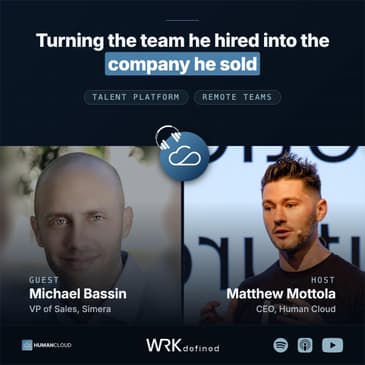
Most talent companies start with a thesis. This one started with a health crisis.
Michael Bassin was a chief revenue officer in Israel when he lost hearing in one ear overnight. The treatment made things worse. Two years of debilitating symptoms later, he left his job, left the country, and started a business for the simplest reason there is: it was the only kind of work he could still do. He could manage about four hours a day, from wherever he happened to be.
So he built a cold email agency and staffed it remotely. Mexico, the Philippines, India, South Africa, the UK. Over a few years he replaced nearly the entire workforce with South Africans, not as a cost decision, but because the work was better. That team became the product. Talent Sam was a complete remote hiring solution for companies hiring in South Africa, with the payroll, tax, compliance, and employer-of-record layer built in. Simera acquired it in 2026.
We're building Human Cloud from the buyer's side of that same problem, so companies can find and deploy vetted global talent partners in minutes instead of months.
In this episode, Michael Bassin shares:
- Why the businesses that survive are the ones that own their workforce, not their distribution channel, and how Google and Microsoft deliverability changes killed a profitable agency that depended on them
- Why South Africa is a genuine arbitrage: a currency that collapsed on top of first-world infrastructure, education, and work culture that did not
- Why the best offshore talent refuses to work freelance, and how misclassification risk quietly forces companies into employer-of-record models
- The honest reason a working talent company sells: Talent Sam had HR, payroll, and compliance handled with the press of a button, but sourcing could not keep pace with AI-native recruiters
- Why Simera's CEO would rather acquire people than hire them, and what that says about how talent companies get valued now
Michael Bassin is VP of Sales at Simera and the co-founder of Talent Sam, acquired by Simera in 2026. He is also the author of I Am Not a Spy, a memoir of studying openly as a Jew in Egypt and the UAE and later serving as an Arabic interrogator in the Israeli army.
Listen now on Apple Podcasts, Spotify, or wherever you get your podcasts.
About Human Cloud: We help companies find and deploy the right flexible talent solutions in minutes instead of months. We automate discovery, compliance, and orchestration across 1,000+ workforce platforms, so business teams move fast, procurement teams stay in control, and rogue contractor spend turns into a strategic advantage.
Powered by the WRKdefined Podcast Network.
[00:00:04] Alright man, Michael, this is going to be fun. So listeners, we haven't met before, but when we hopped on I was like, Michael, we've definitely met based off of, I don't know, your image and your face pre-peanut butter on your lip. But quick context, so co-founder of Talent Sam, acquired by Simera, and literally, we just can't wait to learn.
[00:00:27] And so I guess like, let's start with literally how you got peanut butter on your lip, and then we'll go into your journey. And then also like, where are you located? Whereabouts have you all lived? Because this is also, I love these like founder episodes, where it's like, dude, let's just talk founder to founder. We all know it wasn't a beautiful straight path, right? We all know there were some months you were just loving it. But yeah, man, let's hear about you.
[00:00:52] Thank you. I appreciate it, Matthew. Thank you so much for the opportunity. So why do I have peanut butter on my lip? And why am I wearing a shirt that looks like peanut butter? I have a four and a half month old son named Zev, who's awesome. And he's kind of like, I'm planning on sending him to like the baby Olympics, because he's definitely baby jacked. He's always like flexing his muscles and banging his chest. And right before this episode, I needed some fuel. And so I was trying to like hold him and spread peanut butter on crackers. And I managed to get it on my lip, on his clothes, like,
[00:01:22] it's okay. He's a happy guy. He doesn't mind, you know, so. Did it work? Is he, is he fed now and happy? He was not fed, but he was pretty happy. I mean, he just kind of wanted some attention. Then I put him back down and now he's his mom's problem. So. Well, if he wants to come in the pod, man, we can feel free to just go, okay, I'm going to grab him and we'll do a little guest appearance. Pretty man. Like, listen, obviously I know like, yeah, even if my kid had like a cleft lip, whatever, like some deformity, of course I love him. Sure. But I'm like, wow, this kid's like literally like, I'm kind of worried now because we have a, if you have a daughter next,
[00:01:52] I'm worried that every single time I come in the room, I'm just going to faint, you know? So. So. Well, so give us, let's start with the fun stuff. Like, where'd you grow up? Like, give us the full journey. Cause I saw you went, was it GW that you went to, but like, where, where'd you grow up? Where all have you been? Start with the fun stuff. Sure. Thank you. So, uh, I didn't have a super interesting childhood. I grew up in a lovely little, uh, corner of the Midwest called Cincinnati, Ohio. Uh, and if you know, you know, Cincinnati.
[00:02:21] Of course I do. I actually, the, when we wrote our book, uh, our, our work sessions were in Cincinnati. And so we had, yes, we had, uh, what was it? The beat, like the chili is different. It was like something about the chili. It's not actually everyone likes the chili. That's what it was. Yes, yes, yes. And then we always went to this place where it was, uh, I don't know. It was like a cool little brunch spot, but like cool, meaning Cincinnati. Cool. Not like quirky hipster. Cool.
[00:02:50] Like 20% Brooklyn cool hipster. Yes, yes, yes. And like, you know, like, uh, what are those boots? Just enough purple haired chicks. They're just, uh, believable. No. And the boots kind of bounce. Like, you know, you're going to sit in the booth and you're like, Oh wow. I could like jump on this probably. But yeah. So long story short, very familiar with Cincinnati.
[00:03:10] Yeah. Yeah. So I grew up in Cincinnati. Uh, my parents are originally from Israel and my parents ended up in Cincinnati before I was born. Cause my mom ended up becoming the concert master of the Cincinnati symphony orchestra, which like at the time was like, you know, pretty big. She's like really good at the violin. She's like a, she's a fiddler, you know? Um, she made it a little further than the fiddler on the roof.
[00:03:30] Yeah. And, uh, that's the main reason why I grew up in Cincinnati, Ohio. But, um, you know, uh, the neighborhood I grew up in was very international. I had friends and basically everybody I knew, uh, their parents worked for like big organizations like Procter and Gamble or General Electric. And I had tons of friends who'd spent a couple of years of their childhood in like London or in, uh, Japan or something like that. Cause I was just kind of like the nature of the neighborhood.
[00:03:58] And, um, I always got to like, you know, do a bunch of traveling, but I definitely think that a lot of my like really good friends were just like their parents originally from South Africa or other parts of the world. And they're always going back to these different places. And I just knew as I, since I was a little kid that I really wanted to, to really just see the world, explore the adventurous. And I think the way that I would probably, uh, kind of define myself, which is, uh, I'm not so much like an adrenaline junkie. I mean, I do like to do kind of like some crazy dangerous stuff.
[00:04:28] I've seen videos of, uh, like wingsuit diving, you know, where they jump out of the airplane and they're like flying on the wingsuit. Um, it's very cost prohibitive cause you need like 250 skydives before you can actually legally do that. Um, I like to drive motorcycles and I used to kite surf and whatnot, but I would definitely say that more than that, I'm probably more of like a social adventurer. You know, I like to put myself in kind of interesting situations and talk to new people and, you know, talk about controversial topics. Uh, cause I, I like to learn from people like to, I'm going to
[00:04:58] I'll plug my book a little bit. Okay. But, uh, please no plug it now. Actually plug it now. Get the plug out as soon as possible. So, uh, I went to University. Uh, that's, I guess that's, that's, that's how you say college outside the United States for you, American listeners. Okay. I went to uni University, uh, at George Washington University. I studied abroad. Uh, sorry. Well, I studied international affairs and economics. Cause I thought maybe I'd want to be a diplomat. Um, but then the guy who was kind of like my mentor,
[00:05:26] like, uh, and like the diplomatic world, he ended up, uh, like he was the Israeli and bad, he ended up becoming the Israeli ambassador to El Salvador. And then he was like caught, um, with like a male prostitute inside the ambassador residence tied up with a rubber ball in his mouth. And, uh, I don't know. He told me what the starting salaries were. And I was like, this is, this just isn't for me, man. Okay. This isn't working. All of this isn't working for me. I did do an internship at the Israeli embassy, Capitol Hill. It was very kind of, you know, governmental focus, you know, like, uh, and all that. But, um, at GW,
[00:05:55] they encouraged everybody to study abroad. Okay. And so I actually, because I was a nice, uh, American, Israeli Jewish boy, of course, I realized that the only, uh, logical place I should study abroad was in, uh, Arab Muslim countries. Okay. So I, uh, cause I, I thought, Hey, listen, if I, if you really want to make peace in the Middle East, you gotta go there and knock on people's doors and talk about it, you know? Right. And where'd you go? That's incredible.
[00:06:19] So I, uh, I studied for about, uh, about like 10 months or so in total in, uh, Egypt and the United Arab Emirates. I went to the American University of Cairo for like an extended sort of summer session.
[00:06:32] And then I spent a semester in Sharjah, American University of Sharjah in UAE. This is before like all of the Abraham Accords, Israel, like UAE. This is, this is really when it was like very heavily influenced by the Muslim Brotherhood. Um, and you know, a big part of my experience was, uh, which I, which was not like the case in every single unique circumstance, but for the vast majority of my experiences, I was, uh, open about being Jewish. I wasn't necessarily open up about being Israeli.
[00:06:57] And, uh, that led to the creation of my book, which is called, I am not a spy. Okay. Which isn't that like the first thing you said to me in the first two minutes? Yeah. Yeah. Yeah. I didn't even tell you about the Iranian sex party. Are you a spy? Yeah. That's fine. I didn't tell you that I have like a survival Mandarin kind of, um, a little bit.
[00:07:21] Yeah. Cause I lived in Singapore and like basically lived in China for a little bit. So yeah. So very, very similar, uh, and very similar experience where I was kind of told like, Oh no, China is going to be like dangerous and dirty. And I show up and I'm like, what the hell? This is incredible. Why you guys been gateways for me? This place is awesome. So, but okay. So you go to UAE and Cairo and you're openly Jewish and that leads to the book. So now everyone go grab the book.
[00:07:50] Yeah. I was openly Jewish. And, um, I mean, Cairo, I was more of like an American program, like for learning Arabic. So a lot of the kind of like interesting experiences were with people outside the university, more like on the street or in taxi cabs and various places. Uh, but, uh, when I was in the UAE, I was, uh, I was one of five American exchange students in this university of like 4,000 students about, of whom 25% were Emirati, 10% were Saudi, 10% were Iranian, 10% were Palestinian.
[00:08:19] And, um, basically when it became discovered, a guy basically that my first few days there, people are very friendly. Most people have American level English. Most, it was a very educated population. I'm kind of like their, their shiny new, uh, lighter skin toy. Uh, and, uh, and I, one of my, uh, on the night before university started, like actual classes started, uh, I went out with like all these people to, you know, the mall of the Emirates, which is a very big, you know, shopping mall in Dubai and hanging out and getting along.
[00:08:44] And towards the end of the night, we're all hanging out in the parking lot. And someone just asked, he's like, like, what's your religion? And I was like, I'm a Yehudi. I am a Jew. And, uh, basically like no one said anything, but their eyes kind of just like popped out and everyone kind of played it cool that, okay, that's good. I have you here. And basically the same group of guys kind of ended becoming like my enemies and they ended up spreading like tons of rumors.
[00:09:09] And when basically everybody in the university found out there was a Jew on campus, I became the most popular guy around. Everybody wanted to hang out with me. Everybody. You love me. You hated me. There was like the secret police was chasing after me. There was never internet access in my room. Uh, I was constantly being interrogated by the Mokhabarat. Like to see other people were interrogated by the Mokhabarat. Uh, and, uh, you know, a lot, a lot of like my book and everything is actually, uh, really about, you know, my, uh, my adventures kind of,
[00:09:39] you know, engaging with these people and, uh, really trying to establish, you know, common ground, you know, me learning about them, about me. Um, and then, uh, um, and so, um, you know, I made like, you know, lots of friends, like a bunch of enemies, whatever. And, you know, essentially like the, the positive, like, uh, point of my book, of course, is that, you know, like, you know, obviously face-to-face interaction, intercultural communication is very important.
[00:10:04] Obviously people need to get to know each other. The negative part of my book is I really believe that like this on the societal level, this will ever really be solved. Not really. No, we're not. Yeah. I can be if people really want it to be, but you know, because the Middle East is full, it's so primarily with authoritarian societies. It's, it's primarily a society where like, if like the real leadership decides that it's like, okay to change directions, everybody will.
[00:10:29] And the best examples of that are really the UAE, Bahrain, you know, Morocco. It's like, all of a sudden it's like, okay, they're okay. So let's have like normal communication and, and, and all of that. And, um, and the book is also about, you know, after I, basically after I had these experiences, you know, I really wanted to base myself in the Middle East. I decided that I wanted to move back to Israel and I did the most logical thing for every peace-loving person. I joined the Israeli army. Dude, this keeps getting better. Keep going.
[00:10:56] And when I was in the Israeli army, I ended up becoming a combat Arabic interrogator and a sniper, uh, in a unit focused on urban warfare. Keep going. Because I have two stories for you, but I'm going to hold them until, until you are done because yours are way better. Okay. Gotcha. Yeah. Yeah. Uh, and, uh, yeah, look, I, first of all, Israel, you know, doing the military is kind of like a rite of passage. I was already a little bit older when I moved back, I was 22, which in military terms is kind of like being a grandfather.
[00:11:25] You know, I was like, I was at the same age as like my company commander. That's how young like people are in terms of like positions of authority. But, uh, no, I mean, so I've learned Arabic in university. Uh, of course, like, uh, and as part of these experiences in Egypt, I also went to Lebanon, Syria. I bribed my way across the Syrian border. I have my Hezbollah t-shirt still somewhere packaged away. Uh, funny, funny, funny, quick story.
[00:11:46] Um, me and one of my friends, one of the Americans who, when, when basically everybody in the university found out that there was a Jewish person in the university, everyone assumed it was him, not me. Because my name is Michael. Why that matters? Who knows? Okay. Uh, he's so well, I have two quick ones for you. Okay. So the first is, and then the first one to me is like the, I would say the most extreme, but like nothing compared to what, what you're talking about. So when we published our book, yeah, we published it in 2019.
[00:12:16] But at the time I was like a 24, 25 year old. I don't know, like, I'm not even like rebellious, but more just like whatever, a 24 year old that grew up in the Northeast. So like pretty liberal in that way was living in San Francisco and Seattle. And so I thought it would be funny to have a picture where my co-founder or my co-author and I had like a prom pose, you know? And so like, we had like a prom pose pic.
[00:12:38] And then I used it in the book to be like, Hey, like, even if you're working remote, like you can still be in person and be closer than if you were coming to an office every day. Like, here's the proof. My co-author and I are in a prom pose. So, you know, we're in the, like the publishing, you know, publishing usually takes like two years. So we're in the, that phase and the publisher just keeps taking it out. And mind you, like someone should have told me you're going to regret this when you're, you know, 32, but I just keep being like, no, that's not cool.
[00:13:07] Like put it back in, put it back in, whatever. So it's on page 32. Now getting to my story. So I'm sitting in Saudi Arabia and there's a conference room and there's probably like 12 people. Now, you know how formal it is there. So this is not like a U.S. like people hanging back, like talking about their weekend, whatever. Like, no, no, this is all very formal, buttoned up. There's been gifts and whatever. So I go to gift the book, right?
[00:13:33] And I got my two hands, like as FSAs, I got my two hands on the book and I give it to the prince, I guess. He's in the traditional car. And as I'm handing it, it hits me. No, what's on page 32. And so we give him the book. And mind you, we have like a hundred copies of the book back in the hotel. So we give him the book. And then immediately I have to whisper to my team, you have to get that back. You have to get that back.
[00:14:01] We literally, so we got the book back from him. We went into a restroom. We took out page 32. We went back to the hotel. We went to every single book and we just ripped out page 32. So in the Middle East, there's just not a page 32. I was going to say, would you take that risk? I probably would.
[00:14:31] I would try testing. I would just say, hey, I'm gay. I'm gay. If I had you, I would have take the risk, but I did it. And there's a lot of money on it. But so, okay. Now let's dovetail into your first job was the Washington Post. Did my research get that right? That was a student job primarily. Yeah. I was like, ad space.
[00:14:54] Like my first like world, I mean, my, my kind of career arc is very much like started off in, you know, sales and marketing, mostly because I was a person who was good at oral and written communication. And I didn't want to go to law school. So what else do you do? You go into like sales and marketing. My dad's a lawyer, by the way. So like, so yeah, I got like a really good student job, the Washington Post. But everything I think I actually learned about sales came from what's not on my LinkedIn profile. I used to sell windows and siding door to door in Cincinnati, Ohio, when I was 18 years old.
[00:15:23] And my boss was like a former heroin trafficker who'd spent 15 years in prison and like found Jesus. And like, but like was still very much into like smoking weed and being with like prostitutes and stuff. And I met him through a friend of mine, a neighbor of mine is basically a lifeguard at the pool for the summer. And he used to go to this, it was like a rec center, like a gym or a fancy country club, whatever. And he was like looking for guys who are good at marketing.
[00:15:48] And this guy literally taught me everything I needed to know about sales, about like getting people to talk honestly to. So yeah. So, okay. So it wasn't Washington Post. Okay. So you go into sales. What the hell is the dovetail? So listeners, remember what I told you at first, you were co-founder of Talent Sam and you sold. So, I mean, you're not like, right. You're not, we're not, I'm not talking to a middle level sales manager, right? Like you've been highly successful in the talent space.
[00:16:18] How does this, where's the dovetail? And one theme, by the way, Michael is, you know, I started in the, I started in this space because I believed that meritocracy was not captured in traditional talent channels. I believe the resume is bullshit. I believe that, you know, permanent, permanent employment made sense a long time ago, but not right now. And so for me, it was always like a deeper thing about like meritocracy needs to be driven through these digital networks and digital profiles, which are talent platforms.
[00:16:46] But for you, how the hell did you end up getting into this talent space? Sure. Yeah, absolutely. So, I basically, like after I finished the army and I was actually finished working in my book, I had, I basically was, had to get, you know, my first real job. And the problem is I didn't have like much classical experience. So I did what a lot of people do on their resumes and I lied. I lied a lot on my resume. Okay. I mean, I didn't like say blatant lies. It's not like I said. Yeah, yeah, yeah.
[00:17:14] In company, but I kind of exaggerated like an internship here, like a, like an experience there. And my very first job is at a company called Adcore. And as part of the, I actually applied on LinkedIn. You know, this is like digital recruitment kind of, I was applying on LinkedIn. I was really, I knew I was really good at like writing. I could write cover letters and make my resume look good. And I applied for a job at 26 years old for this company, you know, vice president of business development.
[00:17:37] And they called me back and they said, look, you're not really qualified for that, but we are interested in, you know, you may be for like more of a junior position. Are you interested in that? And I was like, yeah, sure. So I go through the interview process. At the very end of it, they wanted me to do like a, like a sales presentation about something I'd sold before. So I kind of like had done like a two week project for a friend of mine who actually became huge venture capitalist, like huge, huge guy who I can't name on this call, but he's like a huge guy. And he basically had some, he originally he'd like sold this like travel app.
[00:18:08] There's like the European travel app. Okay. And I did, I did, I did work with him a bit on some like, you know, sales stuff, strategic partnerships, but I didn't work there for like a year. And so I basically like took some, also I, cause I was so junior, I was so green when it came to even applying for jobs. I didn't know that my, this, like my new boss wanted me to like create a presentation from scratch. So I took the presentation my friend gave me and I presented it and he was like, oh, you like stole your friend's presentation. And I didn't do any work on it.
[00:18:38] Which Michael, that's called entrepreneurship because I'm sorry, but you know, the Mac was, was not original. It was your, it was your art part. Right. So I'm sorry. Every tech has been. Yeah. Mine. And I was like, and he was, I don't care if he finds this out, right? This is like over 10 years ago. He's like, okay, so you stole your friend's presentation. And then he wanted to like talk to my friend and be like, oh, like, what was Michael like? And then I was like, oh my God, he's going to find out. I lied about everything on my resume. Anyway, I was delaying and hesitating about like giving them each other's phone numbers. And I was just like, I'm going to be caught. I'm never going to get a job in my life.
[00:19:08] And I, and so I ended up, I ended up giving it to him. And then like my new boss called me. He's like, hey, look, you want to offer you the job? I don't really know what you were so worried about. He said great things about you. He just said he wished you'd stuck around a little longer, not knowing that I was there for like two weeks instead of like a year. You know, he's so funny. So that was your first job. And then my first job is a company called Adcore. And I started off in this junior role. And after a year, my boss at the time was a really nice Scottish guy. He's still like a mentor of mine.
[00:19:36] He's still like a, actually was a former Talent Sam partner, like an affiliate partner. And he left after a year. And after a year, I actually succeeded him. And I ended up becoming the actual vice president of business development for this company. And building a big sales team and a marketing team and an account management team. And then I eventually moved on to like a different startup called First Impression, where I was the chief revenue officer.
[00:19:59] First Impression actually was acquired by a different kind of ad tech media company called Front Story, which was kind of like my first like big exit. But something happened to me in 2016 that really did actually change the trajectory of my life and also into the world of remote work, entrepreneurship, more conventional lead generation and talent, which is actually that I got really, really sick. Okay.
[00:20:26] One day in 2016, I woke up and I was supposed to go on a business trip that day. I was supposed to fly to Germany and Florida from Israel. And I couldn't hear out of my left ear. And I didn't know what to do. I wasn't, I didn't think it was such a big deal, but I went to an ENT and the ENT saw me kind of at last minute. And he said, listen, you have to go to the hospital so we can save your hearing. He didn't know what, why he didn't really explain like why, but basically he diagnosed me with sudden sensor neural hearing loss, which is not really like an explanation of like what, like what is wrong. I don't actually have it anymore.
[00:20:55] I can hear fine. What? No. And essentially like the treatment for it was I ended up getting injected in my ear with very, very copious amounts of a drug called prednisone. And I had horrific reactions to that. Horrific reactions. Essentially what took me like basically over the next like two years while I was at first impression, I really started developing a lot of really debilitating symptoms, a lot of really debilitating health issues.
[00:21:22] And I kind of got to a point where in early 2019, I actually decided I needed to leave the job and I needed to actually kind of go on my own little medical mystery tour because I was going to tons of doctors in Israel. I was using Dr. Google trying to figure out what was wrong with me. I was having a lot of different kinds of like nervous system related issues, neurological issues. And the biggest problem, the biggest frustrating thing was that when you kind of go talk to like doctors about some kind of strange issues, they automatically want to like kind of turn it into like an emotional issue.
[00:21:51] Oh, you must be suffering from depression or anxiety. It was like. And you're like, no, I'm at the top of my life. I was like, I have at the top life in the world. Like, why do I feel like I wasn't actually like visibly this, but I had horrific, like full body agitation. And what I eventually learned on this, I ended up going, I ended up like having to leave my job. I moved back to the United States. I ended up moving all across the United States and all across Mexico. And I eventually figured out what was wrong with me.
[00:22:16] And I basically realized that originally the original trigger point was that there was a mold issue in my apartment, which probably triggered the original hearing issue. Like I, my immune system is probably depleted. The steroids caused the mold issue, whatever fumble issue to the steroids depleted my immune system. And made the fungal infection 10 times worse. And over the next couple of years, while I was trying to figure this stuff out, I developed various co-infections, like other kinds of things.
[00:22:44] And gradually I just, you know, like was, I kind of became dysfunctional. And so what I essentially decided to do when I left Israel to kind of go on this medical mystery tour, I knew I needed to start a business because that's the only way I could have supported myself. Wow. So, okay. So crazy life. So let me summarize till now.
[00:23:03] So basically a daily experiment in life from university, from childhood to now, everything from selling windows and whatever, to then living in UAE and Cairo. And then sort of navigating into the sales world and realizing, damn, I'm pretty good at the sales and biz dev thing. Right? So then, right? I'm pretty good at this.
[00:23:27] So, so then getting to CRO and this is very common, but then having a very traumatic experience that goes, holy crap, you have to look outside of the traditional world. Now, was the first business talent, Sam, or how? The first business was actually like a cold email agency called scale up sales, like cold email, go to market, cold calling LinkedIn. And, um, I, uh, actually the first, uh, I basically started off, I knew I had to leave my job and kind of like go figure stuff out.
[00:23:57] I ended up taking on like a part-time consulting world for, uh, one of my friends from high school's businesses, which is actually the largest Palestinian American, Palestinian technology company. He's based in America. And so basically the first, my thing was I was actually helping Israeli companies hire Palestinian developers and stuff. Um, but I mean, I was like truly like, I was in a really bad place, like physically, like really like uncomfortable all the time, really like genuinely, really sick. I was probably able to work about like four or five hours a day.
[00:24:25] And I was like really bumping into a lot of like really kind of goofy stuff. It was actually alternative medicine that did help me out a lot. Actually a lot of alternative medical technology, but not everything alternative is good. Not everything conventional is bad. Like for sure. I didn't expect this episode to go from alternative talent channels to alternative medicine, you know, but I'm all for it. Well, actually one of my, uh, uh, uh, well, basically the first person I hired at first impression, the previous company, Dan, him and I then decided to start this new business scale of sales.
[00:24:54] Dan actually was the one who was the, was actually impetus for going to doing talent, Sam. And then now he's with me at Samara. He's the SVP of growth at Samara. So I've been with Dan now for about, you know, 11 years. Uh, Dan like stepped by me when I was like really just kind of a basket case. Cause he knew I could produce and do things. And I know that like 50% Michael is probably better than a lot of like a hundred percenters, you know, out there. Uh, and so basically I built a business from the ground up.
[00:25:19] Um, uh, it was like a basically like a cold email, the generation agency called scale of sales, which I primarily did from 2020, 2019. I was mostly doing the consulting and kind of fumbling around with like a lot of like really, really good. Like I was in Colorado, I went to a doctor, told me I had to work on my ancestral trauma. And I was like, look, I'm a Jewish person whose ancestry is European and Middle Eastern. We've got ancestral trauma. And then that's the problem. Okay. Such a perfect, yeah. So holy crap.
[00:25:47] And then that, so that business, and then what happened with that business? The juice business was, um, you know, me and Dan, uh, our core skill sets are really in like, you know, relationship building, communication and things like that. And, uh, the whole cold email industry, we're very good at it. We had a number of very good years. We had like, our people, we probably had about 25 clients and 25, like high ticket clients. And so I definitely took, and I started also getting a lot better visit, like, you know, uh, like around COVID actually, COVID was actually, I was doing better.
[00:26:15] I was already like working remotely, staying at home. Um, I was actually in Mexico for it already. And I got, I was going to ask you were in Mexico at this time. So you're in the EST time zone or? CST. Yeah. Yeah. And, um, uh, but I, I basically was doing scale up sales, uh, through 2023 and basically realized that, I mean, Google was, was Google, Microsoft, the major email service providers were, um, making so many changes when it came to deliverability.
[00:26:43] And we did not have a technical co-founder. We didn't really know how to ride the wave very well. And we kind of saw the writing on the wall. And I, uh, we basically decided that we couldn't let like a Google dependent business really be our end all be all. Google could be like a marketing channel that fluctuates, but we didn't want to be an end all be all. With scale up sales though, you know, we worked, I, the entire business was based off of outsourced talent, remote talent all over the world.
[00:27:07] We had team members in Mexico and the Philippines and India and South Africa and UK, like not all third world people is definitely some first world people as well. And so, and obviously I was remote during this time, as I got better, I started to, you know, I moved from Mexico to South America. I went to Europe for a while. I eventually moved. I eventually actually, when I was trying to finally establish myself again in Israel, like I was finally gonna like settle down and like, I got, I signed an apartment and everything.
[00:27:36] Then I realized the apartment building didn't have, uh, this like form you need from the municipality to, uh, actually let everyone move in. Yeah. Okay. Incredible. The, the idea for talent Sam actually came from some of our employees at scale up sales because we ended up actually over time replacing our entire workforce with people in South Africa. And we saw there was like a massive, um, massive talent pool in South Africa, uh, of people
[00:28:05] that were native English speakers that were very qualified, like really talented, very good, very much like on like a Western, uh, level with Western, uh, you know, workforce expectations. And Dan, uh, when he was in Israel and I was obviously still fumbling around the world and all different kinds of places, I was probably, I was actually in, uh, yeah, I was like, I was with, I was trying to figure out how to like bring my wife, like lead Africa. So I was primarily in Africa with her for a long time as well. I know the story just gets better and better.
[00:28:31] Uh, anyways, so, uh, uh, he ended up kind of, he, we both realized in 2023, we needed to like figure something else out. We downsized our workforce. We knew we were going to churn our, a lot of our client base, but we knew we could kind of slow that burn, uh, and like reduce like our overhead with the business while we looked for something else to do. And Dan actually met our third partner, Milan at a networking event in Israel. Milan was like a South African who was living in Israel.
[00:28:56] And, um, and basically Dan and Milan and brought me involved in it. And we all kind of had the idea of doing talent, Sam, which talent, Sam was basically a complete remote hiring solution for companies to hire in South Africa. So let me ask a couple of questions. Um, that's incredible. So first I actually, I want to kind of potentially jump to the end and then come back. Um, in terms of when you mentioned like, Hey, we, we grow this, this cold outbound email agency,
[00:29:24] it's doing really, really well. And then you say, but then Google, Microsoft started to change things and it was just too difficult. Part of, part of what that immediately jumps out to me as, is when we look at the current AI LLM structure and if your business is too dependent on one or the other, right. Or even like, and to me, one of the things that we, that I, you know, we always say is like, listen, AI is incredible. If you think AI is not transformative, then you're an idiot and
[00:29:52] you just get your, your head is in the sand. Like this is going to change your life and it's going to disrupt you if you do nothing. With that said, if you don't have the right humans to own and manage the AI, then you're now at the whims of the fact that we can't afford any of this crap. The fact that none of them are really profitable yet. The fact that if they change things, you know, you are, you are dependent. So there's lots of just risk over here that is external to you,
[00:30:17] but you can control your workforce. So if you have the right people, you're, you're lethal, right. And it doesn't matter if it's Claude or Codex or whatever. So that's the first thing that I, that I hear. Second thing though, is I really want to know why South Africa. So it seems like that's definitely been South Africa and LATAM have been two of the newer regions. And like what we see
[00:30:41] from a customer perspective, we see U S companies are really starting to fully embrace this. From a, you know, company adoption side, the U S is by, by far leading. Yeah. Yeah. So by far leading. Um, Europe is like, meh, you know, and to say Europe is a gross generalization, but like Spain's doing pretty well. Germany is good. Not EU is good. Exactly. Exactly. So, yeah, baby, they're great.
[00:31:08] Exactly. So, so give me the low down. And, and I just, I love that story of like, Hey, we were building a company this way works better. So then we realized, why aren't we going to help more companies do it this way? Right. It's like eating your own dog food. Totally. And I completely agree with you. And if just, you know, actually like how we built town Sam primarily is even what we're doing Samara, we started doing a lot of outbound. It was just at the time doing like an agency model, which was like too much. Like it just wasn't, I also, the truth is this, I'm going to be really
[00:31:36] honest with you guys. Like brutally honest. I love sales and business development relationship building. I also really want like solutions to work. I freaking hate customer success. Like someone's like, Oh, I don't know. There's not enough leads. Or like, I don't know. My solution doesn't work. I'm going to do it. I don't care. Jorge, Jorge is not doing a good job recently. Okay. Fire him. Whatever. I don't know. You want me to say, I know. Oh, let's talk to Jorge and figure out like what's going on
[00:32:04] in his life. Like, I don't care, man. Like, no, no, no, Jorge. Jorge's great. You don't like having to, you don't like having to, I can already tell, you don't like having to not tell the truth in order to keep a client. Right. Which unfortunately that's the consulting game is usually say what's say what's best. Right. But with, if I'm not providing value for you and this, that's the problem also with like an agency like that is you're oftentimes taking on the clients who need the most help. You may or may not be able to help. That's a, that's a transition, you know, very tricky.
[00:32:32] In South Africa, I'll tell you. So, um, I didn't have a whole lot of like exposure. I mean, I, I think new South Africans and I'd been to South Africa once before, um, you know, starting the business, but then my wife and I actually decided to get legally married in South Africa. We had a big destination wedding. As I was exploring the talent, Sam opportunity, I went to South Africa, met with Milan. We stayed at his house in Johannesburg. My wife cannot understand a word him or his mom said ever whatsoever. Uh, I guess not all Africans can understand each other.
[00:32:57] But, uh, um, and, uh, you know, the big thing with South Africans is it's, it's, it's, this is like, look, it's, it's partially kind of, you know, an opportunity based on a lot of the, the downfall of the country. The country used to have a very strong first world economy, you know, where like one South African rand was the equivalent to like one us dollar or one pound. I forget the comparison. So don't quote me on that. And now the currency has dropped a lot. They've had a lot of immigration, but they still actually have the core infrastructure and culture
[00:33:25] of a certain kind of work, a certain type of education, uh, and a certain type of, uh, employment mentality. And so that, and that's not just the case of, you know, the white population that can also be the black population, the colored population, which is a different designation. I'm not being a 1950s racist. Okay. Uh, and, um, uh, and so if, if, for, for, for companies that really need employees that can be client facing or really like have like a very good Western orientation,
[00:33:51] um, it's, uh, there, there's like a huge opportunity. And I would really say like, it's almost like, uh, there's a certain kind of like South African accent mentality, et cetera. I mean, South Africa, you can have like, there's a million different accents. You can not all South Africans are suitable for like U S sales jobs and whatnot. But in terms of, uh, I honestly argue that the culture in South Africa is probably better at, let's say customer deescalation, customer success, customer support, even in the United States. And the biggest problem I think
[00:34:18] we have in the U S is that you also have a lot of people in America right now, deep down inside, they don't really want to work. They're very expensive. And I do think that over time, there's probably going to be a democratization of this, the remote economy. You know, some American salaries might go down. So I was elsewhere, go up. I mean, I've been to a lot of, I've met a lot of really great people from all over the world. There's some Filipinos. I absolutely adore Indians. I do actually a lot of the people I hired first, uh, the first people I hired at Samara, whereas an
[00:34:44] email operations guy from India, a head of data and campaign optimization from India, you know? Um, I mean, I love people from everywhere, but, and I actually believe probably like the next generation, like kids being born now, whose parents are involved in this remote workforce who are able to, they're going to get it to such a degree where I really think it's going to be much closer to like a one-to-one competition and just a working capability with like, you know, top tier right now. Like, uh, it's still the case. I think that hiring offshore,
[00:35:12] it's a bit of a compromise, not all it's a bit of a compromise. If your, your benchmark is like top 50 university educated person working in like a top job and like New York, I mean, these people haven't had the same educational opportunities. It doesn't mean they're not good. It doesn't mean they can't compensate for it, but the next generation, especially with AI and the ability to get a Harvard degree basically from YouTube. Okay. It's, it's a whole new ball game. And like, even when I was traveling to the Philippines, my wife, after we got married,
[00:35:37] I mean, you go to these guest houses where people had, you know, Filipino English and their kids like basically sound American. Yep. Which I want to get into, I want to get into the model. And the thing is, I wish, I wish we had another five hours, Michael. Um, but as part of us both being, executives were like, ah, shit, we're on the clock. So, um, so one, I really want to dig in and listen, this is going to be the first to many, right? So I, I'm, I'm, I'm so interested to learn more about
[00:36:07] the model, but when you looked at this from a founder perspective, looking at talent, Sam, did you look and say, Hey, there's a staff fog world. There's an agency world. There's a talent marketplace world. How did you decide what model to go with? And then what, what model did you go with? Is this a, I pay you 10,000 bucks a month. You provide everything for me. Is this a, we just directly placed this individual and you can negotiate rates with them or whatever. What's what? Yeah.
[00:36:34] Talent Sam, the first thing we basically did was we tried to sell it. You know, the idea was we wanted to be able to create a service where it was totally all encompassing of recruitment, hiring human resources. What does that really mean? Obviously recruitment's at the core thing. I can find you a great person or whatever. And we, we believed of course, that, you know, working with South Africans, it was going to be easier to work with a smaller data set to find those great people, which was largely true, not a hundred percent true, but largely true. The hiring angle
[00:37:03] and the human resources was the big thing that we were trying to advocate for, which meant that good people did not want to work with you as a freelancer. Okay. Also South Africa has very strict employment laws whereby if a person from South Africa is working for a U S business and the U S business is their only client, you're basically at risk of misclassification. Uh, we're not really being her, this person's real employer. And you can, you are, I mean, whether or not you want to ignore a lawsuit from South Africa as your business, but you are at risk and finding good people,
[00:37:32] the real good people in South Africa who are looking for full-time work. They want an employer of record. They want HR. They don't want to just work with some two guys in a WeWork in Orange County, who were like, trust me, bro. On gig basis. Yeah. I want the gig basis. There's a model for that. The Upwork model is fine, but we were not, we're, we're at Samara. We're not competing with the gig basis. Yep. And what, um, when you mentioned the misclassification, like what is the, uh,
[00:37:58] like very quick, like, Oh, uh, differences. Like, is there three months severance requirements? Is like, what is the, yeah. I mean, first of all, you have a, I mean, South Africa does make it very easy to basically take an employer who they feel wrongfully terminated them to basically their version of a labor court. Um, severance is, it's not like such a big deal. I mean, you automatically have a 90 day probationary period, uh, when, and it really is pretty good if you're, if you're not sure about somebody to make a quick decision within 90 days. Um, but, uh, you know, there's, there's tax.
[00:38:28] It's, it's a lot more of like, uh, I would say it's much more of a Western European system than an, I would say Latin American countries are more Americanized in a way because they're, they're the default outsourced country that was giving them a lot of people jobs is the U S people don't necessarily get automatic healthcare. Healthcare is largely privatized. Um, so Africa kind of came out of the opposite. It's sort of like a crumbling Western European social services system. And if you
[00:38:55] can kind of imagine a lot of the regulation that comes out of Europe and how difficult it is, you know, to, you know, the data storage and you can't keep people's resumes and you can't do all these different things that, that kind of has made a European growth anemic. South Africa kind of has the same thing. Interesting. So you, okay. Which we'll talk about this. We, we opened a proper company. We were doing proper. We were, we were handling all of the technology. We're delivering computers to these people's homes in South Africa, which is, there's no guarantee. It's not going to get like
[00:39:23] robbed. Like, like the career is not going to get hijacked. We were doing actual HR. We were not overseeing the work. We were not like a full managed services solution, but we were like giving the employee enough confidence that we were like a real outfit, which we were outfits, you know, and there was a real person to talk to. There was real mediation in case there was like an employment dispute. And we attracted clients that were also looking for a long-term hiring solution as well with that level of support. And we ran wrong though with the business,
[00:39:51] which we, um, we didn't totally anticipate. We actually invested a lot in building technology on that HR management side. So everything related to payroll, tax compliance, legal, we could literally take care of with the press of a button. And Milan was, uh, was responsible for building that along with some developers we hired. So on the HR front, we were incredible, but on the actual sourcing side, as we saw, we did more and more roles. The, oh yeah, South Africans are really great. Started to kind of not work out as well. Cause what the roles became more varied.
[00:40:21] The experience was very varied. Um, you know, you, you see, you have certain churn with certain roles and certain profiles of people, either the employee can quitting or the, the employee, the employer, uh, deciding to fire. And also the more volume of roles we got, you know, we might've been very good at signing master services agreements, but our recruitment was not fast enough to really compete. And like with the solutions that had a real AI recruitment angle. Yeah. Which, so tell me about Samara before we, before we hop, cause we got a
[00:40:51] hop in five, but tell me about Samara and, and tell me from founder to founder, why the acquisition? And I asked that because I think that'll dovetail into why Samara as well. Um, cause I think what, what you're saying of the sourcing became too difficult. What, what we also see is you're just slow. You're just kind of slow. A, a, but a talent business. And, and this is where like, as a me being in tech and being a SAS
[00:41:17] founder prior, like usually in tech getting to zero and one is bloody hard. Right. And then one to a hundred is great. This industry is the exact opposite. It's like getting from zero to one is really easy. Getting from like one to 10 is like moderately hard. Getting from 10 to a hundred is fucking impossible. It can feel like, so I'm not surprised to hear that, but yeah, give me the, so Samara, give our audience a brief, a teaser and then to reach out to you. Yeah. Yeah. Sure. So last September, Samara actually reached out to me by LinkedIn, like one person
[00:41:47] from Samara's team, a lovely woman named Sophia, who's like our chief innovation officer. And she said that basically she, they basically were looking for, uh, to get into the South Africa market specifically. They really want like a talent base in South Africa. They're looking to, um, either from a partnership, partnership, like acquire like some kind of South Africa based, um, like business to basically increase headcounts and maybe some other nice things. And they had some executive assistant find websites, find South African outsourcing companies that had nice websites.
[00:42:14] And so we came up and that was how they first got in touch around the same time. We were already actually working with our own. We were starting to build our own like video resume system, um, to make it much easier. That was like automatic. Like someone that we could basically transpose someone's resume into that. And we had the dream of basically having a search function to basically go through large amounts of candidate data. And Samara was basically 95% of the way towards
[00:42:41] already building that. And so as we were talking with Samara, the, the, the conversation lasted about seven, eight months or so Samara, basically the deal changed a lot and all that mostly because what they, what they basically, what we all kind of agreed upon was that first of all, our head count was relevant. Like they did actually want the foothold in South Africa that was very relevant and the know-how and how to manage like an actual business on the ground there. And like they did, you know, partially acquire us for head count. The second thing was, um, they did actually see
[00:43:08] how a lot of our, how we manage the HR function post, um, hire was, was applicable. That was actually something they'd not really been focusing on very much. There was like a technical integration and, um, they specifically wanted me, Milan and Dan to join their, um, executive team to basically head up different, um, you know, areas of the business. Um, also partially because of the, you know, they wanted to, the, the, the, the CEO Panos is a much bigger believer in, acquiring people rather than hiring people. So, you know, the company is currently raising a series
[00:43:38] B of financing and, you know, need to put like the team together and thought that given our experience that adding us three people to their six people team was a, was a good idea. And what attracted us about Samara was like, was Samara's vision. So Samara's vision is basically two different components. The first component is proprietary verified candidate data. Everyone who signs up for Samara, um, fills out an application that basically makes their profile in Samara's platform. Our own AI
[00:44:07] guides you through and iterates with you on what you need to do to make your yourself as hireable as possible. There's like an AI interviewer. Okay. That helps you make a video. Um, if you're missing components or missing samples of your work, you know, it helps you do that. And the system's also cross-referencing and verifying based on your behavior, based on publicly available information, essentially if what you're saying is true. So I would not have passed the Samara test with my
[00:44:32] six family. So thank gosh, that was a great, which is a great sales motion, which, okay. So unfortunately we got a hop, but with that said, where can our listeners find you, Michael? And this is going to be the first, this is gonna be the first to many, man, because I think this future of work, whatever we want to call it, we're still in like inning two. And I, and I really feel like we're,
[00:44:58] we, I say, I'm like, Hey, we're radically rewiring the way the world works. And that works is in so many different ways, right? We're just simply the talent portion of that, but where can our listeners find you? And, uh, yeah. Uh, back alleys, sidewall, uh, Cairo or UAE? Which, which one? I'll be going, I'll be going to Brazil and Argentina for my wife and son, which is a lot of fun just because we, I mean, as the years go by that the opportunity to do that
[00:45:26] will be, uh, less and less just because, uh, we want to have more children and there does come a time when their stability matters more than my wanderlust. Uh, not really though. We'll just do shorter trips, but eight weeks is tough. Okay. Uh, you can, you can, you're welcome to connect me on LinkedIn. You're welcome to, uh, find me on other social media channels. I'm mostly, I'm a, I'm a Facebook LinkedIn guy. My wife is responsible for the family, TikTok and Instagram and stuff. Uh, and, uh, you know, my email address is Michael at Samara dot,
[00:45:55] at Samara dot me. It's at Michael at Samara dot me. Uh, and, uh, yeah, I'm happy. I always love, uh, you know, random, you know, messages, connection requests, et cetera. And if you have something interesting you want to talk about, you just want to learn more or you want to, you know, even like, you know, pitch me something like more than happy to listen. So love it, Michael, thank you for having me. I really appreciate it. Thank you.
Sponsors
