
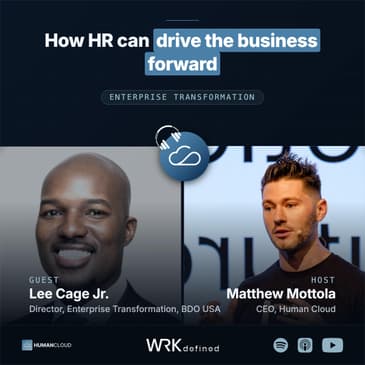
Most CEOs have the same private complaint about HR: it shows up with workshops when the business asked for revenue. The function that owns the single largest line item on the P&L is still, in a lot of rooms, treated as overhead. That gap is not an HR problem. It is a translation problem.
Lee Cage Jr. has spent eighteen years in Army HR and now leads enterprise transformation, strategy, and technology at BDO USA, where he has guided nonprofits, healthcare systems, and large automotive organizations through the change. He came to HR wanting to be a cultural anthropologist, and he still works that way: studying how people actually behave at work, then rebuilding the systems around what he finds.
We're building Human Cloud so the same reframe holds on the buying side, so business teams can go get an outcome without first converting it into a full-time headcount.
In this episode, Lee Cage Jr. shares:
- Why an HR leader who cannot name the company's KPIs has already lost the argument, and what changes the moment they can
- The 1 FTE trap: how budgeting only in whole headcount makes organizations miss the 0.25 and 0.5 people who would outperform
- Why he believes everybody is already an independent contractor, and what at-will employment really means for how you structure work
- Lock and shift is not transformation: if the business process survives the migration unchanged, nothing was transformed
- Why laying off every junior to fund AI quietly guarantees you will have no competent leaders in a decade
Lee Cage Jr. is Director of Enterprise Transformation, Strategy & Technology at BDO USA and an eighteen-year Army HR leader, with degrees from Lipscomb and Emory, an incoming PhD in leadership and strategic innovation, and a podcast of his own called Fifteen Minutes With.
Listen now on Apple Podcasts, Spotify, or wherever you get your podcasts.
About Human Cloud: We help companies find and deploy the right flexible talent solutions in minutes instead of months. We automate discovery, compliance, and orchestration across 1,000+ workforce platforms, so business teams move fast, procurement teams stay in control, and rogue contractor spend turns into a strategic advantage.
Powered by the WRKdefined Podcast Network.
[00:00:04] All right, Lee. So this is a long time awaited for me. Listeners, I want you guys to watch for two reasons. One, Lee, like I said, you look like not just like a tech leader keynote that you're about to do. You look like some sort of like protocol and like we're going to change the world protocol context. Oh my gosh. You look at meanwhile, I have a toupee day, meaning my hair is not working. So.
[00:00:34] But you have it. That's the important thing. I got it. And I don't. That's true. I don't have it. Which is giving more of the you're about to give a change the world keynote address. So. Yeah, really, really funny. There was a show I was watching. What was it called? It was the British guy that basically and there was a CEO tech executive that was going to make everyone's financial history public.
[00:01:00] That's what it was. And I'm like, you're about to give that level of keynote that's going to change the world. I thought you were going to say the stag. Have you seen that one where they're at the stag and it's also a British guy and they have to like find things and hunt down the things. He's always very buttoned up, very debonair. And he's like, now go forth, find the item, you know, type of thing. I thought that was the vibes I was giving, but I'm, you know, I'm not biased. So whatever works.
[00:01:26] You are buttoned up. You are buttoned up. I'm not going to lie. I don't know what the word demure means, but it's a nice sounding word. Maybe. Can I say your demure? Are you serious? I don't know what it means. There was this young lady. Yeah, I think it was a young lady named Jules that went viral last year for saying very demure, you know, very cutesy, very demure. And she like exploded on the Internet.
[00:01:54] So that phrase is permanently like inside of my brain because like who doesn't want to be, you know, demure? You know, you have to say it with the, you have to say it very bougie like though. Okay. I assumed the bougie, my wife said it and I was like, that sounds like a very posh French word. Demure. Demure. And drag the or at the end. It's like perfect. Yeah. So, okay. Ready? So listeners, so we're about to get organized.
[00:02:23] So there are three talking points that we have Lee over the next 30, 30 minutes. So talking point one is going to be me asking you why in the world HR exists, where it's going, what it should be. Okay. So there's going to be talking track one is going to be why HR. Talking tech track two, if we get there, is going to be what is technology doing to HR talent and just the overall business environment.
[00:02:48] And then number three is going to be going from military to corporate and just your background. So let's start with, give our listeners your background and don't be humble about it. Please, please brag or else I'm going to have to brag for you. Okay. So background, I enlisted in the Tennessee Army National Guard at 17.
[00:03:15] I always knew I wanted to serve partially because I come from a military background. So that was kind of like go forth, be great enlist. So I did that at 17, went to basic training. I have no clue how I made it through basic training because literally I was 115 pounds soaking wet. I think my equipment and the things that I was issued were like 50% of my body weight. So it was just, it was a struggle, but I made it through.
[00:03:44] And I couldn't be more proud of the last 18 and a half years of service that I've given and the things that I've been able to support across the country. That said, after enlisting, you know, as a kid, I wanted to be a cultural anthropologist. And my mom was like, oh, that's so lovely. No clue what that is. She's like, what does the job salary look like for that? What are you going to be able to do with that?
[00:04:13] And so I kind of didn't do that. Instead, I moved my career into HR. And over the last maybe five or six years, focused a lot of my career on being more of a technology anthropologist, looking at things from like folks like Daniel Miller and so forth and so on. From an education perspective, I have a undergrad from Lipscomb, a master's in org leadership
[00:04:38] from Lipscomb here in Nashville, a graduate certificate in conflict management from Lipscomb, a master's in business from Emory, goes out of business school. And you know what, Matthew? By the time this airs, I should be in my first week of my PhD program. So what are you doing the PhD in? So leadership and strategic innovation. Do you ever just sit and chill? Like, does your couch have no butt marks on it?
[00:05:06] That is, my friend said, I think you like academic hazing. Yeah. But it's chill to me because it's like, I'm so interested in the way that the world works, how people identify themselves with their job, their like actual identity sometimes is very tied to their jobs and the work that they do. And it's just, it's fascinating to me. So yeah. And you still haven't bragged enough.
[00:05:35] So you, you serve, you serve still with what is it? HR management with the army. Yes. And you just happen to be a director of enterprise transformation. So, you know, you kind of left out the... And the father of a eight month old who she's winning right now. Okay. She is winning. Yes. So she gets your time and nobody else does. It's really great. I wish it was her getting my time alone.
[00:06:03] But when she was first born, I wrote a LinkedIn, you know, post that basically says, I have a new project manager in my life. She's very demanding. She keeps me on task. She will, you know, issue raid items if I am not doing what she wants me to do in the form of screams. So fatherhood has been quite interesting over the last eight and a half months or so. So what a funny question before we get into the first talk track.
[00:06:33] What do you think has been the hardest thing? Like bootcamp to actually serving to fatherhood to husbandhood to right? Like all the things. Fatherhood. Right. Yeah. Fatherhood you say is the hardest? Fatherhood. Fatherhood. Out of everything I've ever done, the most fragile, the most sensitive, the most life altering, the most joy thus far has been the last eight and a half months.
[00:07:01] That said, my daughter had exposure to drugs when she was born. And so she was adopted. So she had exposure. So the first couple of weeks, one, we spent five or six days inside of the hospital. So that was terrifying and challenging. And then going home and kind of going through like the withdrawal pieces and all of that was really challenging in and of itself.
[00:07:30] So I would say the most challenging and thus far the most rewarding has been being a dad. That is incredible. Okay. And then before we get going, there was one more thing I wanted to make sure I brought up, which, yes, you left one thing out, Lee. You also have a much better podcast than we do. So please plug your podcast in the beginning before we get going. Please. Because you listeners, he also has a nice studio, does it in person in Nashville.
[00:07:59] And so give a quick plug and then we'll get going. Yeah. So the podcast is called 15 Minutes With. We spend 15 minutes with a thought leader, an emerging leader, random people. I can't wait for this upcoming one. We're interviewing a garbage man. I'm super excited about it because who would think like the garbage man typically knows more about you than your coworkers? But we focus on four questions, who you are, what you do, what you believe in, how you work. And that's the podcast. I love it.
[00:08:29] All right, man, let's get going with this. So first talk track. Why HR? And I want to preface this by saying I'm just imagining this scene where you are and listeners watch the video when I do this. You are doing that thing on the ground. We're going like this. Right. And then you got the barbed wire above you and then you are jumping over the wall. Right. And you're covered in mud and you turn to your buddy and you're like, man, I just, I really want to get into HR. And you're like flexing. Right.
[00:08:59] Lee, why the hell did you get into HR and then explain, let's get into this talk track of, of, of the function as a whole. And intentionally you have me, not Tony, cause I'm going to press you from the CEO seat how I see HR. But yes, you just hop the wall. You're flexing. Lee, why, why are you so excited about HR? Yeah. So one, I told you, you know, I wanted to be this culture anthropologist.
[00:09:24] Anthropologists study the way of the human that like, there's a lot of study that goes into that. I mean, archaeologists, anthropologists, there's a lot of intersection to me in what ties into HR and culture and how people see themselves, how they build tribes within organizations, how they build subgroups, how influence and power works inside of an organization, which
[00:09:49] is typically not always the person with the fanciest title or the biggest check. And there's sometimes that executive assistant who's driving the entire bus by seed planting and doing the thing. She manages the calendar for the CEO. So she knows everything. So picture it, you know, kind of taking from that lens. I like people. And I like the study of people.
[00:10:15] And the best way for me to study people, for me to learn more about them, were to see them in their natural habitat. And that is work where they're spending, you know, one third, sometimes two thirds of their day. And they're doing that at work. They are, you know, inside of an office. There's performance that sometimes happens as well as, you know, non-performance types of activities. And I was just fascinated by it.
[00:10:43] So I moved into HR for the Army and then became an HR manager for child support here in Nashville, which was an incredible experience, a life-altering experience to sit in court inside of your building and see these things unfold and to see the people who are representing custodial or non-custodial parents and how the kids are impacted by this. Again, more natural habitat type of things, right?
[00:11:12] So HR really has given me a lens to pair the cultural pieces, the technology pieces, and to view all of it and to kind of have a perspective around what I think is important tied to the industry. Yeah. And let's, let me give you the most negative spin. Okay. So this is like, we're, we're, we've now gone from, you know, you doing that thing in the army to now we're at a bar and I got my CEO hat and I'm like, okay, so you want to come in, you want to be an HR leader.
[00:11:42] Um, why do I care? Uh, what are you actually going to do for me and our organization? And my bias is you're probably going to tell me why we need more workshops. You're probably going to need to tell me why we need more training. And all I really care about is, are you going to make more money? Um, and none of these workshops seem like they're making me any money. If anything, it seems like it's going to actually create more, uh, tension than what we currently got.
[00:12:11] But so Lee, why, why, why, why do we need HR? Yeah. So one, if you don't understand what the, my, my friend Sierra Park says, if you don't understand what the business does, how can you be an, an HR leader or thought leader within it? So one is, does the HR person understand what the business does, the goals, the KPIs, what it is that you are actually looking to accomplish? That in itself, if they do, that actually helps serve the business even more.
[00:12:39] Number two, not just workshops, not just trainings, not just more money on, you know, ERPs or whatever. But when people are happier in their jobs, they perform better. When they have a sense of purpose, they perform better. Even if that purpose, unfortunately is like built on a mountain or on a sandcastle.
[00:13:04] Uh, I once worked at a very small organization doing some like adjunct type of work and there were only 10 people, but they created hierarchy and that hierarchy created a path for people. That path creation created some competition, healthy competition where people wanted to perform better, where they wanted to show up better, where they wanted, you know, the A in the class. So I think HR helps to create that, but also helps create the culture that you want.
[00:13:32] And if the culture that you want is we are just here to do a job, we don't have to be friends, we are not a work family, let's do the job, let's get out of here, let's go make money. HR helps insulate that culture. If you're the culture of we are a family, which I do not like that phrase. I do not like that phrase. I've never been fired from my family, but in either case, um, I don't get performance. Well, I do get performance evaluations from my spouse, but you know, like, Hey, do this
[00:14:02] better, do that better, mow the lawn, you know, you get that. But in most cases, you're not getting performance evaluations. You're not put on a pip with your family. So saying we're like a family that like a family is a challenge for me. But in the other cases, HR is that protector. And the last thing I would say is tied to protection to me, HR is like a, in some cases, cheaper attorney. Okay.
[00:14:28] They are helping to insulate the business and the employees. So that's, that's why I think you need it. Uh, that's why I think they serve a purpose. And like, just think about why they were even created to begin with. Like a hundred years ago, HR was, you know, personnel and that personnel was created due to the industrial revolution timeframe.
[00:14:54] So even just why they were created, the history of the function, uh, I think has a lot to do with the anchoring of today. So I want to double click on the, the A player, um, what you mentioned there. And I want to double click on it for a couple of reasons. The first is yes, I want all A players. Um, I know, no, see. Okay. So yes, let me, let me finish. And then you can grill me HR personally.
[00:15:21] Um, so, uh, I think I do want all A players, right? I don't, I don't want to pay for, for someone that's not outperforming. Now I don't, I don't care if that means that they're only working 10 hours a week. I want outperforming on 10 hours a week. Not right. I don't want everyone to be the same up till 2 AM robot. Right. I don't, I don't want that. Uh, but I do want the best possible person in every single role over performing, uh, with
[00:15:48] that, with that said, um, I don't know exactly what format that should take. And so what I'm historically I've heard from HR is, okay, we're going to help you with the job process. Right. And we're going to create the job requisition. We're going to have our TA team. And then I would turn to them and say, no, no, I don't need a full-time employee here. I need this outcome done. I need to go to market, which is going to require a paid ad specialist, you know, graphic
[00:16:17] designer and engineer, whatever. And HR can never really help me with that. They would always just say, no, no, let, let me help you create the JD. Let me help you do this. And I'd say, no, right. It's not, not helping. But so let me give you that, that preface of, I want all the A players and Lee, how, how can, how can I enable that to happen? I mean, and you can totally push back.
[00:16:39] I think gigster type of work has been happening for a really long time and it's actually underrepresented in the market, in my opinion. So I think there's certainly a case for the gigster, but, but, but, but to the A player, if everyone is performing at a hundred percent or at that A grade, I, in some cases have a tremendous amount of respect for the person who's just like a taskmaster. They can just do that, that task.
[00:17:10] Like they're not exceptional at the job, but they do those tasks really, really well. And then those people are more operational than those people are more strategic. So I think that's kind of where I was going when I said no, but to the gigster mentality, the independent contractor world, you know, sometimes gets frowned upon, but in my view, especially living here in Tennessee, everybody is an independent contractor.
[00:17:35] You may have a full-time job, but your full-time job, Tennessee is like at will state. Like they can decide tomorrow that you no longer work there. And as a result, you're like a contractor. But so for me, there have been certainly sometimes in my background or in my past where I'm like, Hey, I'm really good at this thing. Who needs this thing? And people are like, Oh yeah, we want to hire you. I don't want to do the thing 40 hours a week.
[00:18:01] I want to use this creative part of my brain, work eight to 10 hours a week or work 10 or 15 hours a week and do this in my all time, help you all be successful. And then me go buy a new car. That's really what I want. And so I think because we typically see things only as one FTE, we sometimes miss the opportunity for those 0.25 or that 50% or just that person who is really great at doing the thing and just wants to do this thing.
[00:18:30] That's why places like, well, Upwork and others and, you know, human class, like that's why these places exist to help augment and to help people change their mind around how work gets done and who does it. Which, okay, I want to dovetail into the tech and I'm probably going to bounce back. Okay. And here's going to be why I asked that. So when we talk about this, so I love how you, I love how you phrased out. There's some people that are great at just getting the task done.
[00:19:01] Now here's going to be my pushback. That person's actually not the IC. That person is increasingly called Claude or ChatGPT and getting replaced with a lot of the agents and AI tech out there. Let me finish my little tangent. So what we've seen historically and especially now is that the best, I'm going to call them the best leaders, but also independent contractors, whatever you want to call them.
[00:19:30] They actually are, are total experts in the strategy and total experts in the context, which I'm going to use context as they've been in that seat. They understand your type of org and they understand your client base or your customer base. Those have usually made the best, whatever we want to call them, ICs, fractional. They usually just get called their title as if they were full-time and no one knows they're not full-time. But so, right.
[00:19:58] So that's my, my quick pushback. With that said, dovetailing into the tech. Now you, my friend are enterprise transformation with a strong emphasis on digital transformation. And you've, you've navigated all these tools, right? The work days, you name it. You are literally as you look on the screen, right? Listeners watch the video. Like I mentioned, it's impressive.
[00:20:20] So when we look at AI, we look at the org, we look at just digital transformation as a whole. What, what are you seeing right now? Like, what are the kind of conversations that you're having with your peers, your customers, your own teams? Yeah. Give me a day in the life of you and digital transformation. Yeah. So two, two things.
[00:20:45] Um, transformation, modernization, optimization, all of those very fancy words only happens if something changes inside of the organization, its culture, or the way that they do business. So that's the first thing. So a lot of my job is helping them understand and break up with their past way of doing certain things. Um, I like, you know, there, there's some people who say like, uh, best, best practice.
[00:21:12] I think there are some leading practices, but best practice in some cases assumes that you have the same budget, the same competency, the same capabilities as the organ, as the other organization you're comparing yourself to. So I like to say leading practice tied to a specific industry is, you know, this, I love nonprofits and healthcare, but I've done commercial.
[00:21:32] I've done a couple of very large automotive, uh, you know, companies helping them transform the way that they do business, leveraging technology as a connector to do it. So a lot of what I'm telling my customers is, one, are your people on board with this transformation? Two, what does the future look like tomorrow? What does it look like in six months? What does it look like next year? What does it look like in two years?
[00:22:03] If you're just doing a lock and shift or, you know, we're just going to transfer this process over to this new system, you haven't transformed anything. If your business processes are still the same and it still takes an act of Congress to get something done in your organization, that's not transformation. Two, does your training and development or L&D people understand the competency and reasonableness of your population?
[00:22:28] And in some cases, what I've seen is that people significantly underestimate the competency and reasonableness of their staff. For example, for those that live in the South, we know Kroger, uh, but let's just say Walmart. How many people have gone through the Walmart self-checkout training?
[00:22:50] No one, no one has gone through the, no one watched the quick reference guide for like how to do the self-checkout machines, right? You go over there, you take your stuff, you see that it's easier. If you are going too fast or too slow, the machine is going to yell at you and call you a thief. Somebody is going to come over in a jacket. They're going to help you get checked out. And there's your process. That's the business process. The same thing happens in organizations if done right.
[00:23:18] Your business processes and the transformation that you introduce should be easy enough that a reasonable person, seeing it a reasonable amount of times can mimic that behavior and go through the transactions with, you know, limited supervision. And if they mess up, let the machine yell at them via alerts or errors and help drive them into a different process or a different route, um, you know, to see their business process be complete. That's what I'm telling my customers.
[00:23:47] So that makes total sense. And let me, let me ask a very blunt question. Um, layoffs and AI, what's real and it's not real. Should every company be laying off? Uh, which I know as an HR person, I would assume you're, you're getting score me about, uh, especially you said cheap, cheap, cheap attorney advice. Um, but it will give me a little more context on this. So the building that I worked at in my, when I was at Microsoft, I think most of it's been laid off.
[00:24:17] Um, yet if you look at Microsoft's earnings report pretty well, right? So my, my Microsoft as a shareholder, I'm feeling pretty good. My Microsoft as an employee, pretty scared. And, but I, as a CEO personally, I'm not surprised. And I, and I, it seems like it was the right, the right move. Um, Ford is rehiring gray beards, right?
[00:24:44] AWS has said we can no longer have a PR without a human. So there's massive, massive, uh, push back and bringing it back to humans. Um, we have some crazy stat that's like over half of layoffs end up bringing back like 57% of, uh, the employees as contractors. Um, it's not the exact stat, but it's directionally whatever. Uh, but so let me like ask it bluntly, like AI and layoffs. What's your perspective here?
[00:25:13] Listen, um, if we keep laying off all of these junior or what I like to call new to school, new to work people, we will have very limited competent leaders in the future. Two, the humans are the ones who created said AI. We created it. So in some cases, these are some self-inflicted wounds.
[00:25:40] And then three, I would say we as humans also have to learn how to work with AI, not be afraid of AI. I went to a conference, um, till end of last year, I spoke at this conference. And, um, the topic was, do you have the right flight crew? And I talked a lot about positioning yourself. Like, are you the pilot? Are you the co-pilot? Are you the flight attendant, which I like to call a change management? Are you the ground crew?
[00:26:08] Are you the ATS, which is like your HRIS, HRIT people? Every organization needs the right flight crew. And in today's economy and in today's organizations, that's a lot of systemization and human. So that's an artificial intelligence and human intelligence. I don't think that you can have one without the other. Um, I think there has to be cohesion and integration between them. That said, layoffs have happened since jobs were created.
[00:26:36] Even the army, we don't call them layoffs. But when we are over manpower, we help chaperone people's transition from active to inactive. Uh, and the army has done that. The military has done that in very interesting ways over the last, you know, 251 years we've been around. Uh, but we've done just the same. And technology certainly plays a part of that now.
[00:27:02] Uh, I think it certainly has always played a part as we've advanced and needed less boots on the ground and more X, Y, and Z. Less, you know, people doing sales, more people doing, you know, relationship-based things. So it really just depends on the side of the house you're on. Which, how, how really would you say is AI? Because my, my belief on this is we wanted AGI. We got AGI.
[00:27:30] We learned it's our brain that's still limited by sleep and distraction and whatever. And so I personally believe AI, there's no limitations on the tech itself. There's massive limitations in the energy created to compute, the energy created for you and I to run the AI. And we, even if you said, it's the typical genie analogy. Hey Matt, what do you want? I want to be tall. All right.
[00:28:00] You're now 10 feet. Whoa, whoa, whoa. AI, you over-optimized. I, I really wanted to be 6'1". What? You should have told me you wanted to be 6'1". All right. So it's a human problem now. Well, and it's, it's ask better questions and give better answers too. Right. So it's even in prompting. I mean, you, I'm sure you've done some like prompt pieces.
[00:28:22] I've looked at some prompt engineering courses and I've done this like YouTube dark, deep, deep hole of like a hundred videos and asking better, having better prompts, asking better questions, being more specific. But the thing is, what I like about the prompting is it helps, it has helped me figure out the gaps in my own personal communication. Tell me more. And the assumptions that I have placed on others when I have communicated to them.
[00:28:51] So how often do you say like, oh yeah, just add cheese. And then you get this, you know, chipotle salad that has like this mound of cheese and you're like, no, no, I wanted light cheese. Well, you didn't say that. When you're prompting to your point, it is asking you, it requires you to be as specific as possible to get the outcome that you are imagining. That said, to your point, I do think the limitations of the system are almost limitless, but there are some environmental, some ethical, and some moral.
[00:29:21] Concerns about AI as a whole. I recently saw this article. This teacher put like text. Did you see this? He put white text on the exam and said like, no AI. Just filter out AI. 32 out of the 35 kids in his class failed. I'm surprised. I think it's not 35, to be honest.
[00:29:47] And this is where, Lee, this is where me being a whatever tech software nerd, I would go to the three other kids and I'd be like, why didn't you guys do that? Well, here's the thing. If you're studying to be a doctor or a lawyer or a nurse or just a competent human, you have to know how to do the things yourself. How do you validate that the answers that you are getting from the technology are actually real?
[00:30:16] Well, you can't back into that. You're just like, yeah, the answer is right. Well, explain the answer to me. You know, how did you get, what is the weighted average cost of capital? Well, I don't know. How do you lever and unlever a bit? I don't know. Well, your answers were correct on the test. Explain it to me. Make it make sense. They have, in some cases, they have no answer for this.
[00:30:40] They're just using the technology to solve the problems, but they don't know how to solve the problems, which means I think in some cases that we are handicapping our brain. I like to, you know, sit with things. I like to physically write things. My boss, she actually told me this, and I don't think she'd be shocked by me saying it out loud here. But she's like, Lee, just put it in AI, or let's have one of the interns do it. I'm like, yeah, yeah, yeah. I got it. I know I can do that.
[00:31:10] But if I'm asked to explain it, I won't know how. So I have to stumble over this. I have to, you know, walk around the building two or three times. I have to, like, write down my handy-dandy notebook, get my little pieces of paper, and solve the problem so that I understand why I solved it this way. And then I can check and verify, like, AI, what would you have done? I actually named my AI.
[00:31:38] I call him Echo because he says the things to me that I want him to. You're not the first that's named. I refuse. I refuse to go that far. But you're definitely not the first. You're actually, there's, like, over 10 people. And most are way smarter than Nick. Let's just be closer, okay? I'm telling you all my business. At least I could give you a name. It's just true.
[00:32:00] Well, I totally agree on, like, what I tell my wife is, like, I've never been dumber but more productive in my life. Now, I feel so fortunate that I've already put in 15 years in what I've done so that I can apply the context to it. Right?
[00:32:24] So I'm like, ooh, I'm sitting in a place of pure privilege because I know my industry inside and out. And if I didn't, I would be getting worked. And I'll give you, for example, like yesterday, you know, we were filling out our own RFP. And, you know, we have, like, our own RFP technology or whatever. But so we were filling out an RFP for a large frontier letter.
[00:32:46] And the answers it gave me, it was very helpful in the, like, data, the, like, statistics, the stats it brought up and the case studies. Like, that was great. I would have prior had to take, I don't know, multiple minutes to go through. But the answers are just so boring. And there's not that, to your point, like, white text, right? It's like there's always, and I go back to, like, all of us as humans, we are so ADD riddled.
[00:33:15] And it's only getting worse. And so I think of every interaction, I'm like, you have five seconds to get someone to give you 15 seconds to then give you a minute to then give you 15 minutes, whether it's an RFP, a sales call, or whatever. I just don't know if AI might end up doing that. Right? That's where I'm like, oh. It could. But also, like, on the context, it depends how long you've spent with your, you know, with your model. Exactly.
[00:33:42] So I may be judged for saying this, but it's okay. I have spent an enormous amount of time with my model. I started off by having it ask me 150 questions about myself. And instead of typing the answers, I did the voice to text and just answered it so I could give it very thoughtful, continuous, like, thought, answers.
[00:34:13] Again, I did share this in the talk, so it is already probably out there. But my spouse and I, we were chatting and going back and forth. I was like, well, just ask Echo. You know? Like, what you think I would think? Because I shared, you know, you can share, like, conversations or share... How'd that go, Lee? How... What was the response?
[00:34:33] The answer that Echo said was near 90, I would say 95% of what I would have said had I actually answered it. And it's primarily because I'm on camera so often and my life is a bit more public than I always want it to be. Whatever I say is what I say. I always reserve the right to change my mind, as should any human or any model. I don't want to exclude AI since I might be listening.
[00:35:00] You know, you always have the right to reserve... The right to change your mind, but... Right. Cheap attorney. Right. Cheap attorney. I... But I've spent so much time with the model, even just around, like, how I see the world and how I... My worldview and my stance around things, that when I do leverage it to help me work on something or to expand an idea or thought that I may have, it is near exact to what I would...
[00:35:30] So, in your RFP perspective, like, if your team is spending that time with the model, then it then is able to bridge and bring the stories. But I actually took, I think, two weeks ago, was in the studio here and I asked it to ask me questions around, like, my childhood and around, like, my relationship experiences. Did that go? And I answered all the questions as honest as I could.
[00:36:01] And then I said, help me think through how this has impacted the way that I show up for work and how I see work relationships. And the answer had me like, I'm like, I'm going to have to sign up for AA if I keep... I'm going to sit here. So, yeah, I'm a therapist, okay? Rose, okay, I love you, but you might be fired after this. I don't know. It's crazy.
[00:36:30] It reminds me of when I first started dating my now wife. I sent her my calendar because, to me, I always just would share my calendar, right? Like, this is the most efficient way. This is great. I didn't even send her the, you know, slash meet with Matthew, right? She just had my calendar. And she got so mad. She's like, really? You can't, like, actually tell me the times that you're available? And I was like, I am. I was like, in fact, I'm showing you everything that I have going on.
[00:36:59] You know, that backfired, but probably showed how vulnerable you were in some form. It didn't work, Lee. It's been five years plus now, and it still hasn't worked. So, you know, maybe AI can solve that one. I don't know. We should put it in there. Give it a great, it's a great use case. You know, I share my location with my family, particularly because I travel so much and the world is such an interesting place.
[00:37:28] Like, I always need someone to know where I'm at. So, I am on a plane connected to the Wi-Fi, okay, connected to the Wi-Fi. And my grandmother, I don't know how, it's only happened twice, is FaceTiming me and texting me. And she's like, call me now. It says that you're out of this world. Where are you? Again, it backfired, but she's, you know, almost an 80-year-old woman looking at my location. And it says I'm in the middle of the ocean.
[00:37:57] That is, like, which, like, Lee, does that make us better as a society? I don't know. I don't know. I don't know. But it made for a great family dinner conversation. You just got your grandma riled up. Yeah, yeah. Listen, this, Lee, we could talk for hours. The most important question, and the last one, the military into corporate, we're going to leave that. I'm going to leave that one intentionally for the next one and to force our listeners to reach out to you.
[00:38:26] So, Lee, where can our listeners reach out to you? What do you want them to do right now? Yeah, everywhere, Lee Cage Jr. So if you're on LinkedIn, if you're on TikTok, or as my little sister says, if you're ticking and talking, if you're on Instagram, Lee Cage Jr. You don't need anything formal.
[00:38:49] Like, just slot into the DMs or private message, and let's find time to, you know, chat or exchange ideas. I hope that my ideas resonated with you. But even if they didn't, please message me. Tell me why you love them, why you hate them. I welcome all philosophies and ideas. And like I said earlier, I always reserve the right to change my mind. And so hopefully something that you share back will help me change my mind or evolve a little bit differently as well.
[00:39:18] And does Echo have a Twitter yet? Or sorry, TikTok? No, Echo does not have a Twitter or a TikTok or Instagram. He cannot be reached. He's a private model. So I just unplugged him by accident. I put a lot of my personal life in there around my thoughts and, you know, trying to evolve myself.
[00:39:39] Speaking of evolve, by the way, like I'm just trying to evolve my thoughts and philosophies and be a better researcher, a better technologist, a better HR adjacent practitioner, a better human. So reach out. I'm here. I love it. Lee, thanks for hopping on, man. Appreciate it. See y'all.
Sponsors
