
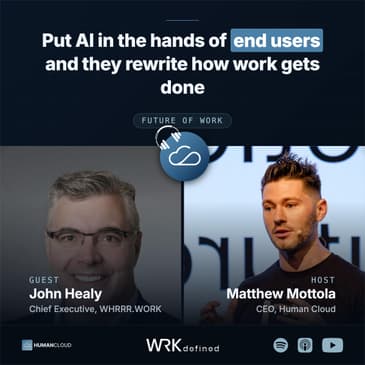
Every enterprise transformation starts the same way. Leadership tasks HR with fixing how work gets done. Then procurement. Then a consultancy. Nothing moves. The people who actually do the work are the last ones in the room, and usually they are not in it at all.
John Healy ran the experiment in reverse. A high-tech company with 30,000 workers globally handed him free rein. He put the end users in the room and left HR and procurement out of it. Two ground rules: you cannot swap out any technology, and you cannot change any policy. Then he loaded the company's own workflows and policy manuals into their private LLM and started keying in every point of failure as people named it out loud.
Three hours later they had working interfaces that let a manager kick off a project and get to talent. Six months later it was deployed, adopted by word of mouth, with the old system still running untouched for anyone who wanted it.
We're building Human Cloud from the other side of that same shift, so any company gets a two click front door to trusted talent without having to build one from scratch.
In this episode, John Healy shares:
- Why the thing that has not changed in 30 years is trust, and why every CV, background check, and interview loop is just an expensive workaround for not having it
- How he ran a design thinking workshop with the end users and deliberately kept HR and procurement out of the room, and why that created a safe space instead of a fight
- The two ground rules that made a six month transformation possible: change no technology, change no policy
- Known talent versus unknown talent, and why trust is the only thing standing between a manager and a two click hire
- How he gets paid on whether the AI agents he built get retained, improved, or terminated, and what a governance model for agents actually looks like
- Why rogue spend is a user experience problem, not a compliance problem, and what happens when you give people a system that actually works
John Healy is Chief Executive at WHRRR.WORK. He spent 30 years at Kelly Services, where he ran the Office of the Future of Work, and now advises companies and governments on radically rethinking how people connect with work.
Listen now on Apple Podcasts, Spotify, or wherever you get your podcasts.
About Human Cloud: We help companies find and deploy the right flexible talent solutions in minutes instead of months. We automate discovery, compliance, and orchestration across 1,000+ workforce platforms so business teams move fast, procurement teams stay in control, and rogue contractor spend turns into a strategic advantage.
Powered by the WRKdefined Podcast Network.
[00:00:04] All right. So listeners, we have an absolute gem of an episode. If you're wondering why my background is different, I told John, there's only one meeting that I'm going to take that's serious today and maybe even this week because I just moved. And so that's how important this episode is. And John being John, the absolute gentleman you are, you're like, Oh, we can move this back. Like, no, no, no, no, no. This needs to happen now. And so let me tee this up, John. So for those listeners out there, you probably already know John. He doesn't need an introduction.
[00:00:35] With that said, there's this very interesting sort of principle in this episode, and it's going to be the talent world becoming the total world and the total world coming into the talent world. So I started on the tech side and I started in Silicon Valley startups, then went over to Microsoft, didn't even know what the word HR meant or procurement, didn't know what the term total talent meant or anything like that. And then when I ran into someone like you, John, I went, Oh, no, no, no, no. You're going to tell me, no, it's going to move so slow.
[00:01:04] It's going to be analog and it's going to be totally technologically behind. Now you have always been my talent guru and especially the contention talent world, the external talent world, that side of it. You are now branching into the total world. And notice I didn't say tech because this is touching absolutely everything. Whereas me, I started in the tech world and now I'm this talent nerd.
[00:01:28] So we have this beautiful convergence, right? Of like what's happening outside the talent world, what's happening inside the talent world. And both are combining in ways that are totally transforming business as a whole.
[00:01:39] So I think that is the bind that's going to hold this episode together. And for you listeners, John's also agreed to come on the community call this month. And so we get to have you twice, which is such an honor, John. So first off, thank you just for hopping on and being such a champion forever. But what do you think about this principle of these two worlds combining? John McClendon I think Matt Watson Watson, Matt Watson Watson, we're in this stage.
[00:02:04] At the core for me, the way people connect with work has been flawed and broken for a long time. We can all explore a lot of different angles on what that is. But the tech today is enabling transformation in ways that I've never seen before. And that's the exciting part. That's the exciting opportunity. Are there risks in it? Yes, there are. But you can't hide from the opportunity that's in front. It's got to be managed.
[00:02:33] And that's where I got this really unique opportunity to help a large organization who wanted to see things in a very different way. And that's why I'm excited to share this story.
[00:02:46] So give us, John, give us the 30 year plus kind of life of John and then the past two years, because I have a feeling you're going to tell me the past two years have been nothing like the past 30 and the past three months have been nothing like the past two years.
[00:03:05] John McClendon Yeah, we're on a hockey stick ramp of change. So historically, I came out of the temporary staffing industry. I spent 30 years with Kelly Services. I ran the Office of the Future of Work for the organization. Got the opportunity to do all kinds of really interesting things with large enterprise companies. That was our target portfolio. A lot of it in the struggles of strategic workforce planning and really thinking through things broader.
[00:03:30] But I left Kelly almost six years ago now and have been operating fractionally since then. So just kind of got into helping companies and governments who wanted to rethink their entire approach to workforce. And part of this, you and I spent time with John Windsor and the Open Assembly team early on as they were going. That's where I got exposed to crowdsourcing.
[00:03:56] And it just told me I had a massive blind spot. I knew about full-time employees. I knew about outsourcing. I knew about temporary, but geez, I hadn't even thought of crowdsourcing. So I needed to kind of reset myself on, let's think about how work gets done. This client that I'm working with now, it's how capacity gets created for their organization to accomplish things.
[00:04:22] It's not about cost savings. It's about how we get stuff done as an organization and an entity. And that's what's changing. So, yeah, AI has certainly changed everything. That's at the center of what I'm doing. But I help companies and governments who want to radically transform the way people connect with work.
[00:04:41] That's where my passion lies. And fortunately, I've had the opportunity to engage with some really fun organizations to do some pretty wild things over the last six years. So let's dive into this, what has changed and how AI has changed.
[00:04:58] Because I think, you know, what's funny is like in my circles in 2016, we were dealing with neural networks, deep learning, machine learning, computer vision, right? And I was actually, I was connecting with a colleague when I was early at Kickstarter. And it was funny. He goes, you realize that we actually built Cloud Code before Cloud Code came out. And it hit me. I was like, oh, my God, you're freaking right. We did.
[00:05:27] And so, you know, we saw this pre-LLM world as early as 2016. And it really wasn't that exciting. And I even remember like the devs, you know, coming on the couch being like, look at this. I took this picture of a pony and I changed it from white to red. And I would be like, one, the pony looks like crab. I'd be like, doesn't even really look like a pony. Two, who cares that it went from white to red without, you know, you having to change it.
[00:05:54] And three, like, who cares, right? And so I've seen that world of, okay, this is never going to change. Now, our life has fundamentally changed with LLM, specifically Cloud Code and the fact that this can all talk to each other and work within each other. But there's still this, I would say, this crazy bifurcation of like, okay, AI has changed everything and AI has changed nothing. And yesterday, John, I was at the Xfinity store and the guy, I just hear the corner of my ear. Well, yeah, AI is a giant farce. It's really nothing.
[00:06:24] And in my head, I'm just like, oh, you poor soul. We don't want to be you right now. But so how have you seen everything change? What has changed? Yeah. It's interesting. He kind of took us back in time of some of the things. So I think of like Google people. Remember that was a skunk works project where they were building things out. And, you know, they had to stop what they were doing because they knew too much about us.
[00:06:52] And they realized, ooh, if Matt knew that I know he's about to change jobs, he's going to be scared of me. And so they had to shelve product that they could really help organizations understand based on our search history. It told them things. So like the data was getting there. And then I think of we built a prototype of a product. We called it Talent Desk.
[00:07:20] And think of doing those design thinking workshops. You've got your dev partner. So you're creating the product requirements definitions. You're building an MVP. You know, it's all videos to start of what you're trying to create. Videos of screenshots. Because it took a while to build things up. You know, 18 months later, we had a prototype of something that we still didn't know if we were ready to use. Today, I can tell you I can deploy that in three months.
[00:07:51] It's the effort around it. But what hasn't changed, Matt, is trust. The absolute lack of trust in the way people connect with work. This is, to me, where we're still broken at our heart. We declare, I need this. You tell me, sure, I can do this. And then I say, I don't believe you. Give me your CV. Prove that you've done it. I need to test you. Now I need to background screen you. Now I need.
[00:08:20] So the need to form trust in the environment is still the element that I think is really missing. And then I think the part that's becoming really fun now is the voice interaction is allowing us to have a conversation instead of me evaluating you based on a piece of paper. And that's going to, I think, bring a little bit more of a human element to the way people go through this exchange.
[00:08:50] So all kinds of fun there. And then we get into all kinds of issues of how the tech engages with us, what your engagement model is. Are you a freelancer? Are you a temporary? Are you an outsourced worker? Are you a full-time employee? Are you subject to IR35? I think I just sent you a note today. We had the, in the Netherlands, you know, we've got issues with people cross-border working. And wait a minute, that work was done for a Dutch company.
[00:09:19] Therefore, I want Dutch taxes to be paid on it, even though the worker was based somewhere else. Okay. So our legal framework is still very confused. And I think it will be for a while. Yep. No, I fully agree on that. So with that, let's touch on some of the very, like, tactical examples of things that have changed in the best way possible.
[00:09:43] Because also, I think in a lot of these conversations, I remember, I remember, John, when I'd have to get stuck talking with CELA, which was the legal department, procurement and HR. And I would always just feel like, oh, my God, I feel like I'm talking to a camp counselor, right? Because I would be like, I really just want to go swimming. You're telling me I can't go swimming, and it makes no sense because I know how to swim. If I drown, it's my fault, and it's not that cold, right? So like, let me swim, damn it.
[00:10:10] But so, you know, I own the preface to say, usually, if the reward is good enough, then eventually, these people just have to listen. But so, in my experience right now, using LLMs and everything, what's the craziest difference? And I love how you mentioned, like, we had to find these screenshots and all these things. So when I would go build a company, I would have to create a pitch deck. And then in that pitch deck, there would have to be a, you know, prototype.
[00:10:37] And in that prototype, I would have to go to other websites, take screenshots to steal some of their UI. And it would take months, right? And usually, it would never get off the ground. Now, I literally say, hey, Claude, can you just go copy, like, LinkedIn? And then I'm going to tell you little things to change. And then, holy crap, it goes out and builds a full stack application without you having to tell anything, right? So the level of, I don't know what you'd call it, productivity, stealing, I don't know. Because this data, right?
[00:11:07] Like, the data it's trained on is all our data. But it's all public. It's all public. And hell, man, like, how did GUI get created? Like, Jobs just kept going to Xerox PARC and taking tours. And then writing down what he was seeing. So, like, I'm sorry, but we've all just copied other things to create technology. But for you, what have you seen the most power? And I know your workshops, too, are phenomenal. So let me take you through this exercise.
[00:11:36] So it's a client example that has been the most meaningful and impactful engagement I've had in a long time. So this is a six-month journey where a close colleague, CHRO of a company, about 30,000 workers globally, it's still confidential, I can't share the details of the organization, but they're in the high-tech space,
[00:12:01] introduced me to the CEO of the organization who said, we've got a reference, we've got to rethink the way we build capacity. Like, we know everything's changing. We've got AI. We've got workforce ecosystems. We've got changing regulation. We've got labor market dynamics. We've got more data than we've ever had before. But my entire user community is frustrated. I've tasked HR with fixing it. I've tasked purchasing with fixing it. No one's fixing it.
[00:12:31] So I need an outside view. Just come in and help me reimagine what's possible here. You've got free reign. Go talk to everyone you want. So it began with doing a design thinking workshop. I was with them up in Toronto. We were just going to gather inputs. And we specifically said, we don't need HR or procurement in the room. And, you know, we got the, what do you mean? And we said, well, we have all your policies.
[00:13:00] I want to hear from the end users. So that's who we went to. End users who were getting work done, who were responsible for the work outcome, the productivity of the organization. And so we had the day schedule for a Friday. I happened to be up there for a presentation. And so I met with them on Monday. And I said, I want to reimagine our workshop a little bit. You guys are comfortable with tech. Can we rethink this a little bit? Yeah. Okay. So they're a co-pilot shop. So, okay.
[00:13:30] So co-pilot your LLM. Can we load into your private instance, all of your processes, all of your workflows that the software is built on? Because, you know, all of your ATSs and your VMSs, they're all workflow software. So let's get your workflows. I want to put them in. So we got that. Yep. We got that. No problem.
[00:13:51] Can I have all your policy manuals for if you're hiring a full-time employee, if you're buying a contractor, if you're outsourcing a project, like what are the rules for the organization? Yep. We have those. Good. That was in. Do you have a test environment where we can plug into, you know, your different applications so we can just see what's there? So, yeah, their IT security team is there. Yep. We can give you that. That's no problem. So we had that.
[00:14:16] We added in some other things like they use Lightcast as a partner for labor market data and working through that. And so, okay, we had everything that we needed. And so when we got together on Friday, instead of, you know, that let's put an idea, put a post-it note, everyone go onto the wall. We just started talking. We started putting process flows up in front of everyone on the screen and saying, what works and what doesn't? What's failing on it?
[00:14:46] And as everyone's giving their input, I'm just keying things in. And our ground rules as we went into this were you can't change any technology out. I don't want to hear we need a new VMS. I don't want to hear we need to get rid of work day. I don't want to hear that we need to get rid of our procurement. No, that's out of bounds. Two, we're not going to change any policies. They are what they are and they're there for a reason right now.
[00:15:15] So what we're actually doing is creating a safe space. So we had that and that's why we didn't need HR procurement in the room. So that's good. The other, and we'll talk more about it, is the whole idea of the two-click experience architecture that comes from Mercer. If you guys haven't seen it, Mercer has three different types of architecture that they look at. The solution architecture, which is kind of what core systems and vendors are you working with. The technical architecture, how the data flows between things.
[00:15:45] And then the experience architecture is what I experience when I do this. And, you know, the optimal example they have is Amazon. When you go to buy a book, it's two clicks. There are 70 different systems involved in making that two-click experience happen. But that's all invisible to you. So we wanted to look at that. And then later on into it, we introduced the Josh Burson HR 2030 model.
[00:16:12] And if you haven't seen that, there's some really neat elements of just exploring how, you know, the average organization has 140 different systems in the way talent is engaged that are disconnected. Right? So we knew all of that as a baseline. So now we're just going through and we're understanding where all of the inefficiencies are. And I'm keying all the fun stuff right into that LLM.
[00:16:39] And at the, you know, every once in a while, we just iterate and say, okay, let's turn this into a product requirement definition. And then lovable was the vibe coding app. So same as Claude code for those of you who don't, you know, pick your poison here. But off we go, boom, we spin something up and now we've got a verbal interface.
[00:16:59] And what we ended up doing, Matt, is we created a whole series of agents that were either automating steps or bypassing steps that were inefficient. What they recognized as a group of users was there was known talent and unknown talent. When they began a project, they wanted to start with the known talent. The known talent could be their full-time employees.
[00:17:23] So they had a, you know, in Workday, they have all of their internal FTEs, their profiles, what their interests and their capabilities. So an internal talent community. They knew from their existing contractors that were in there and the free agents that were in there. They had profiles. So, okay, so now we're mapping all of the skills against the roles. So we're extracting that. We're making sure that we've got those elements.
[00:17:49] So all this information is coming together and we're going through it. But if I can go to known talent first, I have trust there. When I go to unknown talent, yeah, it's a more laborious process, whether it's a full-time employee and I've got to go through specific things for budget approval and posting and whatnot and headcount OKs. Or if it's a new contractor that we've never worked with, the whole onboarding process is entirely different than if it's a known entity.
[00:18:18] And as we went through, three hours later, we had iterated enough that we now had this series of, we ended up with three that we selected of interfaces that would allow people to just kick off a project and get it done. And that just opened the door. You know, we followed it up.
[00:18:43] We had another workshop in Singapore, another workshop in Durham, North Carolina, and getting through things and getting different iterations. The really fun part out of this and what was so meaningful is that it was a safe environment for the company. We're not changing anything. We just have an easier way to get things done. I give Steve Rader and NASA credit for the learnings of how they introduced crowdsourcing to their environment and what happened there.
[00:19:12] This created a place that everyone could go. So you can either go to the new thing, which is already approved. IT was going to go scale some of the software because what you do out of, you know, the vibe coding, not necessarily scalable at an enterprise level. So, OK, they needed to do things, but we knew all the points of connectivity that we needed. They had already been built. Now they were just tightening things up. That's all.
[00:19:38] And so you fast forward a total of six months of exploring. And now today they're able to kind of the deployment model was individual users inside the organization telling their peers, hey, here's a new way. When I have a project, this is how I get it done. And this is what it is. Or if you don't want to do that, keep using the old system. It's still there. Nothing has been turned off. The environment is there.
[00:20:06] And so now we get to start tracking the metrics out of it. Now we get to start looking at some data. We also got all of the points of frustration in the policies that we got to hand to HR and to procurement and to legal and contracting and risk mitigation and IT that said these are things that are causing frustration for your community. Whether you take action on that or not is up to you.
[00:20:33] Now, see how can monitor that with other people. What I'm caring about is are we seeing engagement? Are we getting people faster? Do we have more people that we trust? How is that changing our relationship with the vendors that we work with? Because we want more information so that their people, their talent, who they're working to build relationships with can be part of the trusted community versus the untrusted or unknown community and working through that.
[00:21:00] So now we're just speeding things up all over the place. And kind of the real fun was the cat was out of the bag. If they didn't deploy this, the line managers that we worked with knew they could do it lovable on their own. So it was going to happen. And here's what I say. So, OK, numerous things.
[00:21:23] The first thing that sticks out to me is, oh, my God, if they had gone with McKinsey or Deloitte Human Capital or it probably would have been, what, 15x more expensive and longer to then just get a playbook.
[00:21:40] So one thing is, oh, my God, the power of working with someone like you and also just this model of I trust and the technology enables what used to require this massive org chart, i.e. McKinsey or Deloitte Human Capital. And now if you have the trusted people, oh, my God, can you move mountains? And there's just so many better things.
[00:22:05] Like, for example, you mentioning that, OK, the LLM is capturing what the end users are going through. Talk about removing the bias, because we also know that a lot of leaders bring in the McKinsey's and Bain's and whatever just so that they can pay a lot to tell them what they already want to hear to then tell their boss this is what we needed to do. And it's like, no, no, no, that's called bias, man. Or expose the bias. Or expose it. Or expose the bias.
[00:22:32] All this bias that we want to eliminate was created by the humans who built the process. Exactly, exactly. So let's expose some bias is good. You know, like foundationally, I still see in AI adoption. The lack of base truth and the governance model of who declares what is true to the organization.
[00:22:53] So in their process, those were some of the questions we had to get into is, you know, if it's known, is this a good thing that you're rehiring the same people? Or is that a bad thing? Now we get into a conversation. Well, OK.
[00:23:09] So at what point do you want a reminder to come out and say, hey, Matt, I'm seeing that there are other people in the market who are available who can do some things versus your dependency on John to do this over and over. That might not be good for you. OK, coach me on that. And then let me see. Is Matt's behavior changing on the based on the coaching or not?
[00:23:37] And what I fall in love with, John, is is, OK, so I've been hiring you two months. Right. Right. Don't make me go hire someone that knew. Can I hire someone that's second degree connection or third degree connection with John? Or can I talk with a colleague who's also worked with? So just the ability for for data and digital networks to finally enable either bias, non-bias efficiency, not like it's just to the core of this.
[00:24:05] And you can get into better buying decisions. Hey, John, I've engaged you three times. Your cost of sale is going down pretty much here. Can I get some kind of a discount return on that? We can make our procurement people happy. I'm not I'm not opposed to that. But let's understand what's there. And now we can start getting what value is truly being created. And and that's I can predict and we can predict, John.
[00:24:31] I know that come Q2, you're probably going to be having about, you know, 200 to 500 hours coming from us. And this is consistent. And, you know, which one of the biggest things I never understood at Microsoft and a lot of our customers was because we had our permit temp lawsuit. Right. And so in 99, we had this massive lawsuit. And then so then the policy that came out of that was I forget if it was every six months or every two years. But long story short, if you found a contractor that you really liked, you would just have to stop working with them.
[00:25:00] And I, you know, this is where it's I forget if it was six months or two. It's illogical. It's illogical, right? It's like, this makes no sense. Microsoft was all about the benefit package was the reason that Microsoft had the problems. It was nothing else. It was it. So then you would either have to convert them full time. But then this is where there was a third door. And that was these freelance platforms. So then we would say, oh, let's just BYO. I'm on a freelance platform. Totally noncompliant. Went outside the system. But it's like a cat chasing its own tail. Right. It's like we're just going to keep doing these things that we know are third doors.
[00:25:30] Because the value is just so much better that we're going to we're OK with the risk and the hand slapping. And I'll probably not even be working here in five years. So they're a problem. So that's where you got into questions about from a compliance standpoint. What do we need to go through? If it was if if the I guess the independence of the worker had been validated in the past six months, did I need to start that process over again? Yes or no.
[00:25:59] Is that what if it's the same job title and job function that they're performing? Can we? OK. All right. Now let's look at the work in the project description that was part of the funding in the budget. So now I'm reaching into something saying, wait a minute, Matt. Seems like you're gaming the system because you keep giving John the same title. But the projects are three different things. So, you know, the users were very open to, OK, I need to do validation here.
[00:26:28] But if you try to put that in a workflow, it's it's going so many places versus today's world. I think of in the VMS world coming out of the temporary labor side of things. We had a very large client, a billion dollars of temporary labor spend. And we did their their CIO was also the CPO. And we were so proud when we launched this SaaS software.
[00:26:56] We had 70 integrations. And I remember thinking afterwards, I was like. Did we do too much and are we going to completely eliminate the ability to stay current with the software? And we did, you know, hindsight, much easier to look at. But in today's world, like whatever you do, don't customize all your integrations because you're going to blow up your agents. You're going to kill things. Let's get to some standards and move through things.
[00:27:24] So, you know, I think you have to have that top down leadership in an organization that says we're ready to imagine a different outcome in a different way of getting things done and different results. I think you need outside voices coming in to help you see things that are not politically connected to the previous decisions that have been made.
[00:27:45] But you also need bottom up frustration, which is people quitting and saying, I will not join this company because of how difficult it is. I'm leaving this company because of how difficult it is. And you need to experience the pain of that. And now that you've done that, like the rest of the world just opens up of really digging in and creating some new ways of getting things done in a far more efficient and far more productive manner.
[00:28:14] And if the user experience is good, well, then I follow it. Like all this rogue spend that you talked about. Why? Oh, because this system doesn't work for me. I'm going around it. Well, give me a system that works for me and I won't go around it. Which I want to get into sort of what you've seen change to create some of these conditions. Because I do think there is, it's funny how we, like if you look at innovation, right? There's usually a technology that enabled the scenario.
[00:28:40] But then if you look in the back end, you see there's like two to ten other things that also change that actually enable and catalyze that certain thing. And so one thing I want to bring up, which I think has always been true, is top performers will always do what incentivizes them to get paid more money. Now, in a top performer world, you know, or I'd say in a typical corporate world, payment was literally kind of only tied by tenure, right? It was loyalty. It was tenure. And it was just kind of doing the right thing.
[00:29:10] Okay. That world's kind of out the door right now. And sales had always been a very highly, you know, you have your base and you have your comp. From what we're seeing, and I'll, you know, my example, I'm like 33, so a lot of my friends now are managerial and making decisions like this. It's not as simple as I got a job. It's now actually, okay, what's the comp structure and how do I put myself in the position of success? Now, I look at myself, right?
[00:29:36] If I were to go apply for a job right now and this company said, you will not be able to hire, you know, contractors and you will not be able to use Claude. I would just simply say, well, I'm not going to be successful then, right? It's as simple as that. I'm going to get stuck only getting paid my base. And then you're probably going to lay me off in six months because I can't prove how much I've actually, you know, performed for you. So that's different, right? Right. And AI has enabled me to do more stuff.
[00:30:04] With that said, contractors have enabled me to also expand my reach and companies are now laying off left and right. And so I'm not an idiot. I know that if I don't perform, I'm going to be gone and I have these tools at my disposal. What things, John, do you think, right? And that's the sad reality is like, if you have me as a manager in your company, I'm looking to get paid as much as I possibly can. Everyone is, right?
[00:30:29] The difference is now I can control that because I do have AI and contractors in a way that I didn't before. And I know you're going to lay me off if I don't. So in this engagement, the way I typically engage with people is on a retainer for something. But that's like for access to me. Then when you have something that we're going to get done, we want to define productivity.
[00:30:55] And if I can increase the value of your organization, that's what I want to be compensated on, not just that I'm there. So one of the elements of my compensation is the engagement of the agents that we have created out of this environment. Interesting. Tell me more. This is incredible. Yeah. And whether they are retained or terminated. We have some performance metrics on the agents.
[00:31:24] So there are agents, they can be retained, they can be improved, or they can be terminated. And we have metrics associated to each of them because I go back to base truth from a governance standpoint. We may have agents that end up doing bad things, just like we have people who do bad things. That's going to happen. No one's naive to that. So we have to have a process where we're monitoring the performance of the agents and looking at that.
[00:31:53] So this is one of the components, which now leaves me having responsibility for kind of the workforce strategy is to make sure that we have a governance model to look at these agents and do that. So that's my ongoing engagement model there. Oh, interesting. So if I can have a few agents that really perform well and drive certain success measures, I'm going to get paid very handsomely. If you should.
[00:32:21] If they're poor performing agents, I should get paid as well because we're not creating the productivity. So I think the other part, and this is, I'm back to trust. We had to trust each other when we came up with it. We didn't know what the economic model was going to be until we figured out how we were going to create success. And as we came up with that model to create success, we said, what's a fair way to measure it?
[00:32:48] And that's where, you know, I think people need to be more open to exploring some different things. I think that's where smaller organizations give you more flexibility to say, okay, what is it? And I think for those freelancers who are out there, you've got to be willing to put your money where your mouth is. If you've got an opinion that you can do something, one, you need to put a value on that. But then you need to own up to whether or not that's still a value today.
[00:33:18] Is it a value going into tomorrow? How do we continue that? What things happen? So, you know, I think the number of digital twins that are being created, like if I create a digital twin for you and I give you access to that, like, does your customer base want that on an ongoing point? If you're in an oil and gas company and you're one of those petroleum engineers who's been around ready to retire and there just aren't enough of you to replace that role you're in,
[00:33:45] why are you not creating a digital twin that you can be compensated for or your estate can be compensated for over time as long as it's used? Once it's irrelevant, let it go. So I want to call this out. So this is, I didn't expect to hit on this in this episode, but I mean, John, you just nailed the reason to start fractional and probably have 80% of work start in this manner.
[00:34:13] Because I, there's no better way to align incentives to mitigate the risk of a bad hire than literally just starting on an outcome basis or retainer basis. Let's start in a way that you're not in a permanent situation that you have to have a lever, you know, a severance discussion. Right. So you just know in the head why. Okay.
[00:34:36] To me, I don't every single position, even things like your CFO, your CRO, your CMO, like even that should be trial basis, which none of this is new, right? Like, have you have, have there ever been an executive that's not hired on a trial basis? Like, well, how permanent are any jobs out there, Matt? Like what's the average tenure now? We're at like 18 months. Yeah.
[00:35:02] The days of the gold watch don't exist in too many industries. There's still some that it does and good for those people. Good for, for if that's what fits you and where you're going to make your greatest impact for yourself personally and for the organization you're a part of all for it. But many roles that were that way aren't anymore. Yeah. And, and the, yeah, the gold watch is still here.
[00:35:30] It's just, it belongs to you as the individual, not as your employer. Right. It's just shifted the burden of, to your point, the burden of trust. It used to be, Hey, John, you want to come work at my company? Where'd you come from? Oh, okay. Did you go to Cornell? Did you get myself a gold watch? I know you don't. Cause I know you and I are very aligned in, in, in our lifestyle.
[00:35:51] I got this and you got, listen, if anyone wants to see you and I, John are, are they called salt of the earth, right? I know you're not driving a Porsche or however you pronounce it. Um, but the, the gold watch has shifted to the individual. So you as the individual are accountable to your outcomes now and to who you've worked with and the impact that you've made. It used to be, you would hide under the brand, right? You would hide under the fact that, Oh, I came from Microsoft.
[00:36:20] Oh, I went to, you know, X number school. And, and that worked at that time. Cause it was just really hard to validate trust. Like the only way to validate it was to have a paper resume to do a bunch of interview loops and to hopefully call two to five people that wouldn't lie to you. Yeah. And the credential of what university you went to, what brands you work for, et cetera. Um, and, and sadly, like that's, it's still one of the important components that's there.
[00:36:45] Um, I, you know, I, I don't envy, um, this generation that's entering the workforce because you got to get your experience somewhere. You got to figure out what is that pathway that's going to give me the opportunity to kind of validate some of my ideas, build things out. So same time, the barriers to entering are like so much less than they ever have been of, Hey, if you're not finding your pathway into a corporate life, then go grab something else and get it done.
[00:37:13] Uh, but then engage into the world and, and see what else is out there. You know, that my only fear is the, the people who become insular and only see the world. Uh, it's a, so shout out to Peter Quigley, envelope skeptics, uh, Greek word that translates loosely to navel gazing. When you're just looking inwardly constantly, you've got to have outside views.
[00:37:38] Um, if you're, if you're going to challenge your own thinking, if you're going to challenge your organization or your team's thinking, you've got to have some of those outside views that you make sure you're bringing in. So that, that would be kind of a personal passion point for me. If you, John, if you had to summarize, cause I'll tell you mine, you know what I, what I think after this, but if you had to summarize.
[00:37:59] This episode, as well as what you, what you wake up thinking about today, as well as what you think you are going to wake up and think about a year from now. How would you answer those three questions? How would you summarize this episode? What do you wake up thinking about today? And what do you think you'll wake up thinking about a year from now? Um, you may have to, so, so as I get older, you may have to do the questions one at a time for me.
[00:38:27] But what, how would I summarize? I would tell you, Matt, organizations recognize the chaos that's happening in the way they get work done. Some of them are ready to reimagine a new possibility.
[00:38:49] Those are the, the organizations that I think more people want to engage with because they're open to something different. They're open to your creativity, your new way of thinking the, what can be done, what are possibilities versus what are constraints. And I think that's a massive market opportunity right now for, for people. And it's no longer just your imagination. It's real.
[00:39:18] It's happening in today's world. So that's, I think the, the big piece. Um, what, what am I, um, waking up getting excited about? I think was the second one. Um, yeah, I mean, this is where you are a eternal optimist. John is, uh, I think I said, what are you thinking about? But this is where, this is why you're such a good guy is what am I excited about? I want to make a better experience for everyone that's there.
[00:39:44] Um, you know, I, I love, we talked about the two click piece from Amazon and, and a week later I see on human cloud, your two click section. So you're doing, so, um, I think, I think about who I want to spend my time with. Um, that's very important to me. I want to spend time. Um, I, I have three grandchildren. They, they're number one on my list period, um, for who I'm going to spend time with. But professionally, I want to spend time with people.
[00:40:14] Doesn't matter what age, it doesn't matter where you fit in an organization of the size of the organization, but people who believe that there are better ways to get things done to accomplish work for an organization and to engage humans as part of that work. We've got to do that more effectively. So, um, when I see people who share a passion, that's who I'm going to spend my time with.
[00:40:41] So, you know what, uh, I recommend to everyone listening, take this episode, stick it into your LLM of choice, and then say, what should I do now? Um, cause I think that's the other crazy part, John, is you nailed it on the head, right? You, you tell me about two click and I'm like, my God, how do I go? And literally a demo, um, here's what's, here's what's nuts. If I, if I play all the way back.
[00:41:05] So in 2012, my eyes popped to when I entered the working world, I had to do it at first in a, in a part-time capacity. Cause I had, you know, I had a college scholarship for baseball and I couldn't work full time. So my kind of like, oh, okay. The way the world works. And this is like, I literally need money. So I was like, okay, I'm going to go business to business and ask how I can help. So I went business to business. I'm a small town, went to manufacturing firms and others. And just said, how can I help?
[00:41:31] And to me, like that made sense because, you know, 80% of people said, well, you can't. And then 20% of people said, well, that's interesting. How do you think you can help? And then go do it and prove it and come back. And if you do, then we'll pay you again and again and again. Right. So to me, that's, that's how, whatever the world of talent, I just thought it worked. Now, my eyes were totally shook when I started at a big four consultancy and went, wait, this is not like this ultimate meritocratic world where like, if I do good, get things happen.
[00:42:00] Like it just didn't make sense. So I've been chasing since 2012, how do we open source merit? And to me, the freelance and the crowdsourcing and, you know, this flexible talent world just is a better way to open source merit. And at the end of the day, that's how the way I've thought about it. Now, I'm always, how do you say it challenged in that, like the current way it works sucks. And it's so slow and it's so analog and it's so camp counselor-esque, right?
[00:42:29] Of no, you can't do that. Well, why? Well, because that's just not the rules. All right. Well, those rules are stupid. Why do we do it that way? But when you, my friend told me two clicks to talent, I, it brought me back to 2012 of like, you know what? You're right. It should be two clicks to talent and not one. Cause you still have to click approve, but it should be two. Right. And so we took it and we said, you know what? We're going to actually make this possible. And we literally worked within Claude.
[00:42:56] It took us 48 hours and we figured out exactly how our workflows can be two clicks to talent. We figured out how to configure EORs and relevant talent platforms. So that is the power, John, of, of you telling me, Hey, I think, you know, this is possible and me going, you know what? Bet we're going to make this happen. So you're right, man. It wasn't doing that. That's the community that you bring together. You know, it's, it's the sense-making organizations where people come together and have conversations
[00:43:26] not to sell their wares, but to just explore what's going on. And when you have those conversations, you know what? Sometimes something's going to click to you and you're going to take action. The next time it may not click. And the next time it's someone else who brings something. And, and, and that's the power of the outside ideas of, of being willing to hear from others what they're experiencing. I mean, that's, if you take the simplest aspect of an LLM and it's like, Ooh, whoa, those were a good idea.
[00:43:56] Like I have all these interns available to help me and go through things. Now I'm not going to let the LLM write my board deck without editing it, without reviewing it. You know, wouldn't let the intern do it either. Yeah. I might have it start, which the last, so the, to me, the bow I want to put on this conversation is you started by talking about trust and you, and you teased that the two clicks to talent, you know, you told me about it. And next week it was on human cloud and it was 48 hours. You told me about it.
[00:44:25] Now here's where I want to put it all together. If we hadn't spent the years getting to know you for you to trust us and vice versa. If we also hadn't spent the six years of human cloud working with the talent platforms and the EORs in a way that we can embed them, then the two click to count wouldn't even be possible with human cloud because we would have to be, you know, doing all these things that we've been doing for 10 plus years.
[00:44:53] So it does require, you still have to trust build, right? Like we're not getting rid of the relationships and the trust. We're just making it more possible for everyone rather than just the people in the seat. And if you go back to the example I gave of this client, known versus unknown. Known is an element of trust. And if I have that, I can act in two clicks. If I don't have that, I can't. Well, you've got to make an effort to build that trust, whether, you know, and that's not just your internal staff.
[00:45:23] You know, we've all said there how much turnover is there. So I better be networking in the community that I'm a part of or encouraging my teams to network in the communities where we're going to have need. I need to build those communities that are coming in. I need to work with my external partners to build a bond of trust. So, yeah, purchasing, I want you to control price and make sure I'm getting fair value for what I buy. But don't erode the trust that I'm trying to build with it.
[00:45:52] Like there's a value of a trusted partner that I need to account for in the process. Yeah. Yep. Hey, absolutely. John. Listen, last thing. Where can our listeners find you? And you're going to have thousands of people now probably filling up your inbox. You can always find me there. I love having the conversation. So that's one of the pieces that I enjoy is having the one-on-one conversations with people and exploring. You never know where it's going to go, where it's going to lead, what you're going to learn
[00:46:22] out of it. I think that's a huge missing element in the way work gets done today. I think people are afraid of those conversations or they're botting them or doing whatever. So one, don't hesitate to reach out to me via email, via LinkedIn. I'm happy to have conversations and explore. Don't want to get spammed by all the people who are trying to do lead gen out there. We've got that. I think we've all gotten bombarded there. But bring value to a conversation and I will always engage.
[00:46:51] I love it. John, thank you, my friend. We'll see you in the community club. Good stuff. Take care, Matt.
Sponsors
