
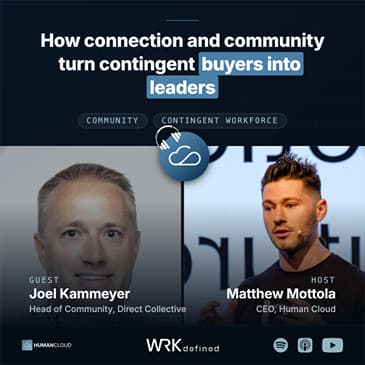
The contingent workforce is the one corner of business where the playbooks are not public. Banks, the Big Four, and Fortune 500 programs do not publish how they run their VMS, vet a freelancer, or catch candidate fraud. That knowledge lives in people's heads. Which means the leaders who win are the ones with the best access to other leaders.
Joel Kammeyer joined Direct Collective in June 2026 after 14 years running programs at Epiq and Cerner. Direct Collective is a curated community of 300+ contingent workforce leaders: Ask the Community, city chapters, monthly member matches, peer pods, and a no-fee job network for leaders caught in a reduction.
We're building Human Cloud to do the same thing for the supply side, so businesses can find, vet, and safely engage the right flexible talent solution in minutes instead of months.
In this episode, Joel shares:
- Why "buyer" is the wrong word, and how a peer network is what earns a contingent leader a seat at the table
- The three things keeping 300+ program leaders up at night: agentic AI inside the program, candidate fraud across the full worker lifecycle, and the freelancer and SOW spend still outside the VMS
- Why AI cannot replace peers in this industry: there is no public data, so the human in the loop is the data
- A day, a month, and a quarter in the life of a Direct Collective member, from Ask the Community to chapters and peer pods
- Why the hiring manager is already going around procurement, and what the carrot and the stick look like for leaders who do or do not build a network
Joel Kammeyer is Head of Community and Contingent Workforce Programs at Direct Collective, following seven years running the contingent program at Epiq and building the program and internal MSP at Cerner from scratch.
Listen now on Apple Podcasts, Spotify, or wherever you get your podcasts.
About Human Cloud: We help companies find and deploy the right flexible talent solutions in minutes instead of months. We automate discovery, compliance, and orchestration across 1,000+ workforce platforms, so business teams move fast, procurement teams stay in control, and rogue contractor spend turns into a strategic advantage.
Powered by the WRKdefined Podcast Network.
[00:00:04] [SPEAKER_01] But cool. All right, man. Well, listen, Joel, I've been excited about this since the announcement. And the first thing I did was text Austin and go, hey, can I have him on? So listen, we're very excited on behalf of all of Human Cloud and all our solutions to just meet you, to be honest. And so I think you want to do a little intro on yourself, Joel?
[00:00:28] [SPEAKER_00] Sure. First, thanks for having me on. My name is Joel Kammeyer. I'm the Head of Community and Contingent Workforce Programs at Direct Collective now. So I've joined Direct Collective in middle June this year. And that came after 14 years on the practitioner side. So most recently at Epic, Epic with a Q, Legal Services, e-discovery. I ran the program there for seven years.
[00:00:58] [SPEAKER_00] And prior to that, ran a program at Cerner. Actually started the program at Cerner. Cerner has recently been acquired by Oracle, but started the program there, built an internal MSP, knew nothing about this industry prior to that. So that's my background. And then I guess prior to that, I did events for Cerner, ran a lot of their C-suite events, internal and external. And then I was in baseball prior to that.
[00:01:27] [SPEAKER_00] So when I first came out of school, I wanted to be scouting and developing Major League Baseball players. Got into that for a few years. Did more sales side, worked for the Kansas City Royals. And here I am otherwise. So I've jumped around a little bit in my career, but I think each area has kind of added a little bit to what has now become a really fun profession in contingent workforce.
[00:01:52] [SPEAKER_01] So I have a funny question for you, Joel. What do you think? And I did not know about the baseball connection. So now we got something between you and I, and I won't tell you why, maybe you can pull it out of me. But what do you think about the Savannah Bananas, Joel?
[00:02:10] [SPEAKER_00] I went to a Savannah Bananas event earlier this year in Kansas City. So interesting. I will say I went expecting one thing. I really, I'll say one thing. I have a lot of respect for Jesse Cole, the owner. I think he's basically built something out of nothing.
[00:02:27] [SPEAKER_00] Kind of the Harlem Globetrotters, but not really. So it's an interesting view of it. So what I came out of, it's not anything about baseball, which I think minor league baseball has kind of been for a while, but you have better players there. Savannah Bananas, I would say it's all about the entertainment.
[00:02:45] [SPEAKER_00] I don't think I walked out of there spending less than $200 or $300 on merchandise. So obviously they're doing something right, but very fun. My three kids loved it. I, you know, they love going to major league baseball games too, but I would say there was more excitement for that event than any other baseball game we've been to.
[00:03:05] [SPEAKER_01] So, okay. So that's a good, it's very political response, Joel.
[00:03:09] [SPEAKER_00] It is a very political response. Being a baseball person, I don't necessarily need the flips and the, you know, the trick, trick plays, trick catch, just make the play and move on. But I do understand in the world we live in, in 2026, that's a more exciting brand of entertainment than maybe your historical boring baseball that some people think.
[00:03:34] [SPEAKER_01] So, well, so it actually, it does dovetail, you know, there actually is a bridge. Okay. There's a connection I swear with what we're going to talk about. And, and part of, part of this connection is that when we talk about this episode where I think we're going to just, you know, talk about for the next 30 minutes, I think we're going to talk about the power of community and connection and that enabling, you know, accelerating knowledge and actually building good programs and knowing where the future of work
[00:04:03] [SPEAKER_01] is what solutions, what partners you should go with. So the reason I bring up this bridge though, is historically in my eyes, there's been the South by Southwest, you know, jumping jacks or whatever you call them, backflips, Savannah Banana-esque, where you pay a bunch of money, you have a bunch of fun, get really drunk, you know, meet your friends, whatever. You have a really good time.
[00:04:28] [SPEAKER_01] And it's all in the corp cards expense. So you feel really excited. You don't really like learn that much, but like you have a great time. Okay. And then you go over to, let's say the baseball purist, which is the industry purist, you know, conferences, which is all of your industry peers.
[00:04:45] [SPEAKER_01] Now, this is where things are moving so fast. And, and where I want to kind of cut and put a little bow around this context is when, when we were enabling, you know, large companies to embrace a flexible workforce, the biggest barrier that we would hear would be nobody is doing this that I know.
[00:05:05] [SPEAKER_01] And then nobody can do this in my environment. And every single challenge would usually be solved by saying, actually, you look a lot like X, meaning the person or the company. And how about you just talk to them? And so literally, you know, the number one lead gen go to market, whatever, for us enabling large companies to scale these flexible workforce programs was nothing related to an ad or an email or the product itself.
[00:05:34] [SPEAKER_01] It was always related to just connecting individuals so they could talk and discuss, you know, what their challenges were, what their pains were, who they were using, who they were thinking about using.
[00:05:45] [SPEAKER_01] So this kind of dovetails into, all right, Joel, what is the future of actually navigating this crazy future of work? And I'm going to hold 100% just on the buyer side. So you are a leader, both in the talent space, not in the talent space. So I think that that bridges. Do you think that's a crazy enough bridge to go from Savannah Bananas into boring corporate conferencing community?
[00:06:10] [SPEAKER_00] Absolutely. Absolutely. It's great. Yeah, that's what these are for. So now I, it absolutely there, there's, we all have to be cognizant of technology and what that's bringing. I think the old of what worked in the past isn't always going to work in the present or the future.
[00:06:25] [SPEAKER_00] So, you know, just having an eye on that, I think you have to be open-minded in anything you do. So, you know, you want to talk about baseball or you want to talk about talent acquisition, contingent workforce, procurement, whatever you want to talk about, you have to be open-minded.
[00:06:42] [SPEAKER_00] That's one thing within the programs that I ran that I knew. I may have been at the company seven years running the contingent workforce program. No two days were alike, though. You always had some kind of challenge that came up. And so I think as you introduce AI, as you introduce direct sourcing, total talent management, there's all these buzzwords we all have used over the years.
[00:07:05] [SPEAKER_00] But at the end of the day, we're all trying to do the same thing, which is efficiently run a program, have the best quality, do it at an efficient cost, you know, and do it compliantly. So I think how you do that, what technology you use, you know, however you want to talk about it, you always have to evolve.
[00:07:24] [SPEAKER_01] So let's, can you start by literally just showing off about Direct Collective and just give us like the context, right? What is it? Who is involved? What's some of the magic? And I say that because, you know, most of our episodes, the show off doesn't happen until the end, to be honest, right? It's like, okay, like, tell me why you're really transforming work. Okay, tell me about the technology that you have. Tell me about your wins, whatever.
[00:07:49] [SPEAKER_01] But in your case, I know how powerful Direct Collective is. And so I'm going to go back to front and just say, Joel, can you please just start off? Please brag about Direct Collective and tell our listeners about it.
[00:08:04] [SPEAKER_00] So I'll start off, I'll say, I've always given Dustin a hard time because I don't think he sells Direct Collective enough. Well, now I'm in the seat and I don't, I probably won't sell it because that's just not the personalities that we have. But I do think I've been in the buyer seat. Dustin gets mad at me for calling them buyers, but I, you know, we're contingent workforce leaders.
[00:08:26] [SPEAKER_00] But when we're talking in the contingent space, it's buyer and seller. And that's what, you know, at the end of the day, we don't want to be known as buyers or leaders. But I think it's what Direct Collective is good at, what it does. At its core, we're a community of contingent workforce leaders. We are peer-to-peer networking, peer-to-peer problem solving. To your point earlier, there's a problem. I don't have to go solve this on my own.
[00:08:52] [SPEAKER_00] I think that's why a lot of the peers in this industry go to these conferences, why they attend webinars, why that, you know, at the end of the day, we all want personal connection. I should say most of us want personal connection. We offer that. We offer an efficient way to get to that. And it's a free membership at its core. If you want to do free, great. If you want to do more, we have that as well.
[00:09:15] [SPEAKER_00] So I think it captures, if you're a procurement or an HR or wherever you sit running a contingent workforce program, it doesn't matter. We're not tailored to one or the other. It can really capture whoever. And I think it's how do we get as many people into that to crowdsource the ideas to, you know, get as many peer-to-peer connections.
[00:09:37] [SPEAKER_00] And, you know, I was mentioning this to you before the episode, but, you know, what, how do we best connect that? So what direct collective runs off a platform called Circle is, is kind of our private area where we can all converse. We can all direct message. We can have access to a member directory. And the things that Dustin and I are building are to make that more efficient. So what is your program DNA? What's your tech stack? What are you looking to get out of this?
[00:10:05] [SPEAKER_00] What, you know, what, what's important today won't be important to you in a year or two years. So I think it's, we see so many people at, at a point in time, I need this solution. We should be able to offer that no matter what. So I think it's Dustin and I looking ahead and making sure that we offer that.
[00:10:23] [SPEAKER_00] And the, the unique thing about Dustin and about what he's built with direct collective is he listens to members. He's not going off what Dustin Talley wants. He's going off. What does our board say? Our board is made up of members. What are our founding members saying? What are the, you know, what are our members wanting? And so we really do a great job. You could have a thousand ideas and you could go work on all of those, but you're not accomplishing anything.
[00:10:49] [SPEAKER_00] I think he does a really good job. And I say he, now we do a good job of what are the five most valuable value add options that, that our members can get value out of. So that's, that's what in a nutshell, direct collective is, you know, how do we connect the community in the most efficient way?
[00:11:10] [SPEAKER_01] So I want to call it two things. The first thing I want to call out is it is hundreds of members yet a very individualist or individual slash protected slash curated network. Right. And I want to make sure to call that both because usually if you hear curated, you think, okay, it's two to 10 of the same people that I'm talking to anyways. Let me just connect with them. Right. Myself. No, no, no, no, no. We're talking about hundreds.
[00:11:38] [SPEAKER_01] But then if you hear hundreds, usually you think, oh, okay. It's just going to be like this massive Slack channel that no one actually knows each other and it's just making stuff up. No, no, no, no, no. So that's the first thing I want to call out. It's hyper, hyper, hyper, hyper curated embedding. The second thing I want to call out, Joel, and this is just me like showing off for you guys in terms of stuff that I know from, from seeing it from, you know, inception with us. And the second thing I want to call out is we all know about list day and Joel, do you know what I mean by list day?
[00:12:08] [SPEAKER_01] Blame it.
[00:12:38] [SPEAKER_01] I have seen it. And so I want to call those two things out just so you listeners know. And then what I do want to ask you, Joel is a day in, I want to talk about a day in the life of a member, a month of a member and a quarter of a member.
[00:12:57] [SPEAKER_01] Meaning what are the things that you see happening? And I bring it up by like day, month, quarter, because I also know that if it's something immediate, like, hey, this term seems off. Hey, did someone run into this? I know there's that quick ability, but then also I know that you're not just sitting back, you know, and doing nothing in terms of what are like monthly meetups or stuff like that. So give us a day in the life, a month in the life, a quarter in the life of the community.
[00:13:27] [SPEAKER_00] What I will say is a day, you know, if you look at it, like to your point, the day isn't always someone getting on direct collective that we don't, most of our members are pretty engaged, but a day may be, I'm going to ask the community. Like I said, I need a point in time. I need an answer on this specific question. So we have a feature that's called ask the community that is, and you know, that's fairly unique.
[00:13:50] [SPEAKER_00] I would say there's some that do similar items, some groups within contingent, but this is to your point. We have currently, you know, 300 plus members and you're crowdsourcing to 300 plus members. It's not 10 people. It's not 15 people. One of our members has seen what you're, what you're going through likely. So, and it's, you know, it's fortune 500. It's the top of the 500, but it's also the bottom of the 500.
[00:14:17] [SPEAKER_00] So you're seeing private public. So I think that's a day in the life. Just, um, you know, how do I connect with this person? How do I, I may not know where the answer is coming from, but I'm going to put it in the platform and I get five to 10 different answers back that, um, some may be relevant, some maybe not as relevant for where I sit in my tech stack, but that's again, something we're, we're going to make more efficient, um, going forward.
[00:14:42] [SPEAKER_00] But, um, a month in the life, I think there's chapters. So chapters are something that we're doing. That's new. It's not just a virtual network anymore. It's okay. We have Atlanta, we have Chicago, we have Bay area, we have New York, um, wherever we see our practitioners, our leaders that are in pockets.
[00:15:03] [SPEAKER_00] Um, you know, some of the ones that I just listed are some of our bigger cities, but if you want to join a chapter, we do, you know, and I say we, Dustin and I don't even have take, take part in a lot of that. It's really led by a chapter lead. And so again, to, to the point earlier, it's not just in our heads, what we're doing, our members are helping curate that experience too.
[00:15:25] [SPEAKER_00] So it's on a monthly basis, at least quarterly, these chapters are getting together and it's, Hey, sometimes we may want to go to a game, an event. Sometimes it's just a happy hour. Sometimes it's just, we're going to go to one of the companies and we're going to spend an afternoon just learning about how they're running their program, crowdsource answers and, and have it in a nice environment.
[00:15:48] [SPEAKER_00] So there's different ways to do it. So that's, that's one thing. The other thing on the monthly and sometimes quarterly basis is the member match. Uh, we do a lot of matches.
[00:15:58] [SPEAKER_00] So, uh, this is part of you join the community, you immediately get two monthly member matches. Um, you're going to be matched with a member. Some, you know, it's, it's AI it's, there's an algorithm. Um, sometimes we, we see a member, a member B, they would be great together. They need to meet. So, you know, we have a little bit of part in that, but, um, member matches it's, Hey, maybe I don't know anybody in this community, but I'm joining. And this is a way it's not forced.
[00:16:28] [SPEAKER_00] Interaction. You can, you can go and say, Hey, Jane Doe meet John Doe. And then they take it from there and they can meet as many times as they want after that, or they can just meet the once, but that's kind of up to them. Um, and then the other thing I'll mention, mention more on like a monthly quarterly basis would be what we call peer pods. Uh, if we see a, you know, something in the industry that's happening, a question that gets asked that has a lot of engagement.
[00:16:57] [SPEAKER_00] We'll stand up a peer pod and we'll either we'll facilitate that ourselves, or we'll let the member that asked the question facilitate that themselves. And it's five to 10 members that get together. And then they're crowdsourcing that idea and saying, okay, how do you do onboarding with contingents? How do, is it the same as you do with full-time employees? Do you make them sign NDA? You know, just, just a couple of topics that, you know, sometimes come up in those. How are you using AI in your program? How, you know,
[00:17:26] [SPEAKER_00] those are the types of ideas that you don't have to wait for that industry conference. You don't have to wait to go to an event or a webinar. You can find that day to day, month to month, however often you want to engage. Um, the other thing I want to mention that we see a lot of our members using this for the new world we live in, in 2026, there's reductions in workforce. There's changes all the time.
[00:17:52] [SPEAKER_00] You run a program for four or five years, you get bored or there's, you know, there's just certain things. Sometimes, you know, it's time for a new challenge. We can all also offer that. So, um, Dustin has done a great job just kind of organically growing this into more of a program, but doing the right thing for the industry. Uh, Hey, I may be looking for my next role.
[00:18:14] [SPEAKER_00] I may be in between roles because I was caught up in a, in a workforce reduction. We help connect those people as well. And, uh, we call it new era, but that is something that it's, it's about doing the right thing. We're not monetizing that. That's just, Hey, John Doe is looking for a job.
[00:18:32] [SPEAKER_00] They're a great leader and we can help connect them to their next role. So, uh, I know I probably mentioned more than what you bargained for, but those are some of the cooler, unique things that I think direct collective does that you're not going to get elsewhere.
[00:18:46] [SPEAKER_01] A little different than legal estate, huh? Just a tiny, tight net. But so, so I wonder, I mean, and you probably have not probably definitely have the closest, um, reach, um,
[00:19:02] [SPEAKER_01] of insights of pain, of priorities across, and I'm just going to call it the external workforce. Um, I'm not going to call it contingent intentionally. I think that word cracks me up. Uh, maybe that's something we'll talk about, Joel's like definitions in this space. What are they? Which ones are ridiculous? Uh, which ones will stay, which ones won't. But I really want to get into, you know, what are you seeing with your members?
[00:19:30] [SPEAKER_01] What's keeping them up at night? What are they worried about? What are they, you know, really prioritizing? I know before we, you know, we, we talked a little bit about remote and the fact that, okay, it's, it's not four years ago. People are going back to the office. Now remote is not as acceptable as it was. Now I say that you and I are sitting at home, not right. So I still see all my meetings, you know, 95% happen like this, not actually shaking hands. Um,
[00:20:00] [SPEAKER_01] and the ones when we shake hands, it's usually like a big meeting, right. Or something that's been prepared, not the first touch or whatever. But so, you know, what, what's keeping your members up at night? What are, what are you seeing right now?
[00:20:15] [SPEAKER_00] Um, I guess I'll point to three things. One AI. I think that's, you know, it's a buzzword in the industry and everywhere. Really? You can't turn anywhere and not have AI. So I think it's the, how do we not just use copilot or chat GPT or Claude just in our everyday work? How do we actually make it more of an agentic solution within our program? So I'm hiring manager. John Doe.
[00:20:41] [SPEAKER_00] And I need contractor ABC and I don't want to go into our VMS or our HCM or wherever you're going to have them log a requisition. I don't want to have to fill out a form for five minutes or 10 minutes and then get a job description and all, you know, all that. So how are we agentifying that? So it's okay. I have a need. I don't care how I feel that need. Sometimes organizations care if it's a full-time employer or contingent or freelancer or whatever.
[00:21:11] [SPEAKER_00] But how do we get that manager, the talent they need in the most efficient and cost-effective manner? And so I think using AI to do that, um, you know, it should be able to see that I'm Joel. I, the last five recs that I filled were for an automation engineer and they were based in Kansas city, Missouri. And they don't, all they have to ask me is here were the last five recs you filled out.
[00:21:39] [SPEAKER_00] Are we looking for someone similar boom and it's being sourced. So I think that's where to me, that's where we need to get. And I think that's where a lot of our program leaders are looking of, yeah, this AI thing is pretty neat, but how do we actually put it into use into our programs and how do we get our VMS partners, our technology partners to rapidly get that into production in their environments too.
[00:22:04] [SPEAKER_00] So that's one, I think two would be candidate fraud. Um, as technology has gotten better and has remote work has gotten more prevalent. Now you've seen all of the candidate fraud that comes in. So I think it's, there's been candidate fraud for many, many years back to when I was just starting in the industry, but it's, it's harder to track. It's harder to catch. They're always staying one step ahead. Um, so I think it's identity verification.
[00:22:35] [SPEAKER_00] You're personas, your personas, your personas, your one cosmos of the world, um, your ropes, AI, you know, there's a bunch of them now that, that do this. Um, but how do we plug that into the program efficiently so that there's not risk? Um, you're catching this upfront, but you're, you know, I helped implement some of this at Epic when I was there.
[00:22:58] [SPEAKER_00] You're doing it so it can track across the full life cycle of a worker. So it's, it's tracking a full-time employee, the same time, you know, same way that you're tracking a non-employee. And so from the time they first take an interview or even get sourced to you to the time right before onboarding to the time their first day to even six months in, right?
[00:23:24] [SPEAKER_00] You know, we, we, we saw bad actors that looked great on paper, showed up, did the job for three months. And then all of a sudden there was a switch that flipped and they were going and being fraudulent. So I think it's the full life cycle.
[00:23:37] [SPEAKER_00] How do you plug that into not only your program, but your full, you know, your cybersecurity people. Um, so that, that kept me up at night in the program seat, I know, and it's, it's very prevalent that that's, you know, pretty uniform across our, our members.
[00:23:55] [SPEAKER_00] Last thing I'll say is just freelancer management, IC management. I'll throw SOW into that. Whatever's not in your program, in your VMS today being tracked, um, or I'll just say program being tracked. How do we get that all in? So we have full visibility to our workforce. So some of your more mature programs have done that. So they're, they're in that, but there's still a ton of programs out there that they implemented their gen one, their gen two, maybe their gen three even.
[00:24:25] [SPEAKER_00] But they still have a portion of that workforce that they either aren't strategically managing or it's just rogue spend and they can't, they can't find a way to partner with their, within their organization to make that come in the program. So that's, that's typically, there's obviously a lot of other topics, but those are the three I would point to.
[00:24:45] [SPEAKER_01] I want to double click. Um, I want to go last to first, uh, and specifically when we mentioned like freelancer management, like I want to kind of start there.
[00:24:55] [SPEAKER_01] And I want to say, you know, the data that, that we rally around is that stat that like 60% of spend is rogue, which it sounds really good high level. But then if you go under, you're like, okay, what do you mean by that? Right. And the best way that I've understood that is rogue equals not planned for, not accounted for, and not understood.
[00:25:18] [SPEAKER_01] So you still might see, you might know that like, okay, we had, you know, $500 million of contractor spend. You might know it, but it's not planned for, you're not being strategic about it. And then these next two points is where it really hits.
[00:25:33] [SPEAKER_01] So for me, when I look at AI and when I look at just, let's say the reduction of layers, which to me, what, what, what drives me crazy about this space and, and mind you, I started in Silicon Valley tech. So I, I knew nothing about HR procurement. I still don't want to know anything about it, but I have to, uh, unfortunately.
[00:25:53] [SPEAKER_01] But to me, you know, first to last, this reduction in layers just makes more sense. And I feel like if you look at the, the industry of talent, which I would say, this is both the staffing and the contingent world. To me, it's been just adding layers to justify why you should get paid for somebody else working. Right. Like that is at the core.
[00:26:14] [SPEAKER_01] That is the talent industry is we make money when someone else does the work and we have to keep justifying that we have value and hopefully keep having a margin of, you know, two to 40% or whatever you want to call it. But so, you know, coming back to this original point of road spent to me, there's, there's two truths that I don't see changing, which is going to create a third truth.
[00:26:38] [SPEAKER_01] And that two truths are the first is that nothing beats a human. And when I say nothing beats, like actually a lot beats, but like, we're still going to need a human. And the second is there's always going to need to be some sort of support or service layer. Now, as that relates to AI, I, we're already seeing it. AI is just pushing on what's already broken. Um, it's not necessarily creating new good things.
[00:27:05] [SPEAKER_01] And what I mean by that is it's not really helping the interview process. Um, maybe it would help if only one side had it, but we now have this world where the person playing for a job is using AI, the filter screening for it is using AI. And at the end of the day, interview loops are just getting longer. Candidates are just getting more confused and TA teams are doing worse than they were before.
[00:27:26] [SPEAKER_01] So to me, the, the biggest problem I see in general is AI is not fixing the core of this talent industry, which is Joel, you just need to get good people to work with you. Right. That is really all we're looking for. And whether it's contingent or HR, we should all be doing the same thing, which is just, Hey, CEO, CMO, CTO, we're going to help you find the best people.
[00:27:52] [SPEAKER_01] Um, I threw a massive statement at you, Joel, and I have a question related to something like, you know, is that true? Is that not true? Is this what contingent leaders are thinking about? But what would you, what would you throw at the nuke that I just threw at you basically saying this industry is struggling?
[00:28:12] [SPEAKER_00] Well, I think first of all, AI, like, well, one, I'll back up. I grew up in talent acquisition within the contingent space. So I think you're absolutely right. I've applied for jobs before. You don't hear back for 12 months. And then all of a sudden you get this rejection email that they didn't even look at you basically, or they didn't know what they were doing. Or, you know, some organizations are just planting the seed to see who's, who might be interested.
[00:28:37] [SPEAKER_00] So talent acquisition at its core is a little bit broken in that way. Um, so what I would say is with AI, I think it has the potential to do great things. We can't lean on it exclusively though. So I say that because your decision making, I mean, I just, I just used chat to put together my son's soccer schedule because it was on these ridiculous apps.
[00:29:01] [SPEAKER_00] We have three different apps to track all the soccer games that we're going to be playing this year. And I needed one view of it. So I did that. It was great. It did it in a minute. However, the font was completely black and red in different parts. And so I think it's, to me, that points to, yes, it can be used to do what it needs to do, but then don't, don't just solely rely on it because there's still a lot of error.
[00:29:26] [SPEAKER_00] It still is going back to the lead source. And to be honest, contingent workforce data isn't prevalent out there. They're your public companies, your private companies. They don't have to report on a lot of what contingent workforce program is doing. And so I think it's, do we even have reliable data to go on? I mean, you talk to leaders all the time.
[00:29:47] [SPEAKER_01] And they shouldn't. We, we, we all know from a lawyer's perspective, they should not be making that stuff public. It'll never be public because why would you open yourself up to get sued? Why? That just makes no sense.
[00:29:59] [SPEAKER_00] But I think that's what makes our industry a little unique because a lot of other industries have access to public knowledge and a lot of the contingent workforce space just isn't public. And you're not even, you have leaders out there. I talk to leaders every day and some of them are very private about what they're sharing. And for very good reason, they're a big bank or they're one of the big four or whatever the case. I wouldn't share that either. They, they, they have to protect themselves. So I think that's what makes our industry a little unique.
[00:30:28] [SPEAKER_00] You can't just use AI to then rely on, Oh, here's how you implemented, you know, this VMS solution. Those playbooks don't really exist out there other than in people's brains, a lot of cases. So I think that's what makes it unique. And so, yeah, I, I wouldn't completely throw out that AI can't be used in any way, but I think it's, how do you plug it in, in the right places? So it's kind of a plug and play solution, but then kind of the human in the loop, you, you still have to have that human in the loop.
[00:30:58] [SPEAKER_00] To help make decisions, to help make sure that it's being guided the right way. You know, so I think that's, yeah, who knows where we're going 20 years from now? Maybe there's, maybe we get to something more like that, but humans still crave and value that human interaction. And if I'm a candidate, I don't want to just be talking to a screen. And then you're thinking, what's that experience? Is this really going to be my experience of, of going to be employed at this, this place?
[00:31:25] [SPEAKER_00] So I, to me, that's where the human interaction is still needed.
[00:31:28] [SPEAKER_01] Yeah. And I'd add, I mean, I, so part of, part of my background too is at, you know, at Microsoft, we were actually in a product team. So I came into the talent space and before that I was at Gigster. So software development, then into Microsoft and we were a product team solving product problems, not a talent team.
[00:31:50] [SPEAKER_01] And so when I would talk with HR and procurement people, I would always just look at them and be like, so what? And it would always come down to things like, why do we even care about a job description or a requisition? I have these specs that I need to get developed, right? Or I have this market that I need to tap and I have this revenue problem. Help me solve that. Don't just make my life more difficult by putting more steps in the hiring process.
[00:32:18] [SPEAKER_01] Cause at the end of the day, I actually don't even want to hire anyone. I just want to get my work done, but I know that it's going to be a lot better if I have these people to help us and we, and whatever.
[00:32:28] [SPEAKER_01] So that's one of the funniest things I'm always running into, especially when I'm at conferences, right? It's like, at the end of the day, like talent is not what the CMO really cares about. Um, nor should they, but if they don't have the right talent strategy, they're going to be screwed. Um, so that's where we come in as the superheroes. And I love, I love the way you put it in the beginning of this episode where you said, we are buyers.
[00:32:51] [SPEAKER_01] We want to be leaders, but we are buyers. And, and what I would potentially, you know, to put a bow on this episode, one of the things I would, I would tell you all listening is people or communities like direct collective enable you to be a leader because when you're sitting in a place of unknown data and you're sitting in a place of not having proof points of what your peers and your competitors are doing, then you're sitting in a place of having to figure it out yourself.
[00:33:19] [SPEAKER_01] But if you have someone like direct collective, you can realize right away. These are the solutions that everyone is using. These are the pains that they're running into. And guess what? Because now I'm not worrying about talent problems. I can be an actual leader and I can talk with my CMO from a talent and leadership perspective, not just from a, well, we need to follow this process. Well, we need. So that's, that's what I want all you listeners to know. Um, Joel, what do you think about that? The transition from buyer to leader?
[00:33:48] [SPEAKER_01] How can all of our listeners be leaders, not buyers?
[00:33:53] [SPEAKER_00] Well, I think it's just organically, this is happening. So as you said, that something that popped into my mind is just how much more strategic and extended workforce program has become in the workforce, because you just have, you know, we talked about layoffs and workforce reductions. All of that is leading to this younger generation that wants more valuable, challenging work.
[00:34:17] [SPEAKER_00] They are open to project work. They are open to doing, they don't necessarily want to work on a team all the time. You have managers that don't always want to manage people. So I think it's, it's all leading us to, we have more extended workforce. I don't always believe the numbers out there that it's going to be 50 to 90% of our workforce or whatever the case long-term.
[00:34:37] [SPEAKER_00] I think there's a lot of people piecing a lot of things together to make ends meet. Um, so when you say we have, you know, X millions of freelancers out there, sure. But we, I think we have, you know, a lot of people doing three or four different freelance jobs. So, um, what I'll say is I just think that there, there is a more strategic value to an extended workforce program. Now, um, we now need to have a seat at the table because we have become that,
[00:35:05] [SPEAKER_00] that, that strategic arm of the, uh, of finding talent. So I think it's, you know, whereas you used to just have a recruiter and you leaned on them to me, you, you, you go from a buyer to a leader, getting the seat at that table, finding credibility. And the way you do that is you bring valuable information, knowledge sharing.
[00:35:29] [SPEAKER_00] And that's where back to your original question or point direct collective can help you bring that in an efficient manner. Your leader comes to you one day, asked you a question you have no idea about, or maybe you don't, you don't know. Maybe you have one perspective.
[00:35:42] [SPEAKER_00] You need five other perspectives to say, Hey, look at it from this lens. And so I think you're becoming more valuable to your organization by having that network that you can rely on and go back to your leader with all those different perspectives and maybe make them think of things a little bit differently as well. So that's, that's how I put a bow on that one.
[00:36:03] [SPEAKER_01] So, so, so I would add that in current state, and I'm just going to say the full talent industry, both HR and procurement. And I, and I know you're going to hate me for doing, but I bucket you two as the same, uh, meaning the contingent side of procurement and HR.
[00:36:17] [SPEAKER_01] But the reality is we are at this inflection point. And I, I thought we were at inflection point in 2016 and 2019 and 2021. And the reason was because, you know, we were very early in a freelance world now flexible talent world.
[00:36:35] [SPEAKER_01] And basically anything that is, you know, flexibility at its core is what, you know, we help. But so we were early in this inflection point and this inflection point right now is driven by the underlying principle is that talent is broken. Staffing is broken. Agencies are broken and they're only broken because there's now another option, right? So if there wasn't another option, if there never was the internet, if there never was AI, then it probably never would be broken.
[00:37:00] [SPEAKER_01] But that's just like saying if, you know, the steam engine didn't create an engine, then horses would be around. So the reality is staffing and agencies, they are fundamentally broken. They take too long. They're too expensive and they're too generalist. Now the inflection point is the fact that the business teams and the hiring managers, they know that it's no secret that going through your existing TA or procurement team is just going to slow things down. You're going to hate working with them. That's no secret, right? The difference was there wasn't an alternative.
[00:37:30] [SPEAKER_01] Now there is an alternative. And so now when we talk about like freelance and whatever we want to say, it's all just independent contractors who can do things that prior they wouldn't have been able to do as much as they could now. So the reality of this inflection point is if procurement leaders don't step up and become leaders, the CTO is already going around you and they're already having their middle management go to platforms like remotely or gigged or others.
[00:37:56] [SPEAKER_01] And they might be using their corporate card. They might be opening up POs that you didn't approve. And the reality is they're finding creative ways to go around you. Now, AI just makes this worse and just makes this more risky because you know more than anyone, Joel, there's a legal component. There's a classification component from the workforce side. There's things like bias. There's things like cyber risk.
[00:38:19] [SPEAKER_01] And at the end of the day, unfortunately, you procurement leaders are going to be the one that gets the axe if all of a sudden there's a misclassification lawsuit or all of a sudden your AI went rogue because a contractor that you don't even know about was using it in ways they shouldn't. Right. So we're at this inflection point and you need you. Right. These people need to be in a community with their peers. There's the carrot and the stick. The carrot is if they join Direct Collective, they'll know what's best in class.
[00:38:45] [SPEAKER_01] The stick is if they don't, they're going to have nothing to tell their boss when they're on the chopping block and about to get fired. So that is my pitch for all you listeners to make sure you go to Direct Collective right now. Joel, where do you want all of our listeners to go to right now? Can they reach out to you? Do you want them to go to the site? Where do you want all of them to go right now?
[00:39:06] [SPEAKER_00] Well, directcollective.com is probably the best way. Obviously, reach out to me on LinkedIn, you know, wherever to get a hold of me. I'm Joel at directcollective.com as well. I'm happy to take anybody through it. Buy side, leader side, procurement side, even solution side. I think it's important that we connect the full industry to peers. So, yeah, directcollective.com.
[00:39:33] [SPEAKER_00] There's a lot of information that you can find there, but reach out anytime. I'm happy to help.
[00:39:38] [SPEAKER_01] And what do you want them to do on day one? Do you want them to tell their peers? Do you want them to introduce themselves? What do you want our listeners to also do on day one when they've joined the community?
[00:39:48] [SPEAKER_00] Day one is I always encourage our new members to introduce themselves to the community. Give one thing you're trying to solve or why you joined the community. What's your purpose here? So that always has sparked conversation of, hey, welcome, Joel, to the community. I've done that before. Feel free to reach out. So, yeah, absolutely. Within the first week, for sure, reach out to the community and you usually get some great
[00:40:18] [SPEAKER_00] answers and meet great people. I love it.
[00:40:21] [SPEAKER_01] All right, listeners, you know exactly what to do right now. Joel, thank you for hopping on. Listeners, a teaser. There'll be some fun collabs that we'll do over the next 6, 12. Hell, man, you're stuck with us for life, Joel. But listeners, go direct collective right now. Joel, thank you for hopping on.
[00:40:36] [SPEAKER_00] All right. Thanks for having me.
Sponsors
