
Everyone in go-to-market got the same memo: blast a million emails, automate LinkedIn, plug in an AI SDR, and watch the pipeline fill. It is not working. Inboxes are numb, positive replies get answered by bots, and the CEOs who tried to automate the whole revenue team are not doing well. Whatever is easy stops working the moment everyone does it.
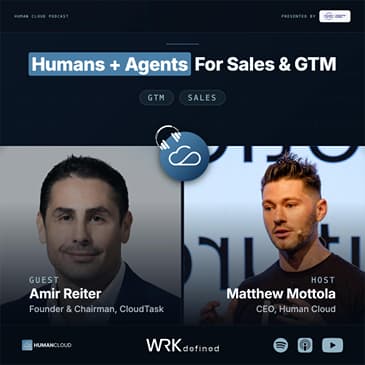
Amir Reiter built CloudTask so companies that are not Anthropic or Meta can still hire A-player sales talent: nearshore teams in LATAM, same time zone, paired with leadership in the US, with the systems and coaching to be productive in 90 days. CloudTask has staffed go-to-market teams for Expensify, Apollo, RingCentral, and Vonage.
We're building Human Cloud to do the same thing across every flexible talent category, so businesses can find the right partner for the hard roles in minutes instead of months.
In this episode, Amir Reiter shares:
- Why the AI SDR is not working, why "whatever is easy does not work," and why the phone, the five-minute callback, and the 60-second ad follow-up are the highest-converting plays again
- The barbell method: leaders in San Francisco or Austin, three SDRs per account executive in LATAM, and why nobody builds nearshore leadership unless they sell there
- Contractor of record vs employer of record: when a five-person remote team should skip the EOR, when an office or an IPO means you need one, and why the right agreement per person beats one policy for everyone
- The go-to-market structure for a 10-person startup, a 2,000-person company, and a Microsoft, and why you do not title a CRO before $15 to $20 million in ARR
- Agents that come with the talent: why the next LATAM hire ships with an agent, how AI already coaches and scores 100 reps every morning, and why Human Cloud and CloudTask are solving the same access problem from opposite ends
Amir Reiter is the Founder and Chairman of CloudTask, the LATAM-focused marketplace for go-to-market and sales talent, based in Medellín, Colombia. He also serves as CRO of a hyper-growth company, where he is building a 100-person sales team.
Listen now on Apple Podcasts, Spotify, or wherever you get your podcasts.
If building a sales team across the US and LATAM without the compliance headache is on your desk, Safeguard Global owns that risk for you.
About Human Cloud: We help companies find and deploy the right flexible talent solutions in minutes instead of months. We automate discovery, compliance, and orchestration across 1,000+ workforce platforms — so business teams move fast, procurement teams stay in control, and rogue contractor spend turns into a strategic advantage.
Presented by Safeguard Global. The employer of record that lets you hire, pay, and manage teams in 187 countries without the risk. Meet Safeguard Global on Human Cloud.
Powered by the WRKdefined Podcast Network.
[00:00:04] [SPEAKER_02] Real quick, before this episode gets started, I have a question for you. How do you scale both your local and your global talent? Do you take on the risk? Do you pay the taxes? Do you actually set up a local entity everywhere your talent is located? Well, I hope you don't, because today's episode is sponsored by Safeguard Global. Safeguard is one of the leading employers record since 2008.
[00:00:28] [SPEAKER_02] Now, there's a reason EORs are the fastest growing segment across human cloud. And that's because they are the have your cake and eat it to solution. What do I mean by that? Well, you get the flexibility of a flexible workforce with them owning the risk. Now, enjoy this episode and go reach out to Safeguard.
[00:00:48] [SPEAKER_02] All right, Amir. Listen, man. So for you listeners out there, this is going to be a fun one. It's going to be something to definitely, I would say, like 80% of your attention go to this episode, 20% go to Claude. You know, so most of brain, not a little bit of brain. But Amir, we've been talking for hell six months now?
[00:01:20] [SPEAKER_02] Feels like forever, Matt. Yeah, yeah. Feels like forever. So we first met, so Amir leads, and Amir, make sure to correct me. But so you lead Latam's largest sales slash growth related talent platform. And when we first met, I said, how the hell are you wrangling sales and growth? Because we've seen a couple applications of this, but it's really, really, really hard.
[00:01:48] [SPEAKER_02] Or even though sales talent should be the easiest to apply to this remote. I know, we'll talk about it. We'll talk about it. But so there's the context. And we've been, for you listeners, we've been talking for six plus months now to get ready for this episode. Just to, you know, going back and forth about, well, where is the industry right now? Where is, you know, sales and growth from a flexible talent perspective?
[00:02:16] [SPEAKER_02] But so there's the context. But Amir, you want to open it up with a nice little intro and where you're based? And you had a cool sweatshirt t-shirt that I love. So you're beating me with the sweatshirt game.
[00:02:28] [SPEAKER_00] It's one of these cold days here in Colombia. It's raining. It's raining season in Medellín. So I walked my dog. I was soaking wet, but he enjoyed it. But, you know, yes, we are focused on GTM and sales. We do have the legal assistants, the medical assistants. We got the engineers, right? But it kind of all starts with revenue related. And a lot of times revenue is the hardest. It drives all the other business, right?
[00:02:57] [SPEAKER_00] If you look at like demand, let's call it demand creation, right? Like the roles that create demands, right? Create revenue. They're usually measured on results and ROI. Results are demand execution, right? Like if you hire a development team, you know, the Jira project. And it's like, are they building the project on time? If you have a customer success, it's like, are they showing up to the account management? It's everything downstream is executing the work that the demand creates, right?
[00:03:26] [SPEAKER_00] So it's the chicken to the egg thing. You have no easy jobs, let's call them, without the hard jobs. So a lot of times people underestimate the hard jobs, which is sales and demand creation. And they think it's easy, but it's not. So, you know, one of the ways that we have been helping is that when it comes to the sales and demand creation GTM roles,
[00:03:51] [SPEAKER_00] we offer consulting services, training and coaching to build the systems. We tell people like, hey, look, Matt, you want to come and you want to hire a salesperson, you can hire them directly. No problem. You know, we're recruiting the staffing company. We have our own platform that allows us to match quickly and to execute the interviews fast, right? You can hire somebody. You want to staff them through us.
[00:04:16] [SPEAKER_00] If they're sales related, sales related requires a little bit of a time commitment because you're not going to hire an SDR and fire them in three months. You're going to give us six months. You're going to let us replace the SDR. If you want to hire an engineer or a customer success rep, you can staff them month by month. They'll profit. Those guys last forever. The reason why we offer lead consulting and training is because what we tell people is like, look, you have choices. You have product market fit. You got an SDR manager. You got a GTM leader.
[00:04:43] [SPEAKER_00] You got a system and you know it's and you got a training and you plug someone in. You know exactly how long it takes them to get up to ramp. You know how long it takes them to start executing. You can throw these people into the system, right? We work for partners like Expensify, like Apollo. They had product market fit, RingCentral, Vonage. They needed highly skilled people. We got them for them. We staffed them. They skilled. We have a team for Expensify that's probably done, you know, 15 million a month for a year, excuse me.
[00:05:10] [SPEAKER_00] We don't have a fraction of the team for eight years straight, but they have product market fit. We didn't build their systems. They built our product. They built our demand. And we made sure people showed up to work, were professional, learned their business and identified as Expensify. You know, they're in their Slack. They're part of the internal team. And then we're checking in with them, making sure that they're, you know, sending the reports, sending the commissions, right? Like calculating all of the busy work, right? But other companies that don't have product market fit, we give you an option.
[00:05:39] [SPEAKER_00] Give us 90 days to build a system and then choose to staff or hire directly. And also hire in the States if you want to, right? A lot of times companies, the companies that staff the best in LATAM have leaders in America. End of story. There's nobody coming and just building leadership in LATAM. The only companies that are building leadership in LATAM are companies that are selling in LATAM. If you're in Medellin, Colombia, and you're selling in Medellin, you build leadership in Medellin.
[00:06:07] [SPEAKER_00] If you're selling to the U.S., you need leaders in San Francisco, in Austin, in your offices, and then you scale teams to LATAM. Yes, you can find leader quality people, but you definitely want to build your team in what we call the barbell method, where it's like leadership's in the office.
[00:06:30] [SPEAKER_00] You have a CTO in San Francisco and you have a VP of engineering, and then you have five engineers in Florinopolis, Brazil, right? Underneath them. So, you know, we've tackled sales. Sales opens the door for other positions. So what we find is that once we earn the right in the sales spot, we get customer success roles. We get account management. We get engineers. There's a lot of landing and expanding.
[00:06:57] [SPEAKER_00] I think that works for a lot of companies in our space where they're first tested on the hard thing and then given the easier stuff once they win the hard.
[00:07:07] [SPEAKER_02] So I want to hit, there's two directions. So, you know, take your pick. And, you know, one direction is I do want to hit on what's been the impact of AI from a growth perspective. Everything from outbound, inbound, SEO, AEO, you name it, what's the impact there? Second direction is what's the impact of AI on talent? Meaning, do you just go hire more full-time employees? Do you go hire AI deployed salespeople? Is that even a thing? Do you go with talent platforms?
[00:07:36] [SPEAKER_02] Do you go with EORs? What's that doing to talent? Those are the two directions. Take your pick, Amir. Which one do you want to start with?
[00:07:45] [SPEAKER_00] I'll take a pick with just, you know, I'll flow with how you opened up, basically. Right? So, in general, some teams are shrinking, some teams are growing. Right? Right? So, what I find is that, like, some very tech-enabled companies that were meant to be small are staying small and they're getting to do more. Right? Like, I have a friend, a brother has an e-commerce company. They do 30 million in revenue. They have three employees. He was going to hire somebody through our marketplace. He said, you know what?
[00:08:15] [SPEAKER_00] I just built something flawed and I don't need that person. Right? So, I've seen that. And then I've seen people that are, like, growing super quickly that want to hire 100 SDRs to build an office because their offer has so much demand. And then they have so many positive replies to their emails that it makes sense to hire centers to call them back. Right? So, it really depends on the people's offer and how that works. And some people have self-serve businesses.
[00:08:41] [SPEAKER_00] So, like, some of the businesses that are really focusing on, like, the self-serve model are finding that they need just to hire customer success. And they can hire one for 25 customers. Right? And some people are finding that more bodies make sense. So, I think there's teams that are contracting, teams that are growing. It has to do with the company's DNA and how they're built. Right? And you're going to find that teams that were meant to be small are staying small.
[00:09:10] [SPEAKER_00] And teams that were meant to grow might be not growing as much. They might have 80 people instead of 100 people. But they're definitely still growing. And then when it comes to, like, EOR or contractor record, it really depends on your company. Right? And that's kind of we give people the flexibility. So, people that come with us, they can staff with us where we do the contractor record or vendor record. Or we could do EOR as well. But we tell people, like, if the team is remote and it's a five-person team, start with VOR. Vendor record, sponsor, contractor record. Let us handle that.
[00:09:40] [SPEAKER_00] If you want to build an office and you want to put them in an office and you're about to go publicly traded, then give them an employer record. Right? Right? So, I think the biggest thing with EOR or VOR is really just having the flexibility to know that, like, a small team remote, you don't need EOR. A team in the office, right? You need EOR. And when it comes time to go to the office, some of your old team might want to stay remote and be on contractor record. And some of the new people that come to the office might be on EOR.
[00:10:08] [SPEAKER_00] So, it's also just having flexibility, I think, so that you give the right agreement to the right person.
[00:10:15] [SPEAKER_02] That's what I've seen. Let's dig into good market. I want to dig into outbound. I want to dig into SEO. And I want to dig into sort of what's changed, what's changing. And I say that because, so, I mean, I started as an SDR, right? So, it was, I don't want to say it was predictable, but there, like, there was a proven playbook. And the question was always, like, oh, are you a challenger sale? Or it was, like, what kind of salesperson are you?
[00:10:44] [SPEAKER_02] But, like, the process was pretty predictable. Now, it seems like at least if you're sending, you know, now it seems like you're sending a million emails instead of a hundred. Or it's just dead for you. It sounds like, you know, you're either in AO or you're not. But what are you seeing from a growth perspective? Like, how has it changed for you as a CRO yourself and having your clients? How has growth really been impacted in the last year?
[00:11:13] [SPEAKER_02] And also, where do you see it going over the next five?
[00:11:18] [SPEAKER_00] I've seen both. So, as you mentioned, right, my, you know, I moved to the chairman of CloudPass. My wife's CEO now, right? I am the CRO of a hyper growth company. And they, you know, without sharing any secret sauce, we send a lot of emails. We also do a lot of calls. We also do a lot of ads. They don't do any SEO. So, I know that it really has to depend on your offer, right? Right.
[00:11:43] [SPEAKER_00] So, like, if you're selling, if you're selling staff, for instance, right? You might really do well with events and networking because it's relationship driven. If you're selling merchant processing or business insurance or things that every company needs, volume might be the approach. So, it really has to do with, like, it has to do with what you're selling, but it's all working.
[00:12:09] [SPEAKER_00] And people just need to adapt to the fact that, like, if you don't have a big TAM and you're selling a very, like, a $50,000 or plus product, you probably don't need to send a million emails. You probably need account-based selling where you're calling into multiple stakeholders. You're creating events. You're using LinkedIn. If you're selling a product that everybody needs, right, call it, like, you know, call it merchant processing.
[00:12:34] [SPEAKER_00] And every year, there's a million net new businesses that start. You might want to email them the day they start, right? And you could use tools to pull the registrations of new ones, right? And that's a volume game because that's timing, right? They know their new business. They need security for their business. Is there an office? Do you need a water cooler? Some of them just need, they even need, like, a water cooler for their, you know, like, Nestle water system, right?
[00:13:02] [SPEAKER_00] Hey, so you started, Matt, in your office in Boston. Maybe we could help you out with Nestle cooler, right? It's going to be, like, you already knew you needed to hire. You already knew that you needed to put a coffee machine in your office. So, that first email that comes to you, like, yeah, put a demo for free, right? But if someone wants to sell you on building an SDR team, you're going to want to vet that person out. You're going to want to see on LinkedIn that they're posting about connect rates, call rates. You're going to see them on Twitter getting into conversations.
[00:13:31] [SPEAKER_00] You want to build authority knowing that you're hiring a service company with the expert, like, there's expertise, right? And then, when it comes to selling style, that's kind of where, like, there's different people who have different, when you're selling different things, you have to have a different authority, right? When you worked, I know that you worked for, I call it, was it Microsoft?
[00:13:52] [SPEAKER_02] Yeah, yeah, yeah. Yeah, yeah. One of the many.
[00:13:55] [SPEAKER_01] And you built big, large teams, right?
[00:13:58] [SPEAKER_00] Of, you probably were sold by the person who had the built it for before for billion dollar companies. And they probably had authority, consultative, right? And you felt comfortable that that person's 10 years of experience that became your experience, right? So, I think it just has to, a selling style has to adjust between what you're selling, where there's a consultative approach when you need expertise, right? And then, there's the listening approach when it's like, hey, I need this kind of coverage for my insurance.
[00:14:28] [SPEAKER_00] Yes, here's a quote, right? Here you go, right? So, just, I think, I think there's a lot, I think a lot of the same principles remain. People just need to not get distracted with all of the distractions and the need to focus on the core principle of, like, is my offer clear? Do I know who my ICP is? Am I giving them more than just asking for a meeting, right? Like, I know how your product works, right?
[00:14:55] [SPEAKER_00] You don't just ask people to pay for money. You give people a free listing, right? I wish. I wish. You give them a free listing. God, that'd be nice and simple. You give them real estate on your platform that has a lot of traffic, right? You have, what, 40,000 buyers coming in every month, something like that? I lost you for a second.
[00:15:21] [SPEAKER_02] You're good. You're good now.
[00:15:22] [SPEAKER_00] Yeah. Yeah. So, you have, what, 40,000 buyers searching your platform? Yeah, I think it's like 38,000. That's funny, but whatever. Yeah, it's a lot. So, you invite people in the real estate, right? You give them a place to talk about their businesses. You talked about SEO and AEO. You are part of AEO and SEO, right? Yep. When I put CloudTask on your platform, it gets indexed. It comes up, right? So, you're running a product-led where you give value first.
[00:15:52] [SPEAKER_00] You give community. You invited me to community calls where I have met other smart people, right? So, if you look at your approach, you're building an asset that attracts the right buyer. You're giving people the opportunity to be part of that, right? And then you're slowly giving them options based on what they need, which we can talk deeper in a different time. But I like that approach because it's very much value-driven. It's not transactional, right?
[00:16:23] [SPEAKER_00] Obviously, there's other things that happen with that, right? Where we could have a huddle and talk about converting and things like that. But it's definitely a good approach. And yeah, I'm like, you mentioned SEO, but AEO is a really big deal. And the big difference to AEO is it's more like people just asking questions. Like, how do I get more business for my staffing platform?
[00:16:49] [SPEAKER_00] You know, what are the best platforms to help me get visibility and buyers if I'm a marketplace for talent, right? You'll come up, right? So, it's really just answering questions that people are asking and then being, you know, like sometimes in Reddit, all of a sudden Reddit's really working and it's not. So, it's just really like, you know, building, being there for answers that people ask on. And it's part of SEO, right?
[00:17:15] [SPEAKER_00] It's really connected, but just writing it almost like the title of your blog is a question, you know? So, that will come up.
[00:17:22] [SPEAKER_02] Let's dig into CloudTask. So, tell me, tell us why at first. Tell us what you've learned and what you think, you know, a year to five years from now. What will, I'm going to say the majority, not all obviously, but what will the majority of go-to-market talent? How will it be structured? But let's dig into the CloudTask story.
[00:17:49] [SPEAKER_00] Yeah, I'm like, the CloudTask story started really strong with SDRs and building sales teams. It's kind of coming back to that because I think with all the AI SDR stuff where it's just not working, and I'm not saying version 10 won't work, but I think that people calling and having conversations is very much back in the need. Because like, whatever is easy doesn't work. So, it's easy to blast emails. It ends up not working, right? And automating LinkedIn and you get these unpersonal messages and you respond back and it's clearly a bot, right?
[00:18:18] [SPEAKER_00] And so, like, what's working with CloudTask right now is like seeing who's following our competitors and starting conversations with them, right? Like, hey, I noticed you follow XYZ, love to chat. Maybe you already know about Nearest for Hiring, right? Our newsletter is great. It's got 100,000 people, right?
[00:18:38] [SPEAKER_00] You know, right now, the CloudTask is run by David Manjura and Michael Sanchez and these guys just do a great job of speed to lead following up with positive replies or people that connect to LinkedIn calling them within five minutes, right? So, the big thing is like, if you're going to run ads, call them back within 60 seconds. If you're going to run outreach and someone says, yeah, sure, I'm interested. Or send me a resume, right? Send me a profile.
[00:19:07] [SPEAKER_00] Call them back in five minutes. So, just kind of connecting the phones to everything that we do and using AI to just build lists really fast and to research, like, who's following. And also, you know, trying to find out people that are about to hire, right? Like, there's job openings. By the time someone has a job opening, they've already made a decision that they're going to recruit internally. So, it's better to call them 90 days later if they can't fill it.
[00:19:35] [SPEAKER_02] Why CloudTask, though, Amir? Like, literally, first principle. Like, why did you even start in the first place?
[00:19:40] [SPEAKER_00] I just saw an opportunity to help companies scale near shore because I noticed that, like, it's hard to basically... What I like to tell people is that if you want to hire the best people in America, you can't just pay 120 grand, right? So, like, you got to pay, like, 180, right?
[00:19:58] [SPEAKER_00] So, I think that people can build better teams by getting A players in LATAM to join the best people in America and pay 40% more than you were going to pay for a U.S. person. Get the best person and then pay $50,000, $60,000 a year in LATAM to get a type A player. So, I just saw that you couldn't... Most companies were not Entropic or Fmeta. They couldn't hire 300,000 or $300,000 people, right?
[00:20:26] [SPEAKER_00] So, I just wanted to bring that level of expertise to the SMB where now companies that were sub a billion dollars, right, could access really high talent. You look at companies like Microsoft, Amazon, HubSpot, Salesforce, they all have offices in LATAM. So, you have a lot of small companies like, oh, I can't... You can't hire someone in LATAM. Like, a billion-dollar company has been here for 10 years making billions of dollars, you know?
[00:20:57] [SPEAKER_00] But, and so, yeah. So, I just saw an opportunity where those people are really smart and I think that people should be building global teams. I'm hyper-focused on LATAM, but I think places like... I think, you know, India's great, Philippines's great, Egypt's great. I like Africa's probably got a huge future. So, you know, I'm... You know, near shores, just in the same time zone. A lot of the people have visas, they come close by. So, like, I'm just specializing in a region, right?
[00:21:25] [SPEAKER_00] But it works well with other companies too that, you know, use EOR and they have teams everywhere, right? A team that has 50 people in Colombia could also have a team in India and they could also have some people in South Africa, right? But specializing in what they do best, right?
[00:21:44] [SPEAKER_02] Which, tell me about this, the perfect team dynamic. So, let's say... Let's actually bucket into three different types of companies and I wonder your response. So, let's say first, there's like a 10-person startup, right? Small and they're like, hey, we need to build out a go-to-market function. Okay. Then let's say there's a mid-sized company. So, let's say it's like 2,000 employees and they are trying to grow, right? They're going to market function. And then we'll say Microsoft. Then we'll say like 100,000 employees.
[00:22:14] [SPEAKER_02] How would you respond to all three, to those three from a team structure perspective?
[00:22:22] [SPEAKER_00] Yeah. So, the small business, I'd have like a... I wouldn't have a CRL until I hit like 15 to 20 million AR or I wouldn't title them that. I would have founder-led growth where you're hiring individual contributors that want to earn that role. And I probably would hire a account executive that can prospect and those that will build systems supported by a sales development rep in LATAM.
[00:22:47] [SPEAKER_00] So, I'd probably build a pod where I'd have three SDRs for every one account executive if I was a small company. I'd also look for a GTM person in LATAM. Supply is low, right? So, if you can't find it in LATAM, you know, you might want to do other regions or the United States. It's not exclusive LATAM. And then if I was a company that is... What was the second one you said? Second bracket? 2,000. 2,000. 2,000 employee.
[00:23:16] [SPEAKER_00] Yeah, you're building an office at that point. You might either have a remote center excellence or an office. You know, like HubSpot has 400 people in Bogota. They do account management, customer success reps. I just run that play. You're quite profitable, right? And then if I was a Microsoft huge company, I would be cherry-picking all of the guys with 10 to 15 years' experience working with SaaS companies that are ready.
[00:23:42] [SPEAKER_00] I met a guy that was working at Microsoft, actually, in Bogota that sold $3 billion of digital services through... I think it was Google. DeepMind or something like that for, like, African countries. And he was making $6,000 a month base, maybe 150K plan, but he was 20-year experience, 40-year-old, right? So, I would be just building, giving better jobs out, giving higher-paying jobs to the best people that have 15, 20 years' experience. And just the same play in America, right?
[00:24:11] [SPEAKER_00] That's what happens.
[00:24:13] [SPEAKER_02] And with agents, Samir, how... So, let's say that I'm a CRO who's like, all right, I'm going to replace everyone with agents. That's like that extreme, right? Actually, there's two extremes, right? It's like, you know, I'm not even a CEO. Let's say extreme one. I'm a CEO over here. I'm a CEO who says, let's replace it all with agents. Fire all the STRs. Fire all the account reps. All agents. And then over here on the left, we have the opposite, who is AI's bullshit, right?
[00:24:43] [SPEAKER_02] AI's bullshit. It's a farce. I don't believe any of it. Where do you fit in this spectrum? And then how do you account for agents and my growth human team? Let's be specific. What agents are you talking about? You tell me. You tell me. Let's start with, I'm the CEO who wants to automate everything. I'm like, hey, I just gave you a club.
[00:25:03] [SPEAKER_00] Those CEOs are not doing well. The only CEOs that are doing well that want to automate everything don't automate everything. It's like the bolts of the world, the lovable. They all have product market fit. They're getting 500 users signing up on their website. They're hiring people like crazy. So, you know, like it's kind of bullshit if you don't ask me. Like they're not doing well. The companies that can use agents, they're not.
[00:25:30] [SPEAKER_00] I'm like, you know, I talked to a guy who was running customer success for globalization partners. He had 300 customer success reps. He did 150 million in revenue. They weren't using agents. They had people. I think these companies like Decagon and like they're like these big billion dollar agent companies. Like I think they're cool. The people who think they're the coolest are the CEOs that love tech.
[00:25:56] [SPEAKER_00] So like when I talk to like a product led CEO, he's like, oh, I went through Fireflies and like they have this AISDR and it was awesome. Right. So it's like the techie CEOs love the agents because they're thinking about like how cool it is to replace people with agents. But the normal people don't. I don't find that the normal people do. And then when it comes to like even AI and STA interviewing interviews. Right. Like I would go through an AISD interview if I was like going into the Y Combinator or Yale or Harvard. Right.
[00:26:25] [SPEAKER_00] So like it's like who you are. You could throw up that filter. Right. But like if you're trying to get the best talent, it's really relationship driven. I think the world, the future is going to be mixed between agents and people. Right. I think, you know, cloud test future. Right. I got to talk to Jessica's the CEO. She's running the show now. It might be end up being agents and people. I don't know. Right. But I think I think at the end of the day that it's just going to be a tool.
[00:26:53] [SPEAKER_00] And when people say I have AI to me, it sounds like I use a computer. I'm a spreadsheet. Yeah. Right. It's like I'm not impressed.
[00:27:00] [SPEAKER_02] Yeah. I do think I mean, like our personal journey here at Human Cloud is you can't replace sales. So to your point, like I do think sales is least prone to replacing with and I'm just going to call it AI because I think agents are just a function of AI. Right. Like at its core, it's like a terminal. Right. It's like a terminal that I interact with. But then they AIs in the background doing it all. But so sales, very, very not prone to getting replaced.
[00:27:31] [SPEAKER_02] Marketing. Highly prone, man. I mean, I think most marketing is is totally getting getting gutted by AI. With that said, the marketing leaders that are good are now a hundred times more valuable.
[00:27:45] [SPEAKER_01] And there's going to be more marketing leaders for companies.
[00:27:48] [SPEAKER_02] There's wasn't a supply. I don't I think it's going to be a rearrangement. Yeah, but I don't see there being more marketing leaders. I'm sorry. I can't see that. It's kind of like saying there's going to be more accountants. But there wasn't enough to begin with. No, there's going to be.
[00:28:02] [SPEAKER_01] There was one good marketer.
[00:28:04] [SPEAKER_00] There was one good marketer for like every ten thousand dollars.
[00:28:08] [SPEAKER_02] Yes. And now now there's a hundred marketers for every company or something. There was a lot of marketers. And you don't need all that. You don't need all the marketers that there were just like accountants. There was a lot of accountants that you really didn't need to have a hundred accountants. One accountant is fine now. Just using just think the workforce is going to change.
[00:28:28] [SPEAKER_00] It's going to change fast. I just think how companies are going to be built are going to be changed quickly where they're going to be a mix of global talents and agents and global talent using agents. That's already happening. I agree.
[00:28:42] [SPEAKER_02] But I think sales is less. How do I say this? Sales. Slower to change. Yes. And just more. The human impact will always be more. Like if we were to say if we were to start fresh and we were to say marketing budget, sales budget. Let's say one human, one human. And then we were like, okay, let's watch this grow as the company grows. I think it used to be, let's say if it used to grow like this.
[00:29:08] [SPEAKER_02] Now it's going to be sales is going to maintain much more humans to grow. Whereas marketing, it's going to be like, ooh, we need way less humans to grow marketing.
[00:29:19] [SPEAKER_01] I'm like marketing is also GTM. It's true. You know, it definitely is true.
[00:29:26] [SPEAKER_00] So it's also sending emails, automating LinkedIn. I just think I understand what you're saying and I agree. But I think that a lot of the people that will be displaced will also become small agency owners and they'll use agents to help other companies. So you're probably going to see a lot more businesses.
[00:29:43] [SPEAKER_00] So instead of seeing a million marketing leaders to support a workforce of, you know, a billion marketing leaders to support 10 million companies, you might have a million marketers supporting 100 million companies. You know what I mean? Like using agents. So I just think it's going to reshuffle, right? If that makes sense.
[00:30:03] [SPEAKER_02] There definitely won't be less. Meaning us humans, we seem to always find more stuff to do.
[00:30:10] [SPEAKER_00] Yeah, we'll be more creative, more building things, right? Exactly. Like more people like you building, you know, building your business and coming up ideas on how to help niche industries, right? Yes.
[00:30:22] [SPEAKER_02] We will have a nice experiment, Amir. In five years, we'll see. We'll put it down in this moment. We'll see. Are there going to be more marketers or less? I'm claiming less. Or I'm claiming the growth of marketers is less.
[00:30:35] [SPEAKER_01] But they just changed their name. Sure.
[00:30:39] [SPEAKER_02] Sure. You know how it's separated? I'm a GTM guy now. You know how it's separated? Is if there's human-to-human contact needed, that will require more humans. If there's not that, like for example, software development. Perfect example. If you told me 12 months ago, the field of software development is going to be so at risk or as much at risk as it is now, I'd be like, no way. Like what would I have told my kids 12 months ago?
[00:31:08] [SPEAKER_02] Major in computer science. It's the hardest thing. It's the hardest thing you can do. Now? Not a shot. Now it's like, unless you truly love software development, it's probably the dumbest field to go into. Just meaning like... It's growing though! The demand for software development is growing. It is for really good developers, but not at large companies. But they're all going to become really good developers. I doubt it. Or something else. I doubt it. Unless you really love it.
[00:31:34] [SPEAKER_02] Like you talk with software devs right now, most of them, they're just plugging into Claude. Not the really good ones.
[00:31:41] [SPEAKER_00] That's fine. Not the really good ones. I think it's going to change. Right? And, you know, ironically, to what you're saying, I'm realizing that like obviously my skill of building people that can sell on the phone is actually really in demand. Right? Like as I said, I'm on a mission of building a team for 100 people for my current role, which I'm super stoked about. Right? Right? And also just can see that people just need teams to have conversations with people. Right?
[00:32:06] [SPEAKER_00] And that AI is actually used to coach, train, and score the calls. So I'm actually able to run schedules every morning that literally go, hey, Jessica, last yesterday you made 15 meetings.
[00:32:20] [SPEAKER_01] Here's your areas of improvement. You can focus on this, this, and that.
[00:32:24] [SPEAKER_00] And I'm messaging my whole team with one button and scoring everything and able to almost be like a personal trainer for a team of 100 people. So, you know, and that's kind of like where, you know, I'm focusing in a lot of our expertise here, you know, here at CloudTask and what I'm doing is just getting people on the phones. But, yeah, the world's going to change, but the world's always been changing. Yep. Yep. Yep.
[00:32:51] [SPEAKER_00] So the speed and uncertainty is uncomfortable, but it's always been uncomfortable.
[00:32:59] [SPEAKER_02] True. That's true. Can you imagine time it wasn't? If you get a hug, I can come over there and give you a hug. I want to talk about it. No, I can't wait to see this play out. Boy, I'm actually going to get my, I know, you can tell. I'm going to get my agents to make sure that we got the right data input to capture the right way to measure this. And then in two years, I'm going to be like, ooh, either I'm massively right or massively wrong.
[00:33:24] [SPEAKER_00] Have your agents talk to my agents, all right? And then one day we'll talk and realize that the agents just consumed a lot of tokens and didn't do anything.
[00:33:31] [SPEAKER_02] You know what hit? I will say one thing that does hit me when going to a lot of these, so these past three weeks were like conference, conference, conference. And one of the things that really did hit me is the field of recruiting, I do think, is getting massively disrupted as of now. To your point, they're like, we're going to need more talent. So maybe the recruiters will whatever, figure it out. But with that said, if I see one more AI recruiter, I'm going to blow my brain out.
[00:34:00] [SPEAKER_02] So I'm annoyed by that.
[00:34:01] [SPEAKER_01] I just think I'm going to disrupt this. People want faster interviews, faster quality. It's just the people who don't move slow are going to be out, right?
[00:34:09] [SPEAKER_02] And to your point, if you're YC, you can do an AI interview. I'm sorry, but like the majority of companies cannot do an AI interview. It's just like resumes. You're only going to find the people who really need a job, not the people who are really good.
[00:34:22] [SPEAKER_00] Yeah, but people are really good. You actually like when I did recruiting stuff heavy, I would cold call candidates and I would find geniuses who would be like, yo, I am making 300 grand. Man, if you can go get a 450 and I have all these skills and I'm like, no problem, man. Like, like I'm looking for the people that are worth 450. Right. So like, no, man, I think the phone and relationships are huge. Right. But I love, I love both. Right.
[00:34:48] [SPEAKER_00] Like right now, like I have in my house, I have a new Mac pro 14, 64 gig Ram M5 processor. I'm using, I got chat GBT, right? I got, I, while we're talking, I have a clone code running some stuff. I got codecs running some stuff. So like, I just like both. Like, I think there's a world where like both where like, you can, like, I could fly and be like, hey, Matthew, let's go out and have dinner. And let's, you know, Matt, hey, Matt, let's go have dinner.
[00:35:16] [SPEAKER_00] Let's go talk about business, but also have my agents running. So like, I am personally just trying to maximize both. I agree. All right.
[00:35:24] [SPEAKER_02] Last question. Cloud task. We're going to be in five years.
[00:35:28] [SPEAKER_00] I think we'll be two years between New York, New York and agents.
[00:35:33] [SPEAKER_02] Ah, all right. What, what is going to change the most about what you're doing today and in two years?
[00:35:42] [SPEAKER_00] Agents. Agents that come with talents. So like I can picture somebody coming in and hiring, you know, somebody in LATAM that's an SDR, but comes with an agent, has a support of an agent, right? So that's kind of where I see the future.
[00:35:58] [SPEAKER_02] That makes total sense. All right. Most important question here. Where can our listeners find you? Cloud task. What do you want them to do right now? What's, what's your season?
[00:36:07] [SPEAKER_00] Right there. Salesperson. Yeah. Come, come check us out. Um, you know, talk with David or talk with Mike and, uh, you find me on LinkedIn. Amir Ryder, or you could find me. Um, yeah, LinkedIn's the best or Instagram or, or, you know, Tik TOK. So I mean, you know, I mean, I'm not, I'm, I'm not on Tik TOK much, but I'm, I'm easy to find that.
[00:36:30] [SPEAKER_02] All right, everyone. Go to Amir's Tik TOK. Thanks for hopping on, man.
[00:36:35] [SPEAKER_00] My Tik TOK straight. All right. See you, dude.
Sponsors
