
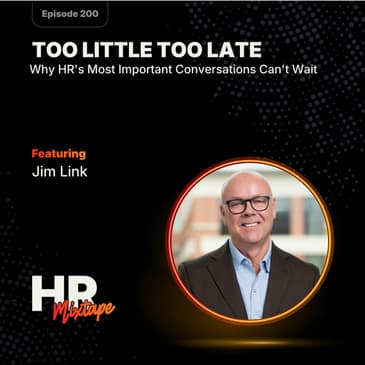
Retention sits near the top of almost every HR priority list. The main tool most organizations use to understand it is a conversation with someone who has already quit.
Jim Link is the Chief Human Resources Officer at SHRM, the largest HR professional association in the world with more than 340,000 members. Before SHRM, he spent three decades in HR at GE, Porsche, and Randstad, where he held full HR accountability for a $5.2 billion business with up to 100,000 employees.
In this episode, he covers:
• Why the reasons your best performers stay are usually a different list from the reasons other people leave, and what that does to a retention plan built on exit data
• How a written performance review becomes a static record that can work against the organization later, especially when the rating feeds a compensation formula
• What SHRM's 2026 State of the Workplace report found about employee experience, including a 91% to 44% split in reported job satisfaction
Timestamps
[00:01:17] Turning the exit interview into a stay interview, and asking the people you want to keep what's keeping them there
[00:01:38] Why leaders wrongly assume stay interviews will produce the mirror image of exit interview answers
[00:02:22] Knowing one personal fact about every person on your team, and why that single connection changes how you manage
[00:03:39] Separating performance ratings from compensation, and what happens when a 2.3 out of 5 turns into a .06% raise
[00:05:39] How an overly glowing written review becomes a bad fact if the employee later exits under performance or restructuring
[00:07:32] Employees and employers both know today's skills won't carry forward five years, which makes the gap solvable
[00:09:10] The risk of cutting headcount before anyone in the organization understands what AI can actually do
[00:12:02] What separates organizations moving the needle on manager development from the ones running the same programs every year
[00:13:48] SHRM research showing 91% job satisfaction where workplace needs get addressed, against 44% where they don't
[00:15:29] Treating stress and burnout as an organizational liability a CHRO is expected to manage
Guest Bio
Jim Link is the Chief Human Resources Officer for SHRM. With more than 340,000 members around the world, SHRM is the largest HR professional association in the world and the leading voice for matters related to workers and the workplace.
Prior to joining SHRM, Link's career included roles of increasing responsibility across a variety of industries and companies including General Electric, the Pillsbury Company, Porsche Cars, and Randstad. While at Randstad North America, he led a global team of 150 HR professionals who were instrumental in transforming the company into an award-winning, inclusive, and sustainable global leader.
Link consistently demonstrates dynamic and visionary thought leadership with a variety of presentations focusing on the interconnection between effective human capital management and business results.
Brought to You by Paylocity
Paylocity is the fastest growing unified platform for HR, Finance, and IT. Paylocity brings your people, processes, and data together in one place so HR leaders can spend less time managing systems and more time doing the work that actually moves their organizations forward. Learn more at paylocity.com
Keywords: stay interviews, exit interviews, employee retention, performance management, continuous feedback, compensation strategy, internal mobility, upskilling, AI in the workplace, critical thinking skills, manager development, middle managers, employee experience, State of the Workplace, burnout, workplace stress, SHRM, CHRO, HR leadership, talent strategy
Powered by the WRKdefined Podcast Network.
[00:00:01] You're listening to the HR Mixtape, a podcast for leaders who want to understand people, strengthen culture, and navigate change with clarity. Today's conversation starts now.
[00:00:15] Joining me today is Jim Link, Chief Human Resources Officer at the Society for Human Resource Management. He brings more than three decades of HR leadership across companies, including GE, Porsche, and Randstad, where he held full HR accountability for a $5.2 billion business with up to 100,000 employees. Jim, as always, it's so great to sit down with you at SHRM.
[00:00:44] Hi, Sherry. How are you doing? I'm doing great. And this is one of the highlights of my year. And I always have to make sure that you're on my list because we have such great conversations. Thank you. I always look forward to these events as well, particularly talking with you. And there's a lot to talk about today. There is. So we're going to get short and sweet because I want to make sure we get to everything. So we're going to start here.
[00:01:03] Retention is still a top challenge in most organizations, but they're still running exit interviews as like their primary diagnostic need to kind of understand what's happening. What should they be doing instead? Those exit interviews, it's too little too late. It's the best way to think about that. Why not turn an exit interview into a stay interview and talk to the people that you really want to keep in the organization and find out what's keeping them there?
[00:01:31] What most people wrongly assume is that they'll hear the opposite of what they hear in an exit interview. That's not the case. The things that retain people are often different than the things that make people want to leave. And so having a deep, thorough understanding of what keeps people in your organization, particularly your best performers and the people you really, really want to keep is often enlightening. And you can build entire HR programming around those things that you learn in those stay interviews.
[00:02:01] The other thing too, I think you have to do is just be engaged in dialogue with your employees on a day-to-day basis. Nothing should be a surprise to an employee about their performance or your expectations of them or how you feel they are doing or what their skill gaps are or what their needs are. So that open dialogue, encouraging that is tantamount. I always tell my leaders they should know at least one personal thing about every person they work with.
[00:02:29] And that's particularly true on like large teams, right? If you know the name of a person's child or their pet or that they like to play softball on the weekends or whatever, just one fact is a connection. And the more of those connections you can have with a person, the better you're going to be able to be as a manager and the better you're going to be in your attempts to retain them in that work. Yeah. And I would say for those that are introverts where that might not come naturally to remember that information, it's totally okay to have a note in your phone with that information on it.
[00:02:59] One hundred percent. And matter of fact, I use a personal phone calendar system where I write down things that I wouldn't necessarily want showing up on my work calendar, right? Like, you know, Sally's cat is named Meow, right? Or whatever. It's these types of things where you really just want to build that connectivity and good for you for that record keeping, right? Yeah. So you talked a little bit about that ongoing conversation. So I want to switch to performance management. You know, there's not a perfect scenario, I feel like, right?
[00:03:28] We've tried annual reviews. We do constant feedback. We kind of go back and forth. Is it linked to comp? Is it not linked to comp? What are you seeing kind of emerging now as best practice in that space? Well, first on the comp question, which you mentioned, it should not be linked to comp. I've never believed that you give someone an annual performance review and then they have an expectation that they're going to get some compensation related to that. And heaven forbid that it's formulaic, right?
[00:03:55] You get a 2.3 out of a 5 on your performance review and that means you're going to get a 0.06% pay increase. No, no, no. Stop that. Don't ever do that. These are separate and distinct things. And performance in particular, there are still organizations that like the annual performance review. But to be quite honest about it, the world doesn't operate that way today. We have instantaneous access to knowledge and information through media, through technology, through all kinds of capabilities.
[00:04:23] So why in the world, in the workplace, would we wait around to tell someone what we think about them in a structured, written down sort of way once a year? And oh, by the way, the content of those things are usually overly glowing because you don't really want to, I think the managers who do that don't really want to have those discussions in the first place. Maybe that's a bit of a stretch.
[00:04:44] But I think the real story here is whatever's comfortable for you as a leader and comfortable for your employee in dialogue about ongoing performance, ongoing expectations, and ongoing skill development is something that should happen with a higher degree of frequency, certainly than once a year. To me, it's much, if you think of a spectrum from everyday communication to the other end of that spectrum being once a year, you should be much closer to the everyday.
[00:05:13] I love that approach. And I couldn't agree more with the formulaic. I know that a lot of organizations are still in that space and they're trying to figure it out, but it does complicate things because there's not, then the employee has the expectation. Oh, I'm guaranteed, I'm using air quotes here, but I'm guaranteed this amount of comp because I got this rating. Where budget wise, maybe you don't have that this year to give. And so being so formulaic can hold you to things that you don't need to be held to. Yeah, 100%.
[00:05:39] And what worries me more, particularly in the day of litigation in which we find ourselves today, is what managers write in employee performance reviews. If they're not vetted thoroughly and they're not an accurate reflection of what is actually happening with that employee, then they shouldn't write them down. Right? You should ensure that you have something that's more thorough in a day-to-day discussion than something that's written down on a sheet of paper because that becomes static.
[00:06:07] And a discussion going back and forth becomes part of the culture of that organization of day-to-day or week-to-week or whatever your cycle is. Feedback. And to me, that's much more important and much more valuable for the employee and the manager than anything that's written down on a sheet of paper. However, those things that become memorialized in that way can actually work against you.
[00:06:26] If you say an employee is a rock star and they're really not, and then you have to get into a situation where that from a performance perspective or an organizational restructure or what have you, that employee goes away. Well, they've got a history then of things in writing about how wonderful they are. And that would be a bad fact if you were ever to get into a litigious situation. Yeah, for sure. All right, let's talk about the skills environment right now.
[00:06:53] You know, I'm listening to my TA counterparts talk about how, you know, candidates are using AI to craft their resumes to match the job descriptions. And our TA partners now have really great tools, but they're all still using AI to vet resumes. So I kind of joke, I've choked about it before. Like the robots are just talking to each other. They are. And it's really hard to find employment now because of, I'm sure that's just one factor.
[00:07:18] So the switch has now been to start to talk about how do we think about internal mobility and creating those skills? How should we start to change our mindset in HR from more of an inside-out perspective?
[00:07:32] When you look at opportunities that exist in a workplace, particularly for what jobs, what skills, what competencies, what capabilities you're going to need in the future, employees understand that many of the skills they have today are probably not transferable for the future.
[00:07:52] Employers, in the same manner, at least I believe have an understanding and an expectation that many of the skills they see employees demonstrating today will not be what they need in the next five years. With those two facts then determined, it's solvable. And it's solvable because it requires an aptitude and a willingness to learn new skills and capabilities on the employee side. And on the employer side, the opportunity to provide that upskilling for employees.
[00:08:22] Where this gets crossways in my mind is employers, and we're seeing some of this. As a matter of fact, it's some of it that makes national news depending upon the size of the organization, is where AI is expected by some miracle to replace the competencies and capabilities that an employee had demonstrated in the workplace.
[00:08:42] Now, are there routine, monotonous tasks that can be put into AI systems and generate as predictable of an outcome from a machine as an employee? Certainly, there are those things. But it's not going to replace concrete, structured, analytical, critical thinking. And I don't see, I've not seen an environment where that has worked so far when people have done it.
[00:09:10] What I fear is that leaders and managers in organizations are taking out employees before they know the capabilities of AI and are just expecting someone at the mid-levels in the organization to figure it out. Not smart. I believe that there are lots of capabilities that technology, including AI, can bring into the workplace. But it has to be done effectively. It has to be done purposefully. And certainly not ad hoc.
[00:09:34] And so many times I talk to managers and leaders where they're getting pressure from their chief executive officers, even their boards of directors, to skinny down their workforces before they have a plan on how the competencies and capabilities are going to be replaced, let alone the results and the business outcomes. So we have to do this right. Technology, particularly AI, is an enabler. It will help us do things better, quicker, faster, hopefully more efficiently.
[00:10:03] But it's not going to help us do things more critically or more smartly than what we might. I think that that opportunity is not yet ripe is probably the best way to put it. Yeah. You know, I've talked to leaders about this exact topic as they've, you know, they're getting the mandates to put AI into kind of everything. And so how do they meet that business ask, right? Be a good business consultant, but also kind of paint the right picture.
[00:10:32] And one of the things we've been talking a lot about is if you're going to train on AI skills, you should train alongside with critical thinking skills. Absolutely. So you can upskill in both areas because you're going to need it going forward. I 100% agree. And I view this as opportunistic. Yeah.
[00:10:48] When you think about what AI has the possibility to do in many organizations is to take those things that none of us really like to do anyway and make them more, you know, make them machine driven instead of us having to punch that ticket and get those things done. I, there are so many things that I traditionally have had to do as a chief human resources offer officer. And even earlier in my career as an HR practitioner, I just, it was, I dreaded it, right? I just didn't want to do it.
[00:11:16] And it was those routine mundane things, right? Where I, you know, I'll never admit this to former employers, but I procrastinated because, you know, I didn't want to get it. You know, I didn't want to do it. Yeah. So, you know, I'd have to force myself and carve out time to do those things. I'm doing much less of that today. Today, I'm getting to think more about what lies ahead and how we here at SHRM, and particularly my role as a chief human resources officer, can help other heads of human resources and human resource teams understand how to navigate this space. Yeah. All right. I got two questions left.
[00:11:45] You know, as I look at the top priorities for CHROs, every single year I see manager development, leadership development at the top of the list. What are organizations doing, the ones that are actually moving the needle in this space, compared to the ones that aren't? The first thing is they're realizing that successful management development is a business priority. It is not a nice to have. And particularly for middle managers, that gap of knowledge and capability is becoming more pronounced.
[00:12:15] And it's becoming more pronounced because there are expectations on the upper end of the corporate ladder that these folks will suddenly learn how to manipulate and do things better with the use of technology or that whatever skill gap that they're missing, that that suddenly is going to appear to them, right? That it's going to be something that, you know, they just grasp out of the sky and make part of their portfolio. It doesn't happen that way. So successful organizations treat management and development as a business priority.
[00:12:42] They also give managers practical tools, coaching, accountability, clear expectations, and they measure managerial effectiveness and reinforce those desired behaviors that come from managerial expectations over time. It's not a one-time type of thing. I also clearly understand that managers play the most important role in the organization around employee experience.
[00:13:06] And we know there's a huge connection between employee experience and every measurement that you can think of, whether it's retention or productivity or engagement or anything else that matters to both the employee and the employer at the end of the day. Yeah. All right. Here's our last one. And I think this one is really important around what is happening here at SHRM.
[00:13:28] So what is the most important thing you think coming out of that 2026 State of the Workplace report that tells us that HR leaders should be acting on right now? The employee experience is the name of the game. And that document really outlined the fact that it's no longer just a soft metric that we get to talk about in the HR world. It really has real-world business impact, sort of like we just answered in the previous question.
[00:13:54] And we also know that our own research at SHRM has found that workers who rated their organization as effective at addressing workplace needs were more than twice as likely to report higher job satisfaction. So there's your connection. The math works, right? The math doesn't fit. And that is a 91% agreement versus 44% if they didn't have those things in place. That's huge. That's almost twice, right?
[00:14:18] At the same time, employee experience in that research report was identified as a top priority. Workers want HR, those of us who work in human resources, to focus on for their organizations as well. That's important. We knew that, but it's nice to have the math. I like to have the numbers because most businesses speak in terms of numbers, so it's good to have them.
[00:14:35] And I just think the message here is clear. Whether you work in human resources, whether you're a chief in an organization, or you're on the front line as an employee, organizations that actively address employee needs, focus on reducing stress and burnout, support their managers, create positive work experiences, and workplace experiences are going to be better positioned to keep their talent and drive organizational performance, which will result in a better business outcome.
[00:15:06] I really appreciate that you added into that stress and burnout. Oh my goodness. Because managing priorities, especially in that middle manager group, I think about them a lot, that they have a lot of not competing priorities, just a lot of priorities coming from top down and bottom up at their level. So making sure that we're providing space for them when they need it is so important.
[00:15:29] It is not lost on me or any other head of human resources that that stress and burnout is leading to things that are undesirable in the workplace. It can lead from everything from just the idea that you're not performing as effectively to horrible, terrible things like workplace violence and those kinds of issues. So you're crazy if you don't address this, right? If you're a chief human resources officer sitting in that chair, this is a liability.
[00:15:57] And you need to think about that liability as something that you can and should manage because you can and you should. Yeah, absolutely. Well, Jim, as always, this was a wonderful conversation. Thanks for chatting with me. You're welcome, sir. Have a very rest of your day. Thanks for tuning in to the HR Mixtape. Like, share, review, and subscribe to support the show and help more people discover these conversations.
[00:16:25] Until next time, keep the conversation going.
Sponsors
