
Most founders treat culture as a launch-phase item: define the values, hire people who believe in the mission, and trust that early momentum carries it forward. It does, for a while. But as the team grows, the distance between the CEO and the day-to-day experience of employees widens quietly, and the gap between what's on the website and what employees actually live starts to show.
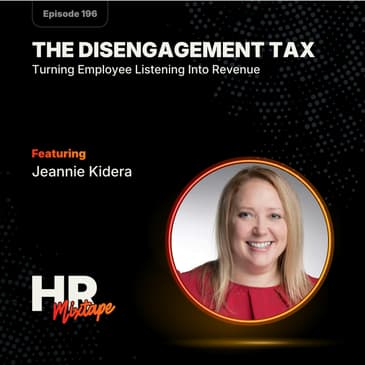
Jeannie Kidera, CEO of Kidera Culture Consulting, uses Gallup-backed research methods to help mission-driven companies turn employee listening data into concrete leadership action. Her practice is built on one argument she's made dozens of times: culture isn't a morale issue, it's a revenue line.
In this episode, she covers:
- Why the disengaged employee who stays costs up to 34% of their annual salary every year, a figure that outweighs the turnover number most HR leaders already track
- How to translate an engagement argument into a money argument, and why that reframe is the most important skill an HR leader can bring to a C-suite conversation
- What a 90-day culture improvement plan actually looks like: the Gallup 12, one focused pain point, a pulse survey, and an action plan communicated back to employees so change is visible
Timestamps
[00:01:19] How teaching literature, and specifically asking "what's the subtext," directly maps to the skills needed for employee listening and interpreting between employees and leaders
[00:03:33] The four Gallup stats every HR leader should have ready: 23% higher profitability, 20% higher sales, 17% greater productivity, and 10% higher customer loyalty in top-quartile engagement companies
[00:05:01] The most common culture mistake founders make without realizing it: assuming that hiring mission-aligned people is enough to sustain and build culture as the company scales
[00:06:00] Why rapid growth forces founders to look outward, creating a belief that culture is a soft part of business strategy rather than a direct revenue driver
[00:06:42] The Gallup stat that rarely makes it into culture conversations: a disengaged employee who stays costs up to 34% of their annual salary every year, and that number compounds across teams
[00:08:16] Why responding to employee survey data matters far more than collecting it, and why ignoring results is actually worse for engagement than not asking at all
[00:11:28] How internal communication functions as a core component of employee experience, including why word choice, "subordinates" versus "team members," alters both morale and culture
[00:12:15] How to turn an empathy-based engagement argument into a money argument, and the Gallup stat that should anchor every culture conversation with leadership
[00:15:39] What it actually takes to live your company values: leadership modeling, public acknowledgment, values alignment assessments, and policies that match what you say you believe
[00:18:31] Jeannie's 90-day culture improvement plan: start with the Gallup 12, identify one pain point, run a focused pulse survey, build an action plan with named owners and deadlines, and communicate it back to employees
Brought to You by Paylocity
Paylocity is the fastest growing unified platform for HR, Finance, and IT. Paylocity brings your people, processes, and data together in one place so HR leaders can spend less time managing systems and more time doing the work that actually moves their organizations forward. Learn more at paylocity.com
Keywords: employee engagement, Gallup research, culture consulting, employee experience, mission-driven companies, startup culture, culture as revenue driver, disengagement cost, values alignment, internal communications, employee listening, 90-day culture plan, action planning, pulse surveys, people analytics, retention, people-first culture, culture ROI, HR leadership, founder culture
Powered by the WRKdefined Podcast Network.
[00:00:01] You're listening to the HR Mixtape, a podcast for leaders who want to understand people, strengthen culture, and navigate change with clarity. Today's conversation starts now. Joining me today is Jeanne Cadera, CEO and founder of Cadera Culture Consulting. Jeanne uses Gallup-backed research methods to help founders and HR teams at mission-driven companies turn employee insights into leadership actions that strengthen culture as they scale.
[00:00:37] Jeanne, thank you so much for jumping on the podcast with me today. Thanks for having me. So you started in education, which I super love. You know, back in the day when I was thinking about what I wanted to do with life, that was what I thought I was going to get my undergrad in. I didn't, but I definitely have a big passion for people that sit in that space.
[00:00:58] And I'm curious, you know, you left because you kept seeing talented people inside these systems that didn't really know their value or recognize it. And that's such a human observation. Yes. How did that experience lead you to where you are now and the consulting work that you're doing?
[00:01:19] Yeah. Well, so I think it's probably important to know that I was a literature teacher. And so I spent a lot of time, obviously, in the classroom asking questions like, what is actually being said here? What's the subtext? What's not being said? And what does that tell us? Right.
[00:01:36] Right. Come to find out now and in my life now, these are all the things that we do in employee listening. Right. This is also really the skills when it comes to interpreting between employees and leaders. But when I was in education, I had become one of those teachers who, you know, throughout grades and was doing skills based rubrics that was all based on empathy development.
[00:02:02] And I kind of got to the point where I was going, the kids are all right. They've got this. It's the adults in leadership that maybe could use a little boost in these soft skills. And how can I take the empathy development work I'm doing in the classroom and pivot to making workplaces less toxic places?
[00:02:25] Because I was seeing a lot of burnout of like really brilliant, wonderful, talented people and leadership not necessarily understanding that these people are your bread and butter. Right. This is where your customer experience is to turn on my my corporate speak instead of my academic speak. And so I actually I landed at a place called Big Think Plus, which is a SaaS company that does professional development.
[00:02:49] But it was really, really hugely beneficial to me because every two weeks I was doing deep dives with like top thought leaders out there with their content, designing interview questions with them. Then the creating the content that was going across, you know, individual contributors, team managers, senior leaders. So I was doing that translation, but I was doing it alongside Adam Grant and Amy Edmondson and Tiffany Bova. Right. Just an incredible education in two years.
[00:03:20] And what I learned was that actually, guess what, like being kind and doing people first culture isn't just good for the employee. It turns out the research shows it's the best business move. Right. So I kind of learned the ROI on it and was like, I need to get into companies and do this. Because the Gallup research, and this is just in the last two years, shows that companies that are in the top quartile of engagement.
[00:03:47] These four stats like should blow everyone's minds away. 23 percent higher profitability, 20 percent higher sales, 17 percent greater productivity and 10 percent higher customer loyalty. Right. Like what else do business leaders want? And the way to get that is to up your employee experience. So I kind of learned that what I was wanting for people was the best of both worlds for everyone involved in the company.
[00:04:17] So I started doing that in an individual company. And then I was like, it's time to take this to more companies. And that's when I launched my consulting work. So. Wow. You know, and with your work, you get to spend time with a lot of mission driven companies that are in that startup phase, which, you know, is such a fascinating place to be because there's so much possibility. Possibility. Yeah.
[00:04:42] That being said, there's also a lot of possibility to make some common culture mistakes early on. So what are you seeing out of those founders who are really, really focused on that growth mode that is preventing them from creating these genuine caring environments in their startup? And I think that that's that's a really good point.
[00:05:03] And I think one of the biggest mistakes and it's it's super without intention, right, is is thinking that culture will take care of itself once it's just originally defined. Or that just hiring really great people who believe in your mission is going to be enough to create and maintain that great culture. And that's a fantastic start. Right.
[00:05:24] But culture needs to be built into absolutely every decision the company's making and every process and neglecting it after just that initial step. It is a really big mistake. It happens because, as you said, founders and CEOs, there's two things that happen right as they enter that rapid growth. One, they get distanced from people. Right. When you start your company, it's you. It's then it's you and five people and it's you and 10 people.
[00:05:49] But then as it keeps going, like you're you are getting further and further away, whether you kind of realize it or not, from the reality of the day to day of what your your people are experiencing. Right. So employee listening needs to be like a non-negotiable at that point. But the other thing that's happening, and this is also supernatural, is you are forced to look outward. Right. Your attention is on client acquisition and product development and branding, because those are the hot in the moment things you need to be doing as you grow.
[00:06:19] And that makes sense. But that stems from a belief that culture is a soft part of business strategy. And it's actually a major revenue driver. Right. If you look at the cost of not paying attention, continuing to pay attention to culture, I think we all everyone in HR is predominantly probably listening to this podcast knows the turnover stat. Right. Like if you lose one person, it's going to cost you anywhere from half to two times that person's salary to replace them.
[00:06:49] But the stat that I think is more important and not as well known, and this also is out of Gallup, is that that disengaged employee that stays right. The one that's that hasn't left but is still disengaged is going to cost you upwards of 34 percent of their annual salary every year. And if you have one, you probably have many. Right. So it behooves you to pay attention to it, keeping in mind also those stats I spit out in the first question,
[00:07:18] which is like you're you're leaving money on the table if you're not like it's a mistake to not consider culture a revenue driver. You know, that gap that you mentioned as leaders start to advance and they really have to focus on some very important business drivers. Right. They're investing a lot of time in that. And, you know, I've heard before, well, I don't I don't have time dot dot dot.
[00:07:46] And we know just based on the numbers, the metrics. Right. Well, then you're missing the mark. Right. Because like you should be making time. Yeah. But that being said, I think sometimes they don't even know what does that mean as far as where I should be spending time, meaning that I have an engagement survey annually. I do pulse checks. I check in with my managers as that head of the organization, as that, you know, culture advocate.
[00:08:13] Where should they be investing their time? Responding to the feedback. Right. Because you can do all of the surveys in the world that you want. It's it's actually not important that you're asking the question. It's important that you're responding to it. Studies show that it's worse to to do engagement surveys, to do pulse checks and then not do anything with the data.
[00:08:39] Right. That's actually detrimental as opposed to just not asking, because the message you're sending then is is that people's voices don't matter. And the minute the people in your organization think that you've activated disengagement. Right. So, first of all, I think a lot of what I'm talking about, like the the organization size I'm talking about maybe doesn't have a people team yet or they maybe have just that one person. There is a danger to having an HR generalist and that's it.
[00:09:08] And then going, hey, I want you to take this on, too, because now you're that person who secretly is probably holding everything together is now going to get burned out and become the statistic. Right. I think it is smart to bring in someone from the outside to do this work if not doing so creates statistics inside of your organization. Right. But what really matters in terms of where should I spend my time, where should I spend my money is the creation of the action plan in regards to to the data.
[00:09:38] Don't just collect data and sit on it. Right. You're harming yourself and your organization and your people if you do that. Well, nothing is worse than taking that, you know, annual engagement survey or giving feedback on what you think the corporate values are. And then you see them go up on the walls and you're like, oh, yeah, there's total buy in like they actually listen to me. And then that's where it stops. Right. You've got really cool posters or you've got really good perks necessarily, but they don't really hit at the heart of that engagement.
[00:10:08] And pulling on, you know, the heartstrings of what people want in their jobs. And I think that often leads to when you do have the data, sometimes there still can be a translation problem between leadership and employees, especially when you think about organizations where there might be a big financial gap between those two roles.
[00:10:30] Right. When you have individual contributors who might be living paycheck to paycheck and you have CEOs who are, you know, playing chess with their stock options. Right. It's completely different worlds. How do we help bridge that communication gap, especially when, you know, like you said, you might be in a small a small organization where you're an HR department of one or maybe you're an HR department of,
[00:10:56] you know, one to three. But, you know, one person's dedicated to payroll, one person's dedicated to benefits. And it's like they kind of have their own lanes that they stick in. This really isn't an HR responsibility in totality. It's a business responsibility. So how do we help that communication between those two groups? Well, first of all, I love that you're asking it in terms of communication.
[00:11:19] I actually like literally on Monday dropped a blog that is about how internal comms is actually a fundamental part of employee experience. So yeah, head over to my website, check out that whole entire blog. But think about the fact that the way we experience each other first is through communication. Right. Do we like the way someone's talking to us? Do we not like the way someone's talking to us? Think about the difference between a manager who refers to the people on their team as subordinates versus the manager who refers to them as team members.
[00:11:48] Right. Like just like that little here comes the English teacher. Right. Just that little word switch alters morale and alters culture. So like the way we communicate up and down the ladder really does matter. So it's an internal comms issue like culture in that sense. So I do think having someone who's able to to look at a message and whether that is here's the feedback from the employee engagement survey. Oh, the CEO is not going to like this. Right.
[00:12:18] Right. Or like this is a seems like a soft argument. It's an empathy based argument. They're going to hear that and they're going to be like, that's nice. Like that would be an how do I this person who's who's doing the analysis of those surveys needs to have the ability to translate that argument into a money argument. Right. Like they need to go. Yes, this is the nice thing to do. But like here's the ROI on if you make make this change. Like here is why having engaged employees.
[00:12:47] There was a study. There's another another. I'm going to keep throwing out Gallup stats for you. But like higher engagement firms enjoy two point five times higher revenue growth rates. Right. So if I just say to someone in leadership, you know, it'd be nice if we could do something about engagement. People people will be happier at work. Sure. But if I say if we do this, our revenue growth rate is going to increase by two point five percent.
[00:13:13] Like now I'm listening because I'm that person that, as you said, is juggling my stocks. Right. Like now you're speaking my language. It goes the other way, too. Right. If I'm a CEO and I have a piece of news I need to deliver that that I know is maybe not going to land well. How do I frame it in a way that, you know, an entry level person or even my team managers are going to hear it and understand the value of it at their level?
[00:13:41] Right. So it is a communication game. And yeah, the person who's doing payroll might not have those skills. Right. So, again, like that's what people like me are here to like help out and do, especially for teams that don't have like full people ops build outs yet. Yeah. And it's worth the investment because when you break down communication and organization, that's where like you lose trust. And that is the hardest thing to build back in an organization.
[00:14:08] It's hard enough in interpersonal relationships. It's even harder at an organization level. Yeah. And that trust between the HR leader and the executive leader that you're having this conversation with, as you were as you were sharing that story about, you know, sharing the engagement data. I'm just thinking about the CEO who's like, yeah, OK, cool story, bro. Like, what is what does that mean for me? And I wrote this down because I think this is such a good tweetable, X-able.
[00:14:35] I don't know what we're calling that now. Takeaway. But taking that empathy statement and translating that into a money argument. I cannot share that enough with my audience that you are a business leader with HR skills, not an HR leader with business skills. Like if you can think that way, that example you gave of giving that statistical number impact to the bottom line, that's going to be huge.
[00:15:01] And when I think about that, the other thing that kind of really plays into that, and I'd love to hear your perspective on this, is, you know, the companies that take their values and use them to manage their business compared to the companies that manage their business and have values. Those are different things. Yeah.
[00:15:23] Those that are doing the first or maybe I guess those that are doing the last, you know, how do they move more to companies that have values and live by them and actually make the business decisions against those values? What does that look like in practice? Yeah. Well, I'll start by telling you what it doesn't look like. What it doesn't look like is just, you know, having a segment of your all hands where you all just repeat, here are our values reminder, right? Or they're just on the website and people know that.
[00:15:52] Or you'll start seeing it in the Glassdoor reviews. I can't tell you how many times in the last year, more so than in previous years, I've seen more and more people turn down interviews or just not even fill out job applications because the first thing they're doing is going to Glassdoor and going, no, this culture does not align with what it says on the website, right? The way you do live your values, I think it's first and foremost, it is leadership accountability. The leaders have to be modeling that behavior, right?
[00:16:21] Not just spouting it. Secondly, they have to be publicly acknowledging people within the organization who are also modeling it, right? And then they need to be doing checks to say, are our employees actually experiencing this? I have a service that I offer. It's called a values alignment assessment. It's something that I can like tag on to larger things or it's a standalone thing, but it comes in and gives concrete data.
[00:16:48] Are your employees experiencing your values or are they just hearing them, right? So doing checks like that and then consciously and intentionally building them into your day-to-day policies, right? Like if your value, and this is common now, is people first, right? But I'm an employee and I find it impossible to go to a doctor's appointment because it will require me to take a half-day PTO. I'm not experiencing a people-first environment, right?
[00:17:16] Like my policies need to align with those values. Well, and it's one of those things that's like where you put your time is what you value, where you put your money is what you value. So that makes a lot of sense. If you're saying people first, then you really do need to have people-first processes and policies and guidelines and the ability to flex. You know, I was at a conference just a few days ago and a woman was sharing a story about her husband's company.
[00:17:44] He had gotten a cancer diagnosis and the company said to him, you know, hey, if you're not feeling it, don't come in today. If you come in and you're halfway through the day and you're exhausted, go home. Like we're not going to track this against some sort of PTO sick time. That really, really was a people-first view of, you know, how do we just come and be there with somebody and care for them because we say that we value that.
[00:18:12] But, you know, as we kind of get towards the end of our conversation and, you know, for those listening, give me like the 90-day cultural improvement plan that you can bring to your founder to help them understand that this is going to help them scale the business the way that they want to. Yeah. And that's a great question because actually like my base package is a 90-day. It's a, I call it like the main pain point solution package, right? And it is a 90-day thing.
[00:18:41] And I think this is really good also for companies that have a small HR department, right? Because what I see a lot of mistakes being made is someone will shoot out a survey that has 20, 30, like really specific questions, right? They're asking, they're just collecting all this data and they think like this is great, but it's overwhelming and it's more than they can actually act upon, right? So rule number one, do not ask for more than you can reasonably act upon, right?
[00:19:10] That goes back to that rule of like if you're not going to do anything about it, don't ask about it, right? So like what I do for a 90-day plan is I come in and I would do the Gallup 12 is the survey I use because it focuses just on the 12 categories in the employee hierarchy of needs. That is all I need to know off the bat, right? Not overwhelming. And it will give me my categories of like where are the gaps? Where am I doing really well? Where are some things we need to work on?
[00:19:37] Do a data analysis on that report, okay? Then I'm going to zero in on just the lowest scoring one. What is my main pain point, as I said? That's what I'm going to fix first. It's going to be the most visible thing for everyone in the organization to see change. And it's going to be the thing that's going to make the most difference, right? So I'm going to do a pulse survey and never ask more than four questions in a pulse survey, right? That's going to be a deeper dive on that.
[00:20:05] And from that data analysis report, I will build out an action plan, right? But you cannot leave it at that. You cannot send that to the C-suite meeting where it will get put in a drawer, right? You need to also have a meeting with the C-suite that involves talks about ownership and deadlines. Who's going to do which part of this by when? And back to communication, how are we going to communicate this plan now for accountability reasons to the rest of the company?
[00:20:33] So they are seeing us take action on this, right? So my advice, focus on one to two main problems in one to three months and do not add anything else onto that until those are addressed. So good. It's such an easy way to kind of think through a very complex problem. Well, if they want to learn more about your work specifically, where do they find you?
[00:20:57] Yeah. So my website is www.cadera, K-I-D-E-R-A, cultureconsulting.com. And on there, I have a free white paper. It's called Why Employee Engagement is Key to Sustainable Growth and Success and Where to Start. So you can download that for free. My blogs are also on there. They cover any range of employee experience, employee engagement topics. And then you can also do a contact form there.
[00:21:24] I will do 30-minute, I call them culture clarity calls. Those are also complimentary. So you can sign up for those on my website as well or connect with me on LinkedIn. I love it. Well, thanks for taking a few minutes to sit and chat with me and really dive into, you know, this connection between emotional intelligence and culture and feedback and values. I loved it. Good, good. I'm glad.
[00:21:55] Thanks for tuning in to the HR Mixtape. Like, share, review, and subscribe to support the show and help more people discover these conversations. Until next time, keep the conversation going.
Sponsors
