
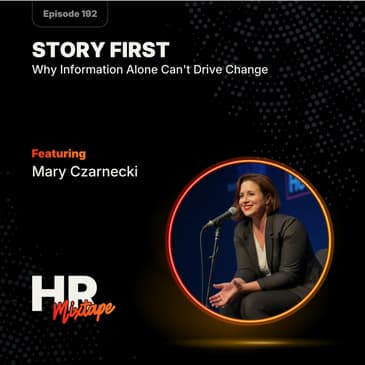
Most change initiatives fail not because the strategy was wrong but because the communication didn't move anyone. HR leaders deliver their message, check the box, and wonder why nothing shifted. The problem almost never lives in the data. It lives in the absence of story.
Mary Czarnecki, Brand Messaging Consultant at Mary Czarnecki LLC, spent more than two decades in marketing and strategy at Johnson & Johnson, WebMD, and Accenture before building a practice that trains leaders at Fortune 500 companies to use story as a practical tool for influence and organizational change.
In this episode, she covers:
- Why more information alone can't produce behavior change, and what story does that information can't
- How to identify where people are getting stuck before looking for a story, so the narrative actually closes the right gap
- The three ingredients in any story that actually lands: a specific moment, sensory details, and a clear arc from before to after
Timestamps
[00:00:16] What it means to help leaders turn ideas into influence, and why storytelling is the vehicle
[00:01:49] Why change initiatives fail because of communication, not strategy, and how story closes that gap
[00:02:31] The first step in storytelling most leaders skip: identifying what someone isn't getting before finding a story
[00:04:11] What the HR Story Advantage actually means, and why knowing the facts about a habit doesn't create the habit
[00:07:47] How to find the right story when you're the messenger, not the creator of the message
[00:09:43] Balancing transparency and oversharing: the audience-centric gut check that keeps stories from backfiring
[00:12:47] The bad perm story: a client example of how a personal, humble story got an entire sales team to bring their own stories
[00:16:42] Where AI helps with storytelling and the one trap to avoid when using it
[00:18:10] The most common communication mistake leaders make today: building a message without putting yourself in the audience's shoes first
[00:19:29] The treasure trove habit: why the best communicators don't find stories on demand, they collect them over time
Brought to You by Paylocity
Paylocity is the fastest growing unified platform for HR, Finance, and IT. Paylocity brings your people, processes, and data together in one place so HR leaders can spend less time managing systems and more time doing the work that actually moves their organizations forward. Learn more at paylocity.com
Keywords: storytelling, leadership communication, change management, HR strategy, influence without authority, organizational change, internal communication, narrative, employee engagement, communication skills, HR leadership, people strategy, trust building, audience-centric communication, Mary Czarnecki, behavior change, change communication, HR story advantage, story structure, workplace storytelling
Powered by the WRKdefined Podcast Network.
[00:00:01] You're listening to the HR Mixtape, a podcast for leaders who want to understand people, strengthen culture, and navigate change with clarity. Today's conversation starts now. Joining me today is Mary Charnecki, keynote speaker and consultant at Mary Charnecki LLC. Mary helps leaders communicate with clarity and confidence, especially during change and high stakes moments.
[00:00:35] Mary, thank you so much for jumping on the podcast with me today. Mary Charnecki LLC Absolutely. Thanks so much for having me here. Mary Charnecki LLC So you really help leaders turn their ideas into influence. And so I'd love to start with maybe a little bit about your background and passion around storytelling as a leader. Mary Charnecki LLC Well, I have always been a storyteller. Just ask my kids. They probably got more stories growing up than the average bear.
[00:01:01] Mary Charnecki LLC But for me, my passion around storytelling and leadership started formulating in my own career when I started to look at the mentors and models that I had as I went through the different roles in strategy and marketing that I had at Johnson & Johnson, WebMD.
[00:01:18] Mary Charnecki LLC And I noticed that there were certain leaders, certain mentors of mine that were just able to be more persuasive, able to get people on board with their ideas, able to help communicate complex strategies or ideas more effectively than others.
[00:01:33] Mary Charnecki LLC And one of the things I started noticing was how they were using story to do that, whether it was personal stories or stories drawn from their work experiences, but using it as a tool to enhance their communication and their leadership. Mary Charnecki LLC So often our change initiatives fail because of communication, not strategy. Mary Charnecki LLC So how do we take those lessons learned from that story side and bring them into how we think about our change initiatives?
[00:02:02] Mary Charnecki LLC Well, it's interesting because, you know, we've all heard, well, what's the moral of the story or what's the lesson that this story is trying to teach us? And most of us have a favorite kid's story that we probably begged someone to read us so many times that we didn't even need the words anymore. And I think about stories now in leadership and in our professional lives in a similar way. Usually, especially with internal communication or getting people on board with initiatives, we have to have people have some sort of transformation.
[00:02:31] They have to shift the way that they're thinking or operating in some way. And the story can help us help them understand it in a more comfortable, more approachable way. And so the way I think about it is first identifying, okay, well, what is the block? What is it that someone isn't quite getting or understanding or seeing as in their best interest or aligned with their goals?
[00:02:55] And then what story could we share that would actually help them understand, oh, it's kind of like this thing that you're already familiar with? Because as humans, we're looking for that familiarity. We're looking for that risk avoidance. You know, right? We all want to survive and thrive. But we don't want to necessarily go outside that comfort zone. We try to. But the story helps build that bridge, I think, for a lot of professionals and leaders from something that feels kind of scary and different.
[00:03:24] Oh, gosh, they're asking me to do something outside of what I've been doing. What does that look like? All of a sudden, you know, our brains start going crazy. The story can help build that bridge to something that's, you know, more accessible, more understood already by someone. Well, and every keynote that I've ever gone to that I absolutely loved was anchored in a story, right? So we know that that works. You know, you have this phrase you use called the HR story advantage. What does that mean in practice?
[00:03:54] I think in practice, it really means looking for those opportunities where people are getting stuck, whether it's a new initiative that you're rolling out, about getting team culture built in an organization that maybe has gone through a merger or new acquisitions or even just adding new team members. I think the story advantage, especially for HR leaders, comes from not just relying on more information or the facts or here's what people should know or it's not about more information.
[00:04:23] We all have had the experience probably of trying to do something different, doing our own habit transformations. I know I can't tell you how many times I've told myself, oh, okay, well, I'm going to eat healthier. I'm going to go to bed earlier. I'm going to, you know, drink more water, whatever it is. Most of us know something might be in our best interest. We might even know the facts about why or why we should do these things or why this is. But just having more information isn't enough.
[00:04:49] So the story advantage gives us a key, gives us a toolkit to actually make sure that we're not just relying on more information to get people on board with a new transformation or new initiative, that we actually can use the story to do that much more easily and effective. Well, I have found in my own career that when I'm working with heavy pieces of data, that it lands better if you can kind of create the imagination and tap into that and use your data points to activate that.
[00:05:19] That's worked for me. But I'd love to hear from you, you know, what do you think are like the essential ingredients that a story actually needs to have to move the needle in the way that we need to in our space? Definitely. And you make a great point, which is sometimes we do need to transmit certain facts or figures or data points. But when we wrap it in that story, I think that's where the memory actually gets built, right? People can absorb the information more effectively.
[00:05:45] So when we're thinking about building these stories, we are looking for a scenario, a moment that people can really kind of embed themselves into. So it's not about telling a hundred year origin story of your company or something like that. It's about picking a moment, a moment, a space, a time, a room that someone can walk into. And so that's the first thing is it's really based in a moment, a story based on a moment of transformation of aha.
[00:06:13] And then thinking about that moment, OK, well, how can we bring them into that space? So thinking about the sensory details that you're going to want to talk about. What were you feeling before or the character, if it wasn't you, you know, what was that person feeling before? What was the status quo? What was the boom moment? What happened? How were they feeling then? What was the room like? What, you know, who walked in? What crashed through the window? Whatever it was. And then what was the feeling afterwards?
[00:06:42] So thinking about the moment, number one, thinking about the sensory details to bring us into that moment, number two. And then number three, thinking about what that arc really is, the before, the moment of transformation, and then the after. And that's really where that aha happens, right? If we're trying to get people on board with this initiative, right, maybe the organization's going through a tough time. We're trying to keep people on board with the culture, align them behind potentially a new leader, whatever it is. We're trying to get them on board with this idea.
[00:07:12] So we're telling this story so that we can see our own arc, our own before, after transformation in this story, this journey that this hero has gone on in that story that we're using as our example. How do you help HR leaders get better at this when they often need to communicate things with clarity? And sometimes those things, they really don't have control over, right? They end up being the messengers of the information, not the creators of it.
[00:07:41] So how do they find that story to be able to communicate it clearly? Yeah, so I think a lot of times it starts with not finding the stories. I think that's one of the mistakes a lot of people make is they're like, oh, we need to tell more stories. Let's just come up with a whole bunch of stories. I think honestly, especially for HR leaders, it's really identifying those story moments, those opportunity areas where where are our teams getting stuck?
[00:08:06] What aren't they able to clearly understand or what aren't they feeling aligned to? What aren't they feeling connected to? Where do they feel that disconnect between what they're spending all their time doing and what the organization may be talking about? So I think that's really where especially HR leaders can make a huge difference is first kind of slowing down the, you know, maybe executive team even that's saying, oh, we need more stories to actually say, okay, but what are the stories going to do? Right?
[00:08:35] What transformation, what understanding, what are we trying to get this story to do for us? And then really making sure that that's the guiding light, right? That is the use case that is being used to choose the right story. And so especially when, like you're saying, you know, this may be something that we're not being asked to transmit. We're not coming. This wasn't our idea.
[00:08:58] But that's a superpower is to be able to kind of slow the room, say, okay, before we jump to just telling any story, we're not telling a story for entertainment. We're telling a story for transmission of information, for transformation.
[00:09:13] And so really being able to guide people to say, okay, if what we need to do is have more alignment on the team, to feel less disconnection, to feel support and excitement about a new initiative that might feel intimidating to people based on their roles. Okay, if that's the job it needs to do now with fresh eyes, with strategic eyes, we can actually take that lens and start to look for maybe farm from either our leadership or ourselves the right story to match that job.
[00:09:43] It's interesting coming at it from that angle because I think right now we're sitting in a space where we're asked to communicate a lot more than we ever have before. The level of transparency that employees want is something I haven't seen in my career at this level.
[00:10:01] And so I'm curious as you've helped people create better stories and find these moments, how do we find that balance between transparency and oversharing or undersharing, like missing the mark with the transparency piece? Yeah, I think we've all probably heard those stories, right? From leaders or mentors where you're like, ooh, that was a little overshare, right? It's like, now I'm uncomfortable. I didn't need to know that about you.
[00:10:31] So I think that's always the gut check, right? So we're passing the, is this going to make people feel more aligned, closer to the initiative, closer to the invitation we're making to them to get on board? With an idea or initiative? Or is this going to make them uncomfortable? I think taking that audience-centric approach and really playing it out and maybe doing also a few test cases, right?
[00:10:59] So I'm a huge fan of not just guessing. My background is in marketing. And so, you know, I will always tell you, the market will tell you. We think we have the best story. We think we have the best marketing campaign. We think it's great. We are just an N of one, N of five. It's a committee, right? Decision. But the market's going to tell you. And so I always like, especially if it's a big initiative or a big rollout that you're developing this for, getting a few test cases, right?
[00:11:27] Getting some feedback from a smaller group is also a great idea. But, yeah, it's one of those things where I think being as audience-centric in that, yes, we need it to do this job, but we're looking for something that is connected to their experience. It's not just a story because we feel like the story is special, right? Or it's going to make someone look extra special. It's about, okay, but what is this going to make them feel?
[00:11:55] How is this going to connect to worries that they already have, things that they want for their life, goals and aspirations that they have in the dark corners of their own mind? And how is this going to connect to their experience? Well, and it puts the story kind of in the eyes of the receiver, not in the eyes of the deliverer, which kind of leads to my next question around, like, two-way communication.
[00:12:19] When you're rolling out these initiatives, you know, one of the biggest things that, you know, you learn in HR, you hear in HR over and over again is, like, don't distribute a survey unless you're going to do something with it. Don't introduce a new initiative unless you've done a testing period and some of those kinds of things. So it's really about how do we find the right way to have two-way communication where, I guess in two ways, one, we can get feedback and the other, we can help those receiving the message kind of co-create the story with us. Yes.
[00:12:48] Yeah, it's interesting, too, because I think it is incredibly important. And I love those reminders of, okay, well, why are we doing this, right? Like, hopefully this is going to generate some follow-on action. And so sharing a story can be just the beginning, right? So asking for people then to say, well, what has been your experience, right? I shared this story. Where has that showed up for you? We'd love to hear that, right?
[00:13:16] So almost as an invitation, as a kickoff, too, then how does this show up in their life? When have you experienced something like this? You know, so for example, just one experience I've had in working with a client on developing one of these stories, she was in a marketing agency and rolling out a new initiative to reach out to a certain new kind of clients and trying to get her team on board with the messaging that they were going forward with.
[00:13:43] Which was, you know, these are certain kinds of clients that in the past have been burned by other marketing agencies. We're trying to help them understand that we operate differently. We are a different kind of setup, right? We have a different way of going to business, going to market. And so the story that she told, her own personal story for her team that was going to be going out and doing the sales for her, was about getting a bad perm, right?
[00:14:11] And so she told this story to her clients when she was doing the selling, but also to her team that was then going to be selling for her. And she shared, look, I trusted my mom. I trusted the stylist, right? I begged them to do this. I, you know, I trusted them. And then I got in the chair. They did the thing. I smelled the chemicals. I was so excited. And then I looked horrible, right?
[00:14:37] She's like, I know what it's like to trust the experts and be betrayed, which is exactly why we operate in our agency in a different way. And so when she was rolling this out to some of the people that were then going to be selling for her, she invited them. She said, look, you can't tell that story. You can tell it about me. That's fine. Borrow my story. But I don't want you going out there and saying this is your story. I want you to bring your story.
[00:15:04] So tell me, right, after today, after this training, like, I'd love to hear from all of you. What's one story where you trusted someone, right? You trusted someone to have your best interest in mind and they didn't. And what did that feel for you? How was that experience for you? And what did you learn, right? And so that you can then, when you're trying to communicate this to our potential clients, to our prospects, how could you show up with your own story and help them understand what we stand for?
[00:15:31] Well, and I will tell you, just as you were relaying her story, if you have ever had a perm and you were talking about the scent, I literally could smell that. And I don't think I've had a perm since I was 10 years old. Yeah. Yeah. But it illustrates your point that there are these innate experiences that you can tap into that are very personal, but it drove a very important business initiative that you were trying to get out the door and communicate to the client. So I love that example.
[00:16:00] It's so good to think about we have all these personal stories and they don't have to be epic. You know, we're not trying to do a TED Talk when we're doing these. We just want to make it personal and make that connection. So that was such a great example, I think, for those listening. Yeah. And I mean, I talk to executives and I coach speakers all the time. And even those that are doing TED Talks, it's usually the humblest story, right? Getting a bad haircut or, you know, forgetting your homework or something like that,
[00:16:29] that these small moments used in the right way can be incredibly powerful. Yeah. How do you see AI helping, hindering or advancing this type of communication? I use AI a ton, both with myself and my client. So I do think that it can be an incredible help. I think the biggest trap is relying on AI to come up with the story, right? We want it to be, to your point, authentic. We want it to be real.
[00:16:58] We want it to be based on a real human's experience and that moment of transformation. And so I think using AI as a brainstorming partner, as a refinement partner is fantastic. And even helping you to even source your own brain, because a lot of us, at least when I'm talking to some of the executives I work with and HR leaders who are trying to come up with their stories, all of a sudden we have to have like a moment and we come back to our life
[00:17:26] and we're like, have I ever done anything? You know, you're like, your mind goes completely blank. So you just, you know, sometimes it's nice to have AI come in and prompt you and say, oh, okay, you know, give me some scenarios that I might be able to go back to my own memories and draw upon. And that's helped some of the executives that I've worked with who've been trying to, you know, work from a blank page. I love that. What a great use of, especially the talk features of some of these AI tools, you know, go for
[00:17:55] a walk, have it in your head and just kind of work through that. I love that. You know, as you've coached leaders on making this transition, what are some of the poor communication tactics that leaders are doing right now that we can help them fix? I think one is just forgetting to take that pause and think about what's in it for them. Right. So I want to say this and I need to communicate these points and these are my, these are my talking points and this is what I have to get across. This is the information, right?
[00:18:25] All of that is important for us to know, but having that moment of pause to actually say, okay, but let me put myself in their shoes. How is this relevant to their world? What is their reality? Like, what would they say they want to feel more of or do more of? Now with that frame, let me think about how I can communicate what I need to communicate through that lens. I think that's one of the biggest transformations that leaders today can make is just taking
[00:18:53] that moment to be more audience centric before they jump into whatever presentation they need to make. Yeah. So often as leaders, we're just trying to get stuff out the door. I mean, that's the reality, right? And we need to get things communicated, but we're, we're missing the opportunity to actually make the connection where what we have to communicate will stick. And that's, I mean, that's really what we want. We want the information to be able to stick.
[00:19:18] As we wrap up our conversation, Mary, my last question for you would be, you know, what's one habit that leaders can start doing today to become better storytellers? I think honestly is finding whatever works for you in terms of starting to build your treasure trove. So yes, you can always go back and, you know, dig through your memories and, and brainstorm the stories, but even just moments where you may have an exchange or something happens and
[00:19:46] you're like, okay, I don't know where I'm going to use that lesson. I don't know where I'm going to potentially pull up that moment, but whether it's a note apps on your phone or a physical, you know, notebook, something that you can start to just keep track of some of those moments, those stories, that's something that I'm seeing as incredibly useful so that you have those stories that you can pull from in the moment where someone needs that, oh, well, this is kind of like this experience that I had. Let me tell you a story. I love it.
[00:20:13] Mary, such great advice around storytelling and better communication and really thinking about influence in a different way. So thanks for chatting with me. Absolutely. Thank you for having me on the show. Thanks for tuning in to the HR Mixtape. Like, share, review, and subscribe to support the show and help more people discover these conversations. Until next time, keep the conversation going.
Sponsors
