
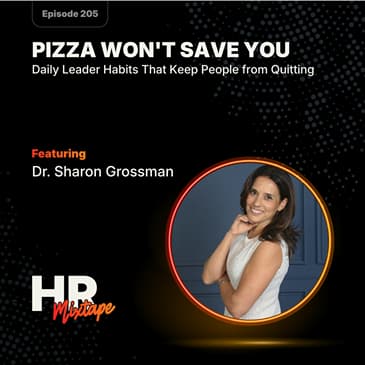
Most companies know turnover is expensive. Plenty of them still answer it with a pizza party on Friday and call that culture.
Dr. Sharon Grossman, Retention Strategist at Turnkey Retention Solutions, spent years as a psychologist coaching people out of burnout before she turned to the problem companies would pay to fix. She wrote Don't Buy Their Lunch, Buy Their Loyalty and has taken the idea to the TEDx stage.
In this episode, she breaks down:
- Why one-off perks and three-day retreats fade, and what a daily "slow drip" of leader behavior does in their place
- How her HABIT system (huddle, appreciation, barometer, improvement, and tracking) fits into 10 to 15 minutes at the start of every shift
- What happens when you plug salary and turnover rate into a simple cost formula, and why the result wakes leadership teams up
Timestamps
[00:02:40] Why companies wouldn't pay for burnout prevention but will pay to stop turnover
[00:03:59] The pizza party problem: one-off perks that get mistaken for culture
[00:05:11] Why a three-day leadership retreat fades unless people apply what they learned within 24 hours
[00:09:05] Promoting top performers into management with no training, and the turnover it causes above and below them
[00:12:20] The daily huddle: 10 to 15 minutes at the start of each shift, mostly spent on people
[00:13:22] The anonymous smiley-face mood check that leaders say they value most
[00:15:28] Asking "what do you need in order to do an even better job?" and coming back the next day with an answer
[00:17:02] HABIT spelled out: huddle, appreciation, barometer, improvement, and tracking as one daily system
[00:21:40] The workshop formula that turns your turnover rate into a dollar figure leadership can't ignore
[00:24:30] Why AI will probably double managers' workloads instead of freeing up their time
Guest Bio: Sharon Grossman, PhD, is a psychologist and industry expert dedicated to solving the employee retention crisis. With over 20 years of experience and a Doctorate from Fordham University, Dr. Grossman moves beyond surface-level perks—a philosophy captured in her book, Don’t Buy Their Lunch, Buy Their Loyalty and shared on the global TEDx stage. She specializes in translating complex psychological research into high-impact strategies that stabilize workforces and sharpen leadership decision-making. From the stage, Dr. Grossman empowers organizations to transform their culture before disengagement turns into attrition, ensuring that top talent doesn't just stay, but thrives.
Brought to You by Paylocity: Paylocity is the fastest growing unified platform for HR, Finance, and IT. Paylocity brings your people, processes, and data together in one place so HR leaders can spend less time managing systems and more time doing the work that actually moves their organizations forward. Learn more at paylocity.com
Keywords: employee retention, turnover cost, employee engagement, disengagement, leadership habits, daily huddles, employee recognition, peer recognition, manager training, new manager development, burnout, workplace culture, culture consistency, pulse surveys, HABIT system, performance habit system, Sharon Grossman, Don't Buy Their Lunch Buy Their Loyalty, AI and workload, HR Mixtape
Powered by the WRKdefined Podcast Network.
[00:00:01] You're listening to the HR Mixtape, a podcast for leaders who want to understand people, strengthen culture, and navigate change with clarity. Today's conversation starts now. Joining me today is Dr. Bushra Khan, psychologist, TEDx speaker, and retention strategist behind Turnkey Retention Solutions and the book, Don't Buy Their Lunch, Buy Their Loyalty.
[00:00:26] She spent 20 years turning psychological research into retention strategy, and today she gets specific about the daily leader habits that keep people from quitting. Dr. Grossman, thank you for jumping on the podcast with me today. Well, thank you for having me, Dr. Sharon. It's been great just kind of getting to know you a little bit, and I'm happy to be here.
[00:00:57] Yeah. So before we get into retention, I would love for our listeners to know a little bit about you and who they're hearing from. So, you know, you started as a counseling psychologist, spent years coaching people through burnout, and now you work with companies on why people leave. So walk us through how all those pieces fit together for you.
[00:01:17] Yeah. So as you mentioned, I studied psychology and I started out by doing therapy, and that slowly morphed into executive coaching, specifically with the area of burnout recovery. So think back to the pandemic. It was 2020, and the one word on everybody's mind was burnout, which is kind of ironic because prior to COVID, I didn't hear anybody talk about it. I didn't even know what it was. Other people didn't know what it was.
[00:01:47] But in 2018, I started researching it because I decided that's going to be my niche. And I would then have my therapy clients come in and I would say, oh, it sounds like you're burned out. And they looked at me like a deer in the headlines. And they're, you know, they're like, nobody really knew what it was. And so every podcast I went on at that time, I was like, I'm here to just let people know what burnout is. Because if you don't know what it is, you don't know that you're in it. And so on. So it kind of started like that.
[00:02:15] I published my book on burnout and was doing that work. And it was very gratifying. And I learned a lot about kind of like what are the patterns that you see in people that are burning out. And did a bunch of speaking on it as well, conferences and such. And then I really just wanted to have a bigger impact. And so I thought, well, you know, when I do this burnout work, it's recovery. I would love to do prevention.
[00:02:43] And anytime I spoke to a company about burnout prevention, they'd be like, we don't care about prevention. Because they don't want to spend money on something that's not quote unquote a problem yet. And so I thought, well, what do they care about? And what they care about is the thing that's already costing them money. And that's turnover. And I thought, well, what leads to turnover is a lot of the same stuff that ultimately you might say leads to burnout. And so I said, so I'm going to be a retention strategist.
[00:03:09] I'm going to help these organizations change their culture so that they can keep their top talent. And they already know that it's costly. We don't need to sell them on that. And so it's like now we can have a real conversation. I love that. You know, so many times we kind of talk around things. Instead of getting to the heart of things. So I absolutely love that perspective. You know, you take a very blunt approach. You know, your book is titled Don't Buy Their Lunch, Buy Their Loyalty.
[00:03:36] What did you see in companies that made you really want to put it that bluntly for them? Well, it's funny because even knowing what they know about the cost of turnover, I find that a lot of companies aren't very proactive. And they're very much in that reactive mode. But, you know, they try to do a little something nice every once and again. And they call that culture. So they're like, we're going to have a pizza party on Friday. And they're like, yeah, we've checked the box. Like we've done something nice for employees.
[00:04:05] And what I want to say to them is lunch once in a while is not the same thing as building culture. In other words, if you think that someone's going to stay because they had a pizza party, then you are dead wrong. And the thing that I keep hearing over and over again from people who really don't get it is, well, you know, my people leave for a dollar more down the street. And I said, well, that's only true because you're not giving them a reason to stay.
[00:04:34] Right. So when we talk about culture, we're talking about all the things that actually build that experience that we want to be there. That people appreciate us, that it feels good to come to work, that we're not ignored, that we're not just like, OK, here, have some pizza. That's not it, you know. So so really being intentional and not this like reactive or like a little bit some of the time. No, it's got to be a little bit all of the time.
[00:05:01] And it's not like a big thing once in a while either. The other thing is like we're going to take everybody and we're going to bring them to a leadership retreat. And I'm like, how great is that? Except that if you're not going to have systems in place to implement what you just learned for three days off site, then what happens is and there's there's like psychology behind this that.
[00:05:25] If like anything that you learn that isn't implemented within 24 hours of learning it, about 70 percent of that is lost already. And so what happens is people come back from conferences and they're like, oh, my God, my inbox. I got to catch up. I've been away for three weeks or for three days. Right. And so it's like, well, we're in catch up mode. We're not actually now taking time to implement all of this great stuff that we learned.
[00:05:51] So it's not a one and done. There's got to be a slow drip and it's got to be a continuous thing, whether it's for leaders or frontline people. But that's going to be part of the culture. So as you can see, I feel very strongly about this issue. You know, it's funny, as you were talking, I was thinking about organizations that I've talked to in the past who, you know, are wrestling with that concept of like disengagement and my employees aren't happy.
[00:06:16] And you start to dig into like, OK, well, what have you done? And they're like, oh, well, we've updated the facility or we did this or we did that. But they change nothing in their leadership. They change nothing in how they approach their employees. And so you see that disengagement turn into attrition. So there's that window in between where I think we have an opportunity as employers to make an impact. What do you think that looks like in reality? What can we do in that moment between disengagement and then that person actually leaving?
[00:06:46] Well, you want to ask yourself, well, why are people disengaged? It's kind of I think about it like I'm a I'm a keynote speaker. So imagine you go to a presentation and you have two different speakers and you got the one speaker who's like literally reading off the slides. The first thing you're going to do is take your phone out and start scrolling because you're bored out of your school. Right. So that's disengagement. Right. Or you might actually walk out the door. We'll call that turnover. Right. So so how do you keep your audience engaged?
[00:07:17] Well, you've got to make your presentation dynamic. You've got to ask them questions. You've got to get them thinking and involved and moving and all this stuff. And if you're not doing that, yeah, they're on their phones or they're walking out the door. Right. And so in organizations, same sort of thing. What are you doing to make them feel valued, engaged and motivated to stay? Those are the three feelings that I think like companies need to purposely perpetuate in their employees.
[00:07:45] And so we talk about, you know, these these are the things that they need to feel. And as we know from Maya Angelou, she said, people are going to remember what you said. They're going to remember. They're not going to forget how you made them feel. And so like it is it's about it sounds kind of soft and emotional and all that. But that's because it's human psychology and that's how we operate. Right. So we want to think business metrics and deadlines and all this. But at the end of the day, we're not robots.
[00:08:15] So if I don't feel seen, heard, acknowledged, valued, I'm going to be looking elsewhere for somewhere else that's going to meet my needs. And so you have to ask yourself as the employer, well, OK, first of all, do you buy into that? Do you buy into the fact that people need to feel this way in order to stay long term? If you don't buy into that, then we already have a problem. Right. It's a belief problem. And we have to start with mindset.
[00:08:45] Right. But if you get that, if you understand that this is important and you're just like, yeah, but I don't know how to do it. Well, that's where I come in and I teach them like a system step by step of how to implement this thing so that they can actually have results, meaning people are engaged. Leaders know what they're doing. I mean, the one thing that I think could contribute so much to all of this chaos is the fact that people are often promoted into leadership without any sort of training.
[00:09:15] And these are people that were really good at what they were doing. They were frontline workers. They were excellent. And then they're like, you're so good at what you do. How about we promote you into management? Here's a team. Go. And like the poor sucker doesn't have a chance because they don't know what they're doing. And everybody beneath them is like another day with this person. God help us. Right. And so like wake up and like provide training for your managers because they don't know what they're doing.
[00:09:44] And everybody's suffering. And then there's also management turnover. Right. People who are like, you know what? I can't take this responsibility. I don't know what I'm doing. There's no support. And then they leave. So the whole thing is chaotic. And we need to own the fact that in order to make an organization run, we have to make sure that people feel supported, feel valued.
[00:10:06] And we got to pour into them, whether it's management training for your managers or certain what I call leadership behaviors that you expect each and every one of your managers to do on a regular basis so that they're pouring into your frontline. And that's how you retain everybody. I think back to when performance management, and I'm going to use that term loosely, was first introduced in kind of the HR space.
[00:10:31] And it came out of the business mindset of, you know, how are we tracking like widgets being produced? How can we take that mindset and bring it into people? And I think we're still seeing the impact of that and how we approach things like performance. We try to keep it at this very, you know, KPI widgets producing mindset. When in reality, like we're all people, like we all want what you talked about.
[00:10:59] Like we want leaders that see us for who we are in our humanity, not the widgets we produce. We'll produce the widgets, but you got to make me feel, you know, like a human at the very basics. And so as you've thought about, you know, teaching managers how to do this and teaching employees who want to be into that management role, you know, what is the thing that they should be doing every day?
[00:11:23] What is the thing that they should start to change to really shift their mindset back to let's talk to the human like they are a human and be empathetic and lean into the things that motivate us rather than, you know, kind of driving against just a solid KPI. Absolutely. I think as we said already, the first thing is you got to buy into the idea that this is important.
[00:11:47] Right. So like, yeah, I truly believe that people need to feel seen and recognized and valued. So that's step one. If you're on board with that now, it's like the how. Right. And as I mentioned before, it's not enough to do a big thing once in a while or just some random thing like buy their lunch. It's really about how can you have a slow drip into them on a daily basis.
[00:12:17] And the way I teach it is five leadership habits. So the first one is you want to huddle with your team each and every day. And by huddle, I don't mean another meeting. So we're talking 10 to 15 minutes at most at the beginning of every shift where you bring everybody together. So it has this sense of belonging where we're going to spend time focusing on people primarily, not on all of this other stuff.
[00:12:42] So there's a little section for, you know, operational communication, things that are important for people to know. Maybe there's a few moments to review KPI and things like that, because that's also important. People want to know how they're doing in terms of performance. But ultimately, the majority of time we're going to spend focusing on people. And what do I mean by that? We're going to talk about expectations. So if a company has certain values, how do we make those observable behaviors?
[00:13:11] I need to know what you expect of me in order for me to actually do the thing that I'm supposed to do. Right. So if you tell me that your number one value is safety, I don't know what that means for me. What am I supposed to do that equals safety? Right. So we've got to translate those values into daily behaviors and then remind people every day of like what they need to do. Right. So expectations have to be clear.
[00:13:38] Secondly, we we want to ask them how they're feeling. And we make it anonymous. So we have a QR code. We have them scan it. And then it very simply asks them to click on smiley face, neutral face or frowny face. So that is very quick. And then you as the leader of the huddle gets insight into how is everybody in the team feeling? Right. Wouldn't you want to know? Well, we don't know because we don't ask.
[00:14:07] So that's important. And then we give them an option to add any sort of comments. And I tell you the one thing of all the things that I teach that most leaders appreciate the most is that one. Because if you have a generational gap and you're not sure what people in this other generation are thinking, you get to tap into their mindset through this one thing. Right. So every day you're asking them, you're getting that.
[00:14:35] And you're you're seeing are people on the team feeling overall OK or are we in trouble? You want to know. Right. The third thing is. Appreciation. So it's an opportunity for the leader of the huddle to recognize at least one person, you know, hey, Dana, yesterday did a great job with the client.
[00:15:00] I noticed you took your time and you quickly explain everything that needed to happen and this and that. So like really stretching it out, explaining what they did, why it was important. And opening it up for peer recognition. We might underestimate the value of that, but when you work with somebody on your team and they recognize you for helping them out, for showing up, for whatever it is, it really builds the team cohesiveness. So super important.
[00:15:30] And then we have an opportunity to ask them this question about improvement, which is what do you need in order to do an even better job? Right. What do you need? What are the resources? And that gives you some input. What's broken? What's missing? So that you can close those gaps. Give them the resources to do the job that you're asking them to do.
[00:15:53] If we're not asking that question, we're sending them to do a job and they're stuck. They've got obstacles. Our job is to remove those obstacles. So every day we want to ask about that. And we then want to do the research, follow up, come back the next day and say, hey, you guys asked for a refrigerator because the one on the third floor is broken. I talked to upper management. I just wanted to give you a heads up. It's coming on Thursday. Right.
[00:16:23] So there's some sort of follow through. People feel like they're being listened to. And then the fifth thing is tracking. You got all of this data from holding these huddles. You want to collect it somewhere and then track progress over time. You want to see who's being recognized over and over again. That becomes your employee of the week, employee of the month, maybe somebody that you would consider for a promotion down the road.
[00:16:51] You want to know how many open tickets do you have? Because all these improvement opportunities have been brought up. But you haven't closed those tickets. We're holding leaders accountable to following through. All of these different things. Right. So just to recap real quick. So we got huddles. We've got appreciation. We've got checking in on their mood, which I call barometer. Right. Getting like a barometer check. Improvement opportunities and tracking.
[00:17:20] And together that spells habit or what I call the performance habit system. And when you do that on a daily basis, that creates culture. That creates that sense of belonging that people feel seen and heard. And that's what I really want organizations to implement so that it's not only going to make people feel the way you want them to feel so that they stay. And then obviously affects performance and everything else.
[00:17:49] But if you do this consistently throughout your organization, in every department, in every location, you've got consistency across culture. And the thing that Dr. Sherry just makes me scratch my head every day is how are companies not being consistent and intentional about culture? How is it that in one department, we're letting this manager do it their way, and in this other department, somebody else is doing it their way.
[00:18:19] It's still the same company. And I, as the CEO, have no idea what's going on under my own nose because we're just letting people make it up as they go along. I think it would be, honestly, so much better if we said, this is how we do it here. This is what we stand for. And we make sure that every manager is following through in the way that we intentionally create a culture, right? And that's important.
[00:18:48] And we see that in some organizations. I don't know if you have a Trader Joe's near you, but I feel like every time I walk into that store, it feels so much different than every other grocery store. It's like they're being very intentional about their culture. And so I'm like, we need to see this more and more in organizations. There is so much to unpack there. All of it was so, so good. I do want to hit on consistency.
[00:19:12] I love that you gave this model, but you went back to that framework of consistency because, you know, you can start off a week great. But if by the end of the week, you can't find your manager, you don't have the feedback, you've lost that momentum. So that consistency in practice, even if it's not perfect, right, you're starting to create that pattern that's going to influence culture. I love that. You know, HR often kind of owns the retention or the turnover number.
[00:19:41] But we know that the manager, right, we don't own the manager's calendar, right? So, you know, often HR leaders are being held accountable for this, but the accountability really should be at the manager level. Or like you said, the CEO dictating in a positive way. This is our culture. This is what we stand for. This is how we're going to show up. So if you're in that HR space and you own that number, you own that responsibility, you know, what are the things that HR practitioners should be thinking about?
[00:20:09] You know, is it mandatory training? Is it one-on-one coaching for managers? Is it a conversation with the C-suite? Where do they start to kind of change this mentality and really bring this idea that retention is owned across the organization at different management levels and not just solely HR's responsibility? I mean, so the question is, who's really the decision maker? Is it HR? Do they have the power to make these sorts of decisions or is it somebody higher up?
[00:20:37] And the answer is going to vary depending on your organization. Sometimes you have companies where, you know, they want HR to make all these decisions or maybe they have an L&D team and they are like, you guys are in charge of all the trainings.
[00:20:51] But I think it starts with, again, with the mindset of like, we buy into this idea that this is important, that we want to invest in culture so that we've got consistency, that we are closing leadership gap when we promote somebody new, so that we are doing all the things that make people want to stay, whatever the case may be.
[00:21:15] If they're not bought into that idea, then we need to do some more work around, well, who's making the decision? Who's the one who's like basically a roadblock to this? And what's their reasoning, right? And sometimes I think that the problem is that people aren't really clear on how much it's costing them to not do it.
[00:21:40] So when I do a workshop on this, one of the things I have people do is whip out a calculator and I give them a formula and I say, you know, plug in the annual salary and your turnover rate and start doing some calculations and multiply that by, you know, one and a half. And that's about what it's costing you per year. And, you know, when you start to see like millions of dollars and lots of zeros, it's like a wake up call because I feel like nobody's talking about it, you know, or not enough.
[00:22:09] And it's, it really is a wake up call when we do these workshops because people are like, whoa, I didn't realize it's costing this much, but it is. And it's not just financial. It's think about what happens when somebody leaves. And the people that are left behind are now expected to do the job of that person that left or multiply that by however many people left. And so they're overburdened. They're overwhelmed. They're more subject to burnout.
[00:22:39] And then maybe they end up leaving, right? So we need to be really thoughtful and intentional about what we're doing, why we're doing it. And so once you've bought into the idea that this is important, then yeah, I think one of the things that every company should own is if we promote somebody into any sort of leadership position, we have to train them. And we have to say, this is what leadership in our company looks like.
[00:23:09] We expect A, B, C, and D. Here's what we want you to do. Here's how you need to show up, blah, blah, blah. If you're not having that conversation, you're just like, here's your new desk, here's your new team, figure it out, then we're in trouble. And that's unfortunately more often the case than not. I love that you brought up data and from the calculation perspective, because I think you're right. We totally miss that.
[00:23:35] Sometimes I'll be sitting in a meeting and I'll look around and I'll think about all the titles that are in the meeting and I'm doing the math in my head and I'm like, this was a $3,000 one-hour meeting and what did we accomplish? This could have been an email. So when you multiply that by everything that we're talking about here, that was such a good example for us to have a good perspective of the dollars that a company is investing or not investing in a good way.
[00:24:03] You know, as we wrap up our conversation, I'd love to talk about AI just a little bit. When I look ahead at the next couple of years, how do you think AI is going to be reshaping how managers spend their time? Do you think retention gets easier or harder or how should leaders be preparing for that? Well, it's kind of an interesting time. I think that AI and I think a lot of companies are embracing it because they don't want to be left behind.
[00:24:29] I think AI makes us more efficient in the way that email made it faster to get mail than snail mail. But what happened when we got used to the email is expectations change. So it's not that, oh, now I get so much more time. I just have more on my plate because this is getting done faster.
[00:24:54] And I think the same thing is going to happen with AI where AI is going to make whatever we do today faster. So next year we're going to be a lot more efficient, but we're also going to have probably double the load. Right. And we always and it's kind of like if you think about it, like when you make one hundred thousand dollars and you spend 80 percent of that. Because you got the money, but then the next year get a raise and you make one hundred fifty thousand dollars.
[00:25:24] You don't continue to spend the 80,000 that you were spending before. Now it's like one hundred and twenty thousand. You know, you like up your expenses. So I think it's the same thing. It's like we're always just pushing the bar a little bit more. And so once again, if you want to be intentional and, you know, some people are talking about doing the four day work week and there's all kinds of discussions happening. I think, again, we have to make a decision about what's important. What are our values? What do we stand for?
[00:25:53] And be really intentional about that. It's going to be different for everybody. But when we're not intentional, the consequence is that we're staying in that reactive mode and things are happening. And then after the fact, we're like, oh, that was really expensive or that was a big mistake. Or how come I didn't do anything about that three years ago? So I'm hoping that whoever's listening to this conversation is having this aha moment right now and saying to themselves,
[00:26:20] actually, we should probably be looking into some of this stuff like we don't have this stuff in place. We should have this stuff in place. And then it becomes the how. Right. Then we can focus on the how. But first, get your mindset, you know, straight and aligned and then we can fill in the rest of the gaps. Sharon, what a great conversation and a great takeaway for our audience as to what to do next. Just like you said, don't walk away from this and not implement what you just learned in the next 24 hours.
[00:26:49] So jot this down and think about that in your organization. So thanks for jumping on the podcast with me today. Thanks for having me. Thanks for tuning in to the HR Mixtape. Like, share, review and subscribe to support the show and help more people discover these conversations.
[00:27:18] Until next time, keep the conversation going.
Sponsors
