
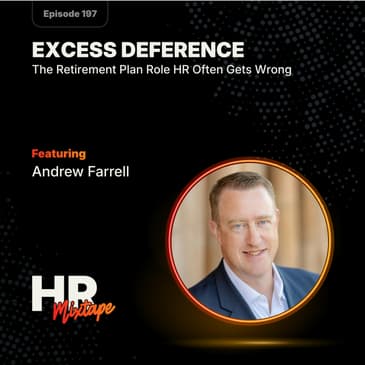
Most HR professionals treat the annual retirement plan review like a status update. The advisor presents, the team nods, and everyone gets back to the work they actually understand. The plan keeps running. Probably.
Andrew Farrell, Retirement Plan Advisor at North County Wealth, has spent 20 years working with businesses on plan design, compliance, and the advisor relationship. He's watched the same dynamic play out across organizations of every size: HR teams that know everything about their company but defer entirely on the plan.
In this episode, he breaks down:
- Why HR is already a subject matter expert in the room, and how to use that expertise to get more out of every advisor meeting
- How to draw a clear line between what HR should own and what should get handed off the moment it leaves the building
- Why missed payroll contributions are the most common retirement plan compliance failure, and the simple calendar habit that catches them before they become a problem
Timestamps
[00:00:39] Where HR's ownership starts in the retirement plan decision chain, from matching rates to enrollment
[00:02:00] Why getting employees enrolled early is HR's most impactful retirement plan move, and why starting late is the primary headwind in savings
[00:03:32] When auto-enrollment creates more administrative burden than it's worth, and the specific scenario where high turnover changes the math
[00:05:08] The "excess deference" dynamic: why HR professionals hand over authority in advisor meetings they should be keeping
[00:06:17] Why your plan advisor needs your company knowledge as much as you need their 401(k) expertise, and what a conversation of equals actually looks like
[00:07:00] Asking your advisor to teach you something, and why using their availability is part of what you're paying for
[00:08:18] The front door rule: what HR should own in plan administration and what to hand off the moment it leaves the building
[00:11:19] Why missed payroll contributions are the most common compliance failure, and how to build the redundancy and calendar checks that catch them
[00:15:38] Why "no" is a valid answer when your advisor pitches new plan features, and the ongoing operational cost of adding any bell or whistle
[00:18:40] What "fiduciary" actually means, how to know if you're a named one, and the four primary duties that come with it
Brought to You by Paylocity
Paylocity is the fastest growing unified platform for HR, Finance, and IT. Paylocity brings your people, processes, and data together in one place so HR leaders can spend less time managing systems and more time doing the work that actually moves their organizations forward. Learn more at paylocity.com
Keywords: 401k, 403b, retirement plan, fiduciary responsibility, HR compliance, auto-enrollment, plan advisor, payroll contributions, benefit design, retirement savings, plan document, financial wellness, employee benefits, retirement readiness, plan sponsor, benefits administration, excess deference, contribution timing, investment liability, HR strategy
Powered by the WRKdefined Podcast Network.
[00:00:01] You're listening to the HR Mixtape, a podcast for leaders who want to understand people, strengthen culture, and navigate change with clarity. Today's conversation starts now. Joining me today is Andrew Farrell, Retirement Plan Advisor at North County Wealth. Andrew works with businesses to ensure their retirement plans run smoothly, efficiently, and effectively so their employees have the right plan for their needs today and tomorrow.
[00:00:35] Andrew, thank you so much for jumping on the podcast with me. Andrew Farrell, Retirement Manager, CEO, and CEO of the Retirement Plan So you sit in this space and I think part of what I want to start with is helping you kind of set the stage for our audience. So, you know, for listeners who might be new in this area, when we talk about things like your company's retirement plan, what are some of the major decisions that HR is actually responsible for? Andrew Farrell, Retirement Manager, CEO of the Retirement Plan for the Retirement Plan
[00:01:00] and kind of which of those decisions have the biggest impact on whether employees can actually retire successfully? Like, where's the ownership on the company in all of this? Andrew Farrell, Retirement Manager, CEO of the Retirement Plan Sure. So, the sequence of decisions for today's purposes will presume that the company has already decided to have a plan. That's, of course, going to be an ownership decision. Andrew Farrell, Retirement Manager, CEO of the Retirement Plan for the Retirement Plan You'll see HR start to move in when there's some discussion about the amount of the matching.
[00:01:26] That's usually the next, how much, how many employer dollars are going into the plan. That's usually some combination of ownership and finance and HR. Specifically, the HR piece that always needs to be heard is, how is that benefit comparable to other companies in your industry? Are you losing candidates to your crosstown rival because they match at 6% and you match at 2%? So, there needs to be some HR voice in the overall contribution.
[00:01:56] Where HR probably has the largest impact is at enrollment and eligibility. Getting everybody enrolled into the plan. Auto-enrollment makes this very easy, of course, but the biggest impact is at enrollment. People like to focus on the investments of a 401k plan or a 403b plan, but they're really savings plans. So, the savings is a function of time. So, the biggest headwind that anyone faces in saving for retirement is starting late.
[00:02:24] So, I would say that HR has the biggest role as getting everyone in early as possible. Certainly, they have a role in providing the support and education, coordinating all those things. And the last thing that I would say is to really set the tone. What is the culture around the benefits package? Do we expect everyone to participate in the plan? Do we promote the plan as a good thing? You know, we love you. We care about you to the point that we want you to not be here someday. And the retirement plan is that vehicle.
[00:02:51] So, setting the tone, expecting everyone to participate and get in the plan, I would put as the most important. Yeah, you mentioned auto-enrollment. I want to talk about that for just a second because I've worked in organizations where they had auto-enrollment and organizations that they didn't have auto-enrollment.
[00:03:11] So, kind of what's the thought process about, I guess, not having auto-enrollment since we know that barrier to entry can be something as simple as having auto-enrollment in your organizations? Mm-hmm. So, auto-enrollment is not for every plan. If you have exceptionally high turnover, then it becomes such an administrative burden. You're constantly getting small balances out. The communication around it can be difficult.
[00:03:38] So, a high turnover, a high volume high turnover firm may, the juice would not be worth the squeeze of auto-enrollment. But if you don't have that sort of high turnover, if you've aligned your retirement plan with the rest of your benefits package, you know, I'll see plans where they are immediately eligible for health benefits, but then they're not eligible for the 401k plan for a year. So, some of those kind of things that make the administration of it more complicated.
[00:04:06] But as a rule, I'm a fan of auto-enrollment. It has become a legal standard. Any plan that is started now has to include auto-enrollment in it by law. So, it's a good thing as long as there's not some specific reason within your firm that it's a bad thing. That makes a lot of sense, that fast turnover administrative burden piece.
[00:04:28] You know, you've been in this space like 20 years, and I think one of the things that, you know, you've noticed is that, you know, even professionals who have also been in their careers for 20 years don't necessarily know how or why or where to push on either their plan advisors or their service providers.
[00:04:50] And I'm curious, you know, where do you think that gap comes from and, you know, what would you advise the HR professional to go back to those organizations? And I don't mean like squeeze them for all there is worth, but there's definitely benefits and resources. I talk about this a lot when I talk about working with your benefit broker, that it's kind of a missed opportunity in so many spots.
[00:05:10] Sure, absolutely. So, I usually, I've seen this quite a lot. I would actually, the term that I would use to describe it is excess deference. You know, whether it's your benefits broker, your retirement plan advisor, a lot of, we're interchangeable in this regard, I think. We're subject matter experts. That's what we've staked our value proposition on. We have experience, we have credentials, we have flashy PowerPoints and tech demos. And, you know, we like to come to meeting with, you know, some shock and awe.
[00:05:41] So, if the plan is running well, and your advisor comes in, and the HR professional already has nine or 10 other things that are actual problems, it's very easy. It's understandable for them to just say, okay, whatever, whatever this person informs me, I'm going to go with. But I, my counterpoint to that, however, and you know, again, they're, Andrew, you're a 401k expert, I'm just going to do whatever you tell me to.
[00:06:04] Fine, perhaps, I will concede. But I would remind that every HR professional is themselves a subject matter expert, and not just in whatever degree of HR technical skill they have. You're a subject matter expert in the company. You know who makes the decisions, how those decisions get made. You know, what are the employees thinking? What are the business agendas and priorities for this year? What are the employees thinking and saying? What do they not say?
[00:06:32] All of that makes you a subject matter expert on your firm. And the value of that is worth its weight in gold and Bitcoin. To those of us on the outside, all we know are 401k plans. We need to make a 401k plan for your firm. And so we, it needs to be very much a conversation of equals. And we're each bringing our own subject matter expertise to the table.
[00:06:55] I would also, just as another piece of that question, is encourage everyone to always push on your advisors and brokers to, at some point during the year, teach you something. You know, whether you do your annual review meeting, and then you break and you come back for 20 minutes when the owner's out of the room so it doesn't look like you're asking dumb questions.
[00:07:18] Have them sit you down and teach you something. You're paying for your advisors. You're paying for their experience. You're paying for their expertise. You're paying for their ability to communicate. But you're also paying for their availability to you. So use them as the subject matter expert to close that technical skill gap, whether it's on insurance or retirement or any of the other things that you're working with.
[00:07:44] So it's not a bad thing. I think it's just a trap that a lot of people fall into. They don't think of themselves as a subject matter expert on their company, when you very much are. If you were giving this advice to a direct HR person, what would you be most excited that they came and asked you to teach them about? Like, what is the thing that you get geeked out about that you're like, hey, I wish more HR professionals would ask me to teach them about this topic?
[00:08:09] Dangerous question for geeks of the field. How much time do we have? I mean, there's a couple of things. You know, a couple of the questions tend to be, you know, what to delegate, where, what can I, what should I be holding on to? What should I be sending to you? You know, the short version of that one, the easiest way to explain that is I tell people, draw the line at the front door.
[00:08:34] If it happens inside your house, enrollment, when are they eligible, some of the payroll, some of those kind of things, then that's most certainly something that we could talk about, but really that's going to be the HR person. But once it gets outside, once the money gets to the plan, you're generally getting investment questions, those kind of things. And there I am pretty adamant that I don't want HR professionals talking about investments.
[00:09:01] It opens you up to a lot of investment liability and liability that you don't want to take on. And that's what we're here for. That's why we exist. So if it's, if it's some question that occurs inside of, inside your office, it's probably you, as soon as it gets outside of the office in any way, shape or form, then you want to pass that off to us.
[00:09:24] Yeah, I think it's the same, you know, advice we give, you know, early HR professionals about, you know, helping employees with onboarding. You know, I, I have definitely been asked in my career, you know, what should I select for my tax exemptions? It's like, well, well, well, here's the resources. I can't give you that advice. I'm not a tax expert.
[00:09:42] So I love that. I think it's good to think about all those different things that the types of questions we get from employees that we really should be using our relationships and pushing them back or, or pointing them to the right resources that aren't necessarily, you know, us as the expert on that topic. Your advisor should know how to fix almost every problem, even if it's not theirs to fix, right? So if it's a missed payroll, again, we can talk about how to fix that, those kinds of things.
[00:10:12] If the participant needs to reset their password at their 401k record keeper, again, we're not going to do that, but we absolutely should know the phone number for them to call or the website for them to go to. So I always want, if there's ever a question, if you don't know, if the answer is, I think I know the answer, but I don't, like call your advisor, email your advisor. Again, you're paying for that availability.
[00:10:33] They should be able to accept all of that delegation in turn and with grace and be able to help you answer those questions. You know, you can hope that you're not getting the same question for the 10th time in the same month. To be fair, there needs to be a two-way dialogue, of course, but when in doubt, ask and delegate and we can take care of it for you. I love that. You know, one of the things that I think can get really complicated or feel overwhelming for HR professionals,
[00:11:02] and I'm thinking, you know, specifically of that HR department of one or that smaller organization where, you know, maybe you're an HR generalist, you're not at a director level, but based on your company sides, you're responsible for all of these things. You know, what are some of the most common compliance gaps that you see and how do you help, you know, HR teams start to recognize them before they become, you know, serious liability for them? Absolutely. Far and away, the most common is missed payroll contributions.
[00:11:33] So in most organizations, there's a payroll person. Sometimes it's the HR person. Sometimes it's not. More often than not, it feels like it is a separate person that's just doing or has that task. And nine times out of 10, 99 times out of 100, it's fine. You know, the firm pays every other Friday. They do the payroll on time. They submit the file. The payment to the actual plan, ACH is out on the same Friday and hits the plan on the Monday.
[00:12:01] Fairly common scenario across the industry. And then the one week that your payroll person is on vacation is the same week when that ACH rejects for some who knows reason. And then you've gone a week before they even get back. No one has noticed. So plans miss payroll contribution. Not every plan every year, but it's very common. It's very easy to correct once it's identified. But it is the most common failure.
[00:12:29] So anytime you touch the plan is a potential point of failure and payroll is touching the plan 24 to 26 times a year compared to one or two or three annual reviews. So it's the most common point of failure. So what I would recommend as a best practice for HR, presuming that you're not also the payroll person, is that it is by far and away the most, the best ROI for redundancy and training to make sure multiple people. What is our process? How is it supposed to be done? What days is it done?
[00:12:59] Who does it? Who's their backup? And who's the backup's backup? And even then, let's say that scenario, you know, we pay on Friday, our contributions are normally hitting the plan by the Monday. I would encourage them to still calendar for like that Wednesday. Just put a little tickler for some time, you know, eight in the morning, nine in the morning, time doesn't matter. To get into the habit, log into your 401k plan, look at your account. Did my contribution hit the way it was supposed to?
[00:13:27] Did the employer contribution hit the way it was supposed to? Yes, you can log out and you're done. If it didn't, then you can do something about it. But if you're looking at your own account, then you're not expressing some sort of distrust in your payroll person. You're sort of quietly, yes, everything is supposed to be hitting. And there's a seven business day safe harbor the government gives us.
[00:13:49] So even if your contribution was supposed to go in on a Monday, you catch it on the Wednesday, you still are within plenty of time to get it done in a compliant manner. So far and away, payroll processing and contribution timing, the first and best place to make sure you have that lockdown. So we are. And I loved how you kind of went through, you know, we run payroll this day, director pods is hit this day. It goes to our plans this day.
[00:14:15] Just knowing that and having multiple people in the organization know that and be able to articulate that, that in itself can be a great first step. You know, I know I've worked in places where I had to kind of ask that question over and over again is like, when does it hit the plan? When do we check it? And I think this is, you know, part of the HR audit planning, right? You just add it into your audit processes. You know, you're going to check this thing. And I would say this is probably one of those areas where you don't just set it and forget it. You know, you don't just automatically assume.
[00:14:43] Same with some of our like our EDI benefit feeds. Like those are things you have to check pretty regularly to make sure because it's pay related, right? It's one of those things like you got to get pay right. You know, that's just that's just that's table stakes in a lot of the ways. So I love I love all those examples. You know, as I think about benefit plan design or retirement planning design in general, I think this can be a great culture lever for us to pull if we have the right package, the right structure.
[00:15:11] There are so many different things for us to consider, though. You know, our employer matching structures, potential financial wellness programs, student loan. That's changed now, right? It used to be tuition reimbursement. Now we're talking about student loan repayment plans. As you look across the industry, what are what are the levers that you think are actually moving the needle for employers and having some real impact on retention and attraction right now? Mm hmm.
[00:15:39] My industry sisters and brothers may not love this answer, but the the real answer, in my opinion, is all of them are good at the margin. There's a few that, again, auto enrollment is great. The Roth contribution option was, in my opinion, the biggest mover. But that was, you know, going on 20 years ago now.
[00:16:00] Yeah. So a lot of the other things that we are developing or have brought to market or will bring to market in the next five or 10 years, as far as I'm concerned, I think a lot of them are great for some plans. I have really not seen too many things in the last five or 10 years in full honesty that I think, like, every client needs to, you know, pony up to the bar and get some of this.
[00:16:23] So a student loan repayment, for example, could be an absolute home run for a tech company in San Jose, but a trucking company in St. Louis. So to that, I would say benefits are great if they're great for your people. So your advisor, your service provider should be bringing the team of decision makers the options. Here's what's available. It got passed by Congress two years ago. We got guidance from it. So we feel very safe moving forward.
[00:16:52] We know very clearly what the rules are. Our product is going to cost you X. Your requirement is going to be Y. Think about that. But decision makers need to remember that they also have no in their toolbox. No, that's just not a good fit. I don't feel like we have good utilization of that feature. We've got two people maybe out of our group of 200. Because every feature, every bell or whistle that you add to the plan has to be monitored. Before you add it to the plan, it's not your responsibility.
[00:17:22] As soon as you add it to the plan, it's your responsibility to monitor, to make sure it doesn't break, to know if you're paying for it. All of these kind of things need to be factored into that cost benefit of every feature before you add it to your plan. That makes a lot of sense. You know, we've had some conversations with other guests about data. And one of the things that they kind of came back with is like, track the things that matter to your organization. Right? Like, not every metric is a representation of things going well.
[00:17:51] So not every benefit offering makes sense for you. So I love that you said that. You know, as we kind of get to the end of our conversation, I'd love maybe if you could dive into a little bit around the term fiduciary responsibility. I think that's one of those terms that can be scary or make HR nervous. But I think in really understanding it, theoretically, it should help alleviate some concerns they have when they're working with a financial advisor.
[00:18:18] So where in that fiduciary responsibility does it sit with HR or the company? And where does it sit with the financial advisor that we've engaged with? Yeah, absolutely. Common unclarity, let's say. I don't want to call people wrong about it, but it's a very common thing that they're not clear about. So the first thing to decide is, are you a fiduciary? Are you a named fiduciary? Or are you not? So the laws and regulations really break down and either identify you as a fiduciary or not.
[00:18:47] And you can do all sorts of things, all sorts of business around the plan in what's called ministerial tasks. So the payroll processor, again, probably touches the plan, makes contributions 26 times a year, probably more than anyone else in the whole firm. Probably not a fiduciary. So to be a capital F fiduciary, you should have signed your name to a piece of paper at some point. So you've signed as an authorized plan signer. You can sign plan documents, plan amendments. You sit on the investment committee.
[00:19:17] You've signed a charter. You're a trustee. Every plan should have more than one trustee in case the first trustee gets hit by the magic bus that's out there killing people. So are you a trustee? Did you put your name on a piece of paper or not? And the HR group probably 60 to 70% of the time is, but certainly is not. And it might not be everyone on the HR team. Just because you're in HR doesn't make you a capital F fiduciary.
[00:19:45] And it's important to know because in theory, you're personally liable if the plan goes incredibly bad and it's the fault of the fiduciaries. You have insurance coverage for that, but it's an important thing to know. Then we move into the topic of are you executing your duties as a fiduciary? And there's really four primary duties of a fiduciary. Your duty of loyalty. So are you making decisions about the plan that are in the best interest of the participants?
[00:20:12] Are we executing our duties without these conflicts of interest? Some of those kind of things. Paying only fair and reasonable fees is a biggie. So there's the duty of loyalty. There's the duty of prudence, which means you have to, if you're going to be involved in monitoring the plan, you have to do it with some skill and care. You can't just check out and come back and, you know, once every five years, look at it. Diversify the plan investments. That's the easiest one. I don't know if I've come across a plan in 20 years that is not diversified in their investments.
[00:20:41] And the last one that does come back to HR a little bit, or probably as much as the others do, is follow the plan document. So every retirement plan has a plan document that sets out the rules of the road. When are people eligible? What are we going to do here? What are we going to do there? Do we have loans? All these kind of things. Newer HR professionals, best first thing you can do about your plan is read your summary plan description, read your document, make sure you know what it is.
[00:21:08] Because I've come across all sorts of situations where you have the way that the company's operating the plan, and then there's the way that their plan document is written, and they're not the same. It happens. Plans evolve over time. Somebody new comes in and says, well, great, but I do it a different way, and we're going to start doing it a different way going forward. Okay. I won't make the argument which one's good or bad, but that's not what your plan document says.
[00:21:34] So every so often, it doesn't have to be annually, but every periodically you should sit down with your plan document, give it a run through. Are we in fact doing this? And then just determine if you're not, which do we need to adjust? Do we need to adjust our behavior and our processes, or do we just need to amend our document to bring it in line with what we're doing? So it's not some sort of apocalypse, but it is important. Yeah.
[00:22:03] That was really, really good detailed information and in a way that I think is pretty easy to understand. So I appreciate you taking the time to kind of go through that last question because it can be sticky. I think there is some fear or some scariness of that, but I think you're absolutely right. That last point, know your plan document. Know what it says and what you're going to be held accountable for as an HR person. So I love that. Andrew, this conversation was wonderful.
[00:22:27] You know, I think this relationship that HR has with their financial advisors and their brokers and their retirement planning people is one of the most important that they have in their bucket when it comes to creating great workplaces. So thanks for sitting down and chatting with me for a few minutes. Yeah. My last takeaway, the acid test to me for advisors, would you invite your advisor to the company picnic and actually hope that they show up?
[00:22:53] And if the answer is like, no, maybe, maybe that means you should revaluate that relationship and the trust there. But that's probably the bumper sticker version of how do I know if I have a good relationship with my advisors? How much do you trust them? I love it. Thanks again, Andrew. Absolutely. Thanks, Dr. Shari Simpson. Thanks for tuning in to the HR Mixtape.
[00:23:20] Like, share, review and subscribe to support the show and help more people discover these conversations. Until next time, keep the conversation going.
Sponsors
