
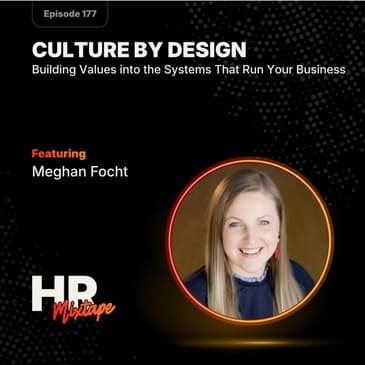
In this episode of the HR Mixtape, Dr. Shari Simpson speaks with Meghan Focht, Human Capital Director at Concurrency, about the intentional design of workplace culture. They discuss how to identify cultural strengths and weaknesses through values and behaviors, and how to implement systems that support a positive environment.
Listeners will learn practical strategies for assessing their organization's culture and making meaningful changes.
• Understand the importance of aligning values with behaviors in the workplace.
• Identify key systems to evaluate when assessing organizational culture.
• Learn how to create a culture of recognition that reinforces desired behaviors.
• Discover ways to engage leaders in cultural conversations and accountability.
• Explore practical steps to implement cultural changes in your organization.
00:00 -- Introduction to the episode
00:54 -- Meghan's experience with culture change
02:43 -- Key systems to assess culture
04:42 -- Linking values to behaviors and competencies
05:15 -- Hiring for cultural fit
06:19 -- Celebrating values through recognition programs
08:11 -- The role of technology in culture
10:39 -- Engaging leaders in cultural alignment
12:50 -- Identifying cultural misalignments
16:00 -- Signs of a healthy culture
17:55 -- Building values from scratch
19:39 -- Actionable steps for cultural improvement
Guest(s): Meghan Focht is the Human Capital Director at Concurrency, where she focuses on developing strong people systems that foster growth and a positive culture. She has extensive experience in identifying and addressing cultural challenges within organizations. Meghan is passionate about creating environments that empower employees and enhance collaboration.
Keywords: workplace culture, assessing culture, values and behaviors, recognition programs, leadership accountability, cultural change, hiring for fit, technology in HR, employee engagement, culture systems
Powered by the WRKdefined Podcast Network.
[00:00:01] You're listening to the HR Mixtape, a podcast for leaders who want to understand people, strengthen culture, and navigate change with clarity. Today's conversation starts now. Joining me today is Megan Fosht, Human Capital Director at Concurrency. Megan focuses on building strong people systems that support growth, leadership development, and lasting culture.
[00:00:35] Megan, thank you so much for joining me on the podcast today. Yeah, thanks so much, Sheri. So you have talked about culture from this perspective that it's built by design. And I'd love to hear more about, you know, what experience really helped you learn that culture isn't accidental?
[00:00:54] Yeah, I, well, first of all, I love Patrick Lencioni. And so his one book, I think it was the Five Dysfunctions of a Team, where it talks about like, one company has the poster boards on the wall and one company doesn't, but the culture thrives better with the company without the posters.
[00:01:11] And I think that always, I found so intriguing. And my first job out of college, I worked at UCLA in the rec department. And I think that was the first time that I realized, oh, this is something like I could maybe think about.
[00:01:27] Because we had some, some sort of broken spots and people who didn't lean on each other or rely on each other and some contention points. And so me being a fresh grad out of college with some HR, you know, classes under my belt, I was like, well, this is a culture change moment and really kind of got down to business.
[00:01:46] So I knew that we needed to empower our people, which were students. And I knew that there are a couple different departments that we were working together with that we didn't have a great relationship with. So I, I think that was, you know, for me, I just saw it as a challenge, like people should get along. I think I've always kind of been born that way, where it's just like, okay, we're all humans. Let's figure out how to work together.
[00:02:09] So yeah, I think there was a systematic approach that I took without realizing it. And then after that, I mean, I was a little bit hooked. It was something that I kept my eye out for and would tackle no matter where I went. I love that you mentioned systems, because I think that there are ways for us to see what culture actually looks like when we kind of peel back the curtain in an organization and look at some of the process and systems that they have in place.
[00:02:36] What are the ones that you kind of go to first to look at to have a better understanding of an organization's culture? Yeah. So it's interesting, too, because I work for an IT consulting company, Concurrency, and we have a lot of clients who do IT projects. But with the way technology is changing, it's becoming culture projects, too, because it affects everyone. It's not just an IT project in the IT department anymore.
[00:03:00] And so as we've been working with those clients, too, I've noticed I've kind of been able to test what I do. And the first thought is, okay, what are the values? Right. What do you say your values are? And that's kind of where my curious brain goes first. And then it's like, okay, are those the values that I'm feeling that our team is feeling?
[00:03:20] Is that really shown obvious and make a lot of sense? And then, especially in this new world with AI coming into play, you need a really a culture that supports empowerment. And so then it's like, are your values impeding that? Right. Like, do you say you want to do something, but a value that you have is getting in the way? So if you say that you assume positive intent is one of ours, right?
[00:03:44] But then you're every like your leader, every time something goes wrong is trying to find the person who's to blame or gets really tough on. Okay, well, why did this happen? Who did it? Why did you do that? And kind of goes to that punishment place first. Then, you know, okay, something's not right here. And so then once we can see that those things aren't right, that's where I start to go.
[00:04:08] Okay, why isn't that right? And sometimes it's the leaders and you don't have the leaders who live and breathe those values and believe in it. Sometimes they just have to be pointed out, right? Like assume positive intent. A lot of times people don't realize the way that they're acting is actively working against something that they think is important. So sometimes it's just bringing it to light. But that's where the real work comes from. It's look at the values, compare it to what the feeling is and sort of what the behaviors are.
[00:04:37] And then from there, you'll figure out, okay, is there work to do here or are things good? I like that you mentioned behaviors because, you know, I've worked in all kinds of organizations. And there definitely have been the organizations where the values are on the wall. And that's it. They're just on the wall. There's no other thought beyond them. I've worked with organizations that have pulled their values all the way through to their competency models and then, you know, the behaviors expected.
[00:05:06] How have you seen kind of that work best, right? That link between values, behaviors, and potential competencies? Mm-hmm. Yeah, I mean, I think, you know, it is about the people, right? So the easiest way to make sure values are working are hiring people and promoting people who naturally gravitate towards those. And that's sort of the magic thing. Now, you can't access that right away.
[00:05:32] You know, if you realize you have sort of a broken link between what you want to be and then what's actually happening, you can't just hire and change it. You know, I've talked to some friends or clients who think that we're going to change the culture, so we're going to start hiring the people who we want the culture to be like. But those poor people, you know, that's a lot to carry for a new hire to be like, you're going to be the change, but we're not changing the systems or, you know, really making a stake in the ground.
[00:06:01] So then I think you just have to kind of go systematically in what's available. Sometimes the leadership isn't available. It's not a thing you can change right away. And so then I go, okay, well, what is tangible today? What's something we can do today? So we could change our hiring approach for sure. You should touch on that, especially if your recruiter is on board and your hiring manager is on board. You can start developing questions that align to the values that you're looking for.
[00:06:28] And you can get pickier on who you decide to hire. But the other thing is even just reward programs, right? So I think about we have a kudos program that's a little bit more casual. Like you see something good, put it in there. We send it out weekly. It doesn't have to be a big deal. And then we have a quarterly like employee excellence award. And so I'm really thoughtful too about, okay, looking at those nominations. Are those the things we want to celebrate? Is there anything in those nominations that we're not celebrating?
[00:06:56] And then I have my ear to the ground because you don't want to manufacture anything. But then I start talking to the leaders and the people and go, you know, assume positive intent or be the differences are our values or be yourself. Like what are those moments where you feel like people are doing that? And then when I hear the story, go put that in. Put that in kudos. Put that in employee excellence. When we do our all company meeting, we ask for people to speak up and talk about how they saw our values present within their coworkers or at work.
[00:07:26] So now it's other voices saying it. So it's like all these moments of reinforcement and reinforcement. It can get to the point where the leaders that maybe are a blocker can't deny it. You know, and it's not just you fighting for it anymore.
[00:07:41] Well, and you reach a tipping point, I think, in any organization that's trying to make a culture change where those that no longer kind of align with it or have the same vibe or the same feel or get excited, hopefully will naturally self-select out. But it also can give you that opportunity to have those conversations, those tougher conversations that, hey, you know, this is the direction we're going. These are the behaviors that we see. And this might not be the right fit for you anymore. And that's OK. Like that is OK.
[00:08:10] So I love really linking it to how it shows up from that behavior perspective. I want to talk a little bit more about the connection between values and culture and systems. This is, you know, obviously working for a tech company myself, you know, I'm very passionate about the fact that employee experience can be elevated and augmented by the technology you use. How have you seen that come to life in, you know, the people that you've worked with?
[00:08:38] Yeah, I mean, for us personally, it's really important that we have an empowerment culture. Like a go try it. Growth mindset is one of our values. It's, you know, the fail fast. Like, go try it. Like, who cares if it doesn't work? Then we know it doesn't work. And so we do have an environment here that is very much like we don't. Who cares if no one else is doing it? If we think we need to do it, let's try it.
[00:09:04] And that is from our our CEO and our founder is very much that way. He's entrepreneur brain. His brain never shuts off. He's super creative. He's constantly looking at should we do it this way? Should we do it that way? He leaves space for us to say, I firmly believe this is something we have to try. And he'll go, OK, that's fine. And, you know, we have a single owner, so we don't have a board we have to try to convince.
[00:09:29] So it allows our culture to be able to be that flexible, which works in this technology day and age. So I was just having a conversation with our project managers yesterday about, you know, which AI tool should we use? And is there a limit? And what's our policy? And, you know, we've got the like we're working on the policy. But also, I'm like, it's we can't restrict you because we're IT consultants.
[00:09:55] So we need you to go out there and try things and see what's out there and see what's good. Like realizing Claude is really good for like a tone. Adjusting the tone for your emails is something we talked about. And even you can use ChatGPT, but you can use Claude for that or just figuring out like what works best. And so we don't want to cut that off. But obviously, we need them to be smart about what they're putting into those tools and be aware of how they work.
[00:10:22] So system wise, right, it's we don't have a really restrictive policy. We do make sure we're talking about these things in meetings. Another way that we've we've thought about that is just how we get people together. We realize that when COVID happened, it wasn't as easy to have all these departments intermixing. You know, it used to be that you'd run in like literal water cooler, right? You could run into anyone and then have all these ideas kind of mix. And oh, you're on that project. That's really cool.
[00:10:52] Did you know this person's working on that? Oh, I done that before. Let me give you some advice. So we've had to like create touch points or different meetings, you know, and everyone hates meetings, but meetings where it could just literally be creative thinking space because it just doesn't happen on accident anymore. So that that's another example of just like ways that we've we've thought about, OK, this is what we want to do. This is how it's showing through. I love that.
[00:11:21] And I think it's a good example of, you know, if you have a culture of innovation, right, how that spills over into your technology use policies. I also think it's great if you have a culture of recognition, you know, linking that up to a tool that gives you the ability to to recognize seamlessly in a in a consumer way. I think that's something that we miss a lot when we are thinking about our employee population and the technology that we're bringing in.
[00:11:49] You know, we think very much about efficiency, both from a financial perspective and from, you know, getting the work done. But sometimes we forget that, like, it's also a big piece of the culture which which influences those things like productivity and bottom line and that kind of stuff. How have you talked with leaders about values to get their buy in when when they don't live in HR? They don't necessarily see the connection.
[00:12:15] And I think sometimes we run into this and I've talked about this on the podcast before where we have leaders who are meeting their KPIs, but their behaviors are in, you know, do not align with the values of our organization at all. And so having that conversation can be difficult for us in HR because we're trying to talk about how important this is. But we don't necessarily have that KPI number to back it up to say that, like, well, you're
[00:12:44] not you're not meeting expectations from a KPI perspective. Yeah, we totally ran into that. And it's so funny because to your point, like they're not in HR for me. All the people stuff comes more naturally. Right. In the same way that I'm super impressed with my coworkers and how their brain works around technology. My brain works around people that way. And so, you know, I don't feel like I need to have it written down to coach someone about
[00:13:13] how to be a good coworker. Right. Like I'm going to have that regardless if it's in the job description or competency or I don't need something telling me that I'm just going to do it. But we did have to add it to our competencies. So we added living our values to our competencies so that it was something that helped managers have that conversation. So even though you might be a top biller or a top salesperson or this, if you weren't
[00:13:41] good to work with, if you weren't assuming positive intent, if you were creating drama or being really close minded when new ideas came, we had a place to talk about it and to, I guess, ding someone for it. Right. Because also the other thing about these systems is you don't really need that when everyone is doing great. So it is sort of that protection of how you guide that conversation.
[00:14:06] And we are not that big of a company, which I also realize makes it a lot easier to do a lot of these things. But these systems then become even more important when you grow and you have two layers of manager. Right. And so you can't just say we're going to hire everyone who just naturally understands how to do this. And putting our values in a competency protects that. So as we get the different layers of managers, they can't skip over it.
[00:14:35] They can't not see that it's important. They have to stop and talk about it and read what the values are and then have that conversation. So there isn't as much room for interpretation that we always want people to come like approach it genuinely and honestly and in their interpretation. But it makes sure it's a little bit more controlled and then we can grow and protect it because we've seen that. We've seen it.
[00:15:00] We've seen it here where we've grown and we lost a lot of that, you know, and it was just other people running the ship. Well, and it gives a common language to have those performance conversations. It does make it easier. You know, it's like, you know, when you're talking to startups and they don't necessarily have a handbook in place yet and they're like, we're running into all these issues. It's like, well, maybe let's start with a handbook because then you have a common language to go back to and have those conversations.
[00:15:29] So, yeah, I completely agree. And I love the idea of pulling it into your competency model because it makes it very clear and you can talk about how those behaviors, how those behaviors look. You know, when you've helped people implement these cultural systems, how do you, how do you coach them on understanding if it's working or not beyond, you know, your annual engagement survey? You know, what are some like quick ways that you can understand if the system's working well so that you can adjust if you need to?
[00:16:01] Yeah, it's like quick ways. I don't know. But there's moments you're going to notice, right? Like I remember moments in other jobs and every job where things are just harder, right? Like you just keep getting stuck in circular conversations or it's like, here we go. It's not just like a friendly professional debate with a solution at the end. It is a conversation. There's backtalk.
[00:16:27] There's conversations about other people happening without that person involved or even where you're trying to get an answer from a leader and you ask that question to five different leaders and get five different answers. You're going to know like something's not working. When I've been the most excited about culture progress is when we have an employee who calls
[00:16:54] out another employee, you know, and not in a way of like you're in trouble, but in a way of, whoa, that's not how we do things here. Like, are you OK? Is everything OK? Because we don't do that at concurrency. We have an open mind. We explore this. We're assuming positive intent. We're generous with our way of thinking. So it doesn't seem you're in that space. What's going on? And when I heard that an employee had that with another employee, I mean, that is like
[00:17:23] HR, like happy moment ever, because everyone expects HR to be like, well, did you go to the person? Did you tell them how you feel? And everyone's like, oh, whatever. Like easier said than done. So when it's someone else doing that, I think that's when you know it's real, you know, and it's not just something happening at the executive table. If you were creating these systems from scratch, if you're walking in and you're the first HR
[00:17:50] person, you're employee number two with the CEO, what do you build first? I think it's I mean, I think it's values. I think that's what you talk about, you know, and I think even with our owner, even though our company has been around for 37 years or 37, it still was going back to him and saying like, what was the original vibe? You know, what were you trying to go for? What were you celebrating? And then is that that way today?
[00:18:17] And we did a value refresh a couple of years ago. And the question that we asked was our best people, the people that we want to be around with, the people that we want to put in front of clients, what are the what how would you describe them? And that's how we came up with our values is like just looking at the people we want to be around that we want to celebrate. And what are we recognizing out of that? And then, you know, that makes it foolproof and it makes it believable and it makes it
[00:18:44] it makes everything else easy because you're going to the what do we want it to be? And it's funny, too, you talk about handbooks because I think they're really funny because they are created by all the things that have gone wrong. Right. It's like if it's in the handbook at some point in history, something happened and I want to know the story. But it's it's sort of the same thing, too. It's like you won't need as many rules.
[00:19:09] You won't need to force it as much if these things are just natural things we want to celebrate. Right. If I'm making a policy, what what do we normally want to do as humans? What are the managers naturally wanting to do? Right. Like at one point we didn't have parental leave, but our managers were giving it. So it's like even if we say we can't afford it, we're doing it. So let's just put it in the handbook in the way people behave and want to behave that we're OK with. Everything goes so much easier.
[00:19:39] I love that. Well, Megan, as we wrap up our conversation, what's one small system change that you think our listeners can make this quarter to strengthen their culture? Yeah, I mean, my first thought is not a hard system as much as it's be a good example. You know, be a good example. Be bold in challenging the people around you to say, is that how we want to be here? And lead with empathy to go like, are you OK? Is everything OK? Like what's getting in your way?
[00:20:08] And then from an HR perspective, I would say, look at how you're celebrating your people. And is that aligned with how you want to be culture wise? And if not, change it or put your own celebration out there and make it really public. The louder you are about the things that you want to keep seeing, people will want to keep doing that. I love that. Such good advice, Megan. Well, thank you for sitting down and taking a few minutes of your day to chat with me. Thanks so much, Sherry. This was awesome.
[00:20:42] Thanks for tuning in to the HR Mixtape. Like, share, review, and subscribe to support the show and help more people discover these conversations. Until next time, keep the conversation going.
Sponsors
