
Pay used to decide who took the job. Now the first question most candidates ask is whether they can work from home, and companies still writing postings around salary alone are losing candidates before anyone even applies.
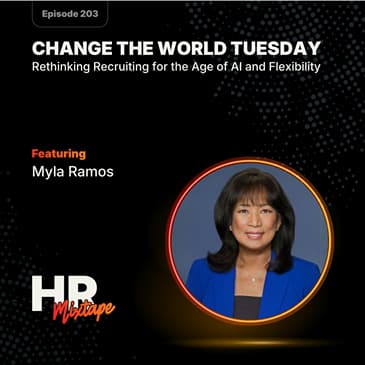
Myla Ramos, co-founder and CEO of SearchPros, built the company from a local Sacramento staffing firm into a nearly $175 million global managed service provider. She cut her company's time to hire by 45% using AI while keeping retention above 70%.
In this episode, she covers:
- Why flexible job postings pull in 10 times more applicants than office-only roles, and why candidates will take 30% less pay to get it
- How SearchPros cut time to hire by 45% by pointing AI at candidates it already had, instead of chasing new ones
- What determines whether a new hire survives the first 90 days, and why Ramos calls it a two way responsibility
Timestamps
[00:01:10] Myla's early years making 200 calls a day, and the shift required to stop doing the job yourself so the company can scale
[00:03:45] The origin of "Change the World Tuesday," SearchPros' internal term for rebuilding a broken process by the start of the next week
[00:05:04] The widest gap between what employers say they want and what candidates actually bring to the table right now
[00:08:41] What leaders get wrong about hiring and keeping Gen Z, beyond the usual complaints
[00:09:21] Why SearchPros dropped its call and placement quotas in favor of measuring results
[00:13:08] Why flexible postings draw 10 times more applicants than office-only roles, and why candidates will take 30% less pay for remote work
[00:15:43] The real hiccups of adopting AI in recruiting, and why there's no single tool that does all of it
[00:17:48] How SearchPros uses AI to mine a database of millions of existing resumes instead of chasing new candidate sources
[00:19:44] Why an estimated 85% of applicants inflate their information, and the in-person interview SearchPros added to catch it
[00:24:10] What actually determines whether a new hire survives the first 90 days, and why Ramos treats retention as a two way responsibility
Guest Bio
Myla Ramos is the CEO and Co-Founder of SearchPros, a full service provider of human capital and workforce solutions. A member of the 2024 SIA Global Power 150, Ramos has earned numerous leadership awards, including the Business Journals Most Admired CEO, Power 100, and Women Who Mean Business; and the National Association of Women Business Owners (NAWBO) Outstanding Women Leader of the Year. She is a finalist for the EY Entrepreneur of the Year award. Ramos is proudest of SearchPros' "Best Place to Work" recognition from numerous organizations, including Inc., the Sacramento Business Journal, and SIA.
Brought to You by Paylocity
Paylocity is the fastest growing unified platform for HR, Finance, and IT. Paylocity brings your people, processes, and data together in one place so HR leaders can spend less time managing systems and more time doing the work that actually moves their organizations forward. Learn more at paylocity.com
Keywords: AI in recruiting, staffing industry, talent acquisition, Gen Z hiring, employee retention, flexible work, remote work, managed service provider, recruiter productivity, candidate experience, resume fraud, pay transparency, onboarding, contingent workforce, HR technology, time to hire, work from home, new hire retention
Powered by the WRKdefined Podcast Network.
[00:00:01] You're listening to the HR Mixtape, a podcast for leaders who want to understand people, strengthen culture, and navigate change with clarity. Today's conversation starts now. Joining me today is Myla Ramos, CEO and co-founder of SearchPros, which she built from a local staffing firm into a nearly $175 million global managed service provider.
[00:00:28] She cut time to hire by 45% with AI and kept retention above 70%, so she can tell you exactly where automation pays off in HR and where it still falls apart. Myla, thank you so much for jumping on the podcast with me today. Of course. Good morning.
[00:00:51] So you built SearchPros from a local Sacramento staffing firm into this global managed service provider over two decades. So I'd love if you could take us back maybe to the early years. What did that business look like when it was just starting? And what were you personally doing every day? I was recruiting. I'm still a recruiter. And I think most of us entrepreneurs that start a company realize early on that we do something really well, whatever it is, right?
[00:01:21] And we're passionate about it. So in the beginning, I took pride in making 200 calls a day, whether it be 200 customers I'm looking for. Hi, this is Myla. Do you need a 10th? Or candidate? Do you need a job? I have a job for you. I took great pride in that. But I think what I realized over the 20 years, being good at what you're passionate about isn't necessarily the way to scale a company.
[00:01:48] So as we grew bigger and bigger, you learned, okay, well, now I'm going to lead by example. I'm not going to do the job myself. I'm now going to lead by example. And you do the recruiting and you have your recruiters next to you and you're recruiting together. Now there's two of you recruiting. And that's really cool. And you double your output. But to grow to the level, like you said, we're international, we put 20,000 people to work. You still can't do it by yourself. You can't even do it with two people or three people.
[00:02:18] So you develop and it's a very difficult thing to do. And not a lot of people I think are able to scale, to realize it's no longer about you. It's no longer about your skill as an entrepreneur. The skill has to develop and change into seeing strategically, letting go of what you love to do to let it grow, to let it breathe.
[00:02:42] And I think the second most important thing is being able to adapt to that because people are stubborn. If you're good at something, you want to do it the same way every time because you've proven it to be successful. Like, gosh darn it, I need displacement doing it this way. If I make 25 calls, I'm going to get 10 interviews and my 10 interviews, I'm going to get three hires. Remember those numbers? And you know, over the years and 20 years that we've been in business, I've seen companies come and go.
[00:03:09] And I think those are the two things that I've learned along the way. One, you got to learn to be strategic and realize that what you were good at yesterday isn't what you have to be good at tomorrow. You have to keep learning. You have to keep evolving and growing. And part of that evolution is learning change and being okay with it. So we actually coined the terminology in our company. They make fun of me because of it.
[00:03:36] But since change is so constant, especially when you're dealing with people and employment law in California, we have a term I call change the world Tuesday. So what happens is, you know, you work all week and you realize all the friction and Friday happens. You realize, crap, this is crap. This is what happened and I can't control it. I think about it all weekend. Then Monday I come back to work and I collaborate with my partners like, this is what happened.
[00:04:01] What if we only recruited purple unicorns instead of blue-eyed unicorns? So by Tuesday, we have a new process. Like, hey, we're going to change the world today. It's Tuesday. It's changed the world Tuesday. We're only recruiting purple unicorns. And I think that's kind of how we evolved. So in the company, the team is just used to change the world Tuesday. So they didn't mind that, hey, tomorrow we're going to do AI and the next day we're going to do agentic. And the next day we're doing, it's just a part of the process now.
[00:04:30] I love that you get to sit in this place where you've been, you know, that recruiter, but you get to hear what employers say they want. And you get to hear what candidates say. And often you get to hear kind of like that behind the scenes, I would say, from your candidates as you're talking to them, you know, on behalf of your clients. Where do you see the widest gap between those two conversations now from, hey, this is what the employer is saying they want.
[00:05:00] And then here's what the candidate is coming to the table with. There are so many. It's changed so much, I think, more than any industry because people have changed so much. I think the biggest difference is expectations. As an employee, my biggest hook to an employee before was, hey, you can make X dollars. It was about dollars and cents. You're going to make $25 an hour. You're going to make $50 an hour.
[00:05:26] And that dollar difference, that 25 cent difference would dictate whether they would work for you or not. Right. People just expect it to work and expect it work to be what it is. And the employer's expectation is you come to work and you're supposed to do all of these things. You owe me this time that if your salary, I can call you at midnight and expect you to answer the phone. And it's a badge of honor to be the first person in and the last person out.
[00:05:55] And now it's all changed. The first question a candidate normally ask is, can I work from home? How flexible is it? Do I have to be there from 8 to 5? What if I have Pilates class at 3? What if I have to pick up my kids at 2.45 because daycare only goes to 6? Is it okay if I use AI to help me do this? Because I could do the same thing. And, you know, 70% of the last time, can I go home? Or can I get three weeks vacation instead of two?
[00:06:22] So the biggest sell I'm finding now for candidates is no longer pay. It's how flexible is it? On the customer side, it's the same thing. They're realizing it's kind of like a pendulum, right? I grew up in the 80s, Generation X, where you're supposed to work till you die, till you burn out, and you can sleep when you're dead. And now, and I remember the days when I was recruiting for companies and they would say, I want stability in their resume.
[00:06:49] If they don't have at least five to seven years in every job, I don't even want to see them. That means they're flighty and they skip around. I can't even find a resume with people that can stick on for a year now. But they're so desperate for people because there's so much work to be done that they're like, okay, I guess it's okay that they've only been in their job for a year. At least they know how to do it. Or the compensation, there are many states now where compensation has to be publicly posted.
[00:07:16] So the transparency in pay has absolutely changed the hiring manager's point of view of, oh my gosh, I can't just do it this way. Okay, they've also changed that, you know, if I'm not flexible, then I won't have anyone doing the job. And then where am I going to be? And if they can do the job in, you know, from eight to three, because they got to pick up their kids at three or walk their dog at 345 or take a yoga class.
[00:07:43] As long as the work gets done, I have to be okay with it. Because at the end of the day, it's the work getting done. And I think that's what I've changed. I definitely feel that. As you were talking, I was thinking back to, you know, my earlier days and when I was, you know, job hunting in my 20s. And I remember at that point, you know, one of the like little carrots people would dangle would be like, we have jeans Friday. Oh, yeah.
[00:08:13] You get to wear jeans on Friday. And that was like, oh my gosh, I get to wear jeans on Friday. Like, and I think back to that now and I'm like, what a silly thing. But that was a thing back then. Like, that was a perk. Yeah. You know, I think about the younger generation. So, you know, when we talk about Gen Z, I think sometimes there's misconceptions about what that generation does or wants. And, you know, I've heard, hey, maybe they're hard to hire. Maybe they're hard to keep.
[00:08:40] You know, in your organization, you have great retention with your candidates. It sits above 70% with that average tenure over seven years. So clearly you guys are doing something right. What do you think leaders are missing when they're having this conversation around hiring Gen Z? It's that flexibility again, right? It's that Change the World Tuesday ideology that we just installed into the company.
[00:09:04] It's the ability to look beyond the norm of what has succeeded in the past and understanding that tomorrow's path is very different than what we learn today. But even something as simple as the KPIs, how many phone calls, how many placements. We took that away, you know, a year or two ago when we live and breathe that coming from the industry, right? How many phone calls? How many candidates can you interview? How many placements can you make? And then changing it to results.
[00:09:33] And the big, also the other differentiators, Gen Z, they lived through all the horrible things with COVID and understanding quality of life balance. So it's no longer being, having a job isn't a badge of honor. Like it built our identity in our age group, right? Like I, this is my job. I'm a manager. I'm so excited. And now they want to travel. They want to explore the world. They want to stay home and watch Netflix all day. That's what fulfills them.
[00:10:02] So having a job for them is not a requirement anymore. It's not something they aspire to. It's something that they have to do. So they want to make sure it means something. So the mission statement of the company. Do you stand for what your brand says? Do you actually contribute? What is your family and traffic ideas? Like what is it that you do that makes you different from another person? Because I can go to In-N-Out Burger and make $25 an hour if I really just wanted to make a living.
[00:10:32] And that's okay. Then there's no stress. I come in, it's burgers and fries. You flip them and you go home and you're stress-free. Why am I going to go to your environment and take on the stress of your requirements if I don't need to? So it's giving them the idea and the wisdom of the why. Why are we doing this? You know, how does this impact other people so that they feel fulfilled? And then couple that with the responsibility. But oh my gosh, the Gen Z, what they do have is innovation.
[00:11:02] Because they have survived so much and they don't have to work for the sake of burgers and fries. They want to be innovative. They're going to give you fresh ideas, new ways of thinking things, new ways of solving problems. Not that they're lazy, but they want to be as efficient as possible. And if I can do this in two hours instead of eight, that's what I'm going to do. You learn from that. And that's how you grow the company. That's how you keep them engaged.
[00:11:26] Because if you show them that their skill sets are valuable, you value their time, you share with them the why, then you have a better chance of keeping them engaged and keeping them within your team. I think about that there used to be this ideology that your identity wasn't your job. You know, when you go back to 1950s, 1940s, right? Your identity was built in the community, right?
[00:11:52] Whatever club you were involved in, you know, maybe your local religious affiliation. That was your identity, your community. So it's interesting to see Gen Z kind of bring that back. Maybe not in the same way, but that idea that my job isn't my identity. And that is also a very unique American thing. You know, that's kind of what we lead when we ask people about themselves. We expect, you know, one or two is going to be family or job. You know, that's kind of how we define things.
[00:12:21] We don't typically lead with, yeah, you know what? I'm really into reading books or I'm really into video games or I'm really into whatever the thing is. We don't define ourselves that way. So I think it's a good thing that Gen Z is kind of pushing us that direction. And it leads me to think about, you know, you've talked about flexibility a lot. And I kind of put that in the benefit category. And, you know, benefits used to be a really great retention story, right? Hey, you know, we're keeping people because we have these great benefits.
[00:12:49] Now that conversation about benefits is showing up super early in the hiring conversation. So as you've talked to candidates, which benefits do you think have actually changed a candidate's decision? And maybe which ones like look great on a career page, but they don't really move the needle when it comes to attracting candidates? Flexibility to work from home. Easily 20 to 30 percent. They will take 30 percent less money if you tell them you can work from home every day, all day.
[00:13:17] When we put a requisition out in the system, we will easily get 10 times more applicants if it has remote. Or flexible hours as opposed to in-office hours all day, every day. Huge. Pay doesn't matter. Yeah. Do you see companies? So, you know, we saw this shift, right? The pandemic happened and everybody was remote work.
[00:13:39] And then we saw the shift kind of come back a little bit in organizations are requiring or encouraging being in the office, which there is value to that. Like, you know, you don't think you can just, I hate the expression, but throw the baby out with the bathwater. I should really look that up and see where it came from. But we have seen that shift change. As you're coaching employers when you're working with them, are you challenging them at all to say, hey, you know what?
[00:14:07] I can get you the candidates, but you're going to have a better response if you consider adding flexibility here. Yes, but it's difficult for our industry because we hire the contingent labor. So, they're contractors to begin with. So, you need to have a certain amount of oversight because they're not from your world. So, and your processes and even their assets, right?
[00:14:34] So, there's a lot of that that happens that's kind of difficult. But I think the higher level get it because they're looking at the output. What's the product or the service that they're creating? Whether they do it here or there is not really relevant for them anymore at the higher level. But the lower level, most definitely, there is a little bit of guidance. But I think most people understand that now. You know, no matter what generation you are. Because we did all live through COVID. We all work from home. We all felt that.
[00:15:04] So, they realize how important it is. But there's just some jobs because, you know, especially in contingent workforce, they just can't do that because of their coming in from the outside. You need to have a little bit of oversight. Yeah, that makes a lot of sense. You know, we've talked so much on the podcast and there's so much chatter right now in the industry around AI. I'd love to hear a little bit about your journey because you were able to cut your time to hire by 45% using AI.
[00:15:31] And I'd love if you could maybe walk us through where that speed really helped to improve your candidate experience. And honestly, maybe what were some of the hiccups? What were some of the things that made worse before you kind of figured it out? There's so many products out there. Everyone claims to have AI. It's sorting through the noise. Everyone is claiming I do AI this, AI that. And there's no definitive way. I found no magic bullet of one AI that does all of it.
[00:16:00] And then you realize, okay, it's not AI. It's how you use it. You know, which one, which language you understand better and which one you can apply. Because each organization is slightly different too. How you process information and how you recruit is all different. So finding the one that makes sense for your company. And again, my Change the World Tuesday is great because we can test it really quickly. And if it didn't work, we could pull it out and try in a different one and say, we're going to try this one. Because this one's not working.
[00:16:29] And you can't really see it until you've used it a couple of times to say, ooh, it doesn't do that part very well. Right? So that's the first part is cutting through the noise. Because I would go to the ASA conference or the CWA conference, SIA. And, you know, six years ago, there were maybe two or three AI companies. You know, last year when I went to the conference, I swear like 80% of the vendors were all AI related.
[00:16:59] Right? I'm like, I don't know. They can all do everything. They don't even need me anymore. And then the second part was leaning on to understand, okay, what do they actually do well? What they do well is the administrative burden. It's the filtering and the sorting and finding data. All of us have these huge databases of candidates with hundreds and thousands, if not millions of resumes. And, you know, Career Builder and Monster went out of business.
[00:17:24] So that point of reference of where you find candidates disappeared overnight. And then LinkedIn is now kind of leading the path of where you're supposed to find people. But it's really not an easy system to use because the person has to reply to you. And there's so much false information, I think, of, you know, what people say and they do and how they're actually qualified in LinkedIn.
[00:17:48] So what we use AI for and what we've been able to cut our time in is the administrative burden of using what we already have. So we have the database with the millions of candidates. Instead of finding new ones all the time, we use AI to look at the ones of the million resumes you already have. And then using it cohesively, you're not just looking for keyword searches. That's a 1980s thing when you do a Boolean search.
[00:18:17] Did they know Word or Excel? And then the Word or Excel, right? Now you can link social media and the capability. So when they say that I'm in Texas and I am an engineer, I can look on LinkedIn or the AI can look in LinkedIn and social media to say, hey, no, this person is in New Mexico, not Texas. All their social media on Instagram is posting that they're in California or New Mexico. Why are they in Texas all of a sudden?
[00:18:46] And, you know, so it verifies the information because people have been very good at using AI to make their resumes look like they're the chief dishwasher when they're actually, you know, I can't think of a good example right now. But you know what I'm talking about? I do. And I'm glad that you brought that up because, you know, when I think about candidates using AI now, right?
[00:19:09] So they're grabbing the job descriptions or the job postings and they're asking AI to help write their resume to, you know, stack it so it matches and their applications and interview prep and all the things. You know, and then I think about, you know, on your side, you're using AI tools to help sort them. So you alluded to it, but like, when is it going to end up being the robots are just talking to each other? We're there. How do we prevent that? Okay. We're just talking to one another.
[00:19:40] So, and identity fraud is so huge right now. Oh, yeah. It's something like 85% of applicants filth for their information. No one does the work anymore. Everyone is just like gave the information from the job description and that's what they do, but they can't actually deliver it. Right? We've had to recently put a filter in so that any applicant cannot get hired until we have an in-person interview.
[00:20:08] And we have situational questions we have to ask because they're either using AI incorrectly so that they're, you know, pumping up their experience when they don't actually have it. We're verifying their social media to make sure they're actually physically where they're supposed to be and doing what they're supposed to be doing instead of something else. Right? And then you'd still need that human connection of, hey, you know, tell me about when you did this, what actually happened?
[00:20:37] Give me an example of that. Because AI has gotten so smart. But the job descriptions are the same way. You know, our content is being created by hiring managers with job descriptions that they pulled out of AI. Right? And half the time, I don't understand what that word is. And then the resume shows up with that word and you put them together and neither one of them can do the job. So I think it's just, it's there and we're working our way around it. And that's the other thing is people think the AI is a magic bullet.
[00:21:05] But if you use it as a tool, as an accelerator of what you do to remove all of the mundane things you don't like to do, that's how we've been able to do it. Like filtering through resumes, making sure that the skill sets actually match the words based on the job description, based on the what title that they have. And then so the recruiters and then the AI text them and email them.
[00:21:29] So the recruiters actually only get into the equation when there's a conversation that's about to happen. So the agentic will schedule an interview time, put it directly on the recruiter's time. So instead of spending the time emailing or calling candidates, you know, 200 calls a day like I used to do 20 years ago, now their schedules are already filled with interviews for the day. And even then, 50% of those people don't even show up on their scheduled interviews with a human being.
[00:21:58] And I don't know why that is, but it's the only way we could filter it. But at least now, instead of being stuck in the mundane, the recruiters are communicating like you and I are talking to each other and learning about the person. So do you think that candidates who aren't using AI to build their resumes are at a disadvantage now? So it depends.
[00:22:20] But yes, only because everyone else is using it, then the system can't even find you if you don't have certain keywords that they're looking for. But it comes down to the people again, right? A lot of times, I think 30% of our placements right now are referrals, which is huge. And it's because of that. Maybe they don't know how to use AI correctly. And if you don't, you're kind of at a disadvantage because we're all moving towards it one way or another.
[00:22:51] I don't know anyone who doesn't use it. If your resume is out there actively looking, I'm like 99% sure they've all gone through AI to fix it because I don't see spelling errors. I don't see, you know, the stuff I used to see 10 years ago, what a resume looks like. I'm like, dude, did you not finish a grade? I don't understand the spelling errors, the grammar errors. Even that alone, removing all that has to be AI. Yeah. Yeah. You know, I started my career in recruiting many, many, many years ago.
[00:23:21] And I remember chuckling about people's email addresses that they weren't paying attention to that. And I got some of the most unhinged email addresses from candidates. And I was like, oh, wow, maybe you should have created a new one before you sent this resume. You know, as we wrap up our conversation, I'd love to get your perspective on this. You know, plenty of companies, I think, are figuring out how to win candidates. They get them in the door and then they lose them in that first 90 days.
[00:23:50] And I think we're seeing this because we're looking at resumes and they're not, there's not 10 years of, you know, three, five, seven years. There's, you know, months or, you know, a year and a half. What's happening inside that new hires three months that really is determining whether they stay and maybe who owns that? I think everybody owns it. Like any relationship is a two-way street. The client side, the company side, they promise the world to get the person in the door, right?
[00:24:20] They say, yes, you could do all of these things. Yes, we will train you. Yes, there's free donuts in the morning and Starbucks at two o'clock. And then the person comes in and they're like, none of those things are happening. They go, yeah, no, we're going to get to it. Right? And people have a very short patience now, very short leash. We know that our time is valuable. It's the most valuable commodity. And we are not going to waste our time on a position or a place where they lied to you.
[00:24:47] So if you don't deliver as a company what you promised when they're coming in, they will remember and they will leave. And I understand that, you know, unemployment is the lowest it's been in a very long time. So they promised the world to them. But they can't always deliver because they have other employees. So buying donuts isn't you buying donuts for your one you hire. That means buying donuts for the entire office. And it sounds trivial, but, you know, I've come across this myself in my office.
[00:25:16] It's like, okay, well, we'll get fresh bagels. Okay, wait a minute. That $2,000 line item was fresh Noah's bagels for 50 people for two months. That's all of a sudden inflated to $10,000. Those are real numbers. So those little off promises that are on the side, you got to make sure you can deliver that. And then on the candidate side, they look at the why.
[00:25:39] It's like, okay, I can make so, you know, the same amount of money every once a go because there's 10 job openings if I'm a good skilled worker. And if I don't align with the management philosophy, with their style, with if the flexibility and micromanagement are not within my expectations, I know I can get another job tomorrow because AI can help me create the perfect resume and apply to 100 jobs tomorrow. So I think those two have to be aligned.
[00:26:09] And it just comes down to transparency and communication, you know, especially those first 90 days. I always make sure the first 90 days, the first week, I make sure we have lunch with the person to learn more about them. You know, what's important to them. We have a little questionnaire. Because in today's world, it's all about me, right? What's in it for me? Why am I going to work? What's important for me? You know, we learn everything from their favorite sodas to their favorite candy bar. We make them feel as special as they are.
[00:26:37] If we expect them to produce, you know, 10 placements a week or a month, then our job is to make sure that they are taken care of so that they can do those things. And if I promise you fresh bagels every morning and a Dr. Pepper or two, you will get fresh bagels in the morning and Dr. Pepper or two, right? Because if I don't promise that, then I can't hold you to your promise that you're going to stay and deliver my 10 placements a month. It's dual responsibility. I love that perspective. This has been a great conversation.
[00:27:06] I think you've given us a peek behind the curtain on some of the things in the external recruiting world that we can bring into our corporate recruiting mindset. So thanks for sitting down and chatting with me. Of course. Thanks for your time, Sherry. Have a great day. Thanks for tuning in to the HR Mixtape. Like, share, review, and subscribe to support the show and help more people discover these conversations.
[00:27:36] Until next time, keep the conversation going.
Sponsors
