
Thanks to HRBench for powering this episode. To find out more about the company building the future of people intelligence, reach out to book a demo at hrbench.com/directionallycorrect!
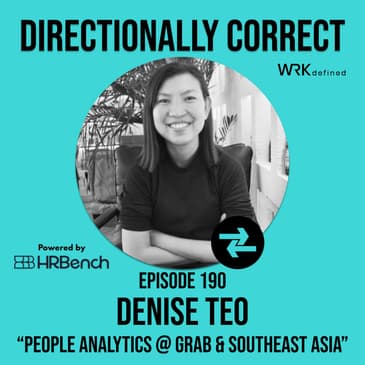
Check out this episode of the #1 people intelligence podcast with special guest, Denise Teo, Former Head of Analytics & People Science at Grab!
Denise spent nearly a decade at Grab, the Southeast Asia super app that began in 2012 to make rides safer where that was not a given. Today it is a hyper-local platform for rides, food, financial services, and B2B work. She joined in 2016 when Grab was still small, first in operations analytics, then commercial and product, before switching into people. She is not from HR or I-O psychology. She came from tech analytics and found the place where quantitative rigor meets the messy applied world of people. She built the function from zero to one, then rebranded it as People Science: stop stopping at insights and get better at effecting change through real partnerships.
Denise is self-critical about the traps people analytics teams fall into. First, caring more about methods than outcomes. Complexity becomes a proxy for skill even when the business is not ready. Firms advertise the coolest methods, then drop people into sanitized work that never uses them. Cole argues there is little correlation between method sophistication and business value. Second, not knowing who the users are: employees, leadership, and the people team. User research should be easier because users sit in the same office, yet teams still skip discovery. Many analytics products exist only to paper over bad HCM interfaces. Third, failing to bring users along. Nascent functions outpace readiness; partners who are not data-native retreat to Excel when the model arrives.
Southeast Asia makes the work harder and richer. Cultures and languages differ sharply. Qualitative text was nearly inaccessible before large language models unlocked an asset that used to sit unused. Denise sees the field growing fast in Asia.
She simplifies the practice into thinking, doing, and communicating. The doing layer is what most people enjoy and what AI is hollowing out fastest. What remains is judgment about the right problems, design of guardrails, and translating insights for brains that do not think like yours. You move from the factory floor to the control tower. Cole maps this to his inquisitor-and-change-agent framing and adds orchestration of agents. Both worry that a thousand flowers blooming can scale noise as fast as signal.
That shift hits identity. Denise is leaving full-time work at Grab to try fractional practice across more organizations. She describes the hollow feeling many analysts report: routines vanish, mastery of SQL or Python feels threatened, and purpose thins when the tasks that defined the job are no longer yours. Cognitive surrender is uncritical acceptance of AI outputs in place of your own reasoning. Cole contrasts people intelligence with workforce intelligence. The first treats AI as a tool that serves humans. The second risks putting people in service to the machine.
Ethics and privacy have cooled even as data use expanded. Denise’s heuristics are symmetry, transparency matched by action, and consent plus agency. Value has to flow back to employees or the exchange stays extractive. Cole tests the principle at the limit with genetic data; Denise holds to those heuristics rather than a yes or no.
In Cole’s Corner she would have been a fusion chef, most wants to see Iceland, and picks the zebra from Racing Stripes who believes he can race with thoroughbreds. On fractional leadership she says budget constraints already push organizations toward smaller units of exchange. They close on Andrew Merritt’s output-gap piece and John Sullivan on brilliant jerks. Denise is on LinkedIn. Hire her. If you like this episode, you’d also love exploring prior episodes—visit colenapper.com for the full archive and show links.
Powered by the WRKdefined Podcast Network.
Sponsors
