
Thanks to HRBench for powering this episode. To find out more about the company building the future of people intelligence, reach out to book a demo at hrbench.com/directionallycorrect!
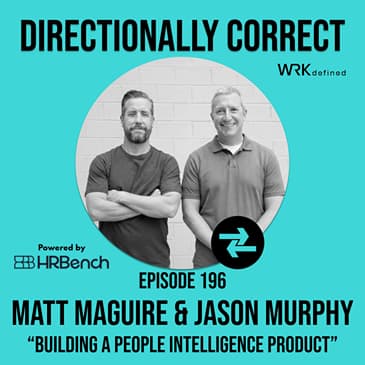
Check out this HR Tech Voices Series episode of the #1 people intelligence podcast with special guests, Jason Murphy, Chief Product Officer and Matt Maguire, Chief Revenue Officer at HRBench!
In this episode Cole Napper sits down with Jason Murphy, Chief Product Officer, and Matt Maguire, Chief Revenue Officer at HRBench to unpack what it takes to build a people intelligence product and why people analytics must move from a transactional function to a product-based one. Jason defines the product role as understanding customer problems and delivering business value so users accomplish their work more efficiently. Matt describes the collapsed feedback loop: client conversations that once required weeks of mockups can now produce interactive prototypes in hours or days. Jason takes real feedback, builds code-based prototypes matching the application, gathers reactions the next day, and hands them to engineering—compressing timelines dramatically while improving accuracy.
The discussion centers on the architecture of people intelligence. After dashboards fade, only an intelligence layer and a data layer remain. HRBench acts as the extensible middle layer that cleans data from disparate sources, applies methodology and health checks, and securely passes it via MCP connectors into other AI tools. Organizations seek to eliminate dashboard maintenance, surface engagement insights, and score AI impact by mapping company jobs to a proprietary taxonomy that includes tasks, skills, and predicted effects. Jason details reskilling and redeployment tools so leaders identify impacted employees and move them into valuable roles. Matt notes that even advanced teams lack clear answers, creating opportunity for AI-native platforms free of legacy technical debt.
Practical examples include headcount planning workflow approvals that replace spreadsheet processes, expanded performance features such as stack ranking and nine-box, richer employee listening, and org charts that combine open requisitions with planning. Tokenomics is rising: capturing agent token spend, assigning annualized costs, and reflecting agents in the org chart so plans show human and machine costs plus hours returned. Jason explains how AI tools transformed product work itself by automating QA test cases and documentation that follows a custom house style, collapsing weeks of effort into hours.
Looking a year ahead, barriers between applications dissolve. Users will work inside a vendor interface or pull data through conversational layers; specialized point solutions will fade as large organizations rely on an intelligence middle layer while smaller ones still need accessible platforms. Cole adds that systems of record must rebuild AI-natively and that former products become features inside broader intelligence and workflow layers. The episode reviews Jack Costl’s argument for portfolio management so teams choose high-value problems rather than polishing every request; Ludic Stella’s analysis linking culture signals such as transparency to return on assets; and a HumRRO paper on indexing AI impact within O*NET through task- and KSAO-level scores. Jason highlights the difficulty of tracking current AI capabilities given rapid model improvement.
In Cole’s Corner the guests address rapid-fire questions and the near-term future of intelligence products. The conversation stays grounded in real customer problems, the speed of AI-native tooling, and the shift from dashboards to solutions that redesign work. Supporting platforms and leaders who deliver this practical progress is essential as years of roadmap compress into months.
If you like this episode, you’d also love exploring prior episodes—visit colenapper.com for the full archive and show links.
Powered by the WRKdefined Podcast Network.
Sponsors
