
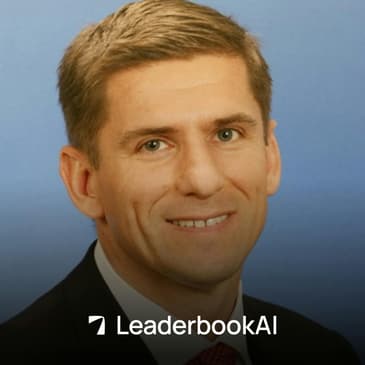
What does it take to be a truly transformational CFO today?
Roman Labutin, former Divisional CFO at Citigroup, joins Felicia Shakiba to unpack how the CFO role is evolving far beyond the numbers. Roman shares how modern finance leaders blend data-driven decision making with people-first leadership—building cross-cultural trust and forging strategic partnerships with HR across compensation, succession, and organizational design.
This episode explores how leadership maturity, disciplined decision making, and clear C-suite strategy elevate finance from control function to value creation engine. Roman explains why collaboration, transparency, and enterprise-wide alignment matter as much as analytics—and how business process automation and digital transformation support smarter execution without losing the human thread.
—
Subscribe to the LeaderbookAI Podcast (formerly CPO PLAYBOOK): https://leaderbook.ai/podcast
Want to create 10x the value of your business or investments? Let’s talk: https://leaderbook.ai/contact
Powered by the WRKdefined Podcast Network.
[00:00:00] Hey podcast listeners, this is our last episode of the season, but don't worry, we'll be back soon. In the meantime, enjoy this episode and if you haven't already, go back and check out some of the earlier ones. Alright, thanks for listening. I'm Felicia Shakiba and this is CPO PLAYBOOK, where we solve a business challenge in every episode.
[00:00:37] In this episode, we're exploring the overlooked intersection of finance and people strategy. How can CFOs, who are traditionally numbers focused, effectively navigate the human side of leadership to drive organizational success?
[00:00:54] Joining me today is Roman Labutin, a seasoned CFO with over two decades of experience at Citigroup, where he has navigated complex transitions, cultural integrations, and large-scale transformations. Roman's career journey has taken him across the globe, from managing financial operations in the United States to leading transformative initiatives in Korea.
[00:01:19] Along the way, he's learned how to balance the technical demands of his role with the interpersonal skills needed to build trust and foster collaboration. Roman, thank you for joining me today. Thank you for having me. Thank you. Roman, you've had an impressive career as a CFO spanning multiple countries. Can you start by sharing your journey and how it has shaped your perspective on leadership? Roman, you've had an impressive career as a CFO.
[00:01:46] Yeah, so fast forward, I will do a quick introduction. I'm originally from Russia. I graduated from, I was at top universities in Russia with a master's degree in physics and applied math. I worked at IBM in Eastern Europe. I got my MBA here in New York, in the United States, and started to work in Citigroup. And over two decades, as you mentioned, I had different roles within Citigroup.
[00:02:15] I started with Smith Barney, a wealth management division of Citigroup. Each time when I take a role, it's always something new needs to be put on. So I was charged to build a planning and analysis function of Smith Barney. We had 12,000 financial advisors. We need to analyze information around compensation and our sales, how we pay them, what they're selling.
[00:02:40] It was a big task, and my team was very creative to come up with different analytical ways to bring new information to the board of directors, to management of the Smith Barney. It was a very interesting journey. As always, we say, Citigroup never sleeps as a marketing slogan. It's not only for their external client, it's also for internal businesses.
[00:03:11] During financial crisis, Citigroup decided to sell Smith Barney to Morgan Stanley. I went with a sale, was in charge of building a united financial team, creating a pipe of new joint venture between Smith Barney and Morgan Stanley. It was a very interesting journey. It was very challenging, given the fact you have to melt Smith Barney culture with Morgan Stanley culture
[00:03:36] and try to work together with both teams to achieve the company goals. I went back to Citigroup and become chief financial officer of a city private bank. A city private bank is operated in over 100 countries. We have clients over the world. We had nine booking centers everywhere.
[00:04:02] My team, spanning from Mexico to Singapore, London, Mumbai, sitting in different places. And that's where cultural differences come in place a lot, when you need to adapt how people operate around the world. It's not one way. There are so many different facets how it works.
[00:04:27] And after working with private bank for more than seven years, I decided to take a leap of faith and took a CFO position for Citi subsidiary, fourth largest bank in Korea, which was owned by Citigroup. And I was the chief financial officer of bank in Korea.
[00:04:50] Definitely another challenging opportunity for me, given the fact that it's far away from New York. It usually takes 14 to 15 hours to fly there and have their own challenges, given the fact that the bank is 100% Korean bank, supported by Korean regulation, and all slow of issues coming with that.
[00:05:17] So that's my overall short teach about the career, how I get where I am right now. Yeah, it's definitely impressive. I think you have been through a lot of different transformations also, it sounds like. And that takes more than just like a numbers and data expertise, right? I mean, in your role, it's a leadership role.
[00:05:45] So how do you approach balancing these technical responsibilities with the interpersonal demands of leadership? Yeah, I think it's important for chief financial officer that it have this very well-balanced between a number-oriented approach, technical approach, and human leadership as well. Ability to communicate the numbers is very important in the current world.
[00:06:13] We all know we're all dealing with the numbers on a daily basis, but how we can communicate to these numbers, it's very important. I see a lot of examples when people hiding behind technical expertise, behind the numbers, because it's a much more comfortable world for us as chief financial officers. And reality is we need to learn the softer skills. We need to learn how to communicate these numbers.
[00:06:43] We have to be active listeners of the problem which business is facing all the time, and we need to understand those needs, right? We need to have this balanced approach as chief financial officers. Reality has always come time, time crunches, right? And that's another problem when you try to build a relationship with an organization.
[00:07:07] So my approach to those issues are I usually delegate highly technical tasks to specific teams, right? We have opportunity to do that. And freeing up your time as a chief financial officer to building relationship and start to communicate information in much more acceptable way, not hiding behind the technical skills.
[00:07:29] You are a translator between finance functions within finance organization, treasury, controllers, FNA. You're translating this information. And as a translator, you need to talk to language of the business, not technical language of finance person. That's where success comes. And you've mentioned the importance of building trust within an organization.
[00:07:54] What are the strategies or practices that you've found most effective in fostering trust across teams, especially in these high-pressure situations that it sounds like are time-bound? Yeah, trust is very, very critical. Trust between CEO and CFO, trust between CFO and leadership. Without that trust, there is no chemistry within an organization.
[00:08:23] That's important. And trust based on probably three components, I would say. Transparency, consistency, and empathy as well, right? Transparency is important. CEO must be transparent and upfront with all the issues. It needs to be consistent how he's approaching the problem. If you approach the problem one way in one situation and another way in another situation,
[00:08:51] management team doesn't know how you will react to those things. They know you can't. They will start feeling that they can't trust you anymore because you're not treating these issues in a consistent way. You have some flexibility and they are smart people. They start exploring these weaknesses. So you have to be very consistent. And of course, you have to manage with empathy. I understand we are all finance folks.
[00:09:19] We are numbers. It's two plus two equals four. And there is no flexibility around that. But we need to bring into that some empathy when we try to manage the organization. For example, in private bank, our all leadership team meetings started, all the offsides, started with a finance presentation. Always start with the numbers and start with the stories behind the numbers.
[00:09:48] And after that, management teams start to develop the strategy, understand where our strategy is supported by the numbers, or we need to do certain adjustment. And you can't imagine the conversations, like so rich conversation coming in out of that, when it's strategy based on the numbers which present it, present it with a story behind it and where the story supports the strategy or not, and what it does is basically engage a lot of people into conversation,
[00:10:16] the management team all working together. And that's where how you're building your trust as a chief financial officer. You're working with a team, not just presenting the numbers and leave them for interpretation another day. That's the connectivity. It's very important. And I think we build it. I was able to build a trust in the city private bank, and we have a great result from a business point of view as well.
[00:10:44] Welcome to the Hire Her podcast, where women and talent call all the shots. We know another recruiting podcast, just what the industry needs. Okay, but hear us out. You ever spend hours sourcing that perfect candidate, but they end up ghosting you harder than your hinge date? Or finally, you get that hiring manager feedback, only for them to, of course, say, can we see more candidates? Lame, right? But let's talk about what's really lame in the industry. How is it that 65% of recruiters are brilliant women,
[00:11:13] yet most of the decision makers look like a convention for middle-aged dudes named Brad? That's where we come in. Hire Her isn't just another podcast about hiring trends you already heard like 50 times this week. We're here to elevate women in talent, share their career journeys, and make sure they take the lead. Because let's face it, if recruiting is the backbone of every company, why are we still fighting for a seat at the table?
[00:11:38] So whether you're a recruiter, a talent leader, or just someone trying to swim through the sausage fest of TA leadership, we got you, girl. Welcome to Hire Her, the recruiting podcast where women's voices aren't just heard, but they're leading the conversation. So subscribe now, because middle management Brad sure as hell isn't going to do it for you. We'll be right back. Back to the show.
[00:12:03] I love that you mentioned the pairing between quantitative data and qualitative data, because I feel like as a CPO, we're also doing the same thing, right? We're looking at the quantitative data of surveys or productivity or compensation, and then really tying together what the story is. What are the numbers actually telling us? Where should we be looking? Where should we dive deep? What shouldn't we care about? How does it align with the strategy?
[00:12:31] And I feel like there are a lot of similarities between a CPO and a CFO in that nature of the work. So I'm really glad that you shared that. And I don't think I really thought of it as much before you said it with the CFO, because when I think CFO, I think numbers, right? But I think it's a critical element of leadership, especially at your level.
[00:12:54] Yeah, I think there is a very close connection between what organization would like to be, whom they would like to be, what they would like to represent. And all we call it KPIs, key performance indicators, right? We people, we are what we can measure in our organization. We are what we are representing through our numbers. If numbers, if we're measuring something which not aligned with a strategy,
[00:13:24] there is a miscommunication within our organization. We need to demonstrate our metrics which align with a strategy. And if we say we would like to go, let's say, north, but we don't have a compass and we're not measuring which way we're going, it's misconception. And what's happening within our organization, organization is not aligned from bottoms to bottoms up.
[00:13:49] There is a miscommunication between senior management, which would like to go one way, and employees who are thinking we're measuring something different because they see it, those metrics are available, they are published, but they not correlate to the strategy of the company. And the companies which make this connection the more explicit, they're actually achieving their success because the numbers start to be part of the DNA of the organization.
[00:14:18] And that's the most important piece. And chief financial officer is actually the person who needs to institute this culture with an organization, making sure that KPIs align with a strategy, not kind of sitting on a site and just numbers for the sake of reporting the numbers. And I'm glad you touched a little bit on culture because in your experience in Korea,
[00:14:43] they required you to really adapt to a different culture and organizational environment, you know, very different, same organization, different region. So what were the biggest challenges that you faced and how did you overcome them to build trust and alignment with your team? Yeah, Korea is an amazing country. I would say for me living there almost four years, I'm very impressed with the culture, impressed with the folks, with all their environment there.
[00:15:13] It's definitely very different, very different. And you feel it the first day you're coming into the country and you continue to feel it. The interesting culture is consistent. It's implemented across the board, implemented across all the layers of society. And definitely if chief financial officer or senior C-suite executive not paying attention to that,
[00:15:41] it definitely can destroy your success within organization. In, as an example, practical thing in Korea is there is a very strong notion of seniority. If senior manager is saying something, everybody needs to follow. There is no notion of challenge. There is no notion of kind of doubting where you're supposed to go.
[00:16:11] So that's the most important. So it's putting extra pressure on the managers to actually make the right decisions because you will not get your feedback. Like in United States, for example, United States during the meeting, you have an open discussion, open dialogue. You're saying something. You have ability to adjust what you're saying based on the feedback of people at the meeting. You have a lot of people at the meeting. That's not happening in Korea.
[00:16:38] If you're in a meeting with your employees, you're saying something, and that's where people, even if they disagree, even if you're incorrect, they respect the seniority. And that's a danger, a very dangerous situation when you come into an unknown role in a different country. You don't know the certain nuances of financial management within this particular country. So it's very important. And for me,
[00:17:06] how I deal with that is actually a lot of listening, a lot of discussion within your team in an open forum before you make a decision. So you understand how it needs to be done. You understand what it is. And because I quickly recognize as soon as you said we're going that direction, there is no more feedback. You're done. You basically have to follow and you have no,
[00:17:36] there is no margin of error there. So you have to be a very good listener and understand when people say a little bit in a softer way that you're moving in a direction which could lead potential issues, right? You need to be a very active listener, specifically in an Asian country, because that's where big cultural difference comes and plays.
[00:18:06] And in cultures, there are no small things, right? You have to be very attentive on small things, what people value. I give you another example. I, in our organization, in Citibank Korea, senior management every year make, make a speech to, to employee. It's, it's recorded. All right. And,
[00:18:35] knowing that I'm falling in a foreign country, I decided to make it in Korea. Of course, it took me probably 50 different, 50 times, try to actually record one minute of perfect, not perfect, but I would say almost mistake free. Congratulations for the new year, for the employees. It took me 50 cuts to actually come to the right place, but
[00:19:05] the time was very well invested because I feel when I came back after, after holidays, you coming back to the country, you, you see people talking about this. I was the first expatriate executive who actually did it in Korean for the bank, right? It was appreciated very well and my time spent, it was the best investments from a building relationship with a broad organization and presenting this new year,
[00:19:35] new year things in, in Korean. That was, I think it was important, but it shows that in the cultures never overlook these small things. They make a big difference for people, for you. Maybe it's, it's a, okay, you're not paying attention much, but in the countries which has a distinct culture, it's become very important. So, I would, my advice to everybody who going to another countries and try to
[00:20:04] operate there, pay attention to small details. Cultural differences are very important. You need to be sensitive to those, to those small things. That's incredibly insightful. helpful. I think I definitely learned something at this moment because when, I mean, I've worked with almost every country in my role and I always love learning new things about different cultures, but I think
[00:20:33] you've taught me today that there's different, you know, measures of cultures in different places, obviously, and who are, you know, more outspoken and who, who are less outspoken, but it's much deeper than that, right? I mean, it's not like when you were in Korea, it's not like you didn't get people's perspectives. You just got them sooner. You got them sooner, you were listening more, you were able to come up with, like you said, there's a lot of pressure to come up with the right
[00:21:03] decision because once it's made, it's done, but it's not that people weren't able to speak up prior to you making the decision. So, that's not something I think I knew before. So, that's really great that you shared that. So, thank you. I also wanted to understand from your perspective, what role does a CFO play in shaping people's strategy, particularly during times of organizational change or restructuring? How,
[00:21:33] how involved are you in those decisions and what really is your role? CFO always supposed to be big partner with HR team. HR holding keys to one of their, the most important line on a P&L. It's a compensation. And this is our, this is item which is sensitive. So, that is why HR handling this. From another
[00:22:02] perspective for finance officer, it's one of the largest expense component. Depends on organization. for the bank is pretty sizable, pretty sizable. We don't have PP&Es, we don't have equipment, we have compensation of the employees. I think that's one of the biggest items on a P&L. And HR is, you have to build a great relationship with HR because
[00:22:32] numbers are driven by number of employees. But the strategy around this, for example, for period of growth, it's important to get return on investments. So, how many people you would like to hire, in which area, chief financial officer working with HR to come up with a people strategy, making sure that we make the best decision when we have limited resources because nobody in organization
[00:23:02] have unlimited resources. We need to spend them correctly. That is why chief financial officer working with HR to make sure we're placing people in where there is the biggest return on investment in revenue growing areas. During restructuring is a little like a different story. During restructuring when we try to balance cost with the needs to retain the best talent. Sometimes
[00:23:31] organization overlooking this balance. For chief financial officer it's important to be balancing these pieces because if you're too focused on the cost cutting you're hurting your organization going forward. Two or three years from now you will have a problem because you have to rehire people at much higher cost. So this balance is very important. important and you also need to ensure
[00:24:01] that people feel and support it and value during this restructuring time. It's not about pure cost cutting. You need to make sure that there is a sense that it's done in appropriate way. You need to communicate much earlier. you need to communicate the reason why this restructuring is important, what we're trying to achieve through that, and making sure that people are supported during this period of time. It's understand the
[00:24:31] situation, asking the right question, having HR as your partners is critical, whether this is a time to growth or whether this is a time to restructure or saving some costs. It sounds like you've led initiatives involving significant transformation. How do you approach addressing resistance to change and aligning teams around new
[00:25:00] goals, the new vision? Resistant to change is nature. We're all creatures of habits. We're doing something for a certain period of time and to make a change is emotional. Make a change is hard because you need to invest some time and effort. So that's important to understand. It's also important that
[00:25:31] you have to be proactive in the change. There are several components which are very critical from a change environment. The first alignment, communication, and I would say I bring empathy again because this becomes so important in the current technological development because given AI development and given other things, empathy starts to play a much, much bigger
[00:26:01] role. Communication is important. Change, you have to clearly communicate to organization. That's what we're trying to achieve. You need to bring your key stakeholders early in the process. For example, you manage a team. You need to tell them what we're trying to do, try to build the buy-in through the organization, why we're doing this change, what consequences, how teams will be impacted. Open communication is very important to make
[00:26:31] sure that people are actually going with you for that change. And of course, it's important in the process to celebrate small wins. You don't need to wait a year and say, finally restructure whole organization, everybody can say, okay, fine, we did it, and go to have a drink or two. It's important to celebrate small wins step by step, how we're moving so team can analyze,
[00:27:00] reflect of what was done, and potentially make some adjustment to the strategy because nobody perfect at the beginning when you start to make a change, it's very hard to predict how it will look at the end. So when you make the stages small wins celebrating, it gives you opportunity to adjust the next step, the next step, if there is adjustment needed. But that's very important. And our communication is a key. As an example,
[00:27:30] when we decided to close retail business and shut down around 40 branches, which we still have in Korea, we need to reduce number of employees to make sure we did it in three different waves. And we have a conversation, team has a conversation with each function, with each employee, what they plan, how they are leaving our company, or they would like
[00:28:00] to stay, because in Korea there is a life employment, so you can't make a decision on your own. This is an employee decision. Employees should decide whether they would like to stay in the bank or they would like to leave. And of course, it's come with the challenges because always the best employees whom you need for the future will decide to leave. So you have to hold hands and making sure that you have a strategy how you could
[00:28:30] retain those individuals whom you really need. So it's a little bit in the different ways and it's happening in the United States but you need to adjust to that and the most important is communication open communication with your team. We'll be right back. Back to the show. It's interesting because I think the transformation is very different across different regions and cultures so thanks for highlighting it. I think that was an important tell.
[00:29:00] You talked a little bit about buy-in. I just wanted to dig a little deeper on that piece because buy-in is sometimes really challenging to get. What ways do you create buy-in for change? How do you get buy-in? I would say the most important piece is help people to understand their reason behind doing that.
[00:29:30] You're not talking only about the fact that we would like to go from A to B. Why B is important? Why is strategic important for the organization? What will happen if we don't do that? What will be consequences for organization? I think buy-in is important from a communication point of view. Everybody understands the rationale. You can be buying the rationale
[00:30:00] or don't. As a chief financial officer, your job is make sure that strategy is clearly communicated. After that, there is a rational approach. Some people can be in total denial and nothing you can do about this. But majority of individuals actually understand and would like to go with the right solution because they understand why we're doing this, what's the consequence of not doing this. I
[00:30:30] think the key for buying if you have a critical mass of senior management team to agree on a strategy. This is a job of chief financial officer to come up with financial justification, strategic, and consequences of not going there. And I think that's critical and this is on us to do this communication. It's going back to regional questions which you have.
[00:31:00] Communication is the key. Balancing numbers with communication is so critical. This is a skills which will start to develop in the current environment because technical skills more and more will start to be replaced by AI. Nobody will replace how you communicate those decisions because you need to get the buy-in. That's a skill which goes for chief financial officer needs to develop
[00:31:30] over time of course, but this is the future. That's where we're going. I'm glad you mentioned that. I think that's really important to note because obviously in the era of AI and transformation we're all still learning how these roles are developing and I think you hit the nail on the head when a lot of the technical or more administrative skill sets are going to turn more AI heavy or collaborative whereas this humanized
[00:31:59] strategic perspective collaboration and so forth those skills are not really something AI can do right when you're dealing with human to human interaction which is absolutely necessary which brings me to my next question which is how do you collaborate with people operations leaders leaders leaders and other other executives to really align financial strategies with people strategies and people strategies meaning compensation succession planning
[00:32:29] or organizational design what is your collaborative strategy usually budget time for chief financial officers is very critical that's where you interact the most of course you interact throughout the year and continue forecasting as well but the budget time it's a time when you step out of the operational component of the role and talk about
[00:32:59] strategy with all executive product line executives or functional executives within organization that's a time for everybody to reflect that's a time for you to present certain KPIs for the organization and that way you start planning process in the future capacity planning become more and more important with each organization and I think from a chief financial
[00:33:28] officer perspective it's opening door in tough conversations with product leaders or functional leaders or functional management within organization capacity planning is a key and it allows you to start thinking strategically about what each team is doing how they operate sales organization is a little bit different in the sales organization strategic planning goes not into capacity
[00:33:58] planning more because you would like to have more sales people and more revenue into organization it goes about compensation plans which align with the strategy for example in a private bank we created scorecard for the bankers which align with strategic development I mentioned to you I worked in Smith Barney and after that become chief financial office of the city private bank what's happened is when
[00:34:28] city sold Smith Barney to Morgan Stanley what's happened we lost all the capabilities related to investments so private bank and city group had very limited opportunity to work on investments for the clients as a result city needed to rebuild that revenue stream within a wealth management organization how we did it we adjusted banker scorecard we worked with HR to come up with compensation plan
[00:34:58] which allows and putting extra focus on revenue coming from investments comparison with other revenue streams so that was a decision and it was done in collaboration between my finance organization and with HR because of course there are a lot of regulatory components around there are human components we need to be very careful how we do it but analytics provided by us where
[00:35:28] we showing how product can be much what kind of product is much more profitable for organization and how we can build it into compensation plans
[00:36:07] for a for you to a very high seller
[00:36:37] you know, if they want to align it with the compensation and reward. So really key point that you made right there. It's important. You mentioned that alignment is, I 100% agree with you. Important compensation to be stable and not changing. Therefore, people, they need to know how they compensate. Stability is critical within an organizational construct. Yes, it's a strategy
[00:37:05] usually stays for three, four, five years, depends on organization. But it's important that compensation align with the strategy, but people know how they will be compensated probably in, in the, I would call it in a short run, but short run can be three, four years. You have to make a strategy adjustment and after that adjust the compensation. But compensation components needs
[00:37:30] to be very stable because people need to know how they, how they should behave. That's very critical. I would not encourage anybody to flip-flop the compensator. Today you are compensated on this KPIs. Tomorrow you're compensated on this. Yesterday we measure this one. Tomorrow we'll do that. So it's create a lot of confusion. And I saw it and I can tell you from experience perspective,
[00:37:56] if it's important, compensation stay as stable as possible. If, meaning compensation construct, but if you need to change a strategy, yes, you need to align the compensation with that. Yeah, I completely agree. And I also think that some of it changes depending on, you know, how volatile your business is and how small or large your businesses are, right? Or if, if you've,
[00:38:21] you know, gone through a transformational change, but, but other than that, I agree because you inject ambiguity in people's careers when compensation is not stable, right? And that ambiguity about someone's career can really lead to disengagement, which is very costly. So yeah, I couldn't agree with you more on that. How, how can the financial insights and the data be leveraged to better support
[00:38:49] these people related decisions within the organization? I think it's finances as a partner to HR has a lot of information, which can be helpful. We can provide return on, return investment on your training programs. We can help calculate workforce productivity. We can come up with a capacity planning for certain portion of organization. Of course, with
[00:39:17] people data, it's not clean cut. So making, I would not encourage HR team, just make a decisions based on financial data, but it could be supporting the information, right? So which training, as an example, training programs can be mandatory training programs. Yes, training programs, which people would like to take, right? So of course, return on investment on mandatory training programs probably is
[00:39:45] irrelevant information. But if there is a return on investments and employee satisfaction scores are actually going up when we introduce certain courses from certain university and people are taking them and engaged into those conversations, that's a great return on investment. Finance can help HR to guide HR which way to go.
[00:40:10] So these extra tools like a capacity planning should not dictate decisions, but it's extra information. It's extra, I would say, help to make a right decision. And finance is actually working as a partner with HR always ready to help and always working to provide advanced analytics where you need it. But it's always a partnership,
[00:40:36] as I would like to highlight. Because in my experience, when you have a relationship with HR, which goes hand to hand, you have a better budgeting, better forecasting, is you know what's attrition rates with an employee, how it's all moving. So it helps you. There is a return. You invest your time to build a relationship with HR team.
[00:41:01] You get a better return by the fact your forecast of the human capital, your forecast of expenses related to their compensation become much more accurate within organizations. So it's a win-win for both functions within a company. And so what you're saying is that the collaboration is really providing multiple data points in order to make great decisions.
[00:41:22] It's not relying on one or two, but looking at how you come together holistically with multiple pieces of data. Right, right. Absolutely. And for CFOs who may feel more comfortable with numbers than with people, what advice would you give them to step out of their comfort zone and really lead more effectively?
[00:41:43] Yeah, I always consider leadership as an extension of problem solving for us as a chief financial officer. Right. We will excel in problem solving skills and most of us a little bit shy of the active leadership from their communication, getting out of our comfort zone perspective. Right.
[00:42:10] Right. So we need to practice this more. Right. That's what I practice. Make us perfect. Right. We need to step out of our comfort zone to be more confident. We have to focus on communication more. We have to communicate about why we're making those decisions. We need to practice and practice will make us, I would say, make us perfect. Right. Right. Leadership skills which can be developed. Right.
[00:42:37] And we need to just practice and do it more and more from a communications point of view. There is no silver bullet there. I would say I would encourage everybody to practice, just practice more. You can't hide behind the numbers. You can't hide behind technical skills.
[00:42:54] Chief financial officers now more needs to be more empathetic, needs to be working with people and be considered more as outgoing, working with a leadership team and be there helping out to navigate the challenging situations. Yeah. And I would say for those in the people function that we also need to maybe be a little bit more data driven.
[00:43:24] Right. As as a whole function. And I think that this partnership is so important because we get so much more data from one another, whether it be quantitative or qualitative, like you said, to make those better decisions. You know, I've worked internally at a few organizations and I can tell you that finance is always very the language is not always the same. Right. Between people ops and finance.
[00:43:49] And so the more often I've been able to meet internally with my financial stakeholders, even if it's just once a month, but it could be, you know, twice a month. That that type of relationship building allows for communication to flow better. And so I would encourage any CFO or CPO, anybody in the finance or people operations function to,
[00:44:16] you know, reach out to your counterparts and really start building the relationship. Put a recurring meeting on the calendar if it makes, you know, if it's helpful. So that's that's what my two cents would be. But I agree. Communication could always be developed more. And so my last question for you is, as the role of CFOs evolve,
[00:44:41] what do you see as the future of CFO leadership in terms of blending technical expertise with human centered leadership? Yeah, it's it's interesting. Right. Over the last two years, in my view, is a role. Let's let's let's let's scale back. The role was keep changing. Right. Role of CFO keep changing.
[00:45:09] We are more moving to be as a strategic partner who can translate financial insight into actionable strategies. Right. That's what's critical mission statement. Let's say two years ago. Right. With the development of AI and technical skills will go more into like machine component.
[00:45:34] Right. And what it does on chief financial officer is more pressure to balance more with a human centric leadership. More balance there is become very important because we not only need to provide insight. I would say I can do it. We still in the point translating this into actionable strategies.
[00:46:03] Fine. Today, AI will not do it tomorrow. AI will tell you what actionable strategies are. But we still on the hook as a chief financial officer. Make sure that this actionable strategy resonates with people. Right. Because people implement the strategy. There is no human like machine who will implement the strategy.
[00:46:29] Machine can advise you with like artificial intellect. But reality is it's people who will be behind implementation of those items. And we are on the front line to make sure that this actionable strategies actually resonate with people. We are on the front line to deliver the message, work with a senior leadership team,
[00:46:52] making sure that the strategy is understood, the strategy well communicated, and the strategy well executed. And then because we have key performance indicators, which show us that's demonstrate that we're progressing towards specific goals. So, as I mentioned before, is chief financial officer can't hide behind numbers anymore. All right. So, we need to get out and we need to work with a whole C-suite.
[00:47:21] The world has changed and we have to change as well. Roman, thank you for being here. Thank you very much for having me. It was a pleasure to talk to you. Great questions. And I think we covered today the big spectrum of issues related to chief financial officer role, as well as interaction and managing human capital within our organization. Very important subject and it will become much more important as years comes.
[00:47:50] If today's episode captured your interest, please consider sharing it with a friend and leaving a review. To learn more about how CPO Playbook can support you or a leader you know with executive coaching or organizational transformation, visit us at cpoplaybook.com. Your support as a subscriber means the world to us. So, thank you for tuning in. I'm Felicia Shakiba. Let's connect on LinkedIn. See you next Wednesday.
Sponsors
