
What does it take to lead successful global expansion without losing alignment?
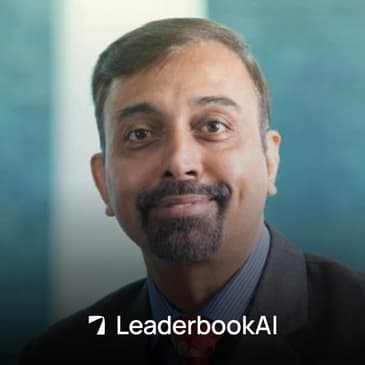
Naveen Kumar, CEO of Nityo Corporation, shares how he navigated cultural complexity, enterprise technology, and internal alignment to scale globally. This episode highlights leadership decisions that balance local execution with global strategy—showing how digital transformation, AI automation, and business process automation enable smarter decision making at scale.
—
Subscribe to the LeaderbookAI Podcast (formerly CPO PLAYBOOK): https://leaderbook.ai/podcast
Want to create 10x the value of your business or investments? Let’s talk: https://leaderbook.ai/contact
Powered by the WRKdefined Podcast Network.
[00:00:00] I'm Felicia Shakiba, and this is CPO PLAYBOOK, where we solve a business challenge in every episode. In the United States, 73% of business leaders believe expanding into new markets is challenging. Navigating global expansion entails significant risks stemming from various factors.
[00:00:26] Chief among these are cultural differences, resource constraints, and internal lack of alignment on meeting diverse customer needs. Cultural nuances can profoundly impact business operations, affecting everything from customer preferences to communication styles and negotiation tactics. Resource constraints pose challenges in managing finances, talent, and infrastructure
[00:00:51] across different regions, adding layers of complexity to expansion efforts. Moreover, the internal lack of alignment on meeting diverse customer needs introduces uncertainty that can hinder strategic planning and investment decisions. Fortunately, we have Naveen Kumar, CEO of NITIO, here to guide us on navigating these challenges effectively.
[00:01:15] Naveen, thank you so much for being here today. Naveen, what challenges do you face during NITIO's growth trajectory? And how did these experiences shape its evolution into a customer-focused organization amidst global expansion? First of all, thank you very much, Felicia, for hosting me.
[00:01:37] It's a great pleasure to be on your podcast. Coming to your question regarding what are the challenges which we have faced during my journey with NITIO Corporation. One of the big challenges was globalization.
[00:01:50] You start with a market and you tend to go from that market to the next market. That is where when you go from one market to another market, the biggest challenge is getting the right people which can drive your vision. People and go-to-market strategy.
[00:02:10] I would say these are the two main challenges while you are going on your expansion more at a global level. I seriously believe the third challenge which comes later as a part of your good growth is towards working with a great delivery. So three challenges.
[00:02:32] Number one, getting the good people which can share your vision. Number two, getting great customers which can believe on your vision and C, getting people which can deliver your vision. I think these were the three challenges in our journey in the last 18 years at NITIO Infotech Corporation.
[00:02:53] I can see how vision plays a role in getting everyone aligned from all different perspectives of the business and the customer piece. What role does diversity play to understand and mitigate cultural differences while expanding globally? How do you get diverse talent? I simply believe in diversity.
[00:03:27] If you go to any one of our operations, we believe that 70% of the talent should be diverse talent in that particular country. 30% of the talent, whether it is technology or vertical expertise which is required, should be taken from outside.
[00:03:47] As a part of our principles, there are territories where we have taken 90% of the talent from that particular country and 10% of the talent comes from other regions which is predominantly on the consulting expertise, vertical expertise or technology expertise.
[00:04:06] So we are big believers at NITIO on diversity because that will give you a much bigger think tank as an organization. How do you manage those diverse conversations? Because obviously they are bringing through innovation, right? But sometimes diverse cultures are meant to have these creative conversations pulling
[00:04:33] decision making from one end to the next. So how do you manage those types of conversations and keeping them from getting too heated or off track? So we do that all the time. So if I have a very diverse talent and everybody is having their own opinion, right?
[00:04:53] First of all, we need to focus towards how do we get those opinions focused on our vision. We need to keep vision and execution as the core center for executing. Now as a CEO and founder, I might be totally wrong and you might be totally right.
[00:05:16] So I should have that maturity, openness in the mind that anybody and everybody is talented. That's the basic principle. So when we have these principles intact and I always say keep your ego at your home, unlock it before coming and throw the key also.
[00:05:38] When you go back home, take ego back. I don't care. But when you come in our meeting room, we are here for an agenda. Let's focus on agenda. Let's focus on vision and the brilliant mind will win in this conference.
[00:05:56] The brilliant mind can be from an average performing territory. The idea can be from a person who is more quieter and the guy who is speaking too much might not be the case.
[00:06:09] So it really depends how do we execute our vision, our core themes and our growth agenda as a center and keep everybody humility wise at a level where we can have a meaningful conversations.
[00:06:30] We talked a lot about vision so far and I think that one of the biggest challenges in sharing and instilling vision are with new employees. What strategies did you employ to streamline the onboarding process for new employees in different countries, ensuring alignment with the company's vision across these
[00:06:54] different subcultures? So nowadays, the old and methods are very poor, which we used to deploy and we were not able to communicate more than 20-30% of what we actually want to do. But thanks to Gen.A.I., where you have virtualization, where you have one-to-one
[00:07:12] vision which you can share and you can take their feedback also. So I'll give you a very immersive experience through ARVR, what we are trying to do now as a part of our new rollout. And I can't speak much because it is an IP.
[00:07:28] So let us say, Felicia joins Nipthio and she gets an ARVR experience from the leadership team. We call it top 11 leaders have their vision which is one-to-one given to you. So first two days, you're only hearing what are our thought process, what is
[00:07:45] our vision, where we want to become by 2030, what kind of company would like to how we are going to build up and what is needed out of Felicia as an individual and as a collaborator to the entire ecosystem.
[00:08:02] I think that communication and giving the open-mindedness is the most important thing at the time of onboarding. We have the culture of open door policy as a part of our global key vision and anybody and everybody can express themselves, open ideas, and those ideas are listened very carefully.
[00:08:24] Right? We do have a lot of Gen AI techniques where you can submit an idea that, OK, this is where I think the company is going and the Gen AI can say there is a great merit in your idea and we are submitting this idea to top management.
[00:08:42] So we are that flexible and that tech savvy where Felicia says, I think our sales strategy, this particular area, we think we have to adopt to this particular new mechanism. And I submit this idea to my AI portal, employee portal, and that idea
[00:09:04] there itself on the merit of it either gives you the answer that, OK, we have implemented this in these countries or this is the past or this is a great idea and we can definitely work towards giving this as a part of highlight for our weekly meetings.
[00:09:23] What you just shared I thought was so important and I hope our listeners are really hearing you because when a new employee comes through the door, the idea and the craving that they always have is how does my role fit into
[00:09:38] the bigger picture and that's not always clear in onboarding. And the fact that you've shared this is the strategy and this is the core of the process, I think is so important, especially with these diverse locations, so many locations that you have getting that alignment is so critical.
[00:09:55] But being able to share where is the company going? How does my role fit into the bigger picture? What is the vision that is so crucial? And then the flip side of being able to be a new employee and see
[00:10:08] opportunities of contribution and being able to provide that feedback almost immediately is also incredible. I mean, that is just the definition of how you create like a fast moving innovative business and I can just see how beneficial it could possibly be right for NITIO.
[00:10:26] What are some of the benefits, I guess, that have come from that strategy? So from the beginning on the part of onboarding or when the employee role has been created, we have the entire vision from bank two to bank 11.
[00:10:44] You know how a particular person can be the CEO. So we have a product called Drishyam. Drishyam means you can see yourself as a CEO of this company if you are And what you need to do to become the CEO of this company from today
[00:11:04] towards the end of your role. So hire to retire, you know, do you see in next 10 years? What are the steps you need to do? What is the best case study in this company of highest growths and what that particular employee has done?
[00:11:22] So we have all that creative data to excite our new employee to envision. Drishyam means seeing the future and we have implemented that as a part of our onboarding. How do you establish effective communication channels and alignment mechanisms between organizational units, particularly in the context of a
[00:11:47] diverse global environment? So we have a very tender communication mechanism. We have the country leaders, various country leaders across the globe in more than 50 countries across the globe where we have nice operations. We have development centers.
[00:12:05] We have software development labs and each leader is an expert in a vertical or horizontal. Now, if I am a global leader in Gen. AI, all the other leaders of various countries and you are in Germany and
[00:12:25] you are a telecommunication vertical experts and I am the country head of United States and I'm Gen. AI leader. So it is natural to have a communication. It is natural to work with you. It is natural to have alignment with you because I require your expertise
[00:12:46] as a part of my go-to-market in telecommunication and you require my expertise as a part of Gen. AI. So it is the thought leadership which unite these all, I call it, high lengths very well and make it united like United States.
[00:13:05] I think in so many organizations that I've consulted with, this is one of the hardest things to get right. I think the cross-functional communication is so critical and so important that sometimes people or leaders are just so thoughtful about what they're doing
[00:13:22] and what their team is doing but they forget this cross-functional collaboration that's so important to the overall vision like we've been talking about the business. Can you provide an example? You talked about thought leadership and being able to lean on the leaders to make those connections.
[00:13:38] What are they doing? What are their strategies? Do they meet every so often? Do they share goals? How do we make sure they stay accountable for those types of collaborative working environments? So the best example is that everybody has to present thought leadership once in a quarter.
[00:13:58] Every country head has to communicate or leader has to communicate at least with 10 leaders on active engagements in a month and every leader at a global level has to present at least 10 new thought papers, white papers across the globe.
[00:14:17] So collaborative effort you cannot escape from any one of these things. When they meet, when they catch up, it's like a delight to them. Hey, I got this from you and every quarter when we catch up virtually or
[00:14:33] face-to-face once in a year for sure, every leader has to give their thought leadership in a 15 minute summarization that beside my wonderful country where I'm working, how I was able to spend 20 to 30 percent of my time collaborating with other people's revenue.
[00:14:54] And I think that is very important as a part of culture. How did Nietzsche foster cross-functional collaboration between product and sales teams to address customer feedback and adapt offerings to evolving market demands? Yeah, so it all starts with our front liners. I call them the sales director team.
[00:15:19] So Nithyo has their venture arm which is called KFC Ventures, Karma Free Capital and Karma Free Capital invest into product capital. Both are privately held. One invest heavily into product companies so that we can go to market strategies for these product companies globally through Nithyo.
[00:15:42] So if Nithyo has 4,000 enterprise customers and Felicia is one of the company where KFC Ventures has invested. Now how do I take this particular product at a global level in 50 countries with 700 plus sales people or market makers and get a real time
[00:16:02] feedback which will take ages for Felicia to reach to all these customers and these verdicts. So each and every sales guy has to organize demos, take feedback. Is it genuinely solving your problem? And consolidatedly we get 100 minimum such feedbacks from our customers
[00:16:29] whether it is fit to the market or whether this particular product is good to go with global strategy or we require improvement or we require major improvements. It's a demand but the product we are only 30-40 percent. If you have 70 percent there, yes this product will do wonders.
[00:16:53] So all that mechanism is captured for all the products at a global level to give sense to the engineering teams, the chief product officer and to the entire customer success team. And that's incredible feedback for all of those functions or both of those
[00:17:12] functions to come together and discuss and collaborate and I think that is the glue between those functions to really see and feel the feedback and seeing what's going to sell and what product iterations that need to be done. That's a fantastic strategy. I love that.
[00:17:30] You had mentioned to me prior the significance of cultivating a continuous learning culture. What was its impact on driving growth and innovation amidst the rapid pace of the company's expansion? I think at the end of the day it is the people, it is the motivated people.
[00:17:52] I've seen, I can't categorize overall but I've seen people's productivity becoming double and I have live cases there is a guy I can't tell you his productivity, how it has impacted. The guy who used to do let us say two deals in a month is today at 500
[00:18:10] percent increase because of this. But overall we have measured this in the last three years. We are able to consistently have seven to ten percent impact on the people's productivity by showing and motivating and giving them more information and
[00:18:29] showing them which means that how you can be different, how you can be the CEO of this company, how you can be the gold medalist. Again it is not a race. Everybody goes with their own pace but I can tell you a small improvement of
[00:18:48] their thinking alignment to the goal vision and what they need to achieve every day for five to ten minutes hammering can absolutely produce wonderful results in my view. And that is what we have seen in last what we call it as thousand days impact.
[00:19:07] How do you measure that impact? Is it through survey? How do you measure productivity? What does that look like an increase in productivity and motivation and work? Different departments if I take the case of finance, how the DSO is
[00:19:23] increased, accounts payable, accounts receivable, how we are dealing with our banking, how efficient we are, how we are able to save because CFO office is efficiency and savings. If I take the engineering, how well they are able to finish their coding,
[00:19:42] their deployment, their CI CD, their entire execution flawlessly can be a measurement of that in case of Chief Product Officer office. So there are different parameters to measure productivity. How fast you're able to bring the product can be the combination of collaboration between engineering and CPO.
[00:20:04] And how many more customers you're able to engage is the measurement of the entire business development team. How much cross-selling you are able to do and how well your product is implemented is customer success. How many less number of calls which are coming is the overall
[00:20:23] quality of your product. So there are N number of parameters and depending upon the department, you measure these parameters on quarterly basis and produce overall productivity of the company. And if I'm able to improve the productivity between 7% to 10% continuously year after year, we are a total different company
[00:20:44] after five years. How do you cultivate a performance driven culture free from political influence, ensuring equitable compensation and action oriented meetings to attract top talent for critical roles? So, Felicia, people work for people, not for companies. Remember that. People never work for companies. People work for people.
[00:21:10] If my boss is great and if he or she is doing a startup, there are very good chances if I'm totally satisfied because satisfaction comes as a part where I need to report every day. How does my boss, my colleague sees me?
[00:21:27] And if I cultivate that environment of collaboration from the beginning, I think that collaboration can take 80% of the problem out. There is no ego. Please come contribute the best. You can be the CEO of this company. Sky's the limit.
[00:21:45] And I'm not saying for the sake of saying improve yourself. Those are some of the core items if I'm able to facilitate and if I'm able to get as a core DMA, everybody should believe onto that. And I'll say by stating, Shilpa Prabhupada,
[00:22:05] when he came to America, he said, I can wake up those people which are sleeping. I cannot wake up those people which are pretending to sleep. So if we can take out the pretension that, oh, I believe in this and that.
[00:22:20] Do you really believe as a core value of the company? So if we are able to create that culture, yes, I'm very valuable for this company. Yes, I'm contributing towards the success and growth of this company. Yes, I'm responsible for my area.
[00:22:40] And how I can improve is majority my portion. And yes, I'm ready to listen, learn from my colleague rather than compete. And having grudges onto that, if you are able to create that culture, I think then we are talking a good atmosphere for people to include.
[00:23:06] And that culture starts with you at the top, executive leadership. Absolutely. I say if anybody do politics in the company, that's the last day of that particular person. Performance is God. Performance is God. We need to measure and worship performance. We need to worship collaboration.
[00:23:29] That's why the culture starts with me and it goes to every country head across the globe. And then at the end of the day, that particular collaboration with other leaders, that collaboration of sales with other sales, that collaboration of customer success with other customer success, thought leadership
[00:23:53] can change the organization to a steering level towards vision. Leadership is so important in any organization at the top. But also at the local level. What role does leadership at the local level play with METEOS expansion? I think local level is where is the general level
[00:24:19] where we get the real growth. So each and every box should be totally aligned. And that is where it's like a train. And if they're not totally aligned and one is pulling another, the train cannot move fast. And we're talking about super fast train at METEOS.
[00:24:39] So it is very important for each and every leader to have the same values and culture in that country embedded. And that is a part of my core leadership to grow, work at a general level, talking to people, taking if I'm four days in Singapore,
[00:25:01] I have four different dinners with different people, four different lunches, four different breakfasts so that everybody can be taken care of. And you see whether the culture, what our vision is. Let them speak about the vision. Let them speak about the company. Let them speak about how successful
[00:25:27] he or she is in the company. It's their talking time for half an hour. And let the group come. Let them speak and see, because that is where the next blood, the next leadership, next people are coming at METEOS. So I think it starts from top to bottom.
[00:25:48] If I think, oh, I go to a country, and country head is the most important guy, and that's it, no. We are killed. We're killing the innovation there itself. Going to the next level in that country and trying to see, can I learn from them?
[00:26:05] Oh my god, I haven't thought in Philippines that particular thing which I can implement in Germany. Or Italy is great in that particular area. And that is a learning for me also. And sharing that learning across the globe is the culture of innovation.
[00:26:22] So till the time an organization doesn't have, the culture of innovation, how you can innovate. Again, I cannot wake up a person which is pretending to sleep. Oh yeah, yeah, yeah, yeah, I can do that. Actually, I'm not listening.
[00:26:37] I'm just doing a lip service, but we should do heart service. What advice would you offer to other leaders seeking success when expanding globally? I think one of the most important things is to learn diverse culture. Value every culture as you value your own culture.
[00:26:57] And be at the ground level with the people to learn how to do business, how does customer do business in that particular, how to attract the best employees, create a very open-door culture in the organization. And it sounds like you've done that. Absolutely.
[00:27:19] Nobody is perfect in this world, but we are going towards where our vision values lies and we are open-heartedly working towards those goals. Well, Naveen, I am excited to see where Nitsia goes next. So thank you so much for being here
[00:27:38] and your time has been absolutely of great value. Thank you. Thank you very much, Felicia. Hope you had a wonderful time. That's Naveen Kumar, CEO at Mitsu, based in Cupertino. If today's episode captured your interest, please consider sharing it with a friend
[00:27:59] or visit CPOPlaybook.com to read the episode or learn more about leadership and talent management. We greatly appreciate your rating, review and support as a subscriber. I'm Felicia Shakiba. See you next Wednesday and thanks for listening.
Sponsors
