
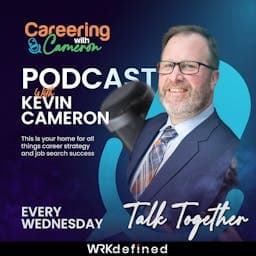
You got the rejection email. Maybe on a Saturday morning. Maybe before you even finished your coffee. In this solo episode, Kevin Cameron shares what to do next and why most people are making a costly mistake by doing nothing.
From AI rejections on roles you were perfect for, to a client who turned a rejection into multiple interviews at the same company, Kevin breaks down exactly how to respond when a door closes and why responding at all puts you ahead of almost everyone else.
Key Takeaways
Getting rejected does not mean the company ever saw your resume - reach out anyway and find out.
A rejection is not a closed door. A gracious, professional response can reopen it faster than you think.
Always follow up with a genuine thank you and ask what would make you a stronger candidate next time.
Connect with everyone you interviewed with on LinkedIn immediately after a rejection.
Not being selected does not change your value or who you are, separate the two.
Most people disappear after a rejection. That silence is your opportunity.
Episode Highlights
The client who got a rejection email - then discovered the company had no idea they'd applied.
How one person went from immediate rejection to multiple interviews just by reaching out.
Why rejections on Saturdays and Sundays are almost certainly AI and what that means for you.
The grief process of being turned down and how to move through it without derailing your search.
How a hiring manager passed one candidate's details across the entire organisation after they responded graciously to a no.
Timestamps
00:00 — Introduction: the rejection tip nobody talks about
00:28 — Why rejections are happening faster than ever
02:25 — The gut punch — and what to do with it
03:15 — The company that had no idea the client had applied
04:40 — Third party job boards and closed listings that aren't actually closed
05:30 — Reach out even when you've been rejected — most people won't
07:00 — What happens when you respond with genuine interest
08:15 — When a role is closed but the process isn't over 09:26 — The gracious follow up after an interview rejection
10:45 — Ask how to be a stronger candidate next time
11:50 — Connect on LinkedIn after every interview
12:30 — You mastered the process — now create more opportunities
14:13 — Real examples: rejection turned into offers
16:00 — Final thoughts: don't let one no change your search
If you found this advice valuable, please hit subscribe, leave us a review.
Visit Talent Connect: Website: www.talent-connect.net LinkedIn: Talent-Connect Kevin's LinkedIn: Kevin Cameron PCC
Production Credit: Edited and produced by @the32collective_ / https://www.the32collective.co/
Powered by the WRKdefined Podcast Network.
[00:00:00] Hello, hello. You're tuning into the Careering with Cameron podcast, your safe place to ask all the dumb questions about finding a job. Hey, everybody. It's Kevin Cameron with Careering with Cameron. I'm excited to have this episode with you today to share a little bit about what I am seeing from folks who are applying to positions. And that process has been challenging. So some tips and tricks that we've discovered.
[00:00:28] One of them is going to be pretty shocking. It's something that you probably have not thought of. Stay with us. Before we get into today's episode, if you're enjoying the podcast, and I really hope you are, I'd be grateful if you could go ahead and support what we're building. Taking a moment to like, comment, or subscribe wherever you're listening or watching makes a huge difference.
[00:00:51] We're on Apple Podcasts, Spotify, and YouTube. And your support allows us to keep having these meaningful conversations with interesting guests every week. Now, let's dig in. One of the things I'm noticing has happened a lot more recently than in the past has been people getting rejections from an application.
[00:01:16] So they're going through the process of essentially saying, you're interested in this role. They spend the time on the resume. They spend the time on the cover letter. They go ahead and submit the application and they reach out to somebody there because they've heard previous podcasts to make sure that they have some way to have a conversation about what the culture is like, what the role is like. Is there somebody they can talk to learn more? All of those fun things you've heard in previous episodes. They're getting a rejection, sometimes very quickly.
[00:01:47] And that is something that really can feel like a gut punch, especially when it's a role that you are super excited about. You feel like you're a great fit. Or it also could be a situation where you're like, hey, I'm going to apply to this role. It's not quite where I want to be, but it feels like a role that I can sort of re-engage with this organization. It's something that I've done before. And so I'm looking forward to joining them because I'm passionate about them and I want to move forward.
[00:02:16] We've been there. We've all gotten that rejection at some point. How do we fix that issue? So what I've seen recently is people are getting rejections faster than ever before. People are getting rejections on Saturdays, on Sundays. They're getting rejections at all hours of the morning. And clearly, that's not just a person, hopefully, reviewing that resume and application.
[00:02:42] But obviously, it lends to the possibility that there's AI involved. We're going to talk more about AI in future episodes. We'll have some experts coming on to share that with you. But the challenge here is you've got the gut punch of the rejection for a role that you felt super qualified for, a role that you were excited about, and something that you were excited to move forward on and thought you definitely had a very good shot at that. What do you do now?
[00:03:14] So the initial answer is give yourself a minute. Step away from the computer, walk away, go for a walk, whatever it may be. It stinks. It's not a fun message for sure. Certainly, it's not a very fun message to review over coffee in the morning. But something that you're going to get, unfortunately. Here's the silver lining in this whole thing. We have discussed this previously softly. I wouldn't say we went into a lot of detail.
[00:03:45] But we've discussed previously the fact that people are getting rejected for roles. And actually, the company has never actually seen their application. They've never seen their resin. We've had a couple situations that happened recently with people who've applied to roles. Fortunately, they did reach to somebody in the organization to express their interest and hopefully get more information on that role. And what we found was that the company actually had no idea they'd apply.
[00:04:15] Not only does that happen because of screening up front, but actually, in one particular situation, the position was supposedly closed. And when they went through the process of reaching out to say, hey, I'm really sorry that I wasn't selected to interview for this position. I understand the position's now closed. And you obviously have made your decision.
[00:04:41] The client responded that said, essentially, the position's not closed. We're still evaluating resumes. We still haven't set up interviews. And so we're ready to move forward. Now, that position was posted from a third party. And so one of the job boards. And essentially, what had happened was, for some reason, that posting was shut down. So maybe it was that there was a time limit on it. Maybe there was a job package where they switched to a different job they were posting.
[00:05:10] I'm not sure exactly the details there. But what I can tell you is this. Reach out even when you've been rejected. Most people don't. Most people, frankly, receive that message that says, you're not selected for this role. They get the gut punch and they go away. And if you truly are passionate about this role, if you really feel strongly, this is the right role. This is a company you want to work for. This is a place where you want to learn more. Tell them.
[00:05:41] Let them know that you're bummed. You really thought that you were going to get this position, at least an interview. And you were really thinking that this would be an exciting conversation. And maybe it's nothing more than that ever. But the conversation, at least, would be exciting for you to learn more about what they're doing. And maybe if not now in the future, it's a good fit. Fast forward. The person that I spoke with who had this experience has now been through multiple interviews with the organization.
[00:06:09] So, you know, as we have seen, obviously, and I'm not saying that AI is a problem. I'm saying that it's an overpopulated structure now where there's too many applicants coming into a job description. And some of that is because of AI. Some of that is because people are not really applying to positions where they should be applying. And I don't mean like a stretch. I mean, like, they're applying to things just to apply. So that's another issue.
[00:06:39] But making sure that you are reaching out in a genuine, passionate way so that they understand this wasn't just you applying to a role because you thought it looked like a fun job. This is a position you applied to because you really thought, like, you could bring something to the table to them and that it was a good connection for both you and the employer. In most cases, you will at least get somewhat of a response and or conversation. In this situation, it turned into interviews.
[00:07:07] But the bottom line is being able to relay that. And there's also sort of a sweet spot here where once candidates have been vetted. And let's just say that the situation is different. Let's say the situation is the position was, in fact, closed because they had enough candidates on board that they didn't want to see anybody else applying and then needing to tell them that they were not going to be selected. Let's say that's the situation.
[00:07:39] If that happens and you are now reaching out and saying, I'm interested in this role, we don't know what's going to happen with the interview process. We don't know if they're going to get into it and discover that the other candidates are not quite what they're looking for. Maybe you are. I have also seen situations where people have received offers and turned them down and the company is scrambling a bit to try to find somebody for the role who can fill it. There's a lot of different reasons why things can go sideways.
[00:08:07] But the bottom line is if you're willing to put yourself out there and network to find an opportunity, then take this one little extra step to increase your odds of landing the job you really wanted. And reach out to them. Let them know your interest. There's been situations I've run into where people have been turned down after interviewing and then called back and informed that they're creating another role.
[00:08:35] It's exactly the same because they felt so strongly about the two finalists that they wanted to hire both of them. This stuff happens, but it can't happen unless you do the extra work on it, unless you do the outreach to let them know how excited you are. Let them know how excited you are.
[00:08:59] Let them know how excited you are. The doorway for that is certainly in your follow-up to them. So when they notify you that you will not be moving on, whether that's either through email or through a phone call, I guess text message.
[00:09:26] I don't think we're using fax machines anymore, but hypothetically it's a possibility, I guess. If that's a situation where people are letting you know that you're not being selected, letting them know that you really enjoyed your conversation with that company and you're interested in them and looking forward to seeing great things. And if the opportunity were ever to arise again, where you could be considered for a role, checking and saying, how can I be a better candidate for you?
[00:09:56] What is it that would help me to separate to be selected next time? And then work with that and keep in touch with them because it's hard to find a role where you really feel good about the company and the people and the position. And so when you find that, continue to keep that in your circle of friends.
[00:10:17] Continue to keep that something where the doors open, the conversations ongoing, because you'll find that those roles with that company, you'll hear about before anybody else. So that's the next thing. Like I said, making sure that that thank you note is a gracious one, making sure you're checking to see how you can be a better candidate next time. You know, sometimes you won't get an answer on why you weren't selected. Can you do anything better? That gets into a lot of different things.
[00:10:47] Either they're afraid to or they don't really have a hard and fast reason or they just have a policy that they won't share feedback on that. That's unfortunate, but sometimes it happens. Also make sure that, you know, you're taking the feeling of not being selected and separate that from who you are. Not being selected does not change who you are. Not being selected does not change your value.
[00:11:17] And so oftentimes I find when coaching people through this process, and it's a bit of a grief process, keeping in mind that this has not impacted the person that they are. The only thing this has done is help them to get closer to what they actually are looking for and having that now clearly identified.
[00:11:37] And then turning around and responding to that organization in a professional, gracious way really says to the organization, like, wow, this person, even at a tough time where they had this position they were really excited about and rejected, they are still gracious and professional. That's somebody we want to have here. Lastly, make sure that you're connecting with the people that you interviewed with on LinkedIn.
[00:12:03] You know, you may want to consider if there are specific things they give you that say, like, this is something that you were missing. This is a skill we were hoping you would have and you didn't. Make sure that that is something that you consider calling out a bit more, maybe on LinkedIn or your resume for next time. And then, you know, the next piece is you were really close to having that position that you really wanted. Go and apply to more positions. Go and network some more.
[00:12:30] You obviously have taken the model that you need to get traction and it's worked. You figured it out. Right. So continue with the process. It's very hard to have a process starting with an interview and going through the research and getting yourself prepared and then saying, OK, I'm going to now go and apply to other positions that are going to have additional research that I'm going to need to do. And I'm going to make sure that I am completely ready for those as well. That's tough.
[00:12:59] It's like having multiple finals in the same day, I would imagine. So so I want you to think of it more as you've mastered the process. So continue creating more opportunities to share what that process looks like. These are big pieces. They don't seem like it when you're in the actual space of hoping for an opportunity and not getting that role and wondering how you're going to find something similar to that again.
[00:13:27] When this has taken a bit of time to find it's it's not a fun experience. It's not going to be your favorite day, but you can turn this into something much better than simply a rejection. You can take it from an end of a relationship to fueling the beginnings of a much stronger relationship by how you respond.
[00:13:48] And I'm telling you, there have been multiple people I've worked with this year alone who have been rejected by a job they applied to that when they turned around and responded this way and they were engaging and they were professional and they were understanding and they really wanted to work with them. It has turned into, if not multiple additional interviews. In some cases, it's turned into hiring managers saying, you know what? We really liked you, too.
[00:14:16] I'm going to take your information and share it with the rest of the organization in the event that they may have a role that would match up with what you could come and help us with because you would be great here. That was an opportunity that turned into an offer and was accepted. We've had another one that was an immediate turndown as soon as they've applied. And as the person networked into that role, they were able to not only get the offer, but get an offer at a level that they were hoping to reach with a really exciting company.
[00:14:44] We also have had people who have been coming in for interviews and kind of trying to figure out where do they fit the organization? How do we how do we utilize their expertise so they're engaged and excited about work over and above just this one position? So these things are out there. My bottom line is don't give up just because somebody said no.
[00:15:05] Come back and understand, you know, how do you improve your odds of continuing your pursuit of that role and working for that company and making sure that they're aware of that. Many times they figure if they've rejected you, you will not want to talk to them ever again. And because there's no conversation that looks like it's true. Let's not do that. Bottom line is don't give up. Make sure that you're following up even after the fact.
[00:15:35] You don't know what's happening on the other side of the screen. You don't know what that organization is going through, what they're dealing with. If there's a change in the role, if they actually hired somebody, if there was an internal hire, that means there's probably a new role available someplace. There's lots of opportunities. Don't let one rejection change your search. Let one rejection turn into an opportunity for you to explore that organization some more. Most people don't do it. This is a tip for you.
[00:16:05] I hope you've enjoyed this. I know it's been a quick show. It's just something that I thought was really critical for the audience here to hear and to make sure that you're aware of it and reminded of the fact that this is still an opportunity for you. It is not a closed door. If you've enjoyed this show, if you know somebody who was recently rejected by a job offer, share this with them. Make sure you subscribe. Go ahead and give us five stars.
[00:16:31] We are on all platforms at this point, and we are looking forward to continuing to grow in terms of having guests on the show as well as sharing additional information. And we are only as strong as you folks out there who are listening and subscribing to our episodes. So please do. We'll see you next time. Thanks.
Sponsors
