
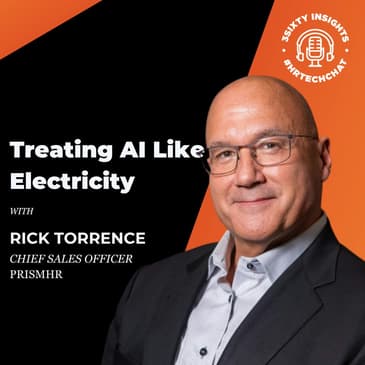
In this episode of #HRTechChat, Dylan Teggart (Principal Analyst, 3Sixty Insights) is joined by Rick Torrence—Chief Sales Officer at PrismHR with over 35 years of experience across the payroll and HCM industry—for a conversation about what happens once AI stops being a novelty and starts being infrastructure.
Rick argues AI is headed toward the same fate as electricity: something nobody thinks about until it's not there. But he pushes back on treating that inevitability as a reason to stop asking hard questions—namely, whether a given AI feature is driving a meaningful outcome or just making something look a little shinier. That question gets more urgent as AI consumption starts carrying a real, variable price tag, and Rick and Dylan dig into what that could do to an industry built on the predictability of per-employee-per-month pricing, and why any shift toward usage-based costs has to be introduced carefully enough that PEOs and regional payroll providers can pass it down without getting squeezed on margin themselves.
They also work through where people fit into all of this. Rick is blunt that AI won't replace headcount in a business built on getting people paid correctly—it frees up capacity that gets redirected toward client outreach and strategic work, not eliminated. From there, the conversation opens outward: how reseller and partner communities can use AI to build real differentiation without getting careless with the sensitive data running through their systems, and how AI is already making it faster for PrismHR's clients to navigate the compliance maze that comes with hiring across borders as the talent pool—and the business—goes global.
Powered by the WRKdefined Podcast Network.
[00:00:00] Hey everyone, this is Dylan Taggart here with another episode of 360 Insights HR Tech Chat Podcast. Today I am joined with Rick Torrence. Rick is the Senior Executive Leading Revenue Generation and Acceleration at Prism HR. And Rick focuses on expanding the company's footprint in the HCM market through revenue generation and acceleration, new sales, client growth and more.
[00:00:25] With over 35 years of experience in the payroll and HCM industry, I'm really excited to speak to Rick today. And I think we're gonna have a great conversation about what's out there, AI, what he's seeing in the market and what's new and what's coming next. Rick, thank you for joining me. Dylan, great to be here. Thanks for having me. My pleasure. So before we start, you might just give a brief intro to yourself, of yourself to the audience out there? Rick Torrence on Treating AI Sure. Thanks. Yeah. And you know, that was nice to know how long I've been in the industry.
[00:00:54] I appreciate it. Just so everybody knows, I started when I got out of kindergarten, right? So, so at 35 years marks from then. So, but anyway, yeah. So I have been in the HCM service provider space, you know, since, you know, 1987 to be specific. And I've worked for, you know, three major organizations that are, that are market leaders in the space, including Prism during that time.
[00:01:24] And also during that time, I started, built my own regional payroll service bureau and, you know, from, from ground up and successfully sold that to one of the companies. And so I've been with, you know, people like ADP, people like UKG, people like I solved and now Prism. So, so deep industry experience. Most of the time in the commercial side of the business.
[00:01:51] So in revenue creation and revenue acceleration, I have spent stints in operations as well. But, but you know, what my love is, is in the, in the revenue generation side of the business. Yeah. It's a, it's that breadth of experience that really piques my curiosity. You know, we're in a time of immense change right now.
[00:02:13] And I imagine for someone like you, it's a bit more tempered, you know, it's not the first thing you've been through and not the first new exciting breakthrough. Um, and right now we're seeing everyone put AI labels on everything. And while AI doesn't really have the cultural cache, it did 12 to 18 months ago, it's still a heavy hitter, you know, like, like the internet was, let's say earlier, you know, years ago, or like the dot-com bubble, something like that.
[00:02:44] But as a selling concept, me personally, as an analyst, I view it a little bit as the ship having sailed a tiny bit and, and feel free to correct me if I'm wrong. And I think there's more of an F less of an emphasis on just having AI and more of an emphasis on what it can actually do for a person, what it can do for a business.
[00:03:03] And, uh, one thing that was spoken about by you and others when I attended Prism HR Live in Denver earlier this year was this concept of AI as utility, like electricity, like the internet, which I think is really valuable for people to wrap their head around. Not just for right now, but more for 5, 10, 15 years from now when it is completely ubiquitous. So explain that concept a bit and why you think it's important for people to wrap their head around. Yeah, thanks, Dylan, I appreciate it.
[00:03:32] And I think it is really, it is really noteworthy, um, because we are in a time where, uh, you know, where a new technology, you know, relatively new technology is in the market, um, and it's accelerating at light speed, right? So the usage of it is accelerating at light speed and we're seeing it, you know, not just in business uses, but in personal uses and, you know, everyday home uses. So it's, it's everywhere.
[00:03:59] And, you know, as you mentioned, and we've talked about before, it will be like electricity. You don't ever think about the lights being on until they're not on, right? And that will be that, that, that will be AI. We will stop asking the question of, Hey, what are you doing with AI? What, what, you know, you're, you're going to stop asking, where is it? Because it will be everywhere.
[00:04:24] Right. And so, and we're starting to see that more and more, but I think the most important thing that we can ask today relative to AI is if you're using it, what is the meaningful outcome it's driving? Right. Right. There's a lot of AI in the market that doesn't drive a meaningful outcome. It might make something look a little better. It might make something a little more user friendly, but it's not driving a meaningful outcome.
[00:04:54] And I think that's one of the questions that as we continue to develop leveraging AI tools or as we embed tools into products, are they really driving a meaningful outcome for the user and for the audience? Or is it just something that makes it look a little better, act a little better, but doesn't really change the experience overall?
[00:05:21] And I think that's, that's one of the things that we will have to do. And the reason that becomes important is because the use of AI is starting to have a more significant price tag. Right. And so it's not this tool out there that you can just use without impacting cost and margin.
[00:05:47] And, you know, as it, as it, you know, is embedded more and more, we're going to have to ask, well, what does that do to margins? What does that do to price points? And how do you manage something that in today's market has a variable price point to it based off of consumption? It's, it's, you know, and, and that consumption changes by activity.
[00:06:15] Right. So it isn't this set easy to monitor, easy to manage cost. It's, it changes by what you're asking the AI to do and what tools you're leveraging. And, you know, as you look at AI, you know, tools and platforms, yeah, there's a wide range in price points, you know, you know, there.
[00:06:38] So I think those are questions that the market and, you know, certainly people that are leveraging AI have to continually today ask ourselves is, are we using it for a meaningful outcome? And is that outcome going to outweigh any cost associated with the leverage, you know, the use of AI?
[00:07:03] And for you personally, you know, within your strategy as someone who looks at revenue, revenue generation and growth, how has it made you rethink your strategy? Or is it, or do you feel like this is similar to other big movements that have been a mix of tech and culture? And it's more of a, just weathering the storm. Yeah, that's a really good question. I think, I think there's a little bit of both of those things, right?
[00:07:28] One is, anytime something new comes into the marketplace, and it changes the way we do things or our paradigms around a thing, then there's always, there's, you always have to let the market catch up to that newness, right? And so, you know, so you have to weather the storm a bit.
[00:07:54] You know, it's like today, as I mentioned, with AI cost and AI usage, people are just getting used to, hey, how many tokens is that costing me? You know, how much impact is that going to have? If I use that to, you know, solve a problem for me, what's the cost impact to me?
[00:08:17] And we see that personally, like, you know, we've all run out and got personal licenses of, you know, tools, AI tools, and have quickly run out of our tokens and said, oh, shoot, now do I have to make a decision? Do I keep using it or not? And so, you know, I think we're going to weather that storm. I think there will be changes to some, you know, adopted norms in our space. I'll give you an example.
[00:08:42] In our space today, when you think about HCM technology and the HCM services that go along with that technology, we've all grown accustomed to the per employee per month fee. It's an established rate. It's easy to monitor it. It's also easy to project it. And it's also easy to then, you know, make sure that you're making the right margins as you assign a PPM to your client leveraging your services.
[00:09:13] Well, what if all of a sudden there's a variable element to that that isn't easily predicted and isn't easily understood? Right. So that's what AI could do to the market, which is add variables that can't easily be predicted. And then we're going to have to start answering the question of or coming up with models that says, hey, you only get to use this much at this price point.
[00:09:40] You know, much like, you know, the AI tools themselves are doing. And we're not there yet. We haven't thought that out completely yet. And those are some of the things that we're struggling with right now as we think about, you know, how do we make sure that we have outcome driven AI that's meaningful to our customer, but our customer can consume the impact of cost associated with it?
[00:10:08] And, you know, it's not an easy answer today. It's something that we're, you know, modeling and struggling with and thinking about. And, you know, do we change the paradigm from PPM to a different paradigm? And anyway, so those are some of the things, Dylan, that we're thinking about as we, you know, keep moving forward in, you know, what is the AI world? So it won't go back. No one's going to stop using it.
[00:10:37] No one's going to say, oh, yeah, we're not going to use it. Because you do see a lot of advantage in outcomes it can drive. It's how do we adopt it so that, you know, we find that balance between existing paradigm and the new paradigm we're going to have to create, if that makes sense.
[00:10:59] Yeah, I feel like AI and the way it's priced, you know, could be, it does definitely put a few chinks in the armor of the PEP model just because it's a different way of pricing thing. And pricing things and it's shaking up what was the standard, I guess, before. And gauging where people feel comfortable shaking up that model is going to be interesting.
[00:11:27] And also because it's, if headcounts are reduced because of AI, but then AI is being used more in the products, there's obviously an exchange of goods and services here still. It just looks a little different.
[00:11:41] And, but for you as someone who has to worry about these things, where do you feel or where do you imagine the line in the sand is going to be drawn with what people are going to be willing to pay and what premiums they'll be willing to pay for, given that AI has been free for so long, but that's starting to change. Yeah. I don't know if I have a solid answer yet.
[00:12:04] I will tell you that it is one of the things that I lose sleep on, trying to think about these models and, and, you know, how we, how we treat our customers thoughtfully in this. And that's, oh yeah, I think that's the key is no matter what we do, we have to think about our customer thoughtfully in that, particularly in our space, particularly in what we do.
[00:12:30] It, it, it is a cost competitive price, competitive marketplace. Okay. And for our clients as you know, my, my clients at Prism are, you know, the regional PEO or the regional payroll provider. And so their clients are the SMBs and they're the clients that are consuming, you know, a PEO services or regional payroll service.
[00:12:58] Our clients are in a very competitive environment competing with other regional providers as well as national brands. And so we have to be thoughtful in that no matter what we do, we have to make sure that our client can thoughtfully pass that on to their client.
[00:13:18] And we cannot put them in a place where it erodes their margin and erodes, you know, their ability to grow, add clients, you know, and, and, and, and, and because if we do that, it ultimately circles back to us and hurts us.
[00:13:35] So you have to be very thoughtful and we are being very thoughtful about what models that we will adopt so that that passes down to the end consumer in a way that is palatable and digestible. And, and, and, and they see the value of getting AI. I like in it, but I live in Arizona, right? Outside today, it's 110 degrees.
[00:14:05] When I go home, I don't turn the air conditioning off because I'm over budget on air conditioning. You know, you just jump, you leave it running. Right. But it doesn't mean that we aren't thinking about ways to keep the house cooler and do other things.
[00:14:23] And so I think, I think we have to be thoughtful in that same vein is we can't just charge whatever, you know, we want because our client won't be able to recoup that on the back end with their client. So we do have to be thoughtful. And again, we are being thoughtful on it, but those are the challenges.
[00:14:45] And I think, I think over time, the market will understand that and the market will adjust accordingly, but it won't do that overnight. Right. Because I can't in the middle of a year say to my client, Hey, I'm changing your advice points just because I put this really cool AI feature in. They didn't budget for it. They're not ready for it. They don't know how to recoup it from their client, et cetera, et cetera.
[00:15:13] So again, those are all the things that, you know, we're thinking about with AI. As we push forward very hard, leveraging AI to drive meaningful outcomes. Right. So we're definitely doing it. We definitely have things we've released and will continue to release. But it, but it is thoughtfully in its approach. Yeah. And I think part of that is balancing out the human aspect of it.
[00:15:42] You know, I think as we've spoken about before, humans are still an incredibly efficient resource. And it seems strange to have to talk about something like that. But as energy comes at a premium, we are some of the most energy efficient thinking machines that are out there. And at a certain point, those tokens, the energy costs related to AI may actually outweigh the cost of someone just being in the office, depending on what you need them for, of course.
[00:16:11] You know, how would you advise a business leader to balance the productivity needs and benefits of AI while finding purpose for their people so they don't just feel the need to replace them? Yeah, I would most, particularly in our industry, I would most certainly caution against that. Right. At the end of the day, we're dealing with an incredibly sensitive business.
[00:16:40] It's people's pay. It's their livelihood. It's their groceries. It is their electric bill. It's all those things that come as a derivative of getting working hard for someone to get paid. And our industry facilitates that at its core nature. There's a hundred other things we do. There's a lot of other services we provide. But at the end of the day, that's what we're doing is making sure that people can get their paycheck.
[00:17:09] They have their benefits. They have their retirement plans, all the things that make the reason they're working. You know, those are the things that they benefit from if they go and they have a job. So at the end of the day, people will always be in and around that. And I don't see it. I don't, particularly in our business, I don't see, AI can do a lot of wonderful things.
[00:17:39] AI can make things more efficient. AI can make it so that I can onboard three more clients effectively without adding labor, but it isn't reducing my labor because I always need that person. And I think we'll see percentages of reduction.
[00:18:04] Well, let's call it, hey, it's going to reduce somebody's effort, you know, human effort by 20%, but you'll never get rid of somebody that way. What you will do is you'll think about how do I take that 20% and apply it in a more strategic area of my business? Added client outreach, added client touches that only human beings can do. Right?
[00:18:30] Those are meaningful strategic things that can come from the value of AI creating efficiency in other parts of the business, is I can shift what those people do to more strategic things versus tactical things. And that's, those are the questions I would be thinking about is, you know, it isn't, it isn't about, can I use AI enough to remove this person?
[00:18:56] It's, can I use AI enough so that I can shift this person to something that's going to drive more value to the customer? The customer expects payroll to be accurate, right? They don't, they don't expect there to be errors. They don't expect errors in our business. So tools that drive more accuracy do create efficiency and do create more time for the operators.
[00:19:25] But you're not changing the outcome. The outcome is still expected to be very accurate, 100% accurate. You're creating a time opportunity. Now let's go use that in more strategic areas of the business. It could be more client outreaches to drive higher satisfaction, to reduce turn, reduce turnover, reduce attrition.
[00:19:48] It could be go back and talk about added product value that I have, that today I don't have any time to do that because I'm so focused on the operations. I don't do any outreach to extend same store sales. Those all become opportunities, Dylan, that we can, you know, we can point AI creating the opportunity. We have to be smart enough to go leverage that opportunity.
[00:20:17] So that's what I would, that's what I would challenge, you know, our clients to think about is, as you know, whether we're developing the AI or they're developing it themselves somewhere. Once you have it, are you evaluating its outcome? And now what do you do with the value of that outcome? How are you changing your business? How are you leveraging it? What are you getting out of it?
[00:20:43] And those are the things that I would challenge, you know, business owners and operators to think about as they deploy more and more AI. Yeah, absolutely. And that leads me to the one question I wanted to ask you, which is about one part of the domestic based HCM organization market. You look at, you know, the reseller community and the partner community. How do you feel like they're navigating it?
[00:21:07] And what kind of advice would you give to them about how to pass through this period of change or take advantage of it also? Yeah, no, I've actually just in talking with our customers and attending certain events and I've seen some pretty cool things going on, right? Is number one, what, you know, AI affords is you no longer have to rely on.
[00:21:33] And, you know, when I say this, I say this, you know, knowing what I'm saying, you don't have to rely on us to develop something. You can go develop yourself too, right? And depending on the magnitude of it, you could do it very efficiently and effectively. And AI can afford you that. It can be very personal to your business or very focused on what you do.
[00:22:02] AI can give you that. These tools can give you leverage there to make something all about you versus when we're developing something, we're developing for the masses. So AI does afford that opportunity. And I think organizations should leverage it to create, you know, their company differentiators.
[00:22:30] But you got to be thoughtful, particularly in our industry, because our industry deals with PPI all over the place. We have very, very, you know, information that is sought after by many bad actors. And so no matter what you're doing, you have to be very thoughtful about the security side of AI.
[00:22:53] And you have to make sure you understand the parameters of what AI can and will do if you don't put parameters around it. And so it isn't a tool that, you know, go play around with, you know, in production mode with somebody else's data without you really understanding, did I lock the doors and windows tight, leveraging these tools?
[00:23:18] And that would be the, you know, so while I'm telling, you know, the market, hey, you should go do some things with AI. I'm also telling you, be careful and be cautious because it is a powerful tool. And as smart as we think AI is, it's also not that smart too.
[00:23:37] And it can, it can open the doors to, to, you know, some bad situations if, if, if you're not thoughtful and if you don't understand, you know, what the potentials are and protect against them.
[00:23:51] So, so, you know, I, I, I see us, I see us affording our clients those opportunities, you know, and, and doing more around connecting our platforms to other opportunities that clients develop. So, you know, data gateways will become more and more and more and more prevalent. It's not, you know, it's not what the UX necessarily will be.
[00:24:21] You know, customers can go out and develop UXs. It's access to the data and, and, and, you know, and making sure that we help protect that data. So. Yeah. And that leads me to my final question, which, you know, is expanding this focal point here. So from the domestic market to the global, you know, the world is going to get even smaller with us by the time this is fully fledged out.
[00:24:49] And, you know, we're 10, 10 years from now, maybe even five years from now, frankly, by the way things go, the world is going to be a smaller place yet again. And for businesses, that means the talent pool expands, the, the markets expand. And if you're paying people overseas, you need to be even more cautious and compliant and AI can be a huge help with navigating that.
[00:25:13] And as Prism does this expansion global as well, what are you seeing earlier on with your customers in this market? And how is compliance and that, you know, cautiousness playing into it? Yeah. Yeah. I couldn't agree with you more. So the world continues to surprise me how small it gets, right? We live in a big planet, but, but our ability to connect with one another across, you know, huge distances is, is amazing.
[00:25:42] And today more than ever. And I think, you know, for the, you know, U.S. domestic market, you know, the global opening up global talent and, you know, we, we launched our global offering earlier this year. It just amazes me how much opportunity is out there, how much we're seeing already.
[00:26:01] Um, and, and it's, it, the funny part about it, Dylan is in, in our spaces, it's almost as if our customers like didn't really know, but now all of a sudden, since they said the words, all these opportunities are popping up.
[00:26:21] And so they're, they're getting an education too, of how much global opportunity is there in the form of, of employment, employment opportunities for their clients, you know, and, and, and it's not just big organizations. It's that, you know, 20 person company that is looking for a piece, you know, a talent can't seem to find it domestically, but wow, did they find, you know, somebody that, you know,
[00:26:50] can fill that talent requirement, you know, overseas. And so now that I have that, how do I pay them? How do I make sure that they, I meet all those regulations, right? And that's the business that we've got ourselves into. And the challenge there, which AI certainly is helping us on is understanding all those regional requirements,
[00:27:15] all those compliance requirements relative to pay, relative to benefits, relative to time off, relative. And, you know, as you, as you think about the U S yeah, you deal with that across, you know, our, our 50 States. Now go to Europe. You know, you're dealing with that and, you know, this country, and then you cross the border in that country.
[00:27:40] And, and, and so it, it, it just expands itself and AI can certainly make that data pool way more understandable for us. It's a lot easier to access the rules, the regulations, the requirements, and help us make sure that our clients are meeting them from a global perspective. That's where AI is really helping us today.
[00:28:07] And, you know, and then, and, and, and, and it is it. So if I go back 20 years, you know, it's not that global is new. It just today I can move into new countries that much faster because AI can help me understand, you know, all those requirements. And so that's how we're, that's how we're seeing a play out globally. And I do believe the world will continue to get smaller there.
[00:28:37] You know, I, I, you know, I, I have a, somebody that works for me that, you know, is, is in South America and he is brilliant. He's, he's brilliant. And, and I wouldn't have found him. You know, I might've found somebody that would bet in the U S but I, you know, he doesn't have to be in the U S and, and, and I get the productivity I get for him as amazing.
[00:29:00] And so I think the world will continue to see, and the domestic U S will continue to see globalization as a, as a huge asset to augment our workforce. Yeah, absolutely. I feel like it's just the natural progression of remaining competitive. It's people are out there and if you want the best, you got to be willing to pay them with where they're at or, or find them with where they're at.
[00:29:28] And it's not always going to be in the city you're in or in the country you're in. A hundred percent. A hundred percent. Yeah. Yeah. Well, listen, Rick, thank you so much for joining me today. It's been a really insightful conversation. And speaking of the world getting smaller, where can people reach out to you? Yeah. Thanks Dylan. Like, yeah. If anybody has any questions or want to connect, you know, I love expanding, you know, my network and they can find me at, I'll give you my email address.
[00:29:55] So again, it's Rick Torrance and my email is R I C K dot T O R R E N C E at Prism, P R I S M H R dot com. Feel free to reach out. Happy to chat with anybody. And Dylan, thanks again. This was, this was fun being here. I appreciate the opportunity. My pleasure. And thank you everyone for joining and until next time.
Sponsors
